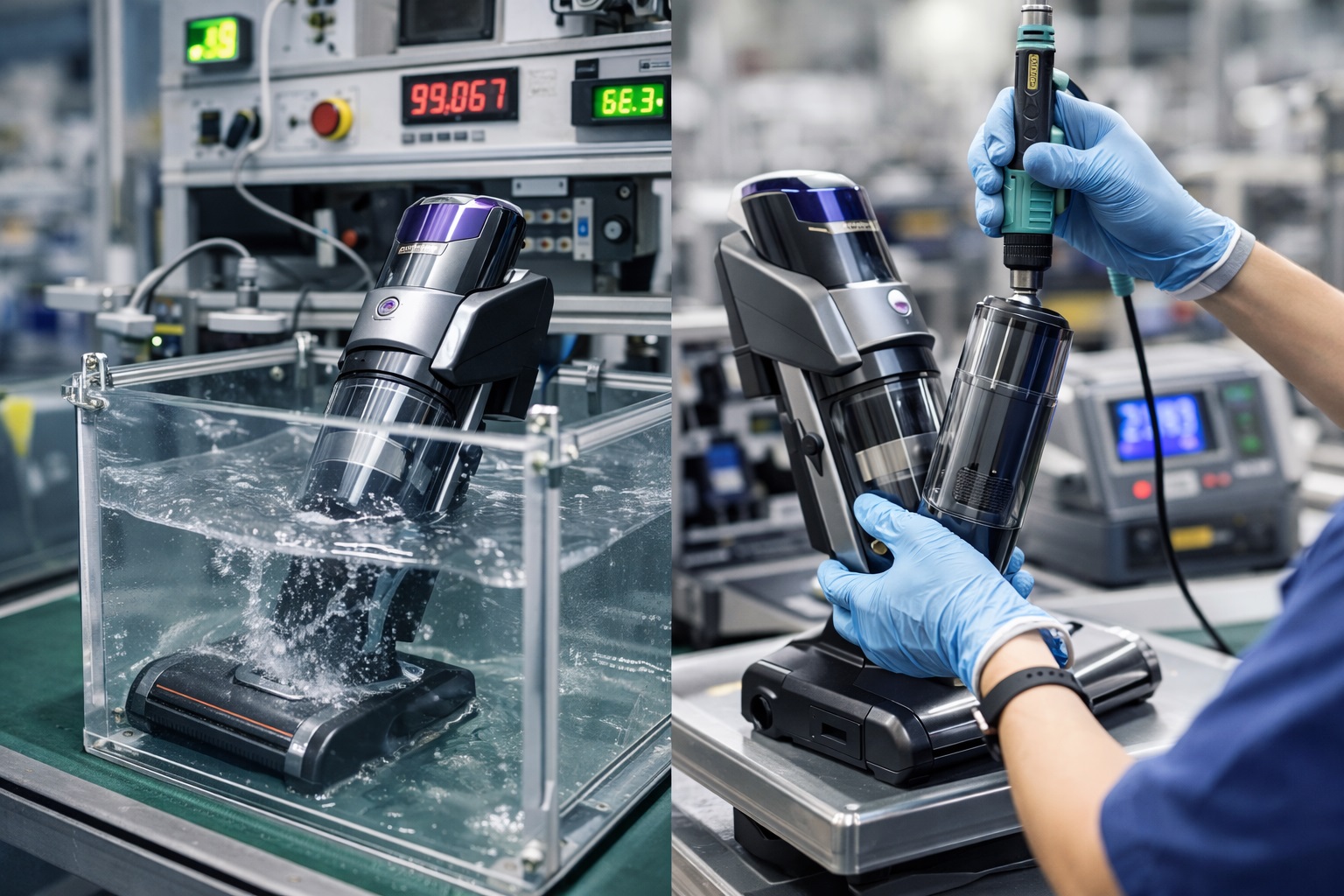
In the vacuum cleaner business, product returns are not a customer problem—they are a manufacturing signal.
For European and Middle Eastern buyers, high return rates quietly destroy margins through logistics costs, distributor disputes, and brand erosion. Yet most returns are predictable and preventable long before products reach the market.
Below are five manufacturing-level secrets that consistently reduce returns across categories, including multi-functional durable vacuum cleaner, wet and dry vacuum cleaner, and cordless vacuum cleaner lines.
These are not marketing tricks—they are structural decisions inside the factory.
🧱 Secret 1: Durability Is Designed, Not Claimed
Many suppliers advertise durability. Few engineer it.
A multi-functional durable vacuum cleaner often fails not because of misuse, but because the product was never designed for repeated stress cycles across different modes.
High-performing factories design durability by:
Reinforcing stress points where wet/dry mode switching occurs
Using fatigue-tested plastics instead of visual-grade materials
Simulating 6–12 months of real usage before mass production
Manufacturing insight:
Factories that run accelerated durability simulations typically see double-digit reductions in early-life returns, especially in mixed-use households and commercial settings.
💨 Secret 2: High Suction That Stays High
A high suction vacuum cleaner that loses power after weeks is one of the most common return triggers.
The problem is rarely the motor alone—it’s the entire airflow system.
Return-focused manufacturers control:
Air leakage tolerance across joints
Filter resistance after dust saturation
Heat buildup affecting motor efficiency
Rather than optimizing for peak suction numbers, they design for suction stability over time, which significantly reduces “performance disappointment” returns.
💧 Secret 3: Wet & Dry Systems That Respect Moisture Reality
Returns for wet and dry vacuum cleaner products often spike due to:
Factories that reduce these returns:
Isolate wet airflow paths from motors
Use moisture-resistant gaskets instead of generic rubber
Test drying efficiency, not just suction
Key difference:
They test what happens after cleaning—not just during cleaning.
🔋 Secret 4: Cordless Systems Built for Battery Reality
A cordless vacuum cleaner is only as reliable as its weakest battery behavior.
High return rates often come from:
Rapid capacity degradation
Overheating under continuous load
Inconsistent charging performance
Advanced factories:
Grade battery cells before assembly
Match motor load profiles to battery discharge curves
Test real-world runtime consistency, not just max runtime claims
For buyers, this directly translates into fewer “battery complaint” returns, which are among the hardest to resolve after sale.
🌬️ Secret 5: Designing for Health Claims Without Overpromising
A vacuum cleaner for allergies faces a unique risk: expectation mismatch.
Returns rise when:
Factories that succeed:
Validate sealed airflow paths
Test filtration efficiency under real dust loads
Balance suction and filtration to prevent rapid clogging
For a vacuum for multi-surface use, this balance becomes even more critical as debris types vary dramatically.
Manufacturing truth:
Products that quietly meet health expectations outperform products that loudly overpromise.
📊 Why These Secrets Matter to B2B Buyers
For distributors and OEM buyers, returns are not just a cost—they are a trust signal.
Factories that apply these five principles consistently deliver:
Lower post-launch defect rates
Fewer distributor disputes
Longer product life cycles
Stronger repeat orders
This is especially important when selling across Europe and the Middle East, where usage environments and regulatory expectations differ.
🚀 The Real Reason Returns Drop
Returns don’t decrease because customers complain less.
They decrease because manufacturing decisions eliminate predictable failure points.
Professional buyers understand this—and evaluate suppliers accordingly.
📌 Suitable Readers
European vacuum cleaner importers
Middle Eastern vacuum cleaner distributors
B2B vacuum cleaner buyers
OEM / ODM sourcing managers
Cleaning equipment entrepreneurs
Vacuum cleaner R&D engineers
Product managers in floor care solutions
📌 Hashtags
multi-functional durable vacuum cleaner, wet and dry vacuum cleaner, high suction vacuum cleaner, cordless vacuum cleaner, vacuum cleaner for allergies, vacuum for multi-surface, OEM vacuum cleaner, ODM vacuum cleaner, vacuum cleaner manufacturer, vacuum cleaner quality control, vacuum cleaner durability testing, vacuum cleaner airflow design, vacuum cleaner battery system, cordless vacuum factory, private label vacuum cleaner, vacuum cleaner return reduction, vacuum cleaner defect prevention, vacuum cleaner for Europe, vacuum cleaner for Middle East, B2B vacuum cleaner sourcing, vacuum cleaner distributor, vacuum cleaner importer, commercial vacuum cleaner, home cleaning equipment, allergy vacuum system, HEPA vacuum cleaner, sealed filtration vacuum, multi surface vacuum cleaner, floor care solutions, portable cleaning devices, vacuum cleaner R&D, vacuum cleaner engineering, vacuum cleaner testing, vacuum cleaner compliance, CE vacuum cleaner, RoHS vacuum cleaner, energy efficient vacuum, low noise vacuum cleaner, durable vacuum cleaner design, vacuum cleaner innovation, cleaning industry manufacturing, vacuum cleaner OEM ODM, product return reduction strategy, supply chain quality control, manufacturing risk management, Lanxstar











