Hi, message us with any questions.
We're happy to help!





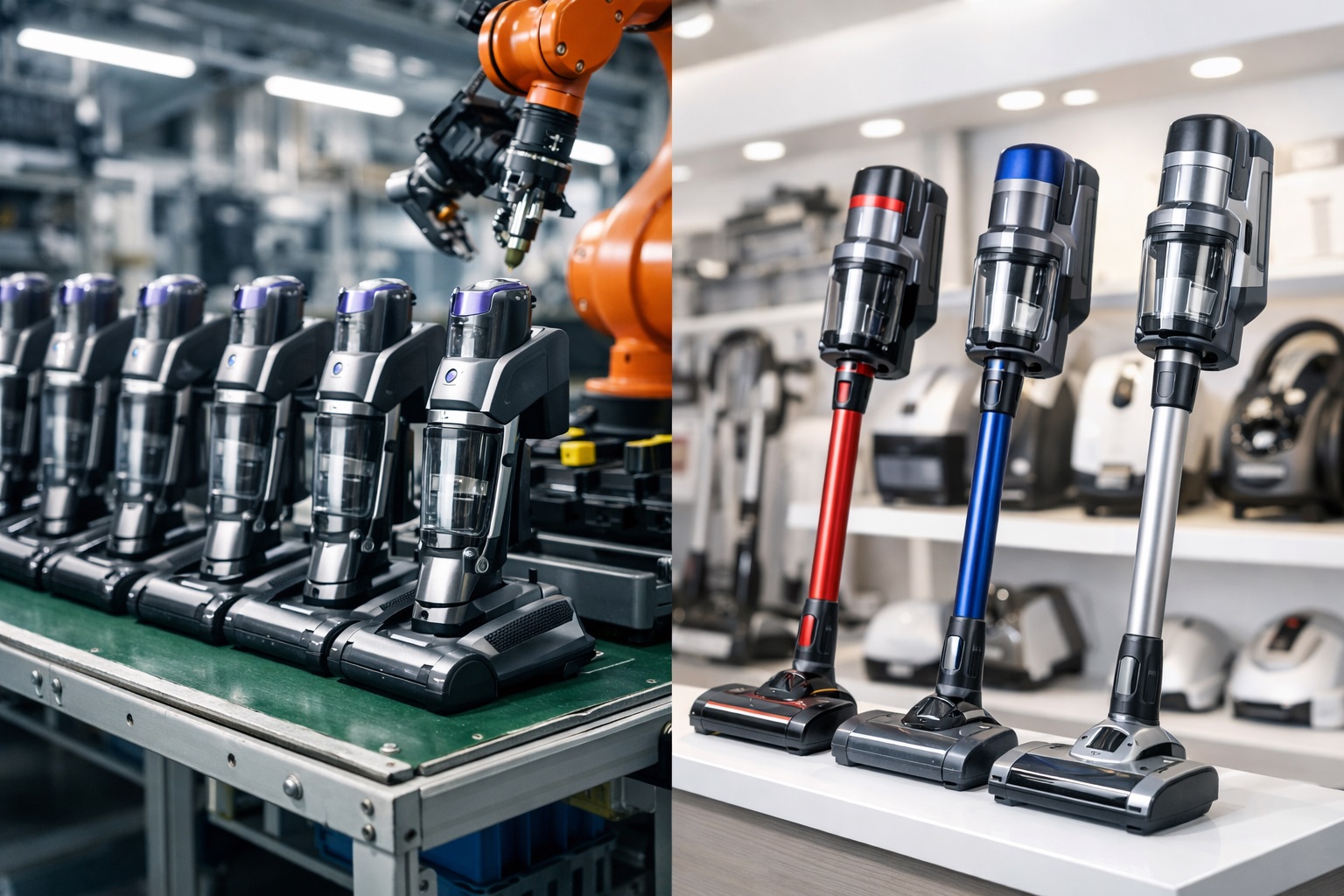
In the global vacuum cleaner market, products do not succeed because of marketing claims. They succeed because thousands of small decisions inside the factory are made correctly—every time, at scale.
For European and Middle Eastern buyers, especially those sourcing OEM or private label products, the real challenge is not finding a supplier, but identifying a manufacturing partner that can deliver consistent quality, regulatory stability, and predictable long-term performance.
This article explains how full-process control—from raw materials to retail-ready packaging—directly impacts defect rates, returns, and brand credibility in the vacuum cleaner business.
🔍 Raw Material Control: Where Most Quality Problems Actually Begin
In many failed sourcing cases, the root cause of quality issues is not assembly—it is material inconsistency.
For products like a wet and dry vacuum cleaner or a multi-functional durable vacuum cleaner, unstable plastics or low-grade copper can lead to:
Housing deformation after 6–9 months of use
Motor overheating under continuous load
Seal degradation in humid or wet environments
Professional factories reduce this risk by:
Locking approved material suppliers
Tracking material batches by production date
Running impact and thermal resistance tests before mass production
Industry observation:
Buyers who audit material control early often see 20–30% lower post-market failure rates compared to those who only inspect finished goods.
⚙️ Engineering for Real Environments, Not Laboratory Demos
A cordless handheld vacuum cleaner that performs well in a lab may fail in real usage scenarios—especially in Middle Eastern climates or high-frequency European households.
Engineering teams design for:
Ambient temperatures above 40°C
Voltage fluctuations
Long-duration suction rather than peak marketing numbers
For a vacuum cleaner for hardwood floors, airflow and brush design are balanced to avoid surface damage while maintaining debris pickup efficiency—an issue frequently mentioned in negative end-user reviews.
Key insight:
Engineering decisions made during early design stages determine most warranty-related issues, long before production begins.
🧪 Component-Level Testing: Reducing Risk Before Assembly
Rather than relying on final inspection, advanced manufacturers test critical components individually.
This includes:
Motor RPM stability under load
Battery cycle life testing for cordless models
PCB humidity resistance
Water ingress testing for wet and dry systems
Component-level testing allows factories to intercept defects before assembly, which typically reduces rework costs by 15–25% and improves delivery predictability for buyers.
🛠️ Controlled Assembly Lines, Not High-Speed Guesswork
High-speed mass production often increases output—but not reliability.
In controlled assembly environments, products such as a portable self-cleaning vacuum cleaner move through clearly defined stages:
Mechanical assembly
Electrical integration
Airflow and sealing verification
Functional calibration
Torque-controlled tools and standardized work instructions ensure that unit-to-unit variation stays within defined tolerance ranges, a critical factor for brand consistency across markets.
🧼 Self-Cleaning Technology: A Feature That Demands Discipline
Self-cleaning systems are attractive for consumers but risky for manufacturers.
Common failure points include:
Residual moisture causing odor buildup
Incomplete drying of filters
Condensation affecting motor components
Factories that succeed separate self-cleaning airflow from motor chambers and apply hydrophobic internal coatings. This approach significantly improves durability for portable vacuum for travel, where storage conditions are unpredictable.
📊 Quality Control That Goes Beyond Visual Inspection
Visual inspection alone cannot protect a brand.
Professional QC systems include:
Random life-cycle testing from each production batch
Suction decay analysis after extended runtime
Noise level consistency testing for EU markets
Leak testing for wet and dry models
Factories applying multi-layer QC systems typically experience lower return rates and fewer distributor disputes, especially in multi-country distribution networks.
📦 Packaging Designed for Global Logistics, Not Just Aesthetics
Many vacuum cleaners fail not in use—but during transport.
Export-grade packaging considers:
Drop testing based on pallet height
Moisture barriers for sea freight routes
Internal fixation for battery protection
Buyers often underestimate packaging, yet logistics damage can account for up to 10% of early returns in poorly protected shipments.
🌍 Compliance as a Manufacturing System, Not a Certificate
CE, RoHS, ERP, and regional energy standards are not final checkboxes—they influence design, materials, and electronics architecture.
Factories integrating compliance during R&D avoid:
Last-minute redesigns
Shipment delays
Market access risks
This approach is essential for scalable multi-functional durable vacuum cleaner lines sold across Europe and the Middle East.
🤝 Why End-to-End Control Matters for Buyers
When one manufacturing partner controls:
Product design
Tooling
Assembly
Testing
Packaging
Buyers gain:
Stable quality across multiple orders
Predictable lead times
Easier private label customization
Lower long-term sourcing risk
This is how OEM relationships evolve from transactional sourcing into strategic partnerships.
🚀 From Factory Floor to Retail Shelf: The Real Competitive Edge
Retail success is not driven by slogans.
A vacuum cleaner that performs reliably in:
European apartments
Middle Eastern villas
Hotels, offices, and travel environments
is the result of systematic manufacturing discipline, not chance.
Professional buyers usually evaluate these control points before approving trial orders, because once a product reaches the retail shelf, every upstream decision becomes irreversible.
📌 Suitable Readers
European vacuum cleaner importers
Middle Eastern vacuum cleaner distributors
B2B vacuum cleaner buyers
OEM / ODM sourcing managers
Vacuum cleaner product managers
Cleaning equipment industry entrepreneurs
Vacuum cleaner R&D engineers
📌 Hashtags
wet and dry vacuum cleaner, multi-functional durable vacuum cleaner, cordless handheld vacuum cleaner, portable self-cleaning vacuum cleaner, vacuum cleaner for hardwood floors, portable vacuum for travel, OEM vacuum cleaner, ODM vacuum cleaner, vacuum cleaner manufacturer, industrial vacuum cleaner supplier, cordless vacuum factory, private label vacuum cleaner, vacuum cleaner quality control, vacuum cleaner production, vacuum cleaner assembly line, vacuum cleaner compliance, CE vacuum cleaner, RoHS vacuum cleaner, vacuum cleaner for Europe, vacuum cleaner for Middle East, B2B vacuum cleaner, vacuum cleaner distributor, vacuum cleaner importer, commercial vacuum cleaner, home cleaning equipment, smart vacuum cleaner, self cleaning vacuum technology, hardwood floor vacuum, travel vacuum cleaner, portable cleaning devices, vacuum cleaner R&D, vacuum cleaner engineering, vacuum cleaner testing, vacuum cleaner packaging, vacuum cleaner supply chain, cleaning equipment manufacturer, floor care solutions, cordless cleaning tools, high suction vacuum, energy efficient vacuum, low noise vacuum cleaner, durable vacuum cleaner, vacuum cleaner innovation, cleaning industry trends, vacuum cleaner OEM ODM, Lanxstar



