Hi, message us with any questions.
We're happy to help!





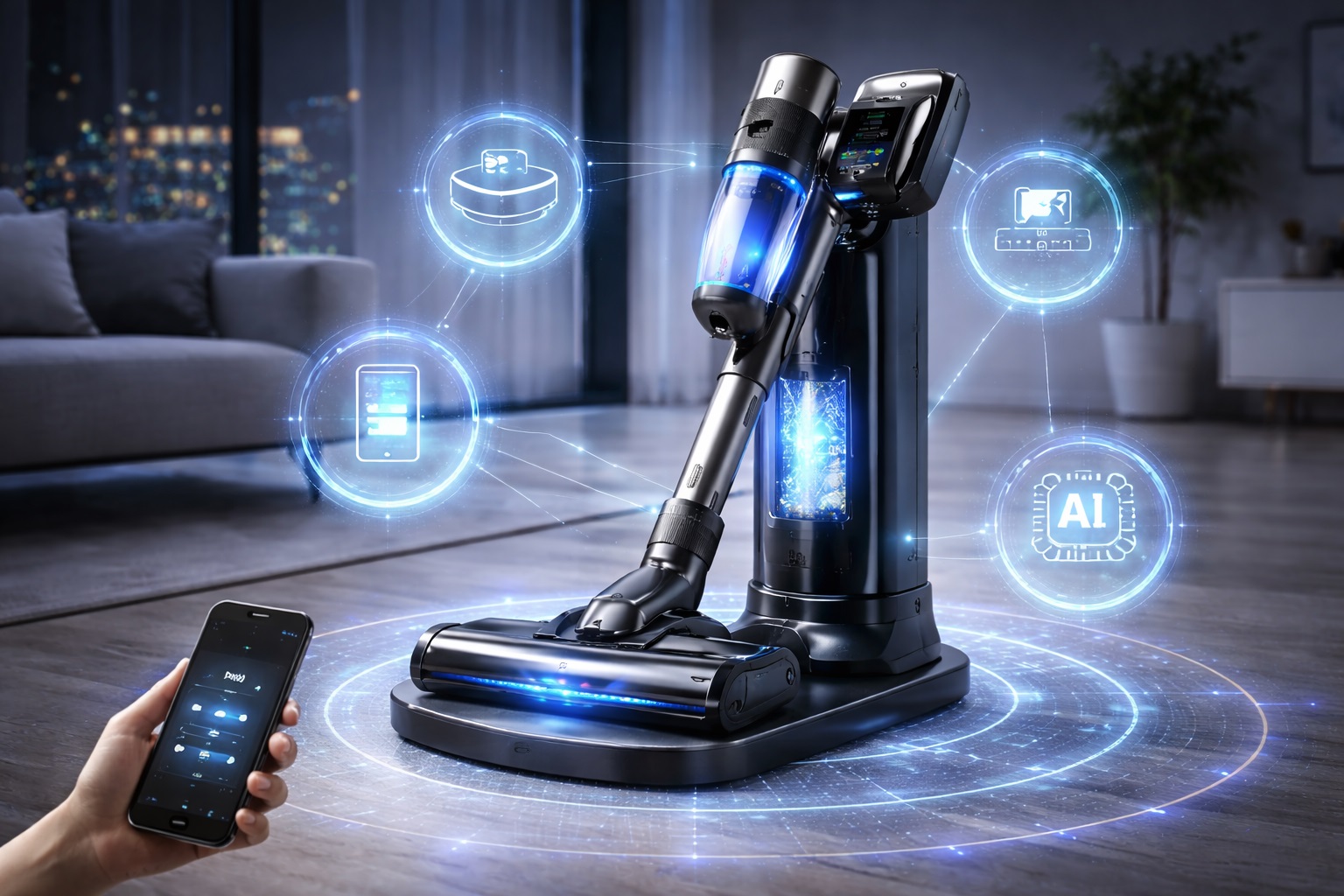
“Smart vacuum” used to mean an app and a fancy display. That era is ending. Consumers now expect smart features to save time, reduce effort, and prevent common problems—clogs, smells, hair wrap, and battery disappointment. At the same time, procurement and distribution partners want smart features that reduce returns, not create more failure points.
The next wave of differentiation will come from smart systems that connect sensing → decision → action → measurable outcomes. Below are the most practical future trends that can help brands stand out—especially in cordless and wet/dry categories—without relying on gimmicks.
I. Smart must equal “time saved,” not “app installed” ⏱️✅
Smart differentiation works only when it answers one of these consumer questions:
“Will this clean faster?”
“Will this be easier to maintain?”
“Will it stay clean and not smell?”
“Will it be quiet when I need it?” 🌙
“Will it keep performance stable over time?”
So the correct innovation approach is:
choose a high-frequency pain point (hair wrap, wet tank odor, clogging)
build sensing + automation that reduces that pain
validate and communicate results with simple metrics
That’s how “smart” becomes a defensible differentiator.
II. Sensor-driven cleaning: adaptive performance is the new “power” ⚡
In future products, consumers won’t care about peak suction nearly as much as adaptive cleaning that feels effortless. This is a big opportunity to differentiate a High Suction Vacuum Cleaner story without relying on risky over-claims.
1) Surface recognition and auto-adjust modes
Expect rapid growth in sensors that detect:
hard floor vs rug
wet vs dry mess
fine dust vs larger debris
Then automatically adjust:
suction level
brush roll speed
water flow (for wet/dry products)
This improves Vacuum for Multi-Surface satisfaction because the vacuum behaves correctly without constant user input.
2) Dirt load sensing and stable suction
Adaptive suction can keep performance stable while lowering noise and saving energy. That supports positioning as an Energy-Saving Efficient Powerful Vacuum Cleaner and also improves cordless runtime.
3) “Quiet intelligence” for daily life 🤫
Smart systems can identify “quiet contexts” (night cleaning, sleeping baby, shared spaces) and optimize the balance between cleaning and sound. This strengthens the quiet vacuum cleaner and Quiet Vacuum for Night Use narratives—especially for Apartment Vacuum Cleaner markets.
III. Smarter wet/dry: hygiene automation becomes the main differentiator 💦🧼
Wet/dry is where smart features can deliver the biggest real-life improvement—because wet cleaning introduces odor risk, residue, and maintenance friction.
1) Intelligent self-clean cycles
A Self-Cleaning Vacuum Cleaner feature will keep evolving from “rinse function” into a guided hygiene system:
automated rinse routines matched to soil level
reminders and guidance for drying steps
tank full and contamination alerts
The goal is simple: fewer smells, less residue, less time spent cleaning the cleaner.
2) Multi-mode wet/dry platforms
Premium direction: a 4 in 1 Cordless Smart Wet & Dry Vacuum Cleaner that runs multiple modes reliably:
vacuum-only
wet wash
edge clean
self-clean / quick dry
Differentiation comes from stability and clarity—mode switching that doesn’t confuse users and doesn’t reduce durability.
3) Capacity optimization
Future designs may use smarter tank monitoring to help larger households. A Large-Capacity Wet Dry Vacuum Cleaner can become more user-friendly when the system provides:
clearer fill/empty guidance
better separation and clog warnings
faster cleanup workflow
IV. Predictive diagnostics and QR-guided service: smart features that reduce returns 🔧📲
One of the most valuable “smart” differentiators won’t be visible on day one—it will appear in month two.
Future differentiation trends include:
clog detection and guided clearing steps
brush roll jam detection and safe shutdown
filter loading detection and maintenance guidance
error reporting that is understandable (not cryptic codes)
A simple QR-based service flow can turn a frustrating moment into a loyalty moment:
“Scan to troubleshoot”
guided steps with short videos
direct link to replacement parts ordering
For vacuum cleaner distribution, this is gold: fewer returns, fewer angry reviews, fewer service tickets.
V. Battery health management: the next frontier for cordless trust 🔋
As Cordless Vacuum Cleaner adoption grows, battery disappointment is a major review driver. Future differentiation will focus on battery health, not just runtime.
For a Li-ion Cordless Handheld Vacuum Cleaner and full-size cordless platforms, smart systems will increasingly provide:
battery health estimation (capacity fade tracking)
optimized charging to reduce degradation
thermal management logic for hot environments (cars, summer storage)
clearer “realistic runtime by mode” reporting
For cordless handheld vacuums, smart battery management is especially important because small packs heat faster and degrade sooner.
The differentiation outcome: consumers feel the product stays “like new” longer.
VI. Filtration intelligence: smarter HEPA and allergy confidence 😷
Filtration is moving from “static component” to “managed system.” Smart filtration trends may include:
filter loading detection and replacement reminders
sealing validation features (design + monitoring)
air path monitoring to flag leakage or abnormal pressure drops
This supports credible positioning for:
HEPA Filter Vacuum Cleaner
Vacuum Cleaner for Allergies
And it helps procurement teams because filtration-related complaints are common return triggers in dust-sensitive markets.
VII. Pet hair and brush-roll automation: less tangling, less regret 🐾
Pet owners want results with minimal maintenance. Smart differentiation will increasingly target:
brush roll torque sensing to detect hair wrap early
adaptive brush speed to reduce tangling
quick-release brush designs guided by UI prompts
This reinforces Vacuum Cleaner for Pet Hair positioning while lowering maintenance friction—one of the strongest predictors of long-term review performance.
VIII. Smart quietness: acoustics + control logic together 🤫⚙️
Instead of only “quiet materials,” future vacuums will use control logic to reduce noise:
smoother motor ramp-up curves
optimized airflow in quiet modes
vibration-aware operating bands
automatic quiet mode in low-demand tasks
That supports premium differentiation for Portable Quiet Vacuum Cleaner products and can pair well with lightweight designs that are often more sensitive to vibration.
IX. Modular, repairable design: smart differentiation for procurement and sustainability 🔁
A smart vacuum that can’t be serviced becomes a warranty headache. Future differentiation will also include:
modular motor/battery units
standardized fasteners and access points
easier replacement of wear parts (brush roll, filter, tank seals)
This matters for:
vacuums procurement teams (total cost of ownership)
vacuum cleaner distribution partners (serviceability and parts revenue)
brand reputation (less “throwaway appliance” perception)
X. How to position smart features credibly (and safely for SEO) ✅
Smart claims should be tied to outcomes and simple proof:
“reduces maintenance time” → show time-to-clean and time-to-maintain metrics
“detects clogs” → show successful detection rate and guided resolution flow
“extends battery life” → show cycle-life improvements or thermal control logic
“quieter at night” → show noise results and mode behavior
Avoid vague promises like “AI-powered cleaning” unless you can describe what it does in practical, user-readable terms.
Conclusion: The future of smart vacuums is invisible work that users feel 🌟
Smart vacuum differentiation is moving from apps to outcomes: adaptive cleaning across surfaces, hygiene automation for wet/dry systems, predictive diagnostics, battery health management, and service-friendly modular design. Brands that combine these innovations with measurable proof can reduce returns, strengthen distribution partnerships, and win consumer trust—especially in cordless and wet/dry categories. ✅
www.lxvacuum.com
Ideal Readers
Product R&D engineers, product managers, and innovation teams
Global vacuum buyers / vacuums procurement teams
Distributors & brand owners / vacuum cleaner distribution professionals
Related Keyword Groups
Lanxstar smart vacuum innovation, Lanxstar vacuum future trends, vacuums procurement, vacuum cleaner distribution, smart vacuum cleaner differentiation, adaptive suction control system, High Suction Vacuum Cleaner with sensors, quiet vacuum cleaner smart mode, Portable Quiet Vacuum Cleaner intelligent control, Quiet Vacuum for Night Use auto quiet, Apartment Vacuum Cleaner smart ergonomics, Cordless Vacuum Cleaner battery health management, Li-ion Cordless Handheld Vacuum Cleaner smart charging, cordless handheld vacuums diagnostics, wet dry vacuum smart hygiene, Wet Dry Vacuum Cleaners sensor-driven modes, Wet and Dry Vacuum Cleaner contamination alerts, Self-Cleaning Vacuum Cleaner automated rinse cycle, 4 in 1 Cordless Smart Wet & Dry Vacuum Cleaner multi-mode stability, Large-Capacity Wet Dry Vacuum Cleaner tank monitoring, HEPA Filter Vacuum Cleaner filter loading detection, Vacuum Cleaner for Allergies filtration reminders, Vacuum Cleaner for Pet Hair anti-tangle automation, brush roll torque sensing, edge cleaning sensor optimization, Vacuum for Multi-Surface surface recognition, Vacuum Cleaner for Hardwood Floors auto soft mode, energy-saving suction mapping, Energy-Saving Efficient Powerful Vacuum Cleaner smart power, Fast Lightweight Vacuum Cleaner vibration-aware control, Multi-Functional Durable Vacuum Cleaner diagnostics, clog detection guided clearing, QR guided service for vacuums, predictive maintenance vacuum system, replacement parts ordering QR flow, distributor service readiness program, battery thermal management for cordless, runtime prediction by mode, smart UI alert design for vacuums, wet tank odor prevention automation, separation efficiency monitoring wet dry, motor ramp curve noise reduction, frequency tone control through mapping, modular repairable vacuum platform, serviceable battery pack design, filter seal integrity design, e-commerce smart vacuum positioning, car cleaning smart handheld kit, Car Vacuum Cleaner smart clog alerts, Portable Vacuum for Travel smart maintenance guidance



