Hi, message us with any questions.
We're happy to help!





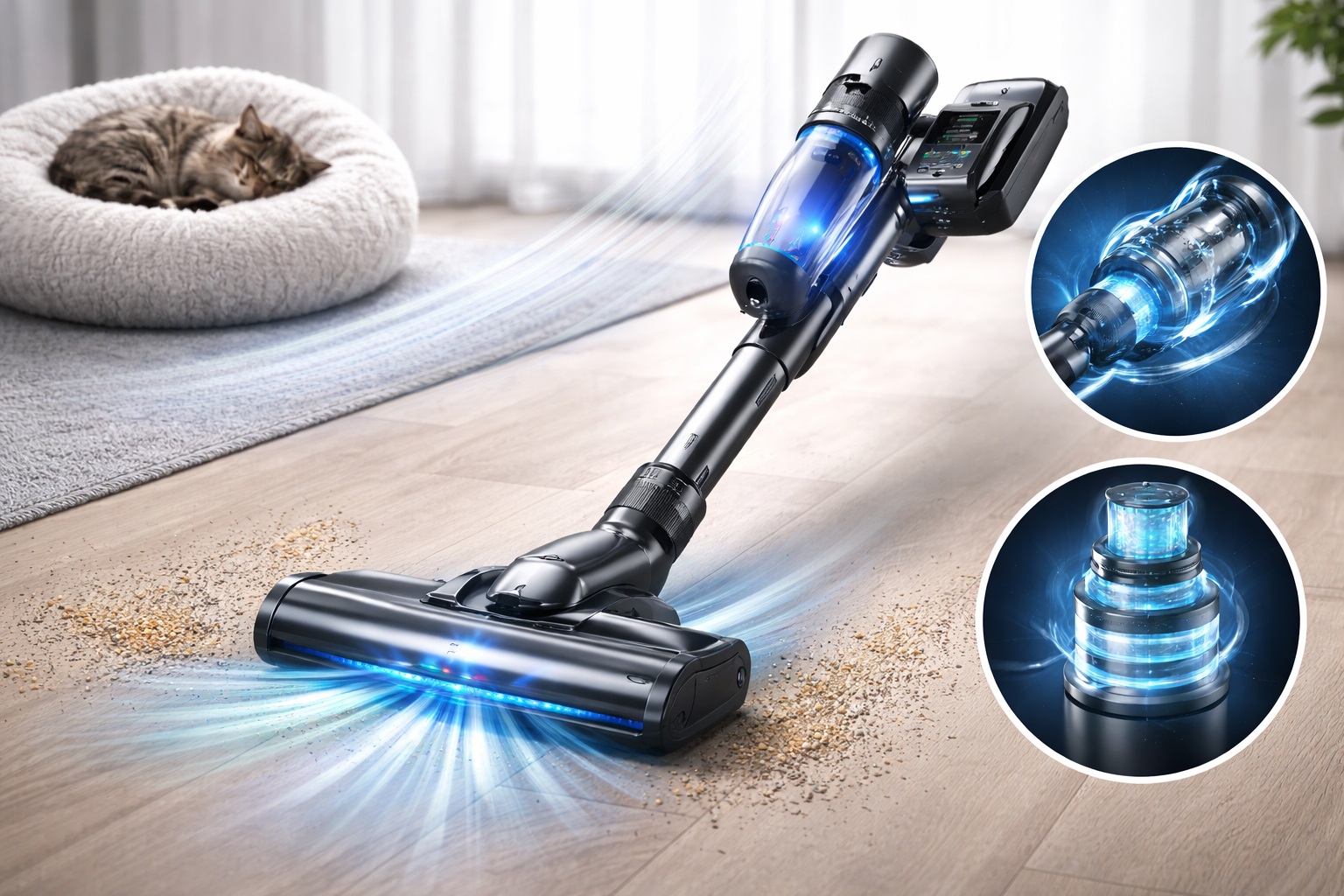
“Quiet” and “powerful” often pull a vacuum cleaner in opposite directions. Higher airflow, higher fan speed, and stronger turbulence can boost pickup—but they can also amplify noise, vibration, and that high-pitched tone consumers hate. Meanwhile, adding thick insulation to reduce noise can increase weight and heat, hurting user experience and durability.
True differentiation isn’t a marketing trick. It’s a technical system that balances acoustics, suction stability, airflow efficiency, filtration sealing, and brush-head losses—then proves the result with repeatable tests. Below is a practical engineering roadmap that helps teams design a Portable Quiet Vacuum Cleaner that still performs like a High Suction Vacuum Cleaner, without relying on exaggerated claims.
I. Define “quiet” and “suction” with procurement-grade metrics ✅📏
If you can’t measure it consistently, you can’t differentiate it reliably. Start by locking down targets and test conditions.
Noise targets
dB(A) at a fixed distance (define it clearly)
Test at multiple modes (standard, boost, quiet mode)
Record a frequency profile (tone matters—whine is often more annoying than volume)
This is crucial for quiet vacuum cleaner positioning and especially for Quiet Vacuum for Night Use and Apartment Vacuum Cleaner segments.
Suction and cleaning targets
Sealed suction / airflow with clear method and environment
Pickup benchmarks on hard floors, rugs, edges, and corners
Performance under realistic conditions (half-full bin, partially loaded filter)
This supports a credible High Suction Vacuum Cleaner story and reduces return risk.
Procurement note 💡: include test protocols in RFQs, not just numbers.
II. Airflow-path engineering: the #1 lever for quiet + powerful performance 🌬️
If you want both low noise and high suction, start with airflow. Many “noise problems” are actually airflow problems: turbulence, abrupt turns, poor sealing, and resonance cavities.
1) Reduce turbulence without choking flow
Smooth transitions (avoid sharp step changes in cross-section)
Fewer abrupt bends and tighter radii in the air path
Avoid poorly aligned grills that create whistle noise
Differentiation outcome: higher effective suction at the nozzle and reduced noise.
2) Control resonance and “whistle points” 🎵
High-frequency whine often comes from:
grill patterns at the intake
narrow slots near the motor housing
cavities that amplify certain frequencies
Prototyping with alternate grill geometries and internal baffles can dramatically reduce perceived loudness while maintaining flow.
3) Minimize leakage to protect suction efficiency
Leaks reduce cleaning performance and can increase noise. Better sealing helps you deliver more cleaning at lower fan speed—good for both quiet vacuum cleaner positioning and power efficiency.
This also supports HEPA Filter Vacuum Cleaner credibility because sealing reduces bypass.
III. Vibration isolation and structural acoustics: stop noise at the source 🛠️🔇
Even with good airflow, vibration can turn the housing into a loudspeaker.
Key approaches:
Soft mounts or isolation elements for the motor module
Stiffness tuning to avoid resonance at motor operating frequencies
Better bearing selection and rotor balance to reduce vibration harmonics
For a Fast Lightweight Vacuum Cleaner, vibration control is even more important—lightweight shells can amplify noise if not structurally optimized.
UX reality: a vacuum that “feels loud” in the hand can get poor reviews even if dB(A) is acceptable.
IV. Motor + fan tuning: suction stability beats peak numbers ⚙️
Consumers don’t clean in a lab. The differentiator is consistent performance across conditions and modes.
1) Use motor mapping for real-life cleaning
Optimize mid-range performance (where most users stay)
Design a boost mode that is powerful but time-limited for heat control
Build a quiet mode that still cleans visible debris well
This is how a Portable Quiet Vacuum Cleaner becomes genuinely usable instead of “quiet but weak.”
2) Manage heat to protect longevity
Heat increases noise (bearing wear), reduces efficiency, and shortens life. Good airflow through the motor chamber, safe thermal cutoffs, and careful power calibration are core to a Multi-Functional Durable Vacuum Cleaner positioning.
3) Efficiency is part of the differentiation story ♻️
If you can achieve similar pickup with lower power draw (via airflow efficiency and sealing), you earn an Energy-Saving Efficient Powerful Vacuum Cleaner narrative that can be supported by engineering logic and testing—especially valuable for cordless platforms.
V. Brush head and nozzle losses: where “suction” is often wasted 🧹
A vacuum can have strong suction at the motor but poor pickup at the floor. Why? Losses at the nozzle and brush head.
To build core differentiation:
Reduce air leakage around the head that bypasses debris
Improve edge pickup channels and sealing near floor contact
Optimize brush roll geometry for hair and fine dust
Balance agitation vs noise (brush roll contact can increase sound)
This matters for:
Vacuum Cleaner for Pet Hair (anti-tangle + agitation) 🐾
Vacuum Cleaner for Hardwood Floors (soft roller strategy, minimal scatter)
Vacuum for Multi-Surface (head adaptability across surfaces)
VI. Filtration and sealing: quiet + suction + health credibility 😷
Filtration choices can increase pressure drop (hurting suction) and create more noise if airflow becomes turbulent around the filter housing.
To avoid this:
Design filter placement to reduce sudden airflow contraction
Maintain consistent gasket compression to prevent bypass
Ensure dustbin sealing doesn’t degrade over time (fatigue testing)
A sealed system strengthens:
HEPA Filter Vacuum Cleaner trust
Vacuum Cleaner for Allergies positioning
suction stability over longer use cycles
VII. Cordless and handheld constraints: differentiation under battery limits 🔋
For a Cordless Vacuum Cleaner or Li-ion Cordless Handheld Vacuum Cleaner, the engineering challenge is achieving strong pickup without draining the battery instantly.
Practical differentiation levers:
Efficiency-first airflow and sealing (more cleaning per watt)
Smart power modes that match power to debris/surface
Accessories and nozzle design that reduce wasted airflow
For cordless handheld vacuums, the “quiet + powerful” story can be a win in apartments and car cleaning—if the form factor remains comfortable and heat is controlled.
VIII. Wet/dry models: noise sources and performance stability in liquid handling 💦
In Wet Dry Vacuum Cleaners and any wet dry vacuum design, the fluid path adds complexity:
pumps, separators, and rotating wet rollers can create additional noise
tank resonance can amplify sound
seals must remain leak-proof while still easy to clean
Differentiation is achieved when the wet/dry system is:
hygienic (easy to rinse, minimal odor traps)
stable in suction and pickup across modes
supported by a Self-Cleaning Vacuum Cleaner workflow that actually reduces user workload
A premium configuration, such as a 4 in 1 Cordless Smart Wet & Dry Vacuum Cleaner, must keep noise under control even in wet mode—otherwise it fails the “night use” and apartment segments.
IX. Validation: the test suite that proves differentiation to buyers 🧪📊
If you want buyers to trust your positioning—and for distributors to defend pricing—ship a clear test package:
Noise
dB(A) at fixed distance, multiple modes
frequency spectrum and tone notes
“hand feel” vibration evaluation
Suction and pickup
sealed suction / airflow
pickup on standardized debris across: hard floors, rugs, edges
performance with partially loaded filters and bins
Durability
brush motor endurance
latch fatigue and drop tests
thermal protection behavior under clogging
User-centered proof
time-to-clean and time-to-maintain
self-cleaning cycle time and drying results (for wet/dry)
This test suite makes your differentiation credible for procurement teams and safe for Google-friendly content claims.
Conclusion: Core technology differentiation is efficiency + control, not louder motors 🌟
Low noise and high suction are not opposites when the system is designed correctly. Airflow tuning, sealing, vibration isolation, motor mapping, and nozzle efficiency allow a quiet vacuum cleaner to deliver real cleaning authority. When you validate with repeatable tests, you earn differentiation that survives reviews, procurement scrutiny, and long-term ownership—across cordless, handheld, and wet/dry categories. ✅
www.lxvacuum.com
Related Keyword Groups
Lanxstar vacuum engineering, Lanxstar quiet suction technology, vacuums procurement, vacuum cleaner distribution, low noise high suction vacuum design, Portable Quiet Vacuum Cleaner acoustics, quiet vacuum cleaner noise reduction, Quiet Vacuum for Night Use engineering, Apartment Vacuum Cleaner low tone, High Suction Vacuum Cleaner stable performance, airflow path optimization for vacuums, turbulence reduction vacuum design, vibration isolation motor mounts, frequency whine control vacuum, motor fan tuning for suction, suction stability with loaded filter, nozzle pressure loss reduction, brush head sealing efficiency, Vacuum for Multi-Surface pickup benchmarks, Vacuum Cleaner for Hardwood Floors soft roller airflow, Vacuum Cleaner for Pet Hair anti-tangle brush design, HEPA Filter Vacuum Cleaner sealed system, Vacuum Cleaner for Allergies filtration credibility, gasket compression durability testing, dustbin seal fatigue validation, Fast Lightweight Vacuum Cleaner structural acoustics, Multi-Functional Durable Vacuum Cleaner reliability tests, Energy-Saving Efficient Powerful Vacuum Cleaner efficiency, cordless airflow efficiency per watt, Cordless Vacuum Cleaner power mapping, Li-ion Cordless Handheld Vacuum Cleaner thermal control, cordless handheld vacuums low noise, Car Vacuum Cleaner stable suction kit, Portable Vacuum for Travel compact quiet design, wet dry vacuum noise sources, Wet Dry Vacuum Cleaners liquid handling design, Wet and Dry Vacuum Cleaner separator efficiency, Large-Capacity Wet Dry Vacuum Cleaner tank resonance control, Self-Cleaning Vacuum Cleaner rinse and dry workflow, 4 in 1 Cordless Smart Wet & Dry Vacuum Cleaner quiet mode, edge cleaning airflow channel design, standardized dB(A) test protocol, suction airflow test method documentation, brush motor endurance testing, latch fatigue cycle testing, thermal cutoff safety validation, distribution-ready proof pack, procurement RFQ test requirements, acoustic foam vs airflow tradeoff