Hi, message us with any questions.
We're happy to help!





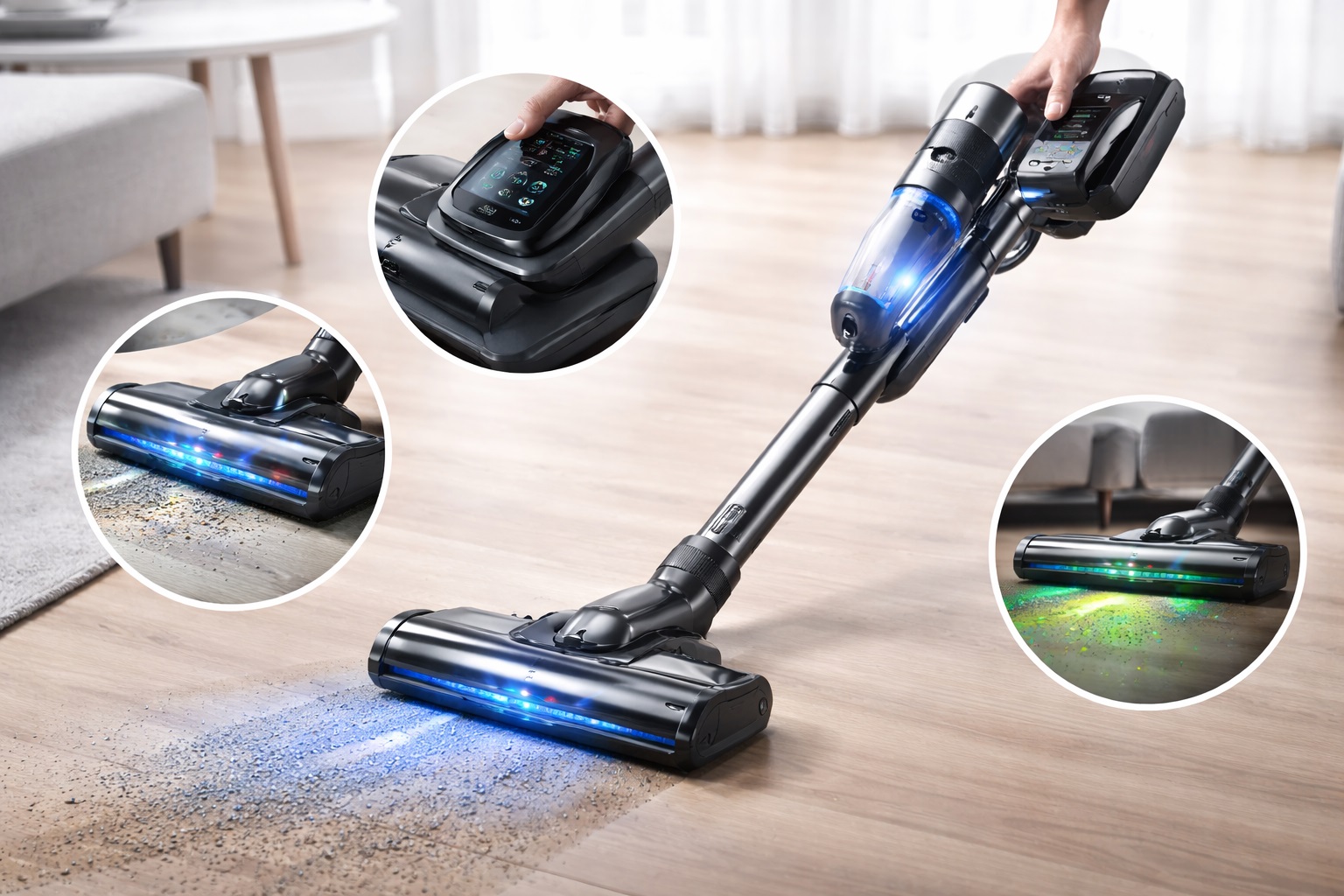
Home vacuum buyers are no longer impressed by long feature lists. They want outcomes they can feel immediately—quiet cleaning at night, fewer clogs, less maintenance mess, better pet-hair pickup, and trustworthy filtration. For brands, the challenge isn’t “adding more functions.” It’s building differentiation that is visible in a demo, meaningful in daily use, and provable in testing.
This article breaks down how to design differentiated features for home vacuums in a way that attracts consumers and satisfies procurement and engineering requirements—without triggering Google penalties from keyword stuffing or exaggerated claims.
I. Start with outcomes, not feature lists 🎯
Consumers rarely buy a vacuum because of “advanced motor technology.” They buy because the product solves a specific frustration:
Quiet comfort for apartments and night use 🌙
Reliable pickup that doesn’t fade after a week
Low-friction maintenance (easy emptying, easy rinsing, fewer hair tangles)
Health confidence (dust containment and allergy-focused filtration) 😷
Pet-hair performance with less brush-roll cleanup 🐾
Portability for cars and travel 🚗🧳
Design your product roadmap around 3–5 “hero outcomes”. Then align airflow, motor control, brush head design, ergonomics, and accessory kits around those outcomes. That’s how you turn a product into a category leader instead of “just another model.”
II. Quiet + power: the combo consumers notice instantly 🤫⚡
A quiet vacuum cleaner is often the fastest differentiator to communicate—especially for an Apartment Vacuum Cleaner or a Quiet Vacuum for Night Use scenario. But “quiet” must still clean well, or reviews will destroy the positioning.
What makes quiet differentiation credible?
Publish a repeatable noise metric (e.g., dB(A) at a standard distance)
Reduce annoying high-frequency tones (whine is often worse than volume)
Provide a practical “quiet mode” that still picks up common debris
Now add real cleaning authority. A Portable Quiet Vacuum Cleaner stands out when it also performs like a High Suction Vacuum Cleaner in everyday situations (crumbs, hair, fine dust, edge pickup).
Engineering reality: low noise is not just insulation. It’s airflow-path tuning, vibration control, motor selection, and housing design working together—without turning the vacuum into a heavy, awkward tool.
III. Design suction as stable cleaning, not peak numbers ✅
Many vacuums look strong on day one and disappoint after the filter loads or the bin fills. Consumers care about stable pickup, not marketing spikes.
To build a believable “power” product story:
Validate performance under realistic conditions (partially clogged filter, half-full bin)
Test on real home surfaces and mixed debris
Prove edge/corner pickup—not only center-lane cleaning
If you want broad appeal, design for Vacuum for Multi-Surface performance (hardwood + tiles + rugs). For hardwood-heavy regions, differentiate with a head and airflow strategy that supports a Vacuum Cleaner for Hardwood Floors without scattering fine dust.
This approach makes “power” an experience consumers can trust—not a claim that creates returns.
IV. HEPA differentiation must be sealed, not just labeled 😷🧪
A HEPA Filter Vacuum Cleaner is a strong conversion driver, but consumers (and reviewers) increasingly expect the HEPA story to be real—meaning the system is sealed and doesn’t leak dust around the filter.
If you want “health confidence” positioning for a Vacuum Cleaner for Allergies, focus on:
Filter fit and housing tolerances to minimize bypass leakage
Maintenance design so users actually keep filters clean
Clear replacement cadence + consistent filter availability
This is also where procurement and distribution teams win: sealed filtration reduces dust complaints and improves long-term review scores, which matters more than launch-week sales.
V. Pet hair differentiation lives in brush-roll engineering and workflow 🐾
Pet owners are ruthless (in a useful way). If hair wraps the brush in two cleanings, the product fails—no matter how premium it looks.
To win the Vacuum Cleaner for Pet Hair segment:
Engineer anti-tangle geometry into the brush roll (not only a “pet tool”)
Prove pickup on upholstery and rugs
Make hair removal easy—tool-free access is a major UX win
Pet-hair differentiation also reduces maintenance friction, one of the biggest drivers of negative reviews in the mid-tier market.
VI. Wet/dry: differentiate through the hygiene lifecycle 💦🧼
The wet dry vacuum category is attractive because it promises fewer tools for more messes. But many wet/dry products fail in the same place: smell, residue, and cleanup hassle.
If you develop Wet Dry Vacuum Cleaners, your differentiation should be built around hygiene:
Tanks that rinse clean fast (no hidden corners)
Seals that prevent leakage and odor
A drying strategy that minimizes residual water
A premium feature is a Self-Cleaning Vacuum Cleaner workflow that truly saves time. “Self-clean” must be fast, repeatable, and easy to complete after every use—otherwise consumers stop using it, and the product starts to smell.
If you’re targeting the premium end, a 4 in 1 Cordless Smart Wet & Dry Vacuum Cleaner can differentiate when “smart” equals real convenience: reliable mode switching, clear alerts (dirty-water full, clog detection), and consistent performance.
For larger homes and family use, a Large-Capacity Wet Dry Vacuum Cleaner can be a high-value differentiator—but only if weight, tank handling, and storage remain manageable.
VII. Lightweight convenience without fragile build quality 🏋️➡️🛠️
Consumers love products that feel effortless. A Fast Lightweight Vacuum Cleaner is especially appealing for quick cleans, stairs, and small homes.
But lightweight becomes a liability if the vacuum feels fragile. If it squeaks, loosens, cracks, or wobbles after a few months, differentiation collapses.
To protect the experience, define durability as measurable outcomes:
Latch fatigue cycles
Brush motor endurance tests
Drop tests (handheld module + main body)
Thermal protection behavior under partial clogs
This is how you create a Multi-Functional Durable Vacuum Cleaner that distributors can support and consumers will recommend.
VIII. Cordless + handheld: differentiate through real portability 🔋🚗
Cordless is mainstream now—so “cordless” alone isn’t differentiation. The real differentiators are portability, runtime stability, and accessory usefulness.
A strong platform strategy is pairing:
A main Cordless Vacuum Cleaner for daily whole-home cleaning
A companion Li-ion Cordless Handheld Vacuum Cleaner for fast spot jobs and tight spaces
For car owners, a Car Vacuum Cleaner story must be practical:
Crevice reach that fits seat rails
Stable suction for embedded grit
Dust containment that doesn’t leak in storage
This is also where cordless handheld vacuums win as bundles: car kit + travel kit + spare filter set.
For travelers, a Portable Vacuum for Travel should be compact, sealed, quick-charging, and easy to empty—because nobody wants a dust cloud in a hotel room 🧳✨.
IX. Energy-saving positioning must still feel powerful ♻️
Energy efficiency is becoming a stronger purchase driver across regions. An Energy-Saving Efficient Powerful Vacuum Cleaner position works when you can show:
Strong cleaning outcomes at optimized power draw
Efficient airflow design (less wasted turbulence)
Smart modes that match power to task without frustrating users
Efficiency also supports a better cordless runtime experience—something consumers feel immediately.
X. Budget shoppers: win “value” keywords without cheap perception 💰
Search intent around value is massive. To attract these buyers, you can use budget phrases naturally (without repeating them obsessively):
best vacuum on a budget, best budget hoover, good budget vacuum, best affordable vacuum, best budget vacuum, best value for money hoover, best value hoover, best vacuum cleaners on a budget, best vacuums on a budget, good budget vacuum cleaner.
But the differentiation rule is: value engineering, not cheap engineering.
Keep “touch points” premium (seals, clicks, head glide)
Reduce fragile complexity
Make maintenance simple and documented
Ensure consumables are always available
That’s how you protect reviews and distributor confidence while still converting budget-driven traffic.
Conclusion: Differentiation is being chosen quickly—and loved later 🌟
To attract consumers in home vacuums, build differentiation around outcomes with proof: quiet comfort, stable suction, sealed HEPA confidence, pet-hair mastery, wet/dry hygiene, and lightweight ease that still lasts. When your story is scenario-led and test-backed, it becomes easy to choose—and easy to support across procurement and distribution channels. ✅
www.lxvacuum.com
Ideal Readers (Listed again at the end)
Global vacuum buyers / vacuums procurement teams
Distributors & brand owners / vacuum cleaner distribution professionals
Home appliance R&D engineers and product managers
Related Keyword Groups
Lanxstar vacuum cleaner, Lanxstar cordless vacuum, vacuums procurement, vacuum cleaner distribution, home vacuum differentiation, High Suction Vacuum Cleaner performance, Portable Quiet Vacuum Cleaner low noise, quiet vacuum cleaner for apartments, Quiet Vacuum for Night Use design, Apartment Vacuum Cleaner compact storage, HEPA Filter Vacuum Cleaner sealed system, Vacuum Cleaner for Allergies HEPA, Vacuum Cleaner for Pet Hair anti-tangle, Vacuum Cleaner for Hardwood Floors soft roller, Vacuum for Multi-Surface pickup test, Fast Lightweight Vacuum Cleaner ergonomics, Multi-Functional Durable Vacuum Cleaner testing, Self-Cleaning Vacuum Cleaner hygiene cycle, Energy-Saving Efficient Powerful Vacuum Cleaner motor control, Wet Dry Vacuum Cleaners supplier, wet dry vacuum odor prevention, Wet and Dry Vacuum Cleaner leak resistance, Large-Capacity Wet Dry Vacuum Cleaner tank design, 4 in 1 Cordless Smart Wet & Dry Vacuum Cleaner features, Li-ion Cordless Handheld Vacuum Cleaner OEM, cordless handheld vacuums bulk, Cordless Vacuum Cleaner platform strategy, Car Vacuum Cleaner accessory kit, Portable Vacuum for Travel compact kit, HEPA sealed filtration engineering, anti-hair wrap brush roll, brush motor endurance testing, latch fatigue cycle validation, airflow path noise reduction, suction stability under clogging, battery runtime verification, fast charging Li-ion vacuum, washable filter replacement plan, edge cleaning performance benchmark, upholstery pet tool effectiveness, wet pickup separation efficiency, self-clean rinse and dry workflow, compact docking station design, low maintenance vacuum ownership, best vacuum on a budget positioning, best budget vacuum cleaner SKU, good budget vacuum cleaner value, best affordable vacuum build quality, best value for money hoover strategy, best value hoover for retail, best vacuum cleaners on a budget SEO, best vacuums on a budget intent