Hi, message us with any questions.
We're happy to help!





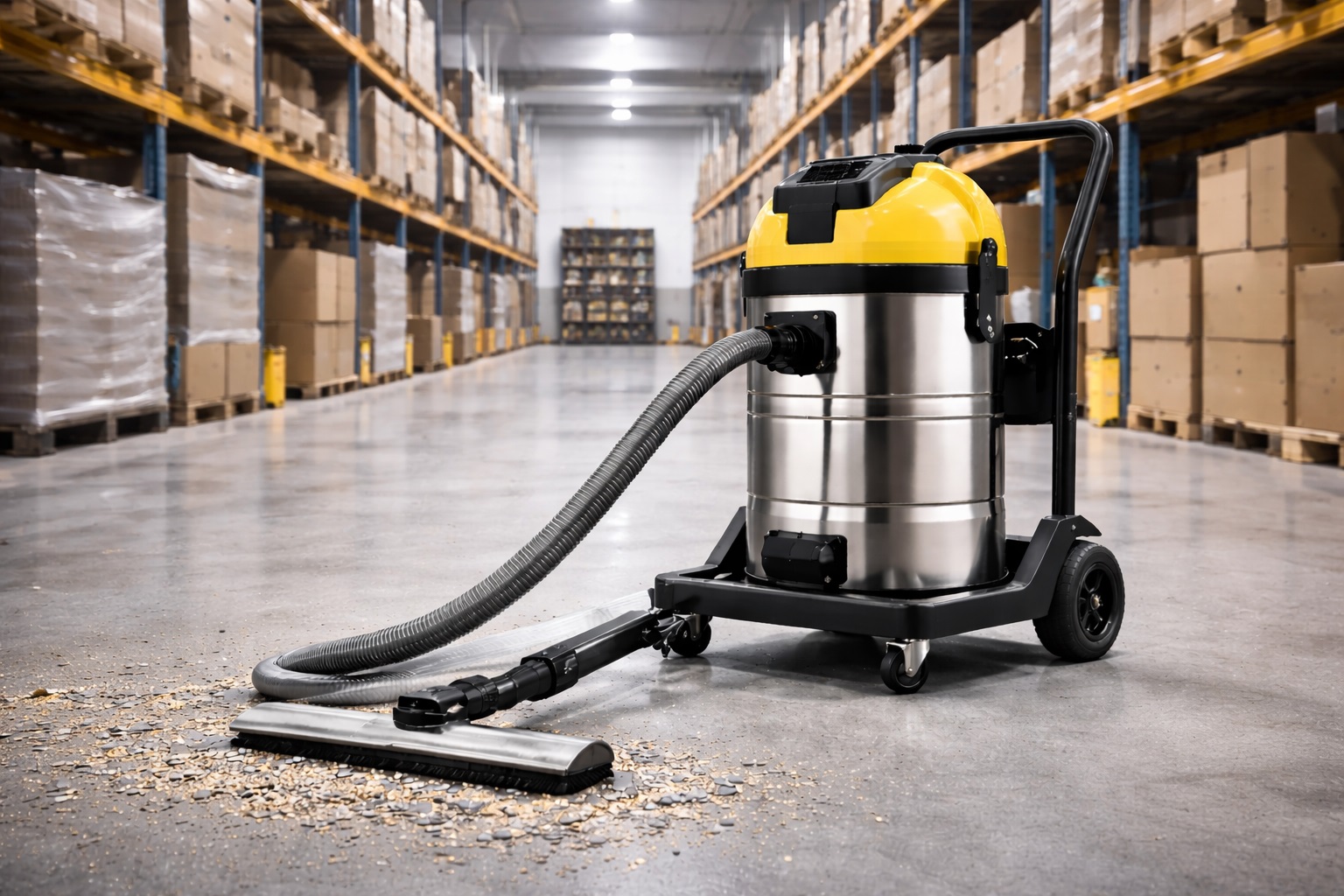
📦 The 3 warehouse “efficiency leaks” hiding in plain sight
Dirt migration: debris enters at dock doors and gets tracked into pick faces, creating repeated cleaning loops.
Spill downtime: small liquid incidents become major delays when crews rely on mops and waiting.
Tool mismatch: dragging a big machine for small tasks—or using small vacuums where bulk pickup is needed—wastes labor minutes every shift.
Warehouses don’t fail on cleanliness; they fail on friction. Every extra minute spent sweeping, re-cleaning, or waiting for floors to dry shows up as slower picking, more safety risk, and less throughput.
That’s why barrel vacuum cleaners (drum-style, high-capacity vacuums) are increasingly used in distribution centers: they reduce emptying interruptions, support long cleaning routes, and recover large volumes of dry debris or liquids when configured as wet/dry systems.
This guide is written for EU & Middle East B2B vacuum cleaner procurement buyers serving warehouses and logistics facilities. It covers practical application cases, measurable effectiveness, and a fleet strategy that improves cleaning efficiency without keyword-stuffing or “marketing-only” claims.
I. 🧭 Where barrel vacuum cleaners deliver the most value in warehouses
Barrel vacuum cleaners are most effective where volume + distance are the real constraints:
Dock doors and staging lanes (continuous debris entry)
Main aisles and high-traffic routes (long cleaning distances)
Pick-face perimeters (dust that affects barcode scanning and product packaging)
Battery charging and maintenance corners (mixed debris + occasional liquids)
End-of-shift bulk cleanup (fewer stops to empty)
Where they are not the default:
Office areas and carpeted admin zones: Upright Vacuum Cleaners are faster and more ergonomic.
Very light housekeeping: Household Vacuum Cleaners may be acceptable in non-operational spaces, but they are not the right tool for bulk warehouse debris.
Rapid spot response: a Cordless Vacuum Cleaner beats walking a drum unit across the building.
Procurement takeaway: Warehouses should buy a fleet mix: barrel for routes and bulk, cordless for point-of-use, upright/household for non-ops.
II. 🚚 Case 1: Dock door “debris injection” and how to stop re-cleaning
Problem
Dock doors are debris entry points: pallet splinters, stretch wrap fragments, dust, and grit. If you clean only inside aisles, dirt re-enters within hours.
Application
Stage barrel vacuum cleaners near dock clusters
Run a “dock perimeter loop” twice per shift (5–12 minutes each)
Use a wide floor tool for lanes + crevice tool for thresholds
Effectiveness
Less debris migration into pick zones
Fewer repeated cleans deeper in the warehouse
Faster cleanup with fewer emptying stops
This is where barrel systems feel like a productivity tool, not a cleaning tool.
III. 🧹 Case 2: Pick-face dust that causes barcode and packaging friction
Problem
Dust buildup around pick faces causes:
dirty labels, harder barcode reads
damaged packaging appearance
more “wipe down” micro-tasks for associates
Application
Use barrel vacuum cleaners on scheduled routes for aisles
Deploy Cordless Vacuum Cleaner units at pick modules for quick spot cleanup (small spills, carton fibers)
Effectiveness
Associates spend less time wiping and more time picking
Better scan rates and fewer exceptions
Cleaner product presentation for outbound shipments
IV. 💧 Case 3: Spill response in battery areas and maintenance corners
Problem
Battery charging zones and maintenance areas see occasional:
water spills, cleaning liquids, coolant-like fluids
tracked wet footprints → slip hazards → safety slowdowns
Application
Use Wet Dry Vacuum Cleaners capability with a dedicated spill-ready unit:
squeegee head for fast recovery
staged tools kept at the corner (don’t borrow from dry-only routes)
For frequent incidents or large footprints, specify a Large-Capacity Wet Dry Vacuum Cleaner so crews can recover liquids without constant tank stops.
Effectiveness
Faster reopening of walkways
Reduced slip incidents and reporting overhead
Less “mop and wait” downtime
A properly staged Large-Capacity Wet Dry Vacuum Cleaner is often the highest-ROI unit in a large warehouse.
V. 🧼 Case 4: Night shift cleaning while operations continue
Problem
Many warehouses run late shifts. Full shutdown cleaning isn’t realistic; loud or slow cleaning disrupts flow.
Application
Schedule route cleaning during low-traffic windows
Place barrel vacuum cleaners in “route nodes” to reduce travel
Use cordless units for tight picks and quick response
Effectiveness
Cleaning happens without stopping operations
Fewer collisions and interruptions
More predictable cleanliness baseline
This is also where procurement should look for an Energy-Saving Efficient Powerful Vacuum Cleaner configuration: stable suction so crews finish routes faster, with less runtime and fewer repeated passes.
VI. ⚡ What “energy-saving” should mean in a warehouse (practical, not brochure)
In warehouses, energy waste comes from:
long runtimes due to weak pickup
repeated passes over the same lane
frequent clogging and tool adjustments
An Energy-Saving Efficient Powerful Vacuum Cleaner should be evaluated by:
minutes to complete a standard route (e.g., dock loop + two aisles)
interventions per shift (filter cleaning, hose unclogging)
runtime per cleanup event (before vs after)
This reframes “energy-saving” as work done per kWh—and it’s the procurement language that matches real operations.
VII. 🧠 Wet/dry discipline: the rule that prevents downtime
The fastest way to ruin a wet/dry unit is mixing workflows carelessly.
Two-mode discipline for Wet Dry Vacuum Cleaners
Mode A — Dry routes
pallet wood dust, wrap fragments, grit
keep filters dry and consistent
Mode B — Wet incidents
spills and recovery only
keep wet tools and disposal routine ready
If your facility tries to use one machine for both without discipline, you’ll get clogs, odor issues, and downtime. That’s why many warehouses standardize as:
1 dedicated wet unit + 1–2 route barrel units + multiple cordless units
VIII. 🧾 Screenshot-friendly procurement scorecard (warehouse edition)
Rate each supplier 1–5. Total /50.
✅ 10-point scorecard
Route efficiency (long-distance cleaning practicality)
Bulk recovery capacity (fewer emptying interruptions)
Wet spill recovery readiness (squeegee tool, seals, practicality)
Suction stability over time (low clogging, consistent pickup)
Energy efficiency in real use (minutes saved per shift)
Cordless integration (fast spot response strategy)
Ease of maintenance (filters, tank cleaning, tool access)
Ergonomics & mobility (aisles, ramps, dock plates)
Consumables availability in EU/MENA
Documentation support (SOP templates, maintenance schedule)
Interpretation:
40–50: strong warehouse fit
30–39: workable with SOP enforcement
<30: expect time-waste and repeated cleaning
Conclusion: warehouse cleaning efficiency improves when routes become predictable
The practical effectiveness of barrel vacuum cleaners in warehouses comes from one thing: predictable routes with fewer interruptions. When staged correctly, barrel systems reduce emptying breaks and make dock loops and aisle cleaning faster. Add Cordless Vacuum Cleaner units for spot response, and keep Wet Dry Vacuum Cleaners capability ready for spills—especially in battery and maintenance corners.
Reserve Upright Vacuum Cleaners and Household Vacuum Cleaners for office and non-operational areas, and evaluate “energy-saving” using route minutes saved—not just nameplate specs. Do this, and you’ll see measurable improvements: less dirt migration, fewer spill delays, and more productive labor hours per shift.
Hashtags
WarehouseCleaning, DistributionCenterCleaning, LogisticsFacilityMaintenance, BarrelVacuumCleaners, DrumVacuumSystem, IndustrialVacuumCleaner, WetDryVacuumCleaners, LargeCapacityWetDryVacuumCleaner, CordlessVacuumCleaner, EnergySavingEfficientPowerfulVacuumCleaner, UprightVacuumCleaners, HouseholdVacuumCleaners, DockDoorDebrisControl, DebrisMigrationPrevention, PalletSplinterCleanup, StretchWrapWaste, AisleRouteCleaning, PickFaceDustControl, BarcodeScanReliability, PackagingFiberCleanup, BatteryAreaCleaning, SpillResponseSOP, SqueegeeRecoveryTool, SlipHazardReduction, NightShiftCleaning, CleanWhileOperating, RouteNodeStaging, BulkRecoveryCapacity, LongDistanceCleaning, SuctionStability, FilterCloggingPrevention, PreSeparatorCyclone, CartridgeFilterSystem, MaintenanceChecklist, ConsumablesPlanning, SparePartsEU, SparePartsMENA, DistributorReadyConfig, ProcurementScorecard, TCOModel, MinutesSavedPerShift, 5SForWarehouses, FacilityHousekeeping, RampAndDockPlateCleaning, HighTrafficLaneCleaning, PickModuleSpotCleaning, OfficeAreaCleaning, CarpetZoneCleaning, SOPStandardization, EUIndustrialProcurement, MENAIndustrialSupply, Lanxstar