Hi, message us with any questions.
We're happy to help!





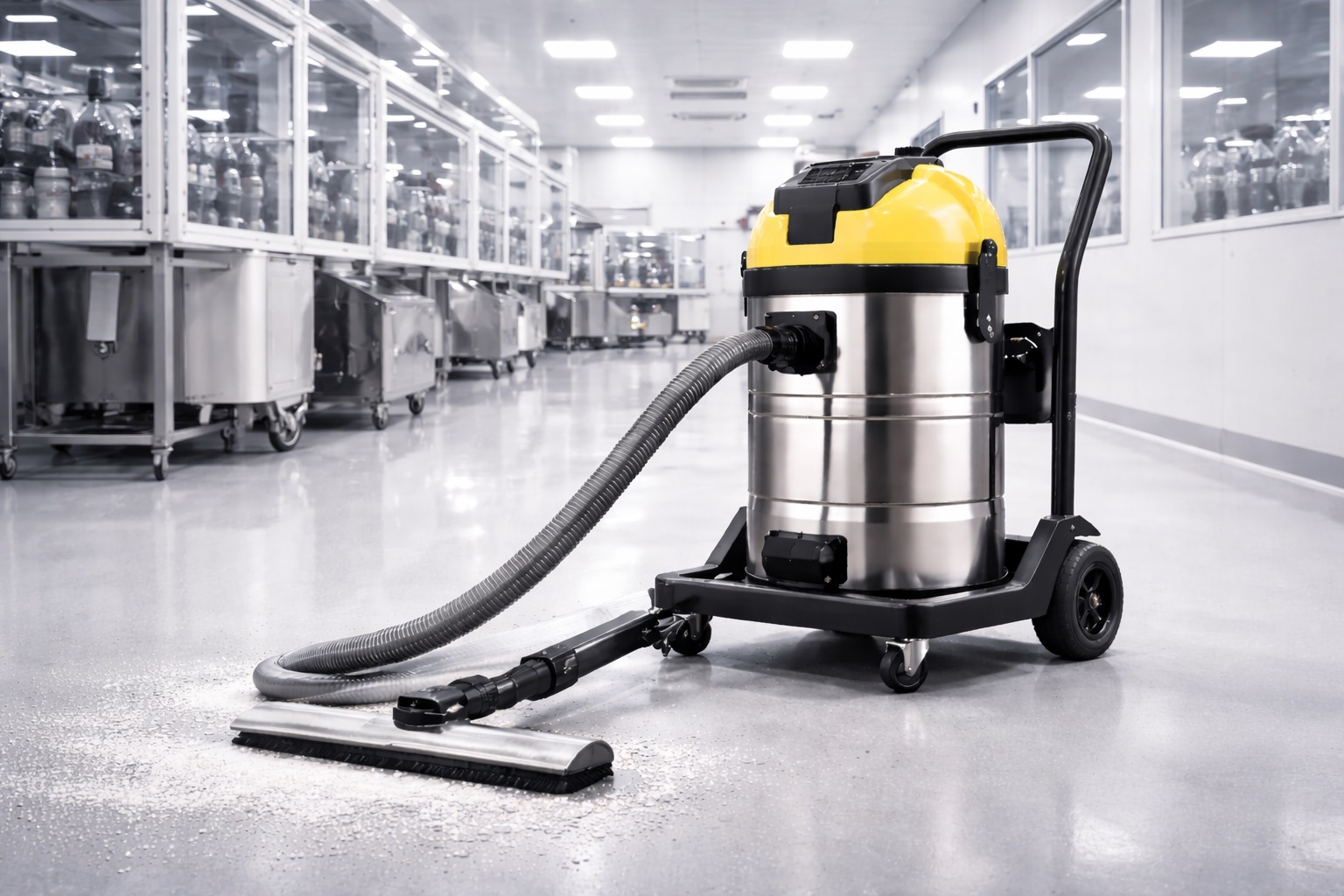
🧪 The 3 “cleanliness gaps” that quietly break GMP performance
Invisible powder migration: you clean the floor, but fine powder relocates into corners, coving, and equipment skirts—then returns during airflow cycles.
Cross-contamination through tools: one hose/nozzle used across areas can undo a full changeover, even if the room “looks clean.”
Vacuum mismatch: a unit that’s fine for general facilities fails in production—filters clog, suction drops, and operators start sweeping (which re-aerosolizes particles).
In pharmaceutical manufacturing, “clean” is not an aesthetic target—it’s a controlled condition. Your cleaning tools are part of your contamination-control system, and that means vacuum selection affects batch integrity, audit readiness, and changeover speed.
That’s where barrel vacuum cleaners (drum-style, large-capacity systems) become highly effective. When specified correctly, they provide stable recovery for powders, support contained waste handling, and reduce interruptions caused by frequent emptying. This guide is written for EU & Middle East B2B procurement buyers supporting pharmaceutical facilities, focused on practical workflows that improve cleanliness without slowing production.
I. 🏭 Where barrel vacuum cleaners fit in pharma (and where they don’t)
Pharma plants are not one environment; they’re a map of zones.
Best-fit zones for barrel systems
Dispensing and weighing support areas (powder cleanup, floor edges, under benches)
Granulation, blending, tablet compression perimeters (routine powder recovery)
Packaging lines (fiber, dust, and product debris volumes)
Maintenance shutdown cleaning (bulk recovery with fewer emptying stops)
Utility corridors adjacent to production (controlled, scheduled routes)
Where barrel systems shouldn’t be the only tool
Tight stations and quick point-of-use cleanup: a smaller unit can be faster to deploy.
Admin and office spaces: Upright Vacuum Cleaners are still the most efficient for carpets and corridors, and Household Vacuum Cleaners may be acceptable in strictly non-GMP office zones (depending on site policy). Keep them out of controlled production areas.
Procurement takeaway: In pharma, you win with a fleet strategy: barrel vacuum cleaners for bulk/continuous tasks, smaller point-of-use units for fast response, and upright/household units restricted to non-production spaces.
II. 🧼 The “vacuum-first” method that improves cleanliness and speeds changeovers
A common time sink is the wipe-down loop: wipe → dust smears → wipe again → particles resettle. The more you wipe first, the more you spread fine residues.
✅ Vacuum-first changeover sequence (high-impact, low drama)
Dry vacuum before any wet wipe
Removes particulate load instead of smearing it.Top-down route
Ledges/cable trays → equipment skirts → coving → floor edges → main floor.Targeted wet wipe last
Wet cleaning becomes smaller and faster because the particulate burden is reduced.
This is also where a Vacuum Cleaner for Multi-Surface setup matters: pharma cleaning isn’t one “floor.” You need controlled cleaning across epoxy, vinyl, stainless surfaces, and hard-to-reach corners without scratching or scattering residue.
III. 🧲 Powder containment: why “strong suction” alone isn’t enough
Pharma powders can be fine, cohesive, and static-prone. Cleaning fails when suction is strong at first, then drops as filters load.
What you actually want: stable pickup + containment
A High Suction Vacuum Cleaner configuration helps, especially for:
long hose runs to reach behind equipment
heavy powder deposits in corners and under frames
consistent recovery without repeated passes
But suction must be paired with containment design:
staged filtration (so filters don’t choke early)
sealed airflow paths (so captured powder stays captured)
controlled waste handling (so emptying doesn’t create a dust event)
Practical buyer warning: If operators complain “it’s strong for 10 minutes, then weak,” the fix is usually filtration staging and handling discipline—not simply a bigger motor.
IV. 🧰 Multi-surface reality: what “multi-surface” should mean in GMP cleaning
In consumer markets, “multi-surface” is a label. In pharma, it must translate to a tooling strategy.
A real Vacuum Cleaner for Multi-Surface toolkit
Wide floor tool for open epoxy/vinyl lanes
Crevice tools for coving, door thresholds, and machine rails
Soft brush/no-mark heads for stainless and painted panels
Angled wands for under-equipment voids and tight corners
Optional squeegee head for wet recovery zones
A Vacuum Cleaner for Multi-Surface solution is effective only if accessories are standardized, available, and controlled by zone (so tools don’t travel from “dirty” to “clean” areas).
V. 💧 Handling liquids safely: wet recovery without recontamination
Pharma facilities still face wet events: wash water, leaks, cleaning solution spills. The mistake is treating wet recovery as a casual add-on.
Two-mode discipline for a Wet and Dry Vacuum Cleaner
Mode A — Dry particulate recovery (routine):
powder and debris only
dedicated dry tools and dry filtration
stable suction and minimal intervention
Mode B — Wet recovery (incidents or scheduled):
liquid spills and recovery only
wet tools (squeegee head), appropriate tank handling
disposal routine that prevents splashing and re-aerosolization
A true Wet and Dry Vacuum Cleaner can support both modes, but procurement should require either:
two dedicated units (dry-only + wet-only), or
a conversion method that is quick, safe, and SOP-controlled
This approach protects clean environments and prevents the classic failure mode: wet + powder → paste → clogged hoses → downtime.
VI. 🌬️ Air quality and comfort claims: how “allergy” language maps to pharma needs
The phrase Vacuum Cleaner for Allergies typically implies high-efficiency filtration and reduced particle re-emission. In pharma, the motivation is different (contamination control rather than comfort), but the functional requirement overlaps:
sealed airflow (reduced leakage)
high-efficiency filtration option where required by your internal risk assessment
predictable maintenance and filter-change routines
Used correctly, a “Vacuum Cleaner for Allergies” concept aligns with particle containment in corridors adjacent to controlled areas, QA spaces, and inspection benches—especially when you need to reduce dust recirculation.
VII. 📍 Practical application cases (what good looks like on real pharma floors)
🧾 Case 1: Dispensing room perimeter dust (the recurring corner problem)
Problem: Powder accumulates in coving, corners, and under benches; wiping spreads it.
Solution: Park a barrel unit outside the core area, run a long hose to corners, and enforce a top-down vacuum-first route.
Result: fewer repeat cleans, more consistent end-of-shift baseline.
Here, a High Suction Vacuum Cleaner setup shows value because corners and under-bench voids often require sustained suction.
🧪 Case 2: Changeover speed in solid-dose areas
Problem: Changeovers get long because teams re-clean the same surfaces.
Solution: Vacuum-first to remove particulates, then targeted wipe. Zone-control the tools to avoid cross-area use.
Result: cleaner restarts and fewer “surprise residues” found during line clearance.
💧 Case 3: Wet incident response near utilities
Problem: Water leaks create slip hazards and force slow mop routines.
Solution: Keep a dedicated wet-ready unit staged as a Wet and Dry Vacuum Cleaner in wet mode, with squeegee tool and defined disposal path.
Result: faster reopening of walkways and fewer disruptions.
📦 Case 4: Packaging fibers and dust migration
Problem: cardboard fibers and debris spread from packaging into nearby corridors.
Solution: Schedule perimeter loops with barrel vacuum cleaners and a multi-surface tool kit (wide tool + crevice).
Result: less migration, fewer wipe-down micro-stops, cleaner appearance for audits.
VIII. 🧾 Audit readiness: make the vacuum part of your documentation system
Pharma audits love evidence of control, not just good intentions.
Buyer requirements that reduce audit friction
Cleaning SOP template that includes vacuum-first sequence
Zone allocation plan (which vacuum and tools belong where)
Maintenance schedule: filter inspection, replacement intervals, hose integrity checks
Training record template for operators and sanitation staff
Simple “pre-use check” checklist (hose, seals, tank, visible damage)
When procurement asks for these in the RFQ, you instantly filter out suppliers who can sell a machine but can’t support a GMP workflow.
IX. 📊 The procurement scorecard (screenshot-friendly for internal alignment)
Rate each supplier 1–5. Total /50.
✅ 10-point pharma scorecard
Containment performance (re-emission risk, sealed design mindset)
Suction stability (not just peak power)
Filtration strategy (staging options and practicality)
Wet recovery readiness (tools + disposal workflow)
Multi-surface tool kit depth (corners, coving, stainless)
Zone-control support (labels, accessory control approach)
Ease of maintenance (fast, clean filter access)
Hygienic cleanability (smooth surfaces, easy wipe-down)
EU/MENA service + consumables availability
Documentation support (SOP, logs, training materials)
Interpretation:
40–50: strong pharma fit
30–39: usable with tight SOP discipline
<30: expect repeat cleaning, performance complaints, and audit stress
Conclusion: clean environments stay clean when vacuuming becomes a controlled process
Barrel vacuum cleaners help pharmaceutical facilities maintain clean environments when they’re deployed as part of a system: vacuum-first routines, zone-controlled tools, stable suction, and disciplined wet/dry workflows. Pair a High Suction Vacuum Cleaner configuration for powder-heavy tasks with a properly managed Wet and Dry Vacuum Cleaner approach for liquid incidents. Add a true Vacuum Cleaner for Multi-Surface toolkit so crews can clean corners, coving, and equipment skirts without spreading residue.
Keep Upright Vacuum Cleaners and Household Vacuum Cleaners in non-production spaces where they belong, and treat “Vacuum Cleaner for Allergies” features as a proxy for filtration and containment discipline—not marketing. Done right, the payoff is measurable: faster changeovers, fewer re-cleans, and a cleaner audit story.
Hashtags
PharmaceuticalCleaning, GMPHousekeeping, CleanEnvironmentControl, BarrelVacuumCleaners, DrumVacuumSystem, IndustrialVacuumForPharma, HighSuctionVacuumCleaner, WetAndDryVacuumCleaner, WetDryVacuumWorkflow, VacuumCleanerForMultiSurface, VacuumCleanerForAllergies, ContainmentCleaning, PowderMigrationControl, CrossContaminationPrevention, ChangeoverCleaningSOP, LineClearanceSupport, DispensingRoomCleaning, SolidDoseManufacturing, PackagingAreaDustControl, CorridorPerimeterCleaning, CovingAndCornerCleaning, UnderEquipmentVoidCleaning, NoMarkBrushTools, CreviceToolKit, StainlessSurfaceCleaning, EpoxyFloorCleaning, ZoneBasedToolControl, DedicatedVacuumByArea, AccessoryLabeling, FilterStagingDesign, PreSeparatorCyclone, CartridgeFilterSystem, HighEfficiencyFiltrationOption, SealedAirflowDesign, WetSpillRecovery, SqueegeeRecoveryTool, SlipHazardReduction, MaintenanceShutdownCleaning, AuditReadyDocumentation, CleaningValidationSupport, OperatorTrainingLogs, PreUseInspectionChecklist, ConsumablesPlanning, ServiceSupportEU, ServiceSupportMENA, UprightVacuumCleaners, HouseholdVacuumCleaners, NonGMPOfficeCleaning, ProcurementScorecard, TCOModel, Lanxstar