Hi, message us with any questions.
We're happy to help!





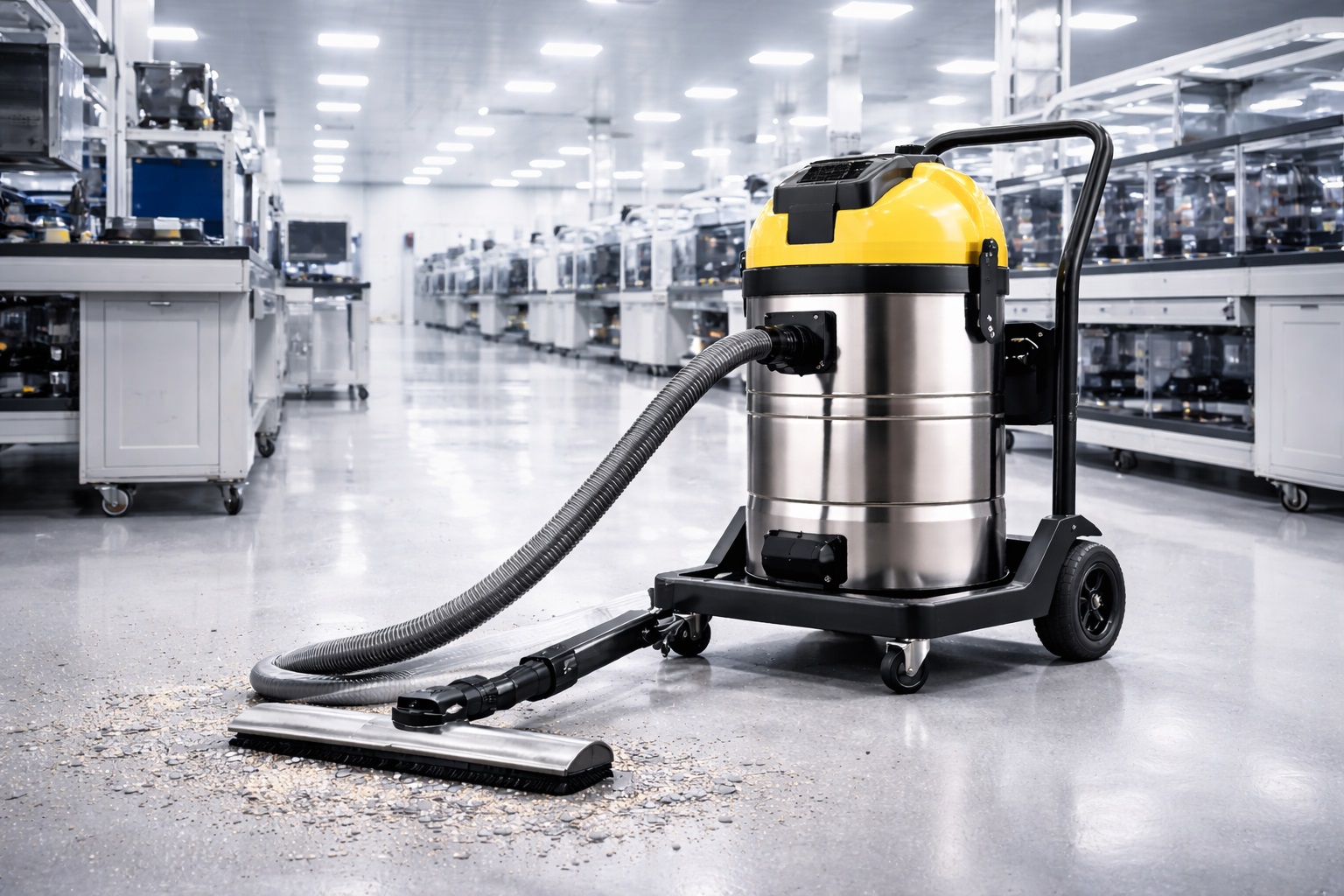
⚡ The 3 “invisible efficiency drains” in electronics factories
Fine dust that you can’t see (but shows up as defects, rework, and yield loss).
Micro-stoppages caused by messy cleanup (operators pause lines for sweeping, wiping, and re-cleaning).
Tool mismatch—using the wrong vacuum type in the wrong zone leads to clogging, suction drop, and repeated passes.
Electronics factories don’t clean like warehouses or construction sites. You’re dealing with fine particulates, packaging fibers, solder/flux residues, ESD-sensitive areas, and a mix of clean zones and general assembly. In this environment, cleaning efficiency isn’t just “faster housekeeping”—it’s shorter interruptions, fewer defects, smoother audits, and more predictable shift routines.
That’s where barrel vacuum cleaners (drum-style, large-tank systems) can become the backbone of an efficient cleaning fleet. When specified correctly, they reduce emptying cycles, stabilize suction over long runs, and support zone-based workflows that protect quality.
This guide is written for EU & Middle East B2B vacuum cleaner procurement buyers serving electronics factories (SMT/PCB assembly, device assembly, battery module lines, packaging areas). You’ll get practical setups, deployment cases, and a screenshot-friendly scoring method that procurement teams can actually use.
I. 🧭 Where barrel vacuum cleaners fit in electronics plants
Barrel vacuum cleaners are most valuable where volume + continuity matter:
Main aisles and production perimeters (constant small debris accumulations)
Under-conveyor and under-bench voids (dust traps that spread contamination)
Packaging zones (cardboard fibers and film scraps build up fast)
Maintenance shutdown cleaning (bulk recovery with fewer stops to empty)
Wet incident zones (coolant/water leaks, mop water, accidental spills)
Where they should not be your only solution:
Tight workstations, quick spot cleaning, and tool drawers → this is where a Portable Self-Cleaning Vacuum Cleaner saves minutes by eliminating filter-fiddling and allowing quick “grab-and-go” use.
Offices and carpeted admin spaces → Upright Vacuum Cleaners remain the fastest for carpets, while Household Vacuum Cleaners may be acceptable for non-production areas depending on policy.
Procurement takeaway: Electronics factories win with a fleet mix: barrel systems for bulk/continuous cleaning, portable units for point-of-use response, and upright/household units restricted to non-process spaces.
II. 🧪 The “vacuum-first 5S” method that cuts micro-stoppages
Sweeping and dry wiping often re-aerosolize fine dust—meaning you “clean” but the dust simply relocates, then comes back as defects or repeated cleanup.
✅ Vacuum-first 5S (a simple routine that scales)
Dry vacuum before any wet wipe (remove particles instead of smearing them)
Top-down path (shelves/cable trays → benches → floor edges → main aisles)
Zone-based tool control (don’t move a dust-laden hose from packaging into assembly)
This approach improves cleaning efficiency because operators stop doing the same area multiple times. In practical terms, barrel vacuum cleaners reduce “emptying interruptions,” while a Portable Self-Cleaning Vacuum Cleaner cuts “maintenance interruptions” at the workstation level.
III. 🧯 Case-based applications that actually improve efficiency
Below are job-realistic cases electronics factories see every week.
🧩 Case 1: Packaging dust and fiber spread (the silent contamination source)
Problem: Cardboard fibers and film scraps migrate into production aisles and settle on surfaces. Sweeping lifts fibers back into the air.
Solution: Park barrel vacuum cleaners at packaging exits and run a “perimeter sweep” twice per shift.
Why it’s efficient: You stop fiber migration early, reducing downstream wipe-down work.
🔩 Case 2: Under-conveyor dust traps and recurring re-clean
Problem: Under conveyors, benches, and cabinets collect fine dust that’s hard to reach, then gets kicked up by airflow and foot traffic.
Solution: Use a long hose on barrel units and schedule a 10-minute under-line routine. Add crevice tools and angled wands.
Why it’s efficient: One planned routine replaces dozens of reactive micro-cleanups.
🧴 Case 3: Flux/solder paste smears (wet + sticky realities)
Problem: Sticky residues smear when wiped first, turning cleanup into a slow, repeated task.
Solution: Use a Large-Capacity Wet Dry Vacuum Cleaner workflow: dry pickup first where possible, then controlled wet recovery for liquid residues.
Why it’s efficient: Less wiping, fewer rework loops, cleaner restarts.
💧 Case 4: Water incidents (HVAC drips, washdown, accidental spills)
Problem: Spills create slip risk and production disruption.
Solution: Keep a dedicated Large-Capacity Wet Dry Vacuum Cleaner staged for emergency response (with a squeegee tool).
Why it’s efficient: “Contain and recover fast” beats “mop and wait,” especially during shift peaks.
🤫 Case 5: Night shift cleaning with noise constraints
Problem: Loud cleaning disrupts operators, QA checks, or shared facilities.
Solution: Specify a Quiet Vacuum Cleaner configuration for routine perimeter work and a quiet portable unit for close-proximity station cleaning.
Why it’s efficient: Crews can clean while lines run, reducing downtime. A Quiet Vacuum Cleaner is not a luxury—it's a scheduling tool.
IV. 🧲 ESD and sensitive zones: how to clean without adding risk
Electronics environments often include ESD-control expectations. Efficiency drops when teams hesitate to clean sensitive zones or when tools are restricted.
🛡️ Practical procurement requirements
Dedicated zone allocation (one vacuum per area family: packaging vs assembly vs test)
Accessory control (labeled hoses/nozzles to prevent cross-use)
Stable filtration and sealed airflow (so captured dust stays captured)
This is also where “comfort terms” become operational: a Vacuum Cleaner for Allergies is typically about high-efficiency filtration and reduced leakage. In electronics, the same concept supports particle control and cleaner air, especially near inspection benches and QA areas. A true Vacuum Cleaner for Allergies claim should translate to sealed design + high-efficiency filtration, not just marketing.
V. 🧰 Multi-tool efficiency: what “portable self-cleaning” should mean in a factory
In electronics plants, the fastest cleaners are the ones operators actually use. Portable units fail when they require constant filter cleaning and performance drops mid-shift.
🧠 What to demand from a Portable Self-Cleaning Vacuum Cleaner
Keeps suction stable with minimal intervention
Quick emptying method that doesn’t create a dust cloud
Tool set for tight spaces (crevice + soft brush)
Usable with gloves, fast to deploy, easy to store at point-of-use
Deployed correctly, a Portable Self-Cleaning Vacuum Cleaner reduces the “walk time” to shared cleaning stations and prevents tiny messes from growing into bigger disruptions.
VI. 💦 Wet/dry discipline: avoid turning dust into paste
Electronics factories often need wet recovery—yet wet + fine dust can create a sticky paste that ruins filters and hoses.
🧯 Two-mode discipline for Wet Dry Vacuum Cleaners
Mode A — Dry pickup (daily routine):
Dust, fibers, small debris
Keep dry filtration dedicated to dry work
Mode B — Wet recovery (incidents or scheduled):
Water spills, light sludge, residue recovery
Liquid-appropriate tools and separation steps
A Large-Capacity Wet Dry Vacuum Cleaner is powerful when your plant has both dry debris and occasional liquids, but procurement should enforce one of these:
two dedicated units (dry-only + wet-only), or
a wet/dry system with a conversion approach that’s SOP-controlled
Also: the keyword Wet Dry Vacuum Cleaners should represent real capability and workflow—not just a label.
VII. 📊 The “minutes saved per shift” model buyers can use
If you want a purchase justified in the language of manufacturing, measure cleaning in shift math:
📌 Three metrics that make procurement decisions easy
Minutes per cleanup event (before vs after deployment)
Events per shift (micro-stops + planned cleaning)
Re-clean rate (how often you clean the same spot twice)
What good looks like:
Barrel vacuum cleaners reduce emptying breaks and repeated passes
Portable units reduce walking time and hesitation
A Quiet Vacuum Cleaner enables “clean while running,” which is the biggest efficiency unlock
VIII. 🧾 Screenshot-friendly procurement scorecard (electronics factory edition)
Rate each supplier 1–5. Total /50.
✅ 10-point scorecard
Fine dust containment performance (stays sealed, doesn’t re-emit)
Suction stability over time (no frequent clogging)
Zone control readiness (labels, accessory control, dedicated sets)
Wet incident readiness (true wet recovery tools and workflow)
“Portable productivity” (portable self-cleaning use-case fit)
Noise control options (quiet operation without major performance drop)
Ease of maintenance (fast access, predictable filter care)
Ergonomics & mobility (site realism, not showroom)
Consumables availability (filters, hoses, tools) in EU/MENA
Documentation support (SOP templates, maintenance schedules)
Interpretation:
40–50: strong electronics-factory fit
30–39: workable with tight SOPs
<30: expect time-waste, repeat cleaning, and performance complaints
Conclusion: electronics factories gain efficiency when cleaning becomes predictable
Barrel vacuum cleaners improve cleaning efficiency in electronics factories when they’re treated as a production support system, not a generic janitorial tool. They reduce the hidden time losses—emptying interruptions, repeated passes, and reactive cleanup—especially in packaging exits, under-line voids, and maintenance routines.
Pair them with a Portable Self-Cleaning Vacuum Cleaner for point-of-use response, specify a Quiet Vacuum Cleaner option to enable cleaning during production, and keep Large-Capacity Wet Dry Vacuum Cleaner capability ready for wet incidents and residue workflows. Meanwhile, reserve Upright Vacuum Cleaners and Household Vacuum Cleaners for offices and non-process zones where they belong.
Do this, and you’ll see the result where electronics factories care most: more stable lines, fewer interruptions, and cleaner quality outcomes.
Hashtags
ElectronicsFactoryCleaning, BarrelVacuumCleaners, DrumVacuumSystem, IndustrialVacuumForElectronics, ESDsafeCleaning, AntiStaticAccessories, HEPAFiltrationControl, FineDustRemoval, PCBAssemblyHousekeeping, SMTLineCleaning, SolderPasteSpillCleanup, FluxResidueControl, CleanroomCompatibleVacuum, ISOClassifiedAreas, PortableSelfCleaningVacuumCleaner, QuietVacuumCleaner, VacuumCleanerForAllergies, LargeCapacityWetDryVacuumCleaner, WetDryVacuumCleaners, IonContaminationPrevention, FODcontrol, 5SInElectronics, ChangeoverCleaning, ConveyorUndersideCleaning, ReworkReduction, YieldImprovement, StaticDissipativeHose, ConductiveWheels, ToolControlColorCoding, DedicatedZoneVacuum, FilterCloggingPrevention, PreSeparatorCyclone, CartridgeFilterSystem, HEPAH14Option, NoiseReductionAtWork, NightShiftCleaning, OperatorErgonomics, MaintenanceChecklist, SparePartsPlanning, ProcurementScorecard, TCOModel, DistributorReady, EUIndustrialProcurement, MENAIndustrialSupply, UprightVacuumCleaners, HouseholdVacuumCleaners, OfficeAreaCleaning, PackagingDustControl, BatteryAssemblyCleaning, Lanxstar