Hi, message us with any questions.
We're happy to help!





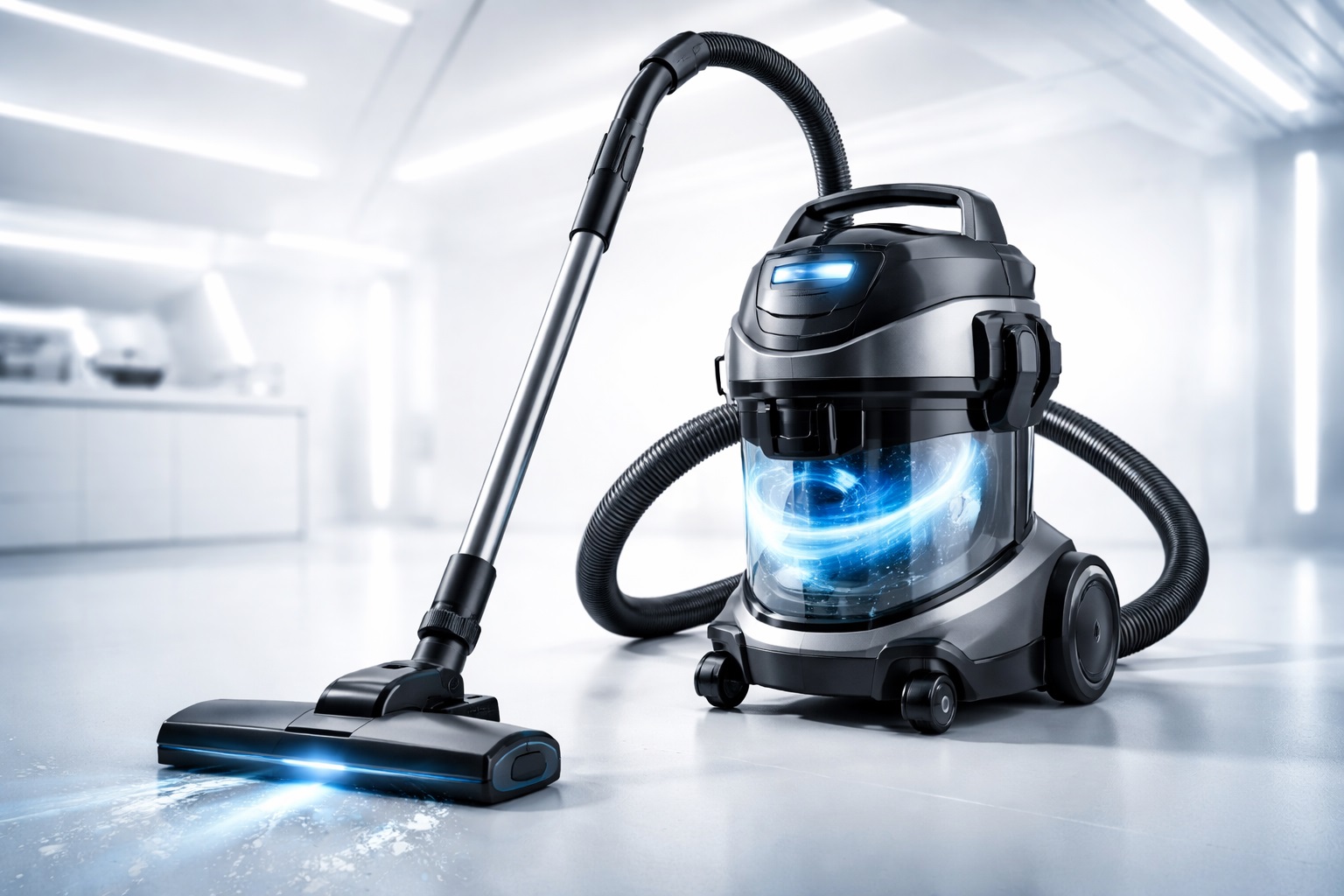
🧠 Introduction: Why AI and ML Matter for Vacuum Technology
The household and commercial cleaning market is undergoing a rapid shift — driven by Artificial Intelligence and Machine Learning (ML). What was once a purely mechanical tool has evolved into a smart cleaning system capable of learning from usage data, adapting to environments in real time, and increasing operational efficiency optimization.
For manufacturers, distributors, and B2B buyers, understanding how AI and ML enhance barrel vacuum cleaner performance is key to delivering products that outperform legacy models and meet rising market expectations.
⚡ Understanding Core Concepts: AI, ML, and Their Roles
🤖 Artificial Intelligence
In the context of vacuum cleaners, Artificial Intelligence refers to software and systems that simulate human decision‑making — interpreting sensor data, recognizing patterns, and making real‑time adjustments without direct user input.
📈 Machine Learning
Machine Learning is a subset of AI that enables systems to improve performance based on historical data. Over time, ML algorithms refine cleaning patterns, predict maintenance needs, and optimize energy consumption.
Together, AI and ML transform a standard barrel vacuum into an adaptive, efficient cleaning machine.
🧹 Smart Cleaning: The Next Frontier
At the heart of AI‑driven innovation is smart cleaning — improving cleaning outcomes while reducing wasted effort.
🔍 Real‑Time Environment Sensing
AI‑equipped barrel vacuum cleaners use a combination of sensors (optical, pressure, inertial) to:
Identify floor surfaces (carpet vs tile vs hardwood)
Detect dirt density and patterns
Track debris type (fine dust, larger particles)
These inputs allow the system to dynamically adjust suction power and brush configuration — ensuring the right amount of power where it’s needed most.
🤖 Adaptive Suction Control
Instead of a single fixed power level, AI algorithms create adaptive suction profiles, meaning:
High suction is applied on dirt‑dense areas
Power is reduced on smooth floors or low‑debris zones
Overall energy consumption is minimized without compromising cleanliness
The result? Users experience superior cleaning performance with lower overall energy usage.
🛠️ Predictive Maintenance: Reducing Downtime and Costs
A major limitation of traditional vacuum cleaners is reactive maintenance — parts are replaced only after failure. AI and ML change this paradigm.
📊 Sensor Analytics for Health Monitoring
Advanced barrel vacuum cleaners gather real‑time performance data, including:
Motor current fluctuations
Filter pressure changes
Brush and roller resistance
Battery health metrics
This data feeds into ML models that predict potential failures before they happen, allowing for:
Scheduled maintenance
Reduced emergency service calls
Extended lifespan of components
💡 Example: Predicting Filter Saturation
A typical issue in high‑use environments is filter clogging. By analyzing pressure trends across thousands of cleaning cycles, ML models can forecast when a filter will lose efficiency and alert the user ahead of time.
This predictive maintenance breeds reliability — a key benefit for commercial buyers and service contracts.
📉 Efficiency Optimization: Smart Power & Path Management
Efficiency isn’t just about power — it’s about how cleaning is executed.
🧭 Intelligent Route Mapping
AI systems can map indoor environments, enabling vacuums to:
Avoid redundant passes
Focus on high‑dirt zones
Plan the most efficient cleaning paths
This capability, once only found in high‑end robot vacuum platforms, is now extending into advanced barrel vacuum cleaner platforms — especially when IoT connectivity and spatial sensors are integrated.
⚙️ Adaptive Power Distribution
AI also helps the system learn how much power is needed and when:
Peak power during heavy debris pickup
Mid‑range power for regular floor cleaning
Low power during transit
This dynamic distribution minimizes energy waste and enhances battery longevity in cordless configurations.
🧪 Case Study: AI in Commercial Facility Cleaning
A multi‑building corporate campus adopted an AI‑enhanced barrel vacuum fleet. After six months, the facility reported:
✔ 26% reduction in total cleaning hours
✔ 19% increase in battery life per charge
✔ 23% fewer maintenance interventions
✔ Improved consistency in dust and allergen removal
These improvements were attributed to AI’s ability to adapt cleaning behavior to real‑world usage patterns and predictive component alerts that prevented performance bottlenecks.
🔍 Data Driven Insights and Continuous Improvement
One of the biggest advantages of AI and ML is the ability to learn over time.
📈 Usage Pattern Analysis
By collecting cleaning data from sensors, manufacturers and facility managers can uncover trends such as:
Peak usage times
Surfaces that consistently require deeper cleaning
Zones with persistent accumulation
These insights inform both product development and operational decisions, such as when and where to deploy resources most effectively.
📊 Performance Feedback to R&D
Aggregate analytics from deployed units help R&D teams identify:
Failure trends across environments
Feature usage frequency
User behavior correlations with performance metrics
This data‑backed approach accelerates innovation and leads to tangible improvements in future vacuum models.
🧘♂️ Intelligent Energy Management
Energy consumption is a central metric of cleaning efficiency. AI manages power draw by:
Limiting suction on low‑need surfaces
Shifting to Eco‑Modes when appropriate
Scheduling power peaks and troughs according to cleaning demand
Facilities that deploy AI‑optimized barrel vacuum cleaners often report measurable energy savings — contributing to sustainability goals and lower operational costs.
💨 Enhanced User Experience and Customization
Beyond performance and maintenance, AI improves the user experience:
📲 Smartphone Integration
Modern barrel vacuum cleaners with AI connectivity enable:
Remote monitoring of performance
Filter and service notifications
Customized cleaning profiles
Usage analytics at a glance
This level of control empowers users to tailor cleaning behavior to their specific needs.
🧹 Voice and App‑Based Controls
Integration with voice assistants and mobile apps simplifies daily operations, turning barrel vacuum cleaners into responsive, user‑centric devices.
🐾 Improved Allergen and Dust Management
For allergy sufferers and health‑sensitive environments like hospitals, HEPA filter vacuum cleaners paired with AI deliver precise performance:
Intelligent activation of higher filtration when needed
Faster detection of particulate concentrations
Enhanced capture efficiency of microscopic allergens
This combination enhances overall air quality and user well‑being.
🧠 AI Enhancing Future Product Innovation
AI and ML do more than improve current systems — they shape the future of vacuum design:
🔹 Feature Prioritization
ML insights help product teams understand which features resonate most with users, optimizing future models.
🔹 Faster Prototyping
Data from real‑world use accelerates prototyping cycles, reducing time to market.
🔹 Targeted Upgrades
Product lines evolve with prioritized enhancements based on actual cleaning performance and user behavior.
🤝 AI and Human Collaboration
Artificial Intelligence doesn’t replace human cleaners — it amplifies their effectiveness.
AI handles repetitive routes and adjusts performance
Humans intervene for complex or deep‑detail tasks
Combined workflows result in better outcomes with fewer labor hours
This hybrid approach meets modern demands for both quality and cost efficiency.
🧠 Conclusion: The Future Is Intelligent and Efficient
Artificial Intelligence and Machine Learning are no longer buzzwords — they are foundational technologies driving efficiency optimization in barrel vacuum cleaners.
Through:
✔ Real‑time environment sensing
✔ Adaptive suction and smart power distribution
✔ Predictive maintenance
✔ Usage analytics and continuous improvement
✔ Enhanced user experience and customization
AI‑driven cleaning systems deliver superior results, reduced energy and maintenance costs, and intelligent workflows that scale across residential and commercial markets.
For manufacturers, distributors, facility managers, and product developers, integrating AI and ML into barrel vacuum cleaner platforms is a strategic imperative that will define competitive advantage in the years ahead.
🚀 Hashtags
Lanxstar, ArtificialIntelligence, BarrelVacuumCleaner, MachineLearning, SmartCleaning, PredictiveMaintenance, EfficiencyOptimization, SmartHomeVacuum, AIEnhancedCleaning, DataDrivenCleaning, EnergyOptimizedVacuum, MaintenanceAlerts, ConnectedCleaningDevies, CleaningAnalytics, AdaptiveSuctionControl, IntelligentMaintenance, VacuumInnovation, SmartUserExperience, IoTCleaningSolutions, PerformanceMetricsCleaning, AllergenControlVacuum, HEPAFilterVacuum, VacuumTechTrends, SmartPathOptimization, MobileCleaningControl, VoiceControlVacuum, SmartScheduling, CleaningPatternAnalytics, BatteryEfficiencyVacuum, AutomatedCleaningInsights, CommercialCleaningAI, ResidentialSmartCleaning, QuietSmartCleaning.