Hi, message us with any questions.
We're happy to help!





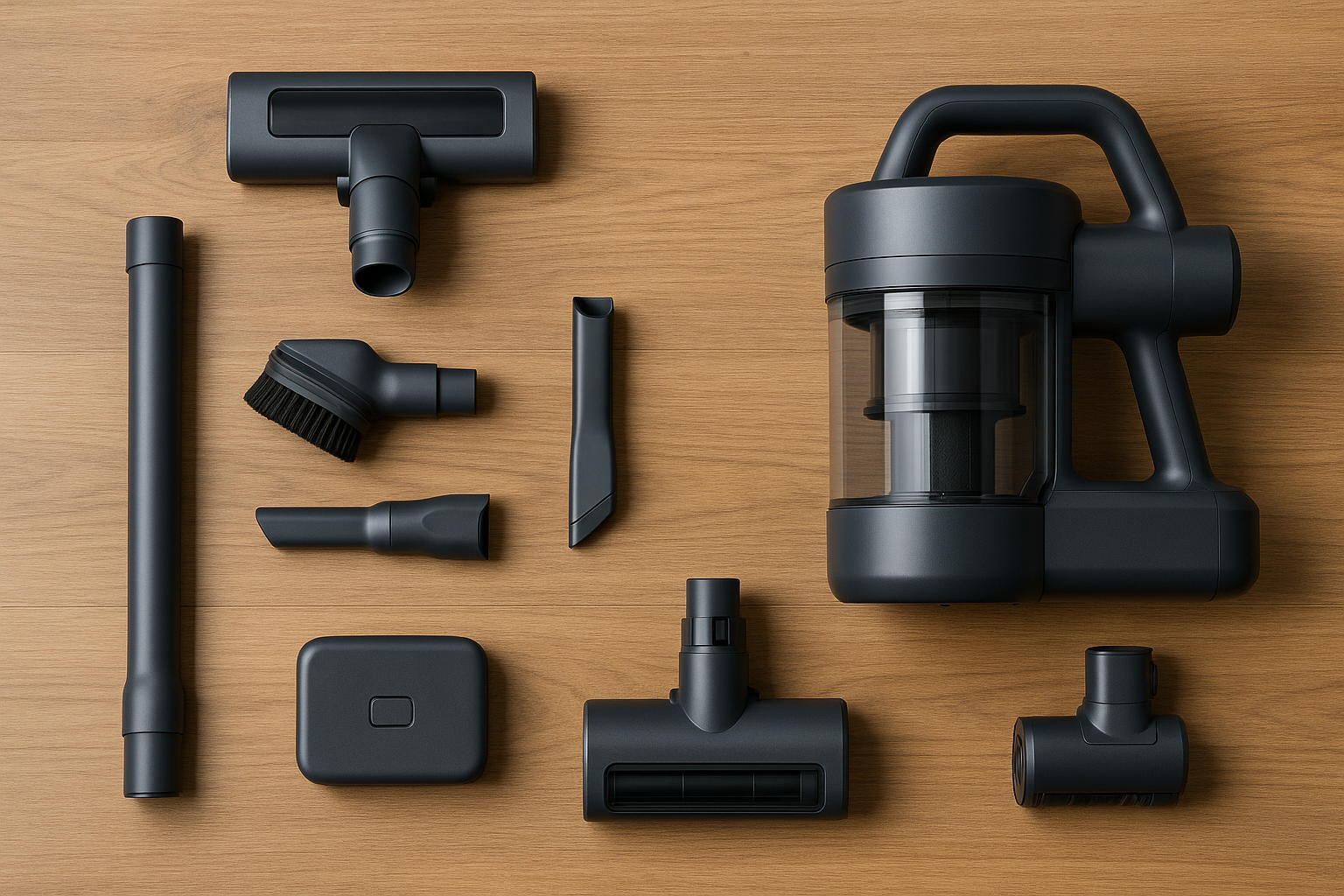
🌍 In today’s fast-evolving appliance industry, vacuum cleaner brands face one of their biggest challenges yet: how to serve vastly different customer segments—residential, commercial, and industrial—without multiplying cost or complexity.
The solution lies in modular platform architecture. By building a shared technical foundation that can flexibly support various product types, exporters and OEMs can meet regional standards, control costs, and scale faster across international markets. This article explores how modular design empowers vacuum cleaner manufacturers to balance customization with efficiency while maintaining consistent performance and reliability.
⚙️ 1. What Is a Modular Vacuum Platform?
A modular vacuum platform uses standardized components—motors, batteries, filters, housings, and firmware—that can be configured into different product variants.
For instance:
The High Suction Vacuum Cleaner for industrial cleaning can share its motor system with lighter models, adjusting only airflow and casing.
A Portable Quiet Vacuum Cleaner designed for home use may use the same control PCB and battery as its commercial counterparts.
The Self-Cleaning Vacuum Cleaner might employ identical sensors but vary its firmware for unique cleaning environments.
This unified approach reduces R&D costs, simplifies certification, and speeds up product diversification—all while maintaining quality consistency.
🔩 2. Why Modularity Matters for Exporters
Traditional “one model per market” strategies waste time and capital. A modular system changes that by:
Allowing exporters to serve multiple regions using a single base design.
Enabling engineers to reuse up to 80% of components.
Simplifying aftersales service through shared spare parts.
For example, the Multi-Functional Durable Vacuum Cleaner and Fast Lightweight Vacuum Cleaner can use the same chassis and motor platform, differing only in shell design, power, and accessories.
This transforms engineering flexibility into a measurable commercial advantage.
📦 3. Core Elements of a Modular Platform
A successful modular vacuum architecture rests on several standardized subsystems:
Core Engine Module: Motor and airflow system adaptable to different suction levels.
Power Module: Shared battery or cord configuration compatible across models.
Control Module: Firmware that supports varied sensors and AI features.
Casing Module: Adjustable housing materials or shapes tailored to market aesthetics.
For instance, both the Energy-Saving Efficient Powerful Vacuum Cleaner and Large-Capacity Wet Dry Vacuum Cleaner may share a 600W motor but differ in structure and surface materials to suit different environments.
🌍 4. Platform Thinking as a Business Strategy
Modularity is not just an engineering decision—it’s a business model.
Exporters can introduce regional variations faster and with fewer risks.
Compliance teams adjust only localized elements such as plugs, manuals, or labeling.
Marketing teams can position “good–better–best” product tiers built on the same foundation.
For example, the Li-ion Cordless Handheld Vacuum Cleaner for domestic use and Wet Dry Vacuum Cleaners for workshops can share identical charging modules, reducing warranty complexity and inventory risk.
🔄 5. Customization Without Complexity
Far from limiting creativity, modularity enhances it. Controlled customization enables design freedom without technical chaos.
The 4 in 1 Cordless Smart Wet & Dry Vacuum Cleaner can swap brush heads, tanks, or sensors to meet regional cleaning habits.
cordless handheld vacuums can use interchangeable battery packs for 110V or 220V regions.
The Cordless Vacuum Cleaner can maintain identical firmware while offering locally tailored designs.
This ensures each market feels personalized, without duplicating engineering work.
💡 6. Cost Efficiency and Supply Chain Simplification
A modular approach reduces overhead across the entire value chain:
Shared components cut supplier numbers and complexity.
Bulk purchasing lowers per-unit material cost.
Simplified assembly lines speed up delivery times.
For instance, both a Car Vacuum Cleaner and a quiet vacuum cleaner may use the same motor shaft and impeller, keeping parts procurement lean.
Manufacturers adopting this approach typically achieve 20–25% faster market response and up to 15% lower production cost.
📊 7. Common Engineering Challenges—and Solutions
Implementing modularity requires discipline and foresight.
Thermal consistency: shared components must perform safely across varying loads, especially for models like the wet dry vacuum.
Firmware harmonization: AI and IoT modules must remain compatible across diverse hardware configurations.
Cross-market compliance: shared parts must meet multiple regional standards simultaneously.
Coordination between R&D, compliance, and supply chain teams ensures scalability without risk.
🚚 8. Case Study: Streamlining 12 SKUs into One Platform
A mid-sized Asian exporter once produced 12 distinct vacuum SKUs. By shifting to a modular platform:
The same motor powering its Self-Cleaning Vacuum Cleaner was reused in its Fast Lightweight Vacuum Cleaner line.
The Li-ion Cordless Handheld Vacuum Cleaner and 4 in 1 Cordless Smart Wet & Dry Vacuum Cleaner adopted the same lithium battery module.
Tooling and mold reuse saved the company 22% in manufacturing cost and cut lead time by six weeks.
The result: reduced complexity, improved quality control, and faster adaptation to export markets.
🌐 9. Multi-Segment Adaptability
A single modular architecture can flex to serve multiple markets:
Residential: Design and comfort-focused products such as the Portable Quiet Vacuum Cleaner and Cordless Vacuum Cleaner.
Commercial: Durability and suction power for models like the High Suction Vacuum Cleaner or Energy-Saving Efficient Powerful Vacuum Cleaner.
Industrial: Capacity and endurance with machines such as the Large-Capacity Wet Dry Vacuum Cleaner or wet dry vacuum.
Each segment benefits from shared components but receives customized usability and branding.
🧠 10. Adding IoT and Data Intelligence
The future of modular design lies in digital integration.
The Self-Cleaning Vacuum Cleaner can transmit performance data to identify high-wear components.
The quiet vacuum cleaner can collect decibel feedback to adjust fan curves automatically.
The Car Vacuum Cleaner can link to mobile apps for usage logs and predictive maintenance alerts.
When each module acts as a smart data node, the entire ecosystem evolves continuously through analytics.
🔧 11. Certification and Compliance Synergy
Standardization simplifies certification processes:
Shared motor assemblies accelerate SASO, CE, and UL testing cycles.
Unified firmware reduces cybersecurity review time for smart models like cordless handheld vacuums.
Consolidated documentation speeds up customs clearance and regional approval.
This efficiency allows exporters to launch market-specific variants in parallel—cutting global rollout time dramatically.
🚀 12. The Future: Modularity as the Core of Smart Manufacturing
The modular vacuum platform is not a passing trend—it’s the foundation for long-term competitiveness.
It enables swift compliance with new energy or IoT regulations.
It supports sustainability through repairability and spare-part standardization.
It improves aftersales efficiency with interchangeable modules and shared service networks.
From the High Suction Vacuum Cleaner to the Cordless Vacuum Cleaner, modular design provides a scalable backbone for innovation and profitability in the global cleaning equipment industry.
For more insights on modular product engineering and platform-based manufacturing, visit www.lxvacuum.com.
📌 Suitable Audience
Vacuum cleaner OEM / ODM engineers
Global exporters and brand developers
Product design and certification specialists
Supply chain and component managers
📌 50 Related Keywords
modular vacuum design platform, standardized motor architecture, scalable vacuum engineering, shared component design appliances, modular manufacturing vacuums, vacuum cleaner R&D platformization, unified motor design exporters, modular battery pack vacuum systems, IoT modular integration vacuums, predictive maintenance vacuum platform, multi-market vacuum design architecture, certification efficiency modular systems, vacuum component interoperability, modular firmware update strategy, platform-based vacuum supply chain, modular tool-less assembly vacuums, vacuum cleaner product scalability, cost reduction modular design, shared chassis engineering appliances, modular design compliance optimization, Middle East modular vacuum strategy, platform standardization vacuum exporters, modular energy-efficient vacuum systems, cross-segment vacuum integration, durable modular design exporters, lightweight vacuum modular components, large-capacity modular tank systems, industrial vacuum modularization, modular wet dry vacuum integration, smart modular architecture vacuums, cordless modular design vacuum cleaners, car vacuum modular design, quiet modular airflow system, IoT-ready modular appliances, hybrid modular vacuum manufacturing, sustainable modular vacuum platform, modular spare parts logistics, predictive data modular framework, modular firmware testing exporters, cross-border modular engineering, adaptive modular vacuum solutions, multi-segment product modularity, efficient modular assembly exporters, long-term modular ecosystem, supply chain standardization vacuums, modular component optimization, high-efficiency vacuum modular platforms, modular platform certification strategy



