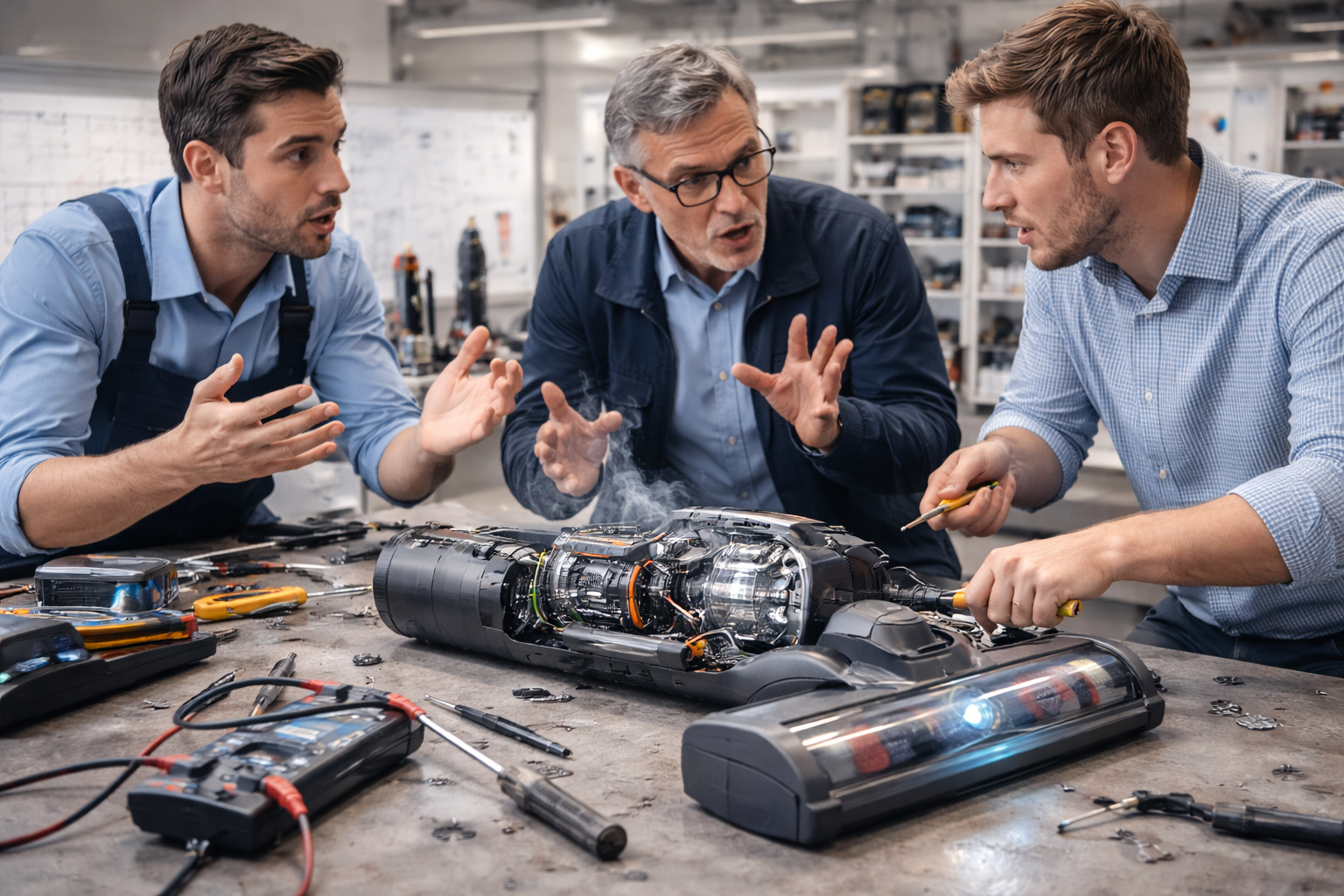
🧠 Behind Closed Doors: The Conversations That Shape Your Vacuum
From the outside, vacuum cleaner development looks orderly:
Requirements
Prototypes
Testing
Launch
Inside engineering teams, it is far messier.
This article is written for European & Middle Eastern vacuum cleaner buyers, distributors, R&D engineers, and advanced users who want to understand the internal debates that quietly decide whether Upright Vacuum Cleaners and Household Vacuum Cleaners succeed—or fail—in the real world.
What follows is rarely written down, never included in brochures, and almost never discussed in public forums.
⚖️ Argument #1: Peak Performance vs. Sustainable Performance
One of the most heated internal debates is deceptively simple:
“Should we optimize for peak performance or sustained performance?”
Marketing prefers peak numbers.
Engineers worry about degradation.
A design labeled as an Energy-Saving Efficient Powerful Vacuum Cleaner often represents a compromise:
Lower peak suction
Higher stability
Reduced thermal stress
Products that chase maximum output win demos.
Products that balance output win markets.
🔊 Argument #2: Noise That Passes Tests vs. Noise People Hate
Noise is measured in labs.
Annoyance is measured in living rooms.
Engineering teams frequently argue about:
Two designs may both qualify as Quiet Vacuum Cleaner on paper, yet one generates significantly more complaints.
This gap is one of the most underestimated failure points in Household Vacuum Cleaners.
🧱 Argument #3: Durability vs. Repairability
“Make it stronger” is not always good advice.
Many Multi-Functional Durable Vacuum Cleaner designs fail because:
Over-reinforced structures complicate repairs
Modular systems age unevenly
Replacement parts become cost-prohibitive
Engineering teams debate whether:
Markets reward forgiveness.
🧲 Argument #4: One Tool or Many Specialized Tools
Should one vacuum do everything?
This debate intensifies with:
Attachments
Modular heads
Hybrid usage scenarios
Engineering reality:
Procurement reality:
The result is often a compromise product that satisfies neither fully.
🪶 Argument #5: Weight Reduction vs. Structural Balance
Lightweight sells.
Balance survives.
Many engineers push back against aggressive weight targets, especially in:
Cordless platforms
Upright frames
Ultra-light designs can:
Increase vibration
Reduce lifespan
Amplify noise
A Cordless Handheld High Suction Vacuum Cleaner that feels great for 3 minutes may feel exhausting after 15.
🧪 Argument #6: Lab Testing vs. Human Testing
Engineering teams trust repeatability.
Markets trust experience.
Lab testing answers:
Human testing answers:
This is why many technically “perfect” Upright Vacuum Cleaners underperform commercially.
🧠 Argument #7: Procurement Cost vs. Ownership Cost
This is where vacuums procurement enters the debate.
Procurement teams optimize:
BOM
Supplier pricing
Volume discounts
Engineers worry about:
Component fatigue
Tolerance stacking
Warranty exposure
When procurement decisions override engineering caution, after-sales costs rise quietly.
🔄 Argument #8: Innovation vs. Familiarity
Should we change the interface?
Engineers love improvements.
Users love predictability.
Radical changes often:
Increase learning curves
Raise return rates
Frustrate distributors
Incremental improvement usually wins—even if it looks boring.
📉 What Happens When These Arguments Are Ignored
When debates are rushed or silenced:
Distributors notice first.
Engineers feel it second.
Brands suffer last.
🧩 What Successful Teams Do Differently
High-performing teams:
Document internal disagreements
Test opposing assumptions
Involve distribution feedback early
They accept that Household Vacuum Cleaners are lifestyle tools, not engineering trophies.
🛠️ A Framework Buyers Rarely See
When evaluating suppliers, ask:
What trade-offs did you consciously accept?
Where did you limit performance—and why?
What complaint types do you expect first?
Suppliers who can answer calmly are safer partners.
🏁 Final Insight: Silence Is Risk
The most dangerous vacuum designs are not controversial ones.
They are the ones no one argued about.
Because unchallenged assumptions quietly turn into market failures.
#Hashtags
#lanxstar #uprightvacuumcleaners #householdvacuumcleaners #energysavingvacuum #quietvacuumcleaner #multifunctionaldurablevacuum #cordlesshandheldvacuum #vacuumsprocurement #vacuumengineering #applianceinnovation #producttradeoffs #vacuumdesign #homeappliances #b2bappliances #appliancebuyers #engineeringinsights #vacuumperformance #longtermreliability #appliancequality #cleaningtechnology #vacuumindustry #productdevelopment #engineeringdecisions #applianceprocurement #consumerexperience #marketfit #homecareindustry #vacuumtrends #appliancebusiness #productstrategy #industrialdesign #engineeringculture #vacuumtechnology