Hi, message us with any questions.
We're happy to help!





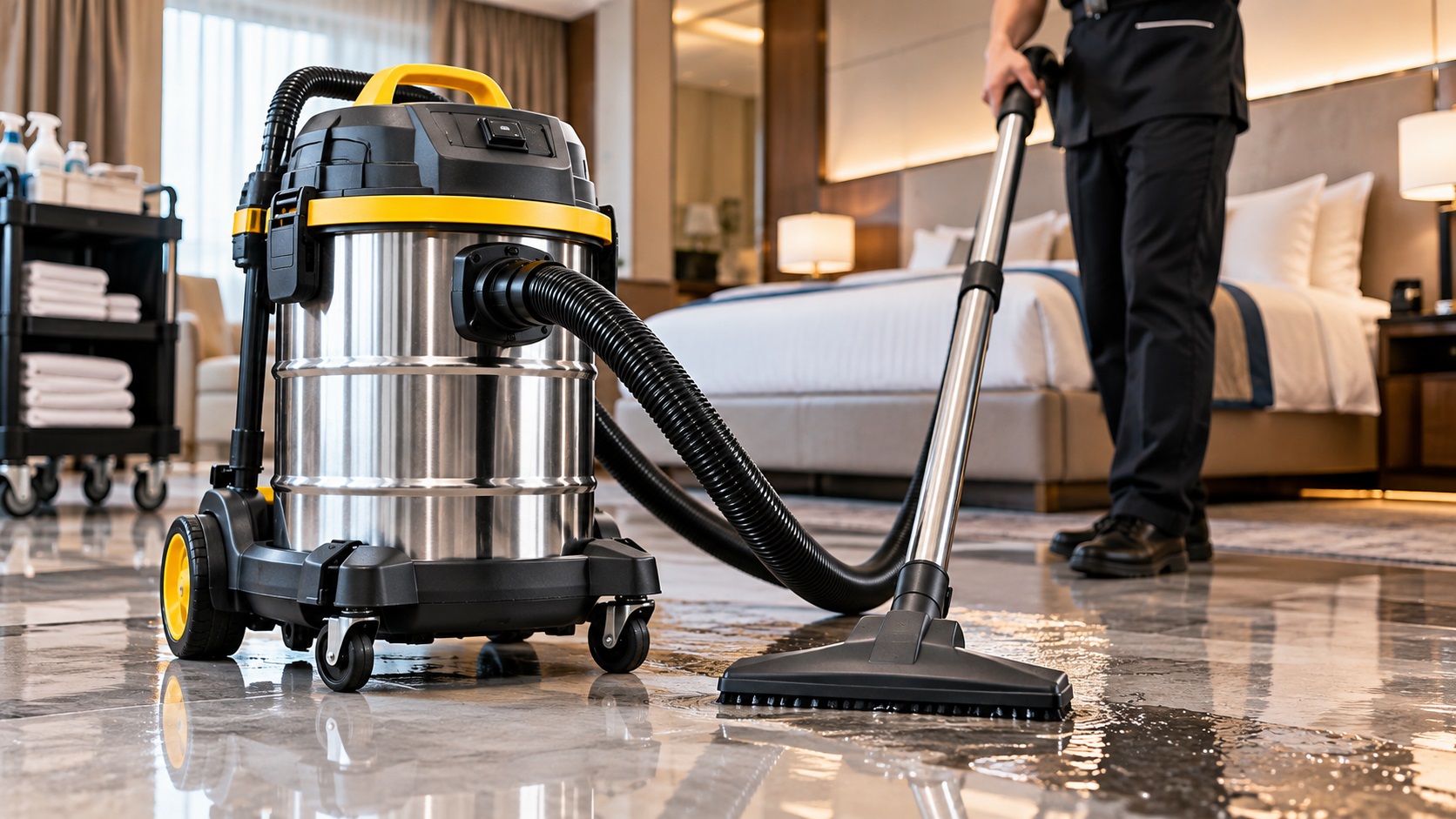
Why Hotels Need the Right Vacuum Cleaning Equipment 🏨
Hotels present a particularly demanding cleaning environment.
Unlike warehouses or factories, cleaning teams must maintain high cleanliness standards while minimizing disruption to guests. A vacuum cleaner may be used in guest rooms in the morning, corridors in the afternoon, conference facilities after an event, and restaurant or lobby areas later in the day.
Different surfaces create additional challenges.
Hotel cleaning teams may encounter carpet, hard floors, upholstery, entrance mats, curtains, furniture edges and occasional liquid spills. This makes equipment versatility an important purchasing consideration.
A professional wet dry vacuum cleaner can provide hotels with the flexibility to collect ordinary dry debris while also handling appropriate liquid spills according to the machine's operating instructions.
However, hotel procurement should not focus on suction power alone.
Noise, portability, tank capacity, filtration, accessories, maintenance, energy efficiency and lifecycle cost can be equally important.
For hotel groups purchasing dozens or hundreds of units, even small differences in operating efficiency can have a substantial long-term impact. 🔍
1. Define Where the Vacuum Cleaner Will Be Used
The first procurement question should be simple:
Where will this machine work?
A hotel can contain several very different cleaning environments.
Guest Rooms
For guest rooms, portability and controlled noise are usually important. Housekeeping employees need equipment that can move between rooms without creating unnecessary inconvenience.
A Portable Quiet Vacuum Cleaner can be particularly suitable for this environment.
Corridors
Hotel corridors often contain extensive carpeted areas. Cleaning teams may require longer working reach, consistent suction and convenient movement.
Lobby and Public Areas
Lobbies experience high foot traffic and may contain a combination of carpets, entrance mats and hard flooring.
Here, fast response and professional appearance can be important.
Restaurants and Banquet Areas
Food debris and occasional liquid spills make wet/dry functionality particularly useful.
Meeting and Conference Rooms
After large events, cleaning teams may need to remove significant quantities of dry debris within a limited turnaround period.
The ideal hotel cleaning equipment therefore depends on the area being cleaned.
Large hotel groups may benefit from using more than one vacuum configuration instead of attempting to use a single model everywhere.
2. Why Wet and Dry Capability Is Useful in Hotels 💧
Traditional dry vacuum cleaners are effective for routine dust and debris, but hotels regularly encounter situations involving liquids.
Guests may spill drinks. Restaurant areas may require rapid cleanup. Entrance areas can become wet during rainy weather.
A wet and dry vacuum cleaner allows appropriately designed equipment to handle both dry debris and liquids.
This can reduce the need to maintain separate machines for basic spill recovery.
For procurement teams, the key is to evaluate the complete wet and dry suction system, including:
liquid capacity;
tank design;
float or shut-off protection;
drainage method;
filter configuration;
hose design;
cleaning and maintenance procedures.
Hotels should also train staff on the correct operating procedure when switching between dry and wet applications.
The result can be a more flexible cleaning fleet and faster response to unexpected situations.
3. Noise Should Be a Major Procurement Criterion 🔇
Noise is one of the clearest differences between hotel cleaning and many industrial applications.
Guests may be sleeping, working, attending meetings or relaxing while housekeeping operations continue nearby.
A very loud machine can create unnecessary disruption.
This is why a low noise vacuum cleaner should be seriously considered for hospitality applications.
When evaluating a commercial vacuum cleaner for hotel use, procurement teams should request noise data from suppliers and confirm how the measurements were obtained.
Do not evaluate noise independently from performance.
An extremely quiet machine that cannot efficiently remove debris from carpet may increase cleaning time.
The goal is to achieve an appropriate balance between:
low noise + effective suction + practical cleaning speed.
For premium hotels, serviced apartments and executive areas, a Portable Quiet Vacuum Cleaner can be particularly attractive.
4. Suction Performance and Cleaning Efficiency
💨 Hotel carpets can trap dust, hair, crumbs and other debris.
A High Suction Vacuum Cleaner can help cleaning teams work efficiently, but motor wattage alone does not determine cleaning performance.
Actual pickup capability is influenced by:
airflow;
vacuum pressure;
motor design;
floor tool design;
hose diameter;
filtration resistance;
seals and internal airflow paths.
A high suction power vacuum cleaner should maintain practical performance during real cleaning—not simply produce an impressive number on a specification sheet.
Hotel buyers should request samples where possible and test them on actual hotel surfaces.
Try the machine on corridor carpet, guest-room flooring, entrance mats and upholstery.
Real-world testing is more useful than comparing marketing claims alone.
5. Portability Can Improve Housekeeping Productivity
Housekeeping staff may move between dozens of rooms during a shift.
Machine weight, wheel design and handle position can therefore influence productivity.
A Fast Lightweight Vacuum Cleaner can reduce the effort required to move between rooms and around furniture.
Procurement teams should test:
machine weight;
carrying handle;
wheel movement;
turning radius;
stability;
cable management;
hose storage;
accessory storage.
Consider how employees will move the machine into elevators, around housekeeping carts and through narrow corridors.
A machine that performs well in a laboratory but is inconvenient to transport may create frustration in daily hotel operations.
Mobility is therefore a genuine productivity specification, not merely a convenience feature.
6. Select Tank Capacity According to the Hotel Area
🪣 Tank size requires a balance between cleaning capacity and portability.
A Large-Capacity Wet Dry Vacuum Cleaner can reduce emptying frequency when cleaning banquet halls, lobbies or other large public spaces.
However, large tanks can increase machine dimensions and weight.
For guest rooms, a smaller commercial model may be easier to maneuver.
For larger common areas, medium or large-capacity equipment may provide greater efficiency.
Hotel groups can therefore consider a mixed fleet:
compact machines for rooms and smaller areas;
medium-capacity machines for corridors and general cleaning;
larger wet/dry machines for banquet facilities, restaurants and maintenance departments.
This approach can improve utilization while preventing hotels from purchasing unnecessarily large equipment for every housekeeping employee.
7. Filtration Is Important for Indoor Environments
Hotels operate in environments where indoor cleanliness is highly visible to guests.
Vacuum filtration should therefore be evaluated carefully.
A HEPA filter vacuum cleaner may be appropriate for applications where higher-efficiency particle filtration is required.
However, buyers should verify the actual filtration specifications rather than assuming every product marketed with “HEPA” provides identical performance.
Procurement managers should ask:
What filter material is used?
What is the stated filtration performance?
How often should the filter be maintained?
Can the filter be washed?
How much does a replacement cost?
Are replacement filters readily available?
Is a different procedure required for wet pickup?
Easy filter access can save housekeeping teams considerable maintenance time.
For hotel groups operating hundreds of machines, filter availability is also an important supply-chain consideration.
8. Accessories Matter More Than Many Buyers Expect 🧹
Hotels contain many surfaces that cannot be cleaned efficiently with one floor tool.
Useful accessories may include:
carpet/floor nozzles;
crevice tools;
upholstery tools;
round brushes;
wet pickup tools;
extension tubes.
Crevice tools can help clean around furniture and room edges.
Upholstery tools may be useful for sofas, chairs and selected fabric surfaces.
Appropriate floor tools can improve cleaning speed across different flooring materials.
When comparing a Multi-Functional Durable Vacuum Cleaner, hotel buyers should therefore evaluate the accessory package alongside the machine itself.
For distributors, offering application-specific accessory kits can also create additional value.
9. Durability and Daily Hotel Operations
Commercial hotel equipment is used far more frequently than an average household appliance.
Machines may be switched on and off repeatedly, moved through elevators, pulled along corridors and operated by different employees.
A commercial grade vacuum cleaner should therefore be evaluated for repeated professional use.
Important components include:
power switches;
motor assemblies;
wheels and casters;
tank locks;
hose connectors;
handles;
cables;
accessory holders.
A stainless steel vacuum tank can provide durability and a professional appearance for many wet/dry applications.
High-quality plastic tanks can also be useful when lower weight and corrosion resistance are priorities.
Hotel procurement should focus on the complete construction rather than one material alone.
10. Hotel Case Study: Reducing Equipment Changes
📋 Consider a 250-room hotel with guest rooms, conference facilities, a restaurant and several public areas.
The housekeeping department originally relies primarily on dry vacuum cleaners. When liquid spills occur in conference or dining areas, employees must locate separate equipment.
Management decides to test several commercial wet/dry models.
The procurement team establishes five priorities:
low noise, sufficient suction, manageable weight, wet/dry capability and easy maintenance.
Rather than automatically selecting the most powerful machine, the hotel tests each model during normal operations.
One configuration is selected for general public-area cleaning, while smaller machines remain in use for guest rooms.
The hotel now has a more flexible cleaning system without requiring every employee to operate a large industrial machine.
The lesson is straightforward:
A hotel cleaning solution should be built around different cleaning zones rather than one universal specification.
11. Hotel Group Case: Centralized Procurement 🌍
Consider a hotel group operating 20 properties.
Individual hotels previously purchased cleaning machines independently, resulting in numerous models, different filters and incompatible accessories.
The group decides to standardize part of its equipment fleet.
Its procurement team compares several commercial cleaning equipment suppliers and evaluates:
product consistency;
spare parts availability;
standardized filters;
accessory compatibility;
warranty procedures;
bulk pricing;
packaging;
delivery schedules.
By reducing unnecessary model variation, the group can simplify staff training and spare-parts inventory.
This type of centralized procurement can be especially valuable when conducting a bulk vacuum cleaner purchase.
However, standardization should not eliminate application differences. Large banquet facilities may still require different machines from small guest rooms.
12. Energy Efficiency and Lifecycle Costs ⚡
Hotels operate cleaning equipment every day.
An energy efficient vacuum cleaner can therefore contribute to operating efficiency, especially across large fleets.
An Energy-Saving Efficient Powerful Vacuum Cleaner should provide sufficient cleaning performance without relying unnecessarily on high electrical consumption.
Hotel buyers should evaluate total cost of ownership:
purchase cost + electricity + filters + accessories + spare parts + maintenance + downtime.
A low purchase price does not automatically represent good value.
For this reason, searches for the best budget vacuum, good budget vacuum, best affordable vacuum or best value hoover should be interpreted differently in professional procurement.
The best financial fit for a hotel is usually equipment that meets the required workload while controlling long-term ownership costs.
13. When Does a Hotel Need Heavy-Duty Equipment?
Not every hotel requires an industrial vacuum cleaner.
For routine room cleaning, a compact commercial machine may be sufficient.
However, larger properties may need a heavy duty vacuum cleaner for maintenance departments, renovation work, extensive public areas or other demanding applications.
A dual motor vacuum cleaner can provide additional performance for certain high-demand cleaning tasks, but the additional size, energy consumption and noise should be considered.
Hotels should avoid purchasing industrial capacity simply because it sounds more powerful.
Equipment should always match the workload.
This approach helps procurement teams control costs while maintaining effective cleaning performance.
14. How Wholesalers and Hotel Groups Should Evaluate Suppliers
For large-volume procurement, supplier capability becomes a major part of the purchasing decision.
When evaluating an industrial vacuum cleaner supplier, vacuum cleaner supplier or cleaning equipment supplier, buyers should examine more than unit price.
Key areas include:
manufacturing capability;
quality-control processes;
available certifications and documentation;
product testing;
production capacity;
spare parts support;
packaging quality;
customization options;
export experience;
warranty arrangements.
Buyers sourcing from a vacuum cleaner manufacturer in China should also establish whether the supplier can support the electrical, documentation and packaging requirements of the destination market.
If possible, evaluate factory capabilities and samples before committing to large-volume orders.
15. OEM, ODM and Private Label Hotel Vacuum Cleaners
Distributors and hospitality equipment companies may want to build their own product lines.
An OEM vacuum cleaner program can potentially include custom logos, packaging, accessories, colors and product specifications.
An ODM vacuum cleaner arrangement may offer deeper product configuration depending on the manufacturer's capabilities.
A private label vacuum cleaner program can be useful for distributors that already supply hotels with complementary cleaning products.
Before choosing an OEM industrial vacuum cleaner manufacturer, confirm:
MOQ;
customization scope;
sample approval process;
packaging requirements;
logo method;
production lead time;
quality standards;
destination-market requirements;
spare parts;
warranty responsibilities.
A professional vacuum cleaner manufacturer should define these items before mass production.
16. Wholesale Procurement: Look Beyond the Factory Price 💰
When requesting a vacuum cleaner price wholesale, importers should calculate the complete landed cost.
The factory quotation is only one component.
Other factors can include:
shipping;
container utilization;
packaging dimensions;
customs duties;
local handling;
warehousing;
spare parts;
warranty reserves.
Buyers planning a bulk order vacuum cleaner should also consider packaging efficiency because large cartons can significantly affect container loading quantities.
For companies looking to import vacuum cleaner from China, this analysis can make the difference between an attractive quotation and a genuinely profitable product.
A factory direct vacuum cleaner program can also provide opportunities for customized packaging and accessory configurations when order volumes are sufficient.
17. Procurement Checklist for Hotel Vacuum Cleaners ✅
Before placing an order, hotel buyers and distributors should verify the following:
Application: Guest rooms, corridors, lobby, restaurant, conference center or maintenance?
Wet/Dry Capability: Is liquid collection genuinely required?
Suction: Does the machine provide sufficient real-world pickup performance?
Noise: Can it operate without excessive disturbance to guests?
Weight: Can housekeeping staff move it conveniently?
Tank Capacity: Is it appropriate for the cleaning area?
Filtration: Are filters effective, accessible and easy to source?
Accessories: Are appropriate tools included for hotel surfaces?
Durability: Are wheels, switches, hoses and connectors designed for commercial use?
Energy: Is power consumption appropriate for the performance?
Maintenance: Can employees clean and service basic components easily?
Spare Parts: Can filters, hoses, wheels and accessories be reordered?
Supplier: Can the manufacturer support volume, quality control and after-sales requirements?
Customization: Are OEM, ODM or private-label services available if required?
Total Cost: What will the machine cost throughout its expected service life?
Building a More Efficient Hotel Cleaning Fleet
🏨 Choosing a wet dry vacuum cleaner for hotels requires more than comparing price and motor wattage.
Guest rooms may benefit from compact, quiet equipment. Corridors require reliable carpet cleaning performance. Banquet areas and restaurants may benefit from wet/dry flexibility, while maintenance departments can require larger and more durable equipment.
For hotel groups, standardizing selected machines, filters and accessories can simplify training and inventory management. For wholesalers and importers, evaluating manufacturing capability, spare parts, customization and destination-market requirements is just as important as evaluating the vacuum itself.
The goal should be a balanced cleaning system built around performance, low noise, mobility, filtration, durability and lifecycle cost.
Lanxstar works with commercial vacuum cleaning applications and can support discussions with hotel equipment buyers, distributors, wholesalers and importers regarding different product configurations, OEM/ODM requirements and bulk purchasing.
For additional product and sourcing information, visit www.lxvacuum.com
If you are interested, please feel free to contact us.
50 Related SEO Keywords:
wet dry vacuum cleaner for hotels, commercial vacuum cleaner for hotel use, hotel vacuum cleaner, hotel cleaning equipment, wet and dry vacuum cleaner, wet dry vacuum cleaner, commercial vacuum cleaner, industrial vacuum cleaner, Portable Quiet Vacuum Cleaner, High Suction Vacuum Cleaner, Multi-Functional Durable Vacuum Cleaner, Fast Lightweight Vacuum Cleaner, Energy-Saving Efficient Powerful Vacuum Cleaner, Large-Capacity Wet Dry Vacuum Cleaner, low noise vacuum cleaner, HEPA filter vacuum cleaner, high suction power vacuum cleaner, energy efficient vacuum cleaner, commercial grade vacuum cleaner, heavy duty vacuum cleaner, dual motor vacuum cleaner, stainless steel vacuum tank, wet and dry suction system, hotel housekeeping vacuum cleaner, hotel carpet vacuum cleaner, hotel lobby cleaning equipment, hotel room vacuum cleaner, hospitality cleaning equipment, professional hotel vacuum cleaner, commercial cleaning equipment, facility management cleaning equipment, vacuum cleaner supplier, vacuum cleaner manufacturer, vacuum cleaner manufacturer in China, industrial vacuum cleaner supplier, industrial vacuum cleaner factory, cleaning equipment supplier, wholesale vacuum cleaner, bulk vacuum cleaner purchase, OEM vacuum cleaner, ODM vacuum cleaner, private label vacuum cleaner, factory direct vacuum cleaner, bulk order vacuum cleaner, vacuum cleaner price wholesale, import vacuum cleaner from China, Lanxstar, vacuum manufacturer, vacuum cleaner maker, OEM industrial vacuum cleaner manufacturer