Hi, message us with any questions.
We're happy to help!





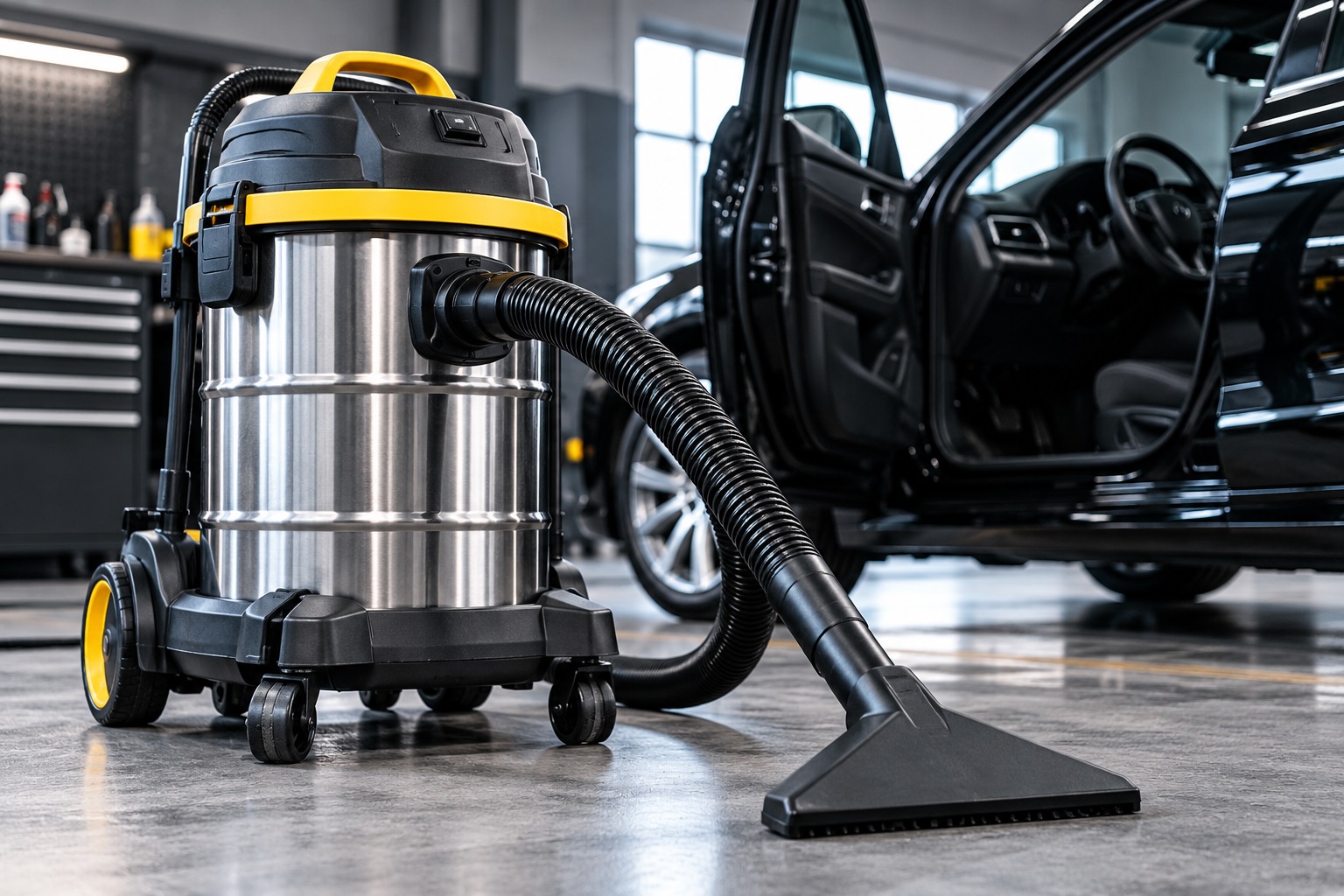
Why the Right Vacuum Cleaner Matters in Car Detailing 🚗
A customer may notice shiny paint first, but professional detailing does not stop with the exterior. Dust trapped between seats, sand embedded in carpets, crumbs under floor mats, pet hair on upholstery and liquid around footwells can all influence how customers judge the final result.
For this reason, choosing the right car detailing vacuum cleaner is an important equipment decision for car wash and detailing businesses.
Unlike ordinary household cleaning, automotive detailing requires a machine that can repeatedly clean confined spaces and different materials throughout the working day. Operators may move from dry carpet debris to seat gaps, dashboards, trunks and occasional liquid spills within minutes.
A professional wet and dry vacuum cleaner can reduce the need to switch machines because it combines dry debris collection and liquid suction in one system.
However, simply buying the machine with the highest wattage or largest tank does not guarantee better productivity.
The right choice depends on shop size, number of vehicles serviced each day, cleaning procedures, available space, noise requirements and expected equipment lifetime.
For wholesalers and distributors, the same principle applies: understand the target customer's working environment before selecting a product range.
1. Start With the Daily Car Cleaning Workload
Before comparing motors, tanks or prices, determine how the vacuum will actually be used.
A small detailing studio handling five vehicles per day has very different requirements from a high-volume car wash processing dozens or even hundreds of vehicles.
A small shop may prefer a Fast Lightweight Vacuum Cleaner that operators can move quickly around a vehicle.
A busy car wash may place greater emphasis on durability, tank capacity and continuous working performance.
Typical automotive cleaning tasks include:
removing sand and dirt from carpets;
vacuuming crumbs between seats;
cleaning floor mats;
collecting pet hair;
cleaning trunks and cargo areas;
reaching underneath seats;
removing dust from narrow interior gaps;
collecting small quantities of liquid;
cleaning the workshop floor after detailing.
This combination explains why a Multi-Functional Durable Vacuum Cleaner can be particularly valuable for professional automotive businesses.
Instead of asking, “What is the most powerful vacuum cleaner?” buyers should ask, “Which machine helps our operators clean more effectively throughout the day?”
That difference is critical.
2. Suction Power Is Important—but Look Beyond Wattage 💨
Strong suction is naturally important when cleaning automotive interiors.
Sand can become deeply embedded in carpet fibers. Hair can cling to upholstery. Dirt can accumulate along seat rails and in narrow gaps.
A High Suction Vacuum Cleaner can make these tasks faster, but buyers should avoid judging performance solely by electrical wattage.
Real cleaning performance depends on several factors working together:
motor performance;
airflow;
vacuum pressure;
hose diameter;
hose length;
nozzle design;
filtration resistance;
sealing of the complete air path.
A high suction power vacuum cleaner with well-designed airflow may perform more effectively than a machine with a larger advertised motor but inefficient air passages.
Professional buyers should therefore request comparable technical specifications from their vacuum cleaner supplier.
For high-volume detailing centers, a dual motor vacuum cleaner may be worth considering where additional airflow and suction are required.
For smaller operations, a single-motor machine may provide a better balance of power, energy consumption, machine weight and acquisition cost.
⚙️ More motor power is not automatically better. The objective is efficient dirt removal with a configuration suitable for the shop's workload.
3. Wet and Dry Capability Makes Sense for Car Wash Businesses
The working environment of a car wash naturally involves water.
Even when a vacuum is mainly used for interiors, operators may encounter wet carpets, spilled drinks, damp floor mats or liquid on workshop surfaces.
This is where a wet dry vacuum cleaner becomes particularly useful.
A properly designed wet and dry suction system allows operators to handle dry debris and appropriate liquids using the same machine according to the manufacturer's operating instructions.
For busy shops, this flexibility can simplify equipment management.
Rather than maintaining separate equipment for every basic cleaning situation, one commercial wet/dry platform can cover multiple tasks.
When comparing machines, buyers should examine the internal liquid shut-off or protection design, tank structure, drainage method and filter requirements for wet operation.
These details become especially important when equipment is used repeatedly by different employees.
Clear operating procedures can also reduce misuse and extend machine life.
4. Select the Right Tank Capacity
🪣 Bigger tanks can reduce emptying frequency, but bigger is not always better.
A Large-Capacity Wet Dry Vacuum Cleaner can be useful for high-volume car washes because employees spend less time emptying collected debris or liquids.
However, larger tanks also make the machine physically larger.
In a compact detailing bay, maneuverability may be more important than maximum capacity.
Consider three typical situations.
Small detailing studio: A relatively compact machine can be easier to move around cars and store after work.
Medium-volume car wash: A medium or larger tank can balance mobility with fewer interruptions.
High-volume detailing center: Larger-capacity commercial or industrial equipment may improve productivity when machines operate for extended periods.
Tank construction is another consideration.
A stainless steel vacuum tank offers a professional appearance and can provide good durability for many applications. High-quality plastic tanks may reduce machine weight and offer corrosion resistance.
Buyers should select materials according to their operating environment rather than appearance alone.
5. Accessories Can Transform Detailing Efficiency
For car detailing, accessories are not minor extras—they are part of the cleaning system.
The passenger compartment contains numerous narrow and difficult-to-reach areas. A large floor nozzle cannot effectively clean all of them.
Useful accessories may include:
crevice nozzles for seat gaps;
upholstery tools for seats;
brushes for dashboards and interior surfaces;
floor nozzles for mats;
flexible hoses for working around the vehicle;
adapters for specialized detailing tools.
A good crevice tool can help operators reach between seats and center consoles. A suitable brush attachment can assist with dust removal on appropriate interior surfaces.
The hose also deserves attention.
If it is too short, operators must constantly reposition the machine. If it is excessively long or poorly designed, suction losses and handling inconvenience can become concerns.
For professional car cleaning, the machine and accessories should therefore be evaluated as one complete system. 🧰
6. Noise Matters in a Professional Shop
Vacuum cleaners are naturally associated with motor noise, but excessive noise can affect both employees and customers.
A low noise vacuum cleaner may be particularly useful for premium detailing studios, indoor car care facilities and locations where customers wait near the cleaning area.
A Portable Quiet Vacuum Cleaner can also provide practical advantages when a shop needs to move equipment frequently without creating unnecessary disturbance.
Professional buyers should request measured noise specifications when available and confirm the test conditions used by the manufacturer.
Noise should also be balanced against performance.
Reducing sound is valuable, but the machine must still provide enough suction for the intended work.
The objective is a practical combination of cleaning performance, operator comfort and customer experience.
7. Filtration and Fine Dust Control
Automotive interiors can contain fine dust, pollen, sand and other small particles.
Filtration therefore deserves attention.
A HEPA filter vacuum cleaner may be useful where higher-efficiency filtration is required, but professional buyers should verify the actual filter specification and system design rather than relying on a marketing label.
Filter maintenance is equally important.
If a filter becomes clogged rapidly, airflow decreases and cleaning performance can suffer.
Detailing shop managers should consider:
how easily the filter can be removed;
whether it is washable or replaceable;
replacement filter cost;
filter availability;
maintenance frequency;
whether different procedures apply to wet and dry cleaning.
For distributors, replacement filters can also become an important part of after-sales support.
8. Durability for Repeated Daily Use 🔧
A vacuum cleaner in a professional detailing shop may be moved around vehicles dozens of times per day.
It can encounter wet floors, hoses being pulled around corners, repeated accessory changes and frequent emptying.
This means durability involves much more than the motor.
When evaluating a commercial grade vacuum cleaner or heavy duty vacuum cleaner, inspect:
wheels and casters;
carrying handles;
hose connectors;
power switches;
cable quality;
tank locking mechanisms;
accessory holders;
motor housing;
drainage components.
A broken wheel may appear inexpensive to replace, but it can interrupt operations.
For a car wash chain with dozens or hundreds of machines, small component failures can create substantial maintenance work.
This is why professional procurement should consider total ownership cost rather than purchase price alone.
9. Case Study: A Busy Car Wash Upgrades Its Vacuum Equipment
📋 Consider a car wash handling approximately 60 vehicles on a busy day.
Its existing compact vacuum cleaners perform adequately for light dust, but operators encounter several recurring problems: small tanks require frequent emptying, hoses are too short, suction decreases as filters become dirty, and separate equipment is needed when floor mats contain significant moisture.
The business evaluates a larger wet and dry vacuum cleaner designed for commercial use.
Instead of selecting solely according to motor wattage, the purchasing team establishes several priorities:
strong suction + larger tank + wet/dry capability + durable wheels + convenient filter maintenance + suitable detailing accessories.
During testing, the team also evaluates how quickly employees can move the machine between vehicles.
The selected configuration reduces equipment changes and provides one platform for a broader range of interior cleaning tasks.
The important lesson is not that every car wash needs the largest machine.
It is that specifications should solve actual workflow problems.
10. Case Study: Premium Auto Detailing Studio
Now consider a premium detailing studio handling fewer vehicles but charging more for comprehensive interior services.
Its priorities are different.
The facility is clean, customers sometimes observe the detailing process, and technicians spend significant time cleaning narrow interior areas.
For this business, a huge industrial machine may not be necessary.
Instead, it might prioritize:
controlled noise;
strong practical suction;
excellent crevice accessories;
flexible hose design;
compact dimensions;
professional appearance;
reliable filtration.
A Portable Quiet Vacuum Cleaner could therefore offer greater practical value than a much larger machine.
This illustrates an important purchasing principle: equipment should match the business model as well as the cleaning task.
11. Commercial or Industrial Vacuum Cleaner?
Should a car wash purchase a commercial vacuum cleaner or an industrial vacuum cleaner?
The answer depends on workload and operating conditions.
Commercial models can be suitable for many standard detailing shops, car dealerships and car care businesses.
An industrial configuration may become relevant when the machine faces more demanding debris, longer operating periods or particularly intensive daily use.
For wholesalers building a product portfolio, offering several levels can make sense:
🚗 Compact models for mobile detailers and smaller studios.
🚙 Medium-capacity commercial models for regular car wash operations.
🚚 Heavy-duty or larger-capacity models for high-volume cleaning facilities and industrial users.
This segmentation allows buyers to select equipment according to actual requirements rather than paying for unnecessary capacity.
12. Energy Efficiency and Operating Cost
An energy efficient vacuum cleaner can be particularly relevant to chains operating many units across multiple locations.
Motor wattage should not be treated as a direct measure of cleaning quality.
An Energy-Saving Efficient Powerful Vacuum Cleaner should combine effective airflow design with sufficient cleaning performance for the intended task.
For a single machine, electricity consumption may represent only one part of operating cost.
Across a large fleet, however, small differences can accumulate.
Procurement teams should consider:
equipment price + electricity + consumables + maintenance + spare parts + downtime + expected service life.
This is a more complete measure of value.
13. Buying on a Budget Without Sacrificing Business Needs 💰
Terms such as best vacuum on a budget, best budget vacuum, good budget vacuum, best affordable vacuum and best value for money hoover are often associated with consumer purchasing.
Commercial buyers should approach “budget” differently.
A cheap machine that requires frequent replacement may become expensive over time.
For a detailing shop, value means obtaining the required cleaning performance and acceptable durability at a sustainable total cost.
When comparing vacuum cleaner price wholesale, professional buyers should therefore consider replacement components, warranty arrangements, accessories and expected service life.
A good-value professional vacuum does not necessarily have the lowest purchase price.
It provides an appropriate balance between performance and long-term operating cost.
14. What Wholesalers and Importers Should Check 🌍
Global buyers sourcing from a vacuum cleaner manufacturer in China should evaluate the supplier as carefully as the product.
Before a bulk vacuum cleaner purchase, consider:
manufacturing capability;
quality-control procedures;
available product testing;
electrical configurations;
market-specific compliance documentation;
spare parts availability;
packaging quality;
production capacity;
export experience;
warranty arrangements;
customization capability.
When evaluating an industrial vacuum cleaner supplier or cleaning equipment supplier, request product samples whenever practical.
Test those samples in realistic conditions.
Vacuum vehicle carpets. Collect sand. Test seat gaps. Check wet pickup according to instructions. Move the machine repeatedly around a vehicle. Remove and reinstall the filter.
Real-world testing can reveal usability issues that are difficult to identify from a catalog.
15. OEM, ODM and Private Label Opportunities
Car care equipment distributors may want products under their own brands.
An OEM vacuum cleaner program can potentially include logo printing, packaging, accessories, colors and selected specifications.
An ODM vacuum cleaner project may involve deeper configuration or development depending on the manufacturer's capabilities.
A private label vacuum cleaner can also help established distributors build a consistent car care product portfolio.
When discussing a project with an OEM industrial vacuum cleaner manufacturer, buyers should confirm:
MOQ;
sample requirements;
branding method;
packaging design;
available colors;
accessory combinations;
electrical standards;
certification responsibilities;
production lead time;
inspection requirements.
An experienced vacuum cleaner manufacturer should clearly define what can and cannot be customized before mass production begins.
16. How Distributors Can Build a Car Detailing Vacuum Range
A distributor does not necessarily need dozens of similar models.
A focused product range can make purchasing easier for customers.
For example, one portfolio could include a lightweight model for mobile detailers, a medium wet/dry model for regular car washes, and a larger heavy-duty model for high-volume operations.
Each product should have a clear application.
This strategy can also help buyers planning a wholesale vacuum cleaner program or bulk order vacuum cleaner purchase avoid unnecessary SKU complexity.
For a vacuum cleaner distributor Europe, electrical specifications, documentation and applicable regulatory requirements should be confirmed before ordering.
Likewise, businesses planning to import vacuum cleaner from China should calculate landed costs rather than comparing factory quotations alone.
Freight, packaging dimensions, duties, spare parts and after-sales requirements can affect the real cost of the program.
17. A Practical Buying Checklist for Car Wash and Detailing Shops
Before purchasing, answer these questions:
Cleaning: What types of dry debris and liquids will be collected?
Workload: How many vehicles will each machine service daily?
Suction: Is the performance sufficient for sand, carpets and seat gaps?
Tank: Is the capacity large enough without reducing mobility?
Wet/Dry: Does the machine provide an appropriate wet and dry suction system?
Filtration: Is filter maintenance simple and are replacements readily available?
Noise: Will the machine operate near customers?
Accessories: Are appropriate crevice, upholstery and floor tools included?
Durability: Can the wheels, hose, switches and connectors tolerate repeated professional use?
Maintenance: Are spare parts easy to obtain?
Cost: What is the estimated total ownership cost?
Supplier: Can the manufacturer support bulk orders, OEM/ODM requirements and the destination market?
Answering these questions creates a much stronger purchasing framework than simply searching for the best industrial vacuum cleaner or choosing the model with the largest motor.
Choosing the Right Car Detailing Vacuum Cleaner
🏁 A professional vacuum cleaner should help a car wash or detailing business clean vehicles faster, consistently and with less unnecessary equipment handling.
High suction is valuable for embedded dirt and sand. Wet/dry functionality increases versatility. Appropriate tank capacity reduces interruptions. Useful accessories help technicians reach difficult areas. Reliable filtration supports consistent airflow, while durable components become increasingly important as daily workloads increase.
For smaller detailing studios, portability and low noise may be priorities. High-volume car washes may need larger tanks and heavier-duty construction. Wholesalers and distributors should additionally evaluate manufacturing capability, quality control, customization, documentation and after-sales support.
Rather than looking for one machine that is supposedly perfect for every situation, buyers should match the vacuum cleaner to the real cleaning environment.
For global importers, wholesalers, car care businesses and distributors seeking commercial wet/dry vacuum solutions, Lanxstar can provide product options for different applications and sourcing requirements, including discussions around OEM, ODM and bulk purchasing.
For additional product and sourcing information, visit www.lxvacuum.com
If you are interested, please feel free to contact us.
50 Related SEO Keywords:
High Suction Vacuum Cleaner, Portable Quiet Vacuum Cleaner, Multi-Functional Durable Vacuum Cleaner, Fast Lightweight Vacuum Cleaner, Energy-Saving Efficient Powerful Vacuum Cleaner, Large-Capacity Wet Dry Vacuum Cleaner, wet and dry vacuum cleaner, wet dry vacuum cleaner, car detailing vacuum cleaner, car wash vacuum cleaner, auto detailing vacuum cleaner, commercial vacuum cleaner, industrial vacuum cleaner, industrial vacuum cleaner supplier, vacuum cleaner manufacturer, vacuum cleaner supplier, vacuum cleaner manufacturer in China, industrial vacuum cleaner factory, commercial cleaning equipment, industrial cleaning equipment, wholesale vacuum cleaner, bulk vacuum cleaner purchase, OEM vacuum cleaner, ODM vacuum cleaner, private label vacuum cleaner, cleaning equipment supplier, car interior cleaning equipment, professional car wash equipment, wet dry car vacuum, commercial car wash vacuum, high suction power vacuum cleaner, heavy duty vacuum cleaner, dual motor vacuum cleaner, stainless steel vacuum tank, low noise vacuum cleaner, energy efficient vacuum cleaner, wet and dry suction system, commercial grade vacuum cleaner, professional detailing equipment, car carpet vacuum cleaner, car upholstery vacuum cleaner, detailing shop cleaning equipment, bulk order vacuum cleaner, factory direct vacuum cleaner, heavy duty vacuum cleaner supplier China, OEM industrial vacuum cleaner manufacturer, Lanxstar, vacuum manufacturer, vacuum cleaner maker, car care cleaning equipment