Hi, message us with any questions.
We're happy to help!





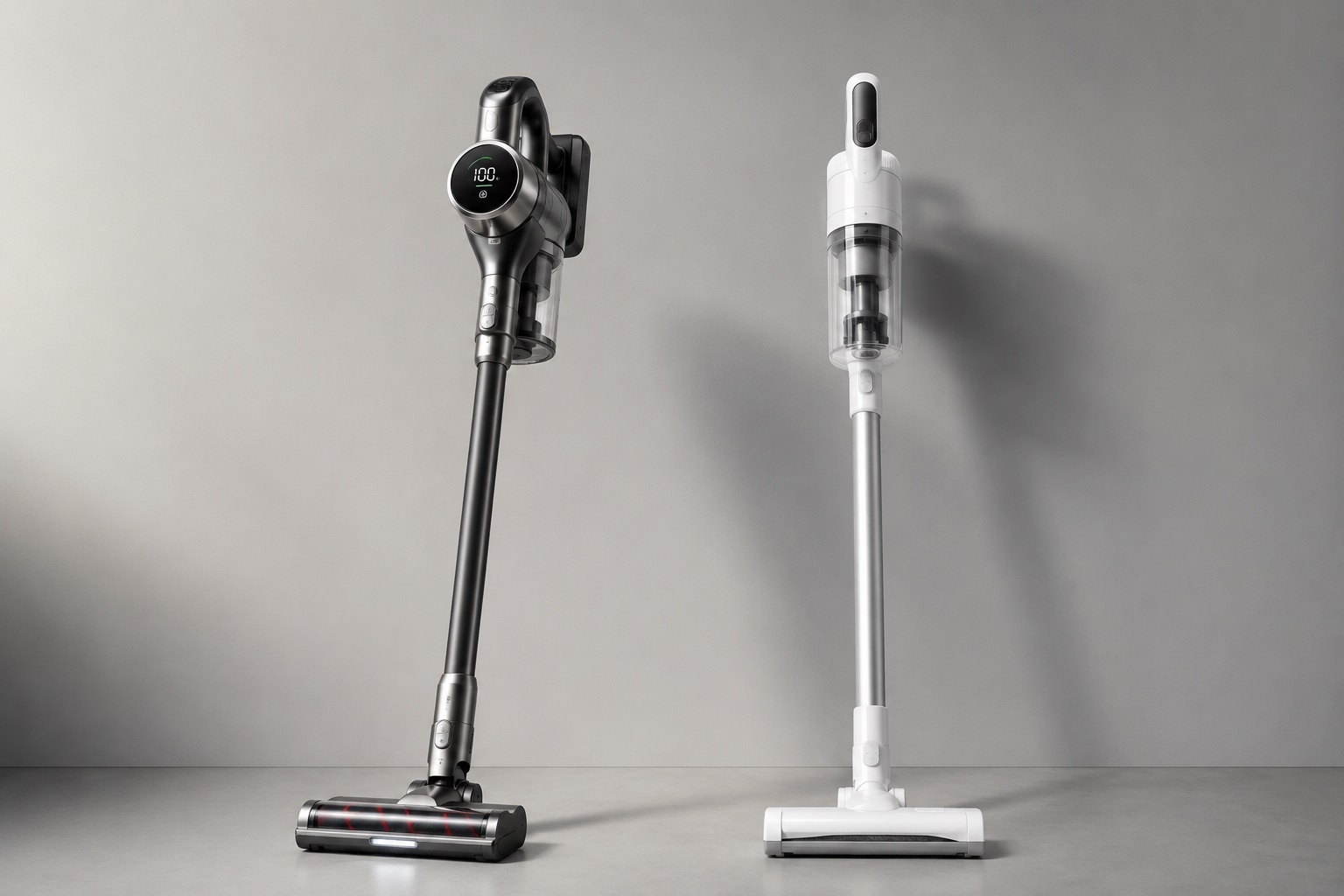
🚀 The Vacuum Cleaner Industry Is Entering a “Two-Speed Market”
For years, the vacuum cleaner industry followed a predictable formula:
More suction.
Lower cost.
Better appearance.
But in 2026, the market is changing dramatically.
Today, the real battle is no longer:
corded vs cordless
It is:
smart vacuum cleaner vs basic vacuum cleaner.
And surprisingly, the market is not choosing one side.
Instead, the global vacuum cleaner industry is splitting into two completely different consumer ecosystems.
One side demands:
automation
AI integration
app connectivity
smart cleaning technology
The other still prioritizes:
simplicity
affordability
reliability
easy maintenance
For vacuum cleaner suppliers, OEM vacuum factory owners, and European distributors, understanding this division is becoming critical for future survival.
Because the next generation of winning products may not be the most advanced.
They may simply be the products that create the least friction in everyday life.
📊 1. Smart Vacuum Cleaner Demand Is Growing Rapidly — But Unevenly
There is no doubt that smart vacuum cleaner demand is expanding globally.
Driven by:
smart home adoption
AI ecosystem growth
voice assistant integration
younger digital consumers
premium lifestyle trends
Smart cleaning appliances are becoming one of the fastest-growing categories in home electronics.
Industry analysts project continued growth in robotic and connected cleaning devices through 2026 and beyond.
But there is an important reality many manufacturers still ignore:
Smart vacuum cleaner growth is highly regional and highly psychological.
🌍 Different Markets Want Different Things
In premium urban markets such as:
Germany
Netherlands
South Korea
Nordic countries
parts of the United States
Consumers increasingly value:
automation
convenience
low manual effort
ecosystem compatibility
However, in price-sensitive regions:
Eastern Europe
South America
Southeast Asia
Consumers still prioritize:
lower purchase cost
durability
repairability
operational simplicity
This is creating a “dual-track market” that many OEM vacuum factory strategies still fail to recognize.
🤖 2. Smart Cleaning Technology Is Changing Consumer Psychology
One of the biggest market shifts in 2026 is psychological rather than technical.
Consumers are no longer comparing only:
suction power
motor wattage
battery capacity
Instead, they increasingly compare:
convenience
automation quality
software experience
friction reduction
📦 Real Retail Case: Smart Features Changed Buying Behavior
In 2025, a European appliance retailer introduced a premium smart vacuum cleaner lineup featuring:
LiDAR navigation
SLAM mapping systems
app-based room zoning
voice assistant compatibility
automatic dust collection stations
The retailer noticed something unexpected.
Customers spent less time asking:
“How powerful is the motor?”
And more time asking:
“Does the app work reliably?”
“Can it avoid pet bowls?”
“How often does mapping fail?”
“Can elderly users operate it easily?”
This marked a major shift:
Smart cleaning technology is transforming vacuum cleaners from appliances into experience-driven products.
⚠️ 3. Why Some Smart Vacuum Cleaners Fail Despite Advanced Technology
Many vacuum cleaner manufacturers assume:
“More smart features automatically create premium products.”
But the market increasingly proves the opposite.
In many cases:
complexity itself becomes the product problem.
🚫 Real Case: Over-Engineered Products Frustrate Consumers
A UK retailer launched a highly connected smart vacuum cleaner featuring:
touchscreen controls
cloud synchronization
AI cleaning analytics
advanced scheduling systems
Initial marketing performance looked excellent.
But within months, customer complaints increased sharply.
The biggest issues were:
unstable firmware updates
app connection failures
difficult onboarding
confusing interface design
The retailer later discovered something surprising:
Older basic vacuum cleaner models continued generating:
higher user satisfaction
fewer returns
lower support costs
The problem was not hardware quality.
It was friction.
This reveals one of the biggest hidden risks in smart cleaning technology:
Consumers love automation — until automation becomes work.
🔇 4. Basic Vacuum Cleaners Still Win on Reliability
Despite smart home growth, budget vacuum cleaner demand remains extremely resilient globally.
Why?
Because simplicity itself has become valuable again.
Many consumers still associate basic vacuum cleaners with:
lower failure risk
easier maintenance
longer product lifespan
lower repair costs
Especially among:
elderly households
commercial cleaning businesses
practical consumers
Reliability often outweighs innovation.
🛠️ Real Commercial Case: Simplicity Reduced Operational Risk
A Northern European commercial cleaning contractor tested:
smart vacuum cleaner systems
traditional commercial vacuum cleaners
The smart models offered:
cloud monitoring
digital maintenance alerts
AI cleaning optimization
However, after field testing across hotels and office buildings, the contractor continued purchasing basic vacuum cleaner units.
Why?
Because:
staff training was easier
repairs were faster
downtime was lower
maintenance costs were predictable
The contractor eventually concluded:
“Operational stability mattered more than smart functionality.”
This reflects a growing industry trend:
In many professional environments, reliability still beats innovation.
📉 5. Smart Vacuum Cleaner Returns Are Quietly Becoming an Industry Concern
One hidden issue in the smart appliance industry is rising return complexity.
Unlike traditional vacuum cleaners, smart models introduce:
software dependencies
firmware risks
connectivity issues
app ecosystem maintenance
This dramatically changes after-sales requirements.
📦 Real Distributor Problem: Software Became the Weakest Component
A startup appliance brand in Western Europe launched a smart vacuum cleaner targeting young urban consumers.
The product featured:
mobile app integration
AI route optimization
cloud-based cleaning history
Hardware quality was strong.
But software instability created major problems:
random app crashes
WiFi disconnections
failed firmware updates
navigation errors
Online reviews deteriorated rapidly.
Retailers soon faced:
high product return rates
customer support pressure
reputation damage
The company later realized:
The weakest component was not the motor. It was the software ecosystem.
This is becoming one of the most underestimated risks in smart vacuum cleaner development.
🌱 6. Why Basic Vacuum Cleaners May Survive Longer Than Expected
Many industry analysts once predicted:
smart vacuum cleaners would quickly replace traditional products.
That prediction now appears overly simplistic.
A growing percentage of consumers are beginning to value:
repairability
simplicity
product longevity
reduced digital dependence
This trend is especially visible in Europe.
♻️ Simplicity Is Quietly Becoming a Premium Feature
Several European distributors now report growing interest in:
durable cordless vacuum cleaners
repair-friendly designs
replaceable battery systems
simplified interfaces
Why?
Because consumers are increasingly frustrated with:
software instability
short product cycles
forced ecosystem upgrades
Ironically, in some market segments:
“Less smart” is becoming more attractive again.
This may become one of the most important appliance trends after 2026.
💡 7. The Future Market Will Belong to “Balanced Products”
The future is unlikely to belong entirely to:
smart vacuum cleaners
orbasic vacuum cleaners
Instead, the winners will likely be products that balance:
practical usability
stable technology
intuitive design
long-term reliability
🔮 2027 Industry Prediction
The next generation of successful smart vacuum cleaner products will probably focus less on:
excessive features
complicated interfaces
aggressive AI marketing
And more on:
frictionless automation
firmware stability
silent operation
battery durability
seamless user experience
At the same time, basic vacuum cleaner products may continue surviving far longer than many analysts expected because:
simplicity itself is becoming emotionally valuable.
📦 8. What European Buyers Actually Want From Vacuum Cleaner Suppliers
European distributors are becoming far more strategic in 2026.
They no longer simply ask:
“Is the product smart?”
Instead, they increasingly ask:
Is the software stable?
Is the firmware maintainable?
Are replacement parts available?
Can elderly users operate it easily?
Will the app still function in three years?
Does the smart feature solve a real problem?
This is the real evolution happening in the vacuum cleaner industry.
🔥 Real Industry Insight: Consumers No Longer Want “More Features”
For years, appliance brands believed:
More functions = more value.
But modern consumers increasingly reject unnecessary complexity.
Many users now prefer:
quieter operation
intuitive controls
stable performance
minimal setup friction
This creates one of the biggest paradoxes in the 2026 appliance market:
The smartest vacuum cleaner is not always the best-selling vacuum cleaner.
Sometimes the most successful product is simply the one consumers never have to think about.
❓ FAQ: Smart vs Basic Vacuum Cleaner Market Trends
❓ Are smart vacuum cleaners replacing traditional models?
No. Smart vacuum cleaners are growing rapidly, but basic vacuum cleaner demand remains strong due to affordability, simplicity, and reliability.
❓ Why do some consumers still prefer basic vacuum cleaners?
Many users prioritize:
durability
lower repair cost
operational simplicity
easy maintenance
longer product lifespan
Especially in commercial and value-driven markets.
❓ What is the biggest weakness of smart vacuum cleaners?
Common issues include:
firmware instability
app connection failures
complicated interfaces
software maintenance problems
higher after-sales complexity
Poor software experience can quickly damage customer trust.
❓ What should OEM vacuum factory owners focus on in 2026?
The most successful OEM vacuum factory strategies usually focus on:
balanced feature integration
firmware stability
reliable hardware
intuitive usability
long-term support systems
Consumers increasingly value low-friction experiences over excessive functionality.
🚀 Conclusion: The Future Is Not “Smart vs Basic” — It Is “Low Friction vs High Friction”
The vacuum cleaner market is no longer moving toward one universal solution.
It is splitting into two psychological directions.
Some consumers want:
AI automation
app ecosystems
connected cleaning experiences
Others still prioritize:
simplicity
durability
operational reliability
This means both smart vacuum cleaner and budget vacuum cleaner categories will continue growing — but for very different emotional reasons.
The future winners in the appliance industry will not necessarily be the brands with the most technology.
They will be the vacuum cleaner suppliers capable of removing the most frustration from everyday life.
Because in the future cleaning industry:
consumers may forgive limited features — but they will not forgive friction.
📌 Suitable Readers
European vacuum cleaner distributors
OEM vacuum factory owners
Smart home appliance startups
Vacuum cleaner sourcing managers
Cleaning appliance retailers
Product engineers
Household appliance wholesalers
B2B vacuum cleaner buyers
📌 Hashtags
smartvacuumcleaner, smartvsbasicvacuumcleanersales, vacuumcleanersupplier, OEMvacuumfactory, budgetvacuumcleaner, smartcleaningtechnology, LiDARnavigation, SLAMmapping, AIvacuumcleaner, appcontrolledvacuum, smartvacuumsystem, smartcleaningdevices, vacuumcleanerOEM, vacuumcleanerODM, cordlessvacuumcleaner, robotvacuumcleaner, firmwarestability, airflowdynamics, batterycycledegradation, dockingstationreliability, edgecleaningalgorithm, smartvacuumengineering, homecleaningtechnology, smartvacuummarket, cleaningtechnology, vacuumcleanerinnovation, householdappliances, durablevacuumcleaner, practicalcleaningtools, smartvacuumfeatures, wirelessvacuumcleaner, intelligentcleaning, smartlivingproducts, cleaningappliancemarket, energyefficientvacuum, lownoisevacuumcleaner, commercialvacuumcleaner, vacuumcleanerfactory, vacuumcleanerbusiness, Europeanappliancebuyers, smartcleaningindustry, appconnectedvacuum, vacuumcleanersourcing, vacuumcleanerbrand, vacuumcleanermanufacturer, vacuumcleanerexporter, consumercleaningbehavior, smartvacuumtrends2026, vacuumcleanerindustry, Lanxstar



