Hi, message us with any questions.
We're happy to help!





“When a vacuum suddenly stops mid-cleaning, it’s not laziness—it’s physics protecting itself.”
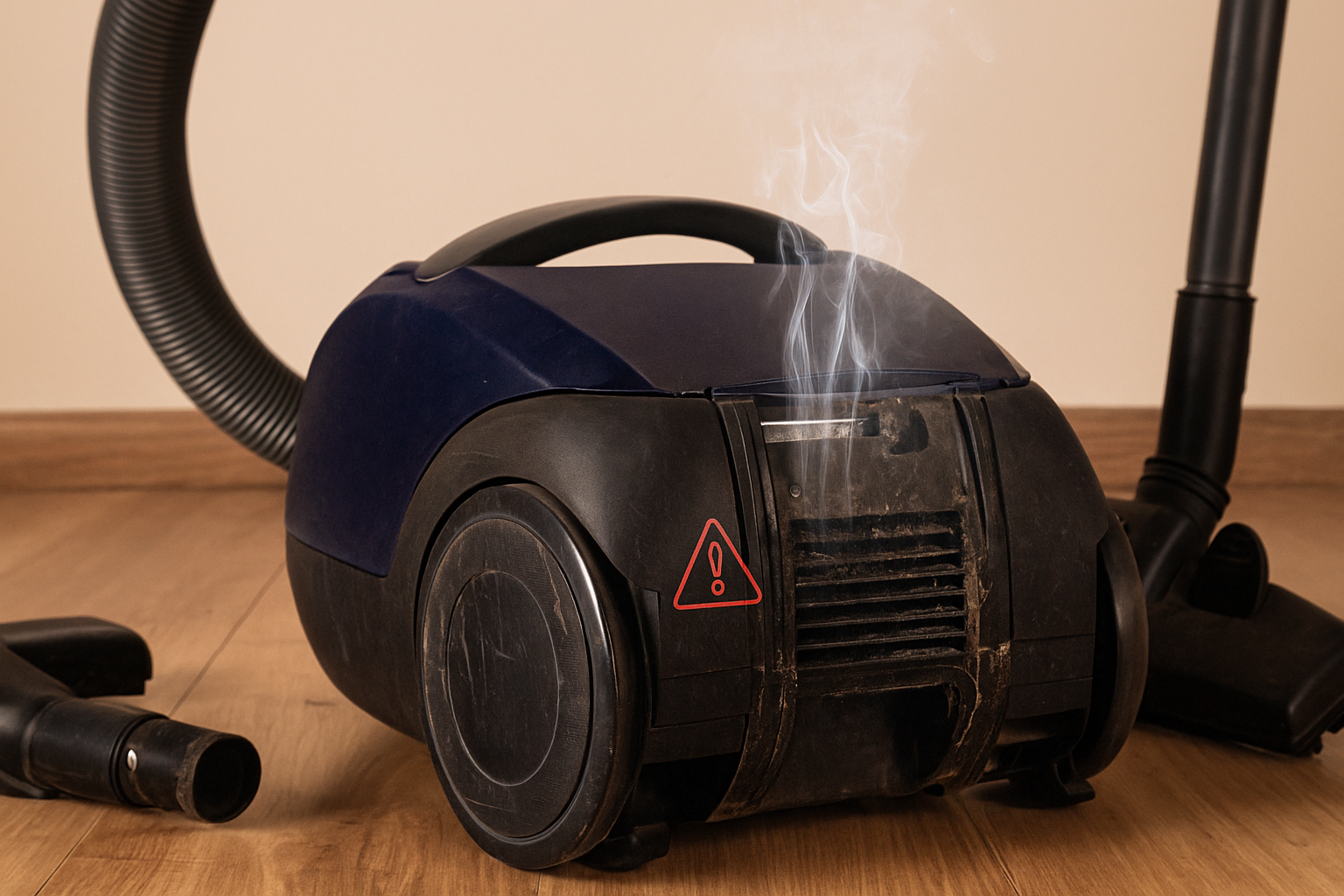
Thermal shutdown is one of the most common service complaints in both domestic and industrial vacuums.
The machine works fine, runs hot, then cuts out unexpectedly. After a few minutes, it restarts as if nothing happened.
This cycle of heating and cooling is frustrating, yet it’s a critical safety mechanism that prevents irreversible motor damage.
Let’s explore the engineering principles, design factors, and user habits that cause overheating—and how manufacturers mitigate it.
🔧 1. The Physics of Heat in Vacuum Motors
Every vacuum motor converts electrical energy into two outputs: mechanical suction and waste heat.
Roughly 25–30 % of input power is lost as heat through friction and resistance.
Key heat sources include:
Armature friction: The spinning rotor and bearings create mechanical drag.
Electrical resistance: Current flowing through copper windings generates Joule heat.
Air compression: As air accelerates through narrow ducts, compression raises temperature.
Blocked airflow: Dust or hair buildup restricts cooling air around the motor housing.
When this heat cannot dissipate quickly enough, internal temperatures exceed safe limits (often 130–150 °C), triggering a thermal cut-off switch.
🧠 2. Built-In Protection Systems
Modern vacuums incorporate several protective measures to avoid permanent burnout:
Thermal fuse: A single-use component that melts at critical temperature, breaking the circuit.
Bimetal switch: Reusable; it opens when hot and recloses once cooled.
Temperature sensor feedback: In smart models, sensors feed data to control boards that reduce power or stop the motor.
These systems safeguard components but also reveal deeper issues—persistent tripping usually means an underlying airflow or mechanical problem.
💨 3. Airflow Design and Cooling Efficiency
Efficient cooling depends on how air moves around the motor, not just through the dust path.
a. Bypass vs. Thru-Flow Motors
Thru-flow designs use the same air for suction and cooling—compact but vulnerable to moisture and clogging.
Bypass motors employ separate fan stages; cooling air never touches debris, giving better temperature control and durability.
b. Cooling Duct Geometry
Sharp bends and narrow ducts create turbulence that traps hot air.
Smooth, curved channels improve convection and reduce thermal load.
c. Filter Placement
If filters sit too close to the intake, airflow drops drastically.
A clogged HEPA filter alone can raise core temperature by 20 °C in under ten minutes.
🧽 4. User-Induced Overheating
Even the most efficient motor can’t survive bad habits. Real-world service data show that over 60 % of overheating incidents come from use and maintenance errors rather than design flaws.
🔒 a. Blocked Filters and Full Dust Bins
When dust containers exceed their capacity, airflow resistance skyrockets.
The motor must spin harder to maintain suction, producing excess current and heat.
Regular emptying and filter cleaning restore normal pressure balance.
🧵 b. Obstructed Hoses or Nozzles
A trapped sock or clump of pet hair can reduce airflow to almost zero.
With no moving air to cool the coils, internal temperatures rise within minutes.
🧹 c. Using the Wrong Mode
Some users operate dry-only vacuums on damp floors.
Moisture sticks dust to filters, blocking pores and trapping heat.
Wet–dry systems are engineered for liquid resistance; standard models are not.
⚡ d. Power Supply Variations
Fluctuating voltage, common in some regions, stresses motors.
An undervoltage draws higher current to compensate, heating windings faster.
Voltage stabilizers or soft-start circuits protect against these surges.
🧱 5. Material and Component Limits
Every material inside a vacuum has a thermal ceiling.
Once surpassed, chemical degradation begins.
| Component | Material | Max Safe Temp | Failure Result |
|---|---|---|---|
| Motor winding | Copper with enamel | 155 °C | Insulation cracks → short circuit |
| Bearing grease | Synthetic oil | 120 °C | Friction spikes → noise & seizure |
| Plastic housing | ABS / PP | 100 °C | Deformation, loss of sealing |
| Foam gasket | Polyurethane | 90 °C | Shrinkage, leaks |
Designers therefore combine heat-resistant plastics, ceramic bearings, and high-grade enamel wire to push these limits higher.
🧪 6. Laboratory Testing for Thermal Reliability
Before production, vacuums undergo a battery of thermal tests.
Continuous-Run Endurance: Operate for 500 hours under nominal load while recording temperature rise.
Thermal Shock: Alternate between 0 °C and 60 °C environments to test material expansion.
Overload Simulation: Block airflow intentionally for 30 seconds to confirm that thermal protection trips correctly.
Infrared Thermography: Detect hotspots in the motor housing and circuit board during long runs.
Passing these tests ensures that the vacuum’s safety margin remains stable over years of use.
🧰 7. Preventive Maintenance and Cooling Practices
Keep air paths clean. Tap filters gently or replace them every three months.
Monitor unusual noise. A high-pitched whine indicates bearing wear, which raises friction heat.
Allow cooling intervals. For heavy duty cleaning, rest the machine 10 minutes per hour.
Inspect vents. Ensure motor exhaust grilles aren’t pressed against curtains or walls.
Avoid overheating environments. Prolonged use above 40 °C ambient temperature cuts motor life in half.
Small preventive steps delay the need for costly motor replacements.
🌍 8. Design Innovations Reducing Overheating
Brushless DC motors minimize friction and operate 20 % cooler.
Thermal-conductive polymers transfer heat away from coils faster than traditional plastics.
Smart control boards adjust RPM dynamically when sensors detect temperature rise.
Dual-channel airflow separates suction and cooling streams for consistent ventilation.
Self-diagnostic apps alert users to maintenance needs before shutdown occurs.
Innovation now focuses on predictive prevention, not just protection.
✨ 9. Key Takeaways
Heat buildup is inevitable; the goal is safe dissipation.
Proper airflow and clean filters are the best defense.
Thermal cut-offs save motors from burnout.
Advanced materials and smart sensors are redefining reliability.
Overheating prevention blends engineering with good user habits.
“A vacuum that cools wisely cleans longer.”
🧩 Conclusion
Overheating and thermal shutdowns aren’t design flaws — they are reminders of physics and preventive safety working hand in hand.
Every time a vacuum pauses to cool down, it signals that its protection systems are saving the motor from permanent damage.
By understanding airflow, cleaning filters regularly, and respecting duty cycles, both users and engineers can extend product life far beyond warranty expectations.
Future innovations in brushless motors, thermal-conductive plastics, and intelligent temperature sensors will continue to make vacuums safer and more efficient.
Maintaining the balance between power, temperature, and airflow remains the core of sustainable appliance engineering.
📊 SEO TAG
vacuum overheating, thermal shutdown, vacuum heat protection, vacuum motor temperature, airflow design vacuum, vacuum cooling system, brushless vacuum motor, vacuum thermal fuse, vacuum maintenance, blocked filter vacuum, vacuum air path, vacuum heat dissipation, vacuum reliability testing, motor overload protection, temperature sensor vacuum, vacuum motor efficiency, vacuum performance, cooling airflow, smart vacuum design, overheating prevention, durable vacuum cleaner, industrial vacuum heat, home vacuum safety, vacuum shutdown cause, thermal switch vacuum, vacuum cleaning safety, filter cleaning, vacuum heat management, vacuum protection system, motor heat sensor, cooling vents vacuum, airflow optimization, long lifespan vacuum, vacuum energy efficiency, overheating guide, heat resistant materials, vacuum maintenance tips, vacuum power control, high temperature vacuum, thermal control vacuum, overheating problem, vacuum thermal test, vacuum cooling ducts, vacuum air circulation, overheating cause, vacuum smart sensor, energy saving vacuum, quiet efficient vacuum, overheating prevention tips, vacuum durability.