Hi, message us with any questions.
We're happy to help!





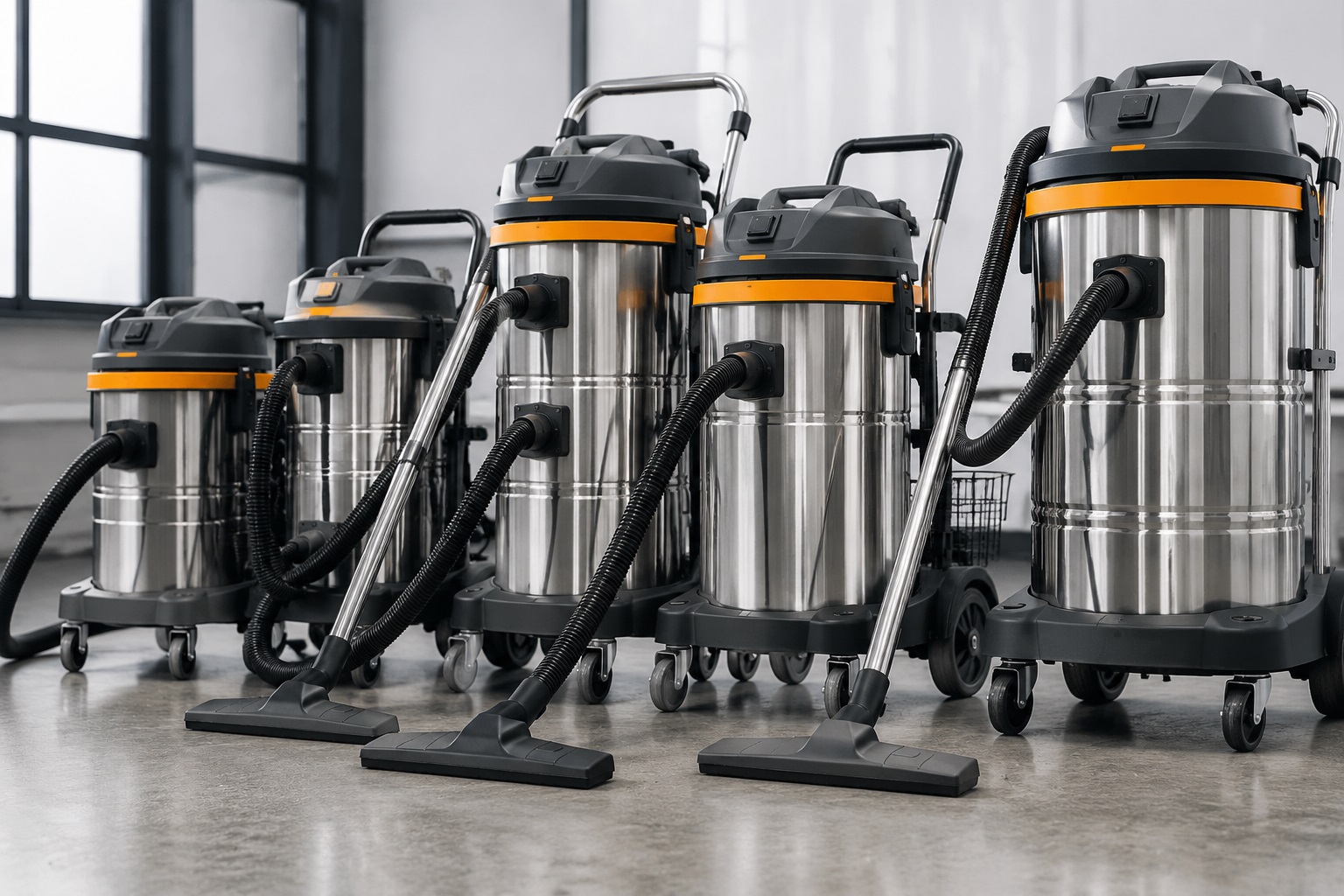
In the global cleaning equipment industry, a quiet but powerful transformation is happening. More distributors in Europe, North America, and the Middle East are shifting away from standard branded resale models and actively partnering with an OEM industrial vacuum manufacturer instead.
This is not just a sourcing change—it is a structural shift in how industrial cleaning equipment is designed, branded, and delivered to end users.
For vacuum cleaner distributors, B2B procurement managers, and private label entrepreneurs, the real question is no longer “Which brand should I sell?” but rather:
“Which manufacturer can help me control product definition, compliance, margins, and long-term scalability?”
This article breaks down the real reasons behind this trend, based on supply chain behavior, industrial demand patterns, and OEM manufacturing economics—not marketing assumptions.
⚙️📦 1. The Distributor Market Has Changed: From Resale to Ownership of Product Identity
Ten years ago, most vacuum cleaner suppliers dominated distribution channels with fixed catalogs and rigid branding systems.
Today, that model is breaking down.
Modern distributors increasingly demand:
Private labeling flexibility
Custom industrial configurations
Region-specific compliance (EU/CE/ATEX)
Faster product iteration cycles
Differentiated pricing structures
This is why private label vacuum cleaner production has become a core strategy in industrial cleaning markets.
🧠 Key shift:
Distributors no longer want “a product to sell.”
They want a product they can own, modify, and defend in the market.
OEM manufacturers enable this shift by allowing control over:
Motor specifications
Filtration systems (HEPA, ULPA, cyclone hybrid)
Tank capacity design
Noise reduction engineering
Branding architecture
This level of control is impossible in traditional wholesale models.
🏗️💡 2. Margin Compression Is Forcing a Structural Supply Chain Reset
One of the strongest drivers behind OEM adoption is margin pressure.
In industrial equipment distribution, three forces are squeezing profitability:
Rising logistics costs
Price transparency across global marketplaces
Aggressive competition from low-cost brands
Standard industrial vacuum wholesale models leave distributors with limited control over pricing strategy.
📉 The problem:
If every distributor sells the same branded product, the only differentiator becomes price.
That leads to:
Margin erosion
Channel conflict
Weak brand loyalty
📈 OEM solution:
Working directly with a commercial cleaning equipment supplier that supports OEM production allows distributors to:
Create exclusive SKUs
Control regional pricing
Build brand equity instead of resale dependency
This transforms distributors from “middlemen” into market owners.
🧪⚙️ 3. Industrial Vacuum Technology Is Becoming Highly Application-Specific
Another major reason OEM partnerships are growing is technical fragmentation.
Industrial vacuum systems are no longer generic cleaning tools. They are now highly specialized machines for:
CNC machining dust extraction
Metal chip recovery
Woodworking sawdust filtration
Pharmaceutical cleanroom maintenance
Food production hygiene systems
A single standardized product cannot efficiently serve all these environments.
🧠 Critical insight for engineers and R&D teams:
Modern industrial vacuum performance is defined less by suction power and more by:
Airflow stability under load
Multi-stage separation efficiency
Filter regeneration cycle
Particle type adaptability
This is why OEM partnerships matter. They allow engineering teams to build application-specific vacuum architectures instead of relying on mass-market configurations.
🔧🌍 4. Compliance Pressure in Europe Is Reshaping Procurement Strategy
For European distributors and procurement teams, compliance is no longer optional—it is a competitive barrier.
Key regulatory frameworks include:
CE certification
RoHS compliance
ATEX explosion safety standards
ISO industrial safety standards
A standard off-the-shelf vacuum system often fails to meet specialized requirements for:
Fine combustible dust
Metal particulate handling
Continuous-duty industrial cycles
⚠️ The hidden risk:
Non-compliant systems can result in:
Factory shutdowns
Insurance claim rejection
Legal liability exposure
🧠 Why OEM matters here:
A qualified OEM industrial vacuum manufacturer can integrate compliance directly into product architecture instead of retrofitting it later.
This includes:
Anti-static filtration design
Explosion venting structures
Certified motor systems
Region-specific electrical configurations
For distributors, this reduces risk while increasing enterprise-level trust.
📊🏭 5. Branding Control: The Real Reason Private Label Is Exploding
Private label strategy is often misunderstood as “just putting a logo on a machine.”
In reality, modern private label vacuum cleaner programs are about full ecosystem control.
Advanced OEM partnerships allow distributors to define:
Product naming systems
Industrial use-case positioning
Spare parts ecosystem
After-sales service model
Digital documentation and training assets
🧠 Strategic insight:
In industrial markets, brand trust is not created by advertising—it is created by uptime performance.
OEM models allow distributors to engineer reliability into the product itself, not just market perception.
🔄🔩 6. Supply Chain Stability Has Become a Competitive Weapon
Global disruptions over the past years have exposed a weakness in traditional sourcing models:
Long lead times
Unstable inventory availability
Dependency on single-brand suppliers
For B2B buyers of industrial equipment, unpredictability is now more costly than price.
📦 OEM advantage:
Direct collaboration with a vacuum cleaner supplier operating as an OEM partner allows:
Predictable production scheduling
Component-level transparency
Multi-line manufacturing redundancy
Faster engineering revisions
🧠 Industry reality:
Distributors are no longer competing on price alone—they are competing on delivery reliability and technical responsiveness.
🧠⚡ 7. Engineering Collaboration Is Becoming a Sales Advantage
One of the least discussed but most powerful trends is the convergence of engineering and distribution.
OEM manufacturers increasingly collaborate with distributors on:
Product redesign for regional markets
Industry-specific vacuum optimization
Noise reduction for EU urban environments
Energy efficiency improvements
Smart sensor integration
This transforms distributors into co-developers, not just buyers.
🧠 Example:
A distributor serving woodworking factories in Germany may request:
Higher fine-dust filtration efficiency
Lower decibel output for factory compliance
Continuous-duty motor upgrades
These changes are impossible in standard wholesale catalogs but routine in OEM systems.
📉🔬 8. The Hidden ROI of OEM Industrial Vacuum Partnerships
At first glance, OEM sourcing may appear more complex. But the long-term ROI is significantly higher due to:
Reduced product redundancy
Lower warranty exposure
Higher customer retention
Premium pricing capability
💰 Real cost advantage:
Instead of competing in a saturated wholesale market, distributors build proprietary product lines with defensible margins.
Over time, this leads to:
Stronger brand equity
Lower customer churn
Expanded B2B contract opportunities
🚀📈 9. Future Outlook: Industrial Vacuum Industry Is Becoming Modular
The next evolution of the industry is modular OEM architecture.
Instead of fixed machines, future industrial vacuum systems will be built from:
Interchangeable filtration modules
AI-based airflow control systems
Application-specific suction heads
Smart maintenance prediction systems
This shift will further strengthen OEM manufacturing models because only flexible production systems can support modular customization at scale.
🧭 Final Insight
The rise of OEM industrial vacuum manufacturing is not a trend—it is a structural correction in how industrial equipment markets operate.
Distributors are moving toward OEM partnerships because they offer:
Product control instead of dependency
Margin protection instead of price competition
Compliance security instead of regulatory risk
Engineering collaboration instead of static catalog sourcing
In short:
The future of industrial vacuum distribution belongs to those who control product definition, not just product access.
🏷️ Hashtags
industrial vacuum cleaner, OEM industrial vacuum manufacturer, vacuum cleaner supplier, private label vacuum cleaner, industrial vacuum wholesale, commercial cleaning equipment supplier, B2B vacuum solutions, industrial dust extractor, metal chip vacuum system, CNC vacuum cleaning, woodworking dust collection, factory cleaning equipment, industrial suction system, HEPA filtration vacuum, ATEX certified vacuum, EU industrial equipment supplier, industrial cleaning technology, vacuum system engineering, industrial equipment OEM, custom vacuum solutions, manufacturing cleaning systems, workshop dust control, centralized vacuum system, mobile industrial vacuum, high power industrial vacuum, continuous duty vacuum, smart vacuum system, IoT industrial vacuum, energy efficient vacuum system, factory hygiene solutions, industrial air filtration, dust separation system, cyclone vacuum system, metalworking cleaning system, machining dust control, production line cleaning, industrial safety equipment, cleanroom vacuum system, pharmaceutical cleaning equipment, food industry vacuum system, heavy duty vacuum cleaner, industrial maintenance tools, equipment distributor strategy, B2B manufacturing supply chain, wholesale vacuum equipment, industrial cleaning distributor, OEM product development, private branding strategy, industrial engineering solutions, supply chain optimization, Lanxstar



