Hi, message us with any questions.
We're happy to help!





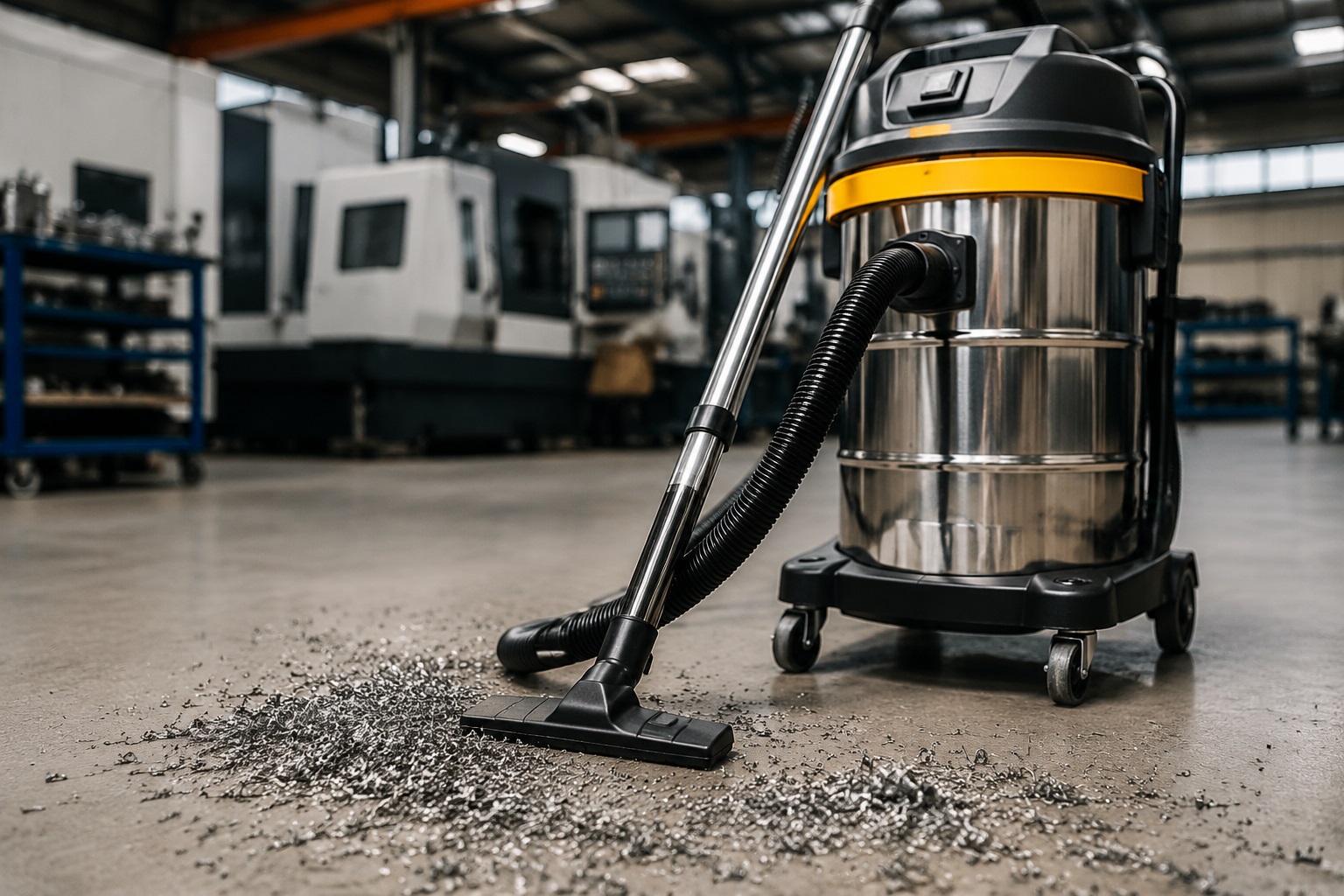
In European manufacturing environments—especially woodworking factories, CNC machining workshops, and metal fabrication plants—dust and chip management is no longer a “cleaning issue.” It is a production efficiency, compliance, safety, and machine lifetime issue.
For B2B vacuum cleaner buyers, distributors, R&D engineers, and industrial cleaning associations, the real challenge is not “how to vacuum dust,” but how to engineer a stable, non-clogging, compliant, and scalable dust collection system that survives continuous industrial load.
This article breaks down a field-tested approach to woodworking dust collection, metal chip vacuum systems, and fine dust control in CNC machining environments, with a focus on practical system design rather than generic product advice.
🌲⚙️ 1. The Hidden Complexity of Woodworking Dust Collection Systems
Woodworking dust is often underestimated because it looks “light.” In reality, it is one of the most dangerous industrial particulate categories.
🌫️ Fine wood dust is a combustion risk, not just waste
In EU workshops, especially furniture manufacturing and panel processing plants, fine sawdust behaves like:
A flammable airborne suspension
A filter-clogging micro-particle system
A respiratory hazard (PM2.5-level penetration)
A professional woodworking dust collection system must therefore solve three problems simultaneously:
Continuous suction under variable load
Fine particle separation efficiency above 99%
Explosion risk mitigation (ATEX compliance in many EU regions)
🧠 Engineering insight most suppliers ignore:
Most failures in woodworking vacuum systems are not motor-related—they come from filter saturation caused by resin-coated micro dust, which behaves differently from dry industrial dust.
⚙️🧲 2. CNC Machining & Metal Chip Vacuum Challenges
Metalworking environments introduce a completely different extraction physics.
In CNC workshops, you are not just handling dust—you are dealing with:
Sharp aluminum chips
Steel swarf
Cast iron powder
Oil mist + coolant mixtures
Conductive debris accumulation
🔩 Why “normal industrial vacuum” fails here
A standard industrial vacuum cleaner fails in CNC environments because:
Metal chips damage impellers over time
Coolant contamination clogs filters rapidly
Static conductivity can cause internal short risks
Heavy chips settle before reaching filtration stage
This is why metal chip vacuum systems require a fundamentally different architecture than dust vacuums.
🧠 Key insight:
CNC waste is not “suction problem,” it is a separation engineering problem.
Without pre-separation, even the most powerful industrial vacuum will degrade within weeks.
🧪⚠️ 3. Fine Dust vs Metal Chips: Why Hybrid Environments Are the Real Challenge
Modern EU factories are increasingly hybrid:
Wood + aluminum composite machining
MDF + metal inserts production
Mixed CNC + polishing + cutting lines
This creates a dual waste stream:
Lightweight fine dust
Heavy sharp chips
🚨 The real failure mode:
Most systems fail at the interface of both materials.
If the vacuum is designed for dust:
→ chips damage filters and block ducts
If designed for chips:
→ fine dust escapes filtration and contaminates air
🏗️🌀 4. The Correct System Architecture: Separation First, Vacuum Second
A high-performance industrial dust control system must follow a 3-layer logic:
🧱 Layer 1: Pre-separation Unit (Critical)
This is where most cost-saving mistakes happen.
Effective options include:
Cyclone separator (for dry dust)
Chip basket separator (for metal swarf)
Magnetic pre-filter (for ferrous particles)
Without this layer, downstream system life drops by 50–70%.
🌪️ Layer 2: Primary Industrial Vacuum Unit
This stage defines performance:
Key parameters for B2B buyers:
Airflow stability (not peak airflow)
Negative pressure consistency (kPa stability under load)
Motor duty cycle (continuous industrial grade)
🧼 Layer 3: Fine Filtration System
Depending on application:
HEPA for fine dust
Oil mist filter cartridges for CNC coolant environments
Anti-static filter media for conductive dust
🏭🔧 5. Centralized vs Mobile Systems: Choosing the Right Factory Strategy
🏢 Central vacuum systems (recommended for large EU factories)
Best for:
Multi-machine CNC workshops
Large woodworking production lines
Continuous manufacturing environments
Advantages:
Stable airflow distribution
Lower long-term maintenance cost
Easier compliance control (EU safety audits)
🚚 Mobile industrial vacuum units
Best for:
Small workshops
Maintenance teams
Flexible production lines
Advantages:
High adaptability
Lower initial CAPEX
Easy relocation
🧠 B2B decision insight:
If your factory runs more than 6 CNC machines or 3 woodworking lines, mobile units become operationally inefficient due to repetitive maintenance cycles.
🧯🔥 6. Compliance Reality in Europe: ATEX, Dust Explosion, and Safety Engineering
European industrial vacuum procurement is heavily influenced by compliance:
Key frameworks include:
ATEX directives (explosive atmospheres)
CE certification
ISO 21904 (industrial dust exposure)
💥 Hidden risk most buyers miss:
Wood dust explosions do not require visible dust clouds—accumulated fine dust layers inside ducts are enough to trigger secondary explosions.
⚡📊 7. Performance Metrics That Actually Matter (Not Marketing Specs)
For procurement teams and engineers, ignore “max power” claims.
Focus on:
📌 1. Sustained airflow under load
Not peak suction, but performance after 30–60 minutes of operation.
📌 2. Filtration lifecycle
How many hours before filter pressure drop reaches critical threshold.
📌 3. Chip handling capacity
Especially for CNC systems:
Basket volume
Compression ratio of swarf
📌 4. Maintenance accessibility
If filter replacement requires full disassembly → operational cost increases significantly.
🧠🔬 8. R&D Trend: Smart Industrial Vacuum Systems
The next generation of industrial dust collection systems is shifting toward intelligent monitoring:
Emerging features include:
Differential pressure sensors across filters
Predictive clogging alerts
IoT-based maintenance scheduling
Energy optimization via load sensing
📡 Why this matters for EU buyers:
Energy efficiency regulations are tightening, and vacuum systems are now being evaluated as continuous energy consumers, not static machines.
💰📉 9. ROI Logic: Why Better Dust Systems Reduce Total Factory Cost
A high-quality vacuum system does not reduce cleaning cost—it reduces:
Machine downtime
Tool wear (CNC cutting efficiency improves)
Fire risk insurance premiums
Maintenance labor hours
🧠 Practical ROI insight:
In metal CNC environments, improved chip extraction can extend tool life by 12–25% depending on machining intensity.
🧭 Final Engineering Takeaway
For EU B2B vacuum buyers, the mistake is thinking in terms of “vacuum strength.”
The correct framework is:
Separation design + airflow stability + filtration intelligence = industrial dust control success
Whether it is woodworking dust collection systems or metal chip vacuum solutions for CNC machining workshops, performance depends on architecture, not raw power.
Factories that treat dust extraction as part of production engineering—not cleaning—consistently achieve higher uptime, lower maintenance cost, and better compliance stability.
Hashtags
industrial vacuum cleaner, metal chip vacuum, woodworking dust collection system, CNC machine vacuum cleaning, industrial dust control system, workshop dust extraction, metalworking dust collector, CNC swarf removal system, machining workshop vacuum, industrial suction system, HEPA industrial vacuum, cyclone dust separator, factory dust removal system, CNC coolant chip separation, oil mist filtration system, heavy duty industrial vacuum, continuous duty vacuum system, EU industrial cleaning equipment, ATEX dust vacuum system, woodworking sawdust extractor, fine dust collection technology, industrial vacuum engineering, production line dust control, factory maintenance vacuum, centralized vacuum system, mobile industrial vacuum unit, machining debris extraction, metal shavings cleaning system, CNC machine maintenance tools, workshop safety equipment, industrial air filtration system, dust explosion prevention system, high pressure industrial vacuum, vacuum filtration system design, industrial cleaning automation, smart vacuum monitoring system, IoT vacuum cleaner system, energy efficient industrial vacuum, factory hygiene system, precision machining cleaning, industrial waste suction system, chip conveyor vacuum integration, manufacturing dust safety, heavy particulate vacuum system, resin dust collection system, composite material dust control, industrial vacuum R&D, workshop environmental safety, production efficiency optimization, Lanxstar



