Hi, message us with any questions.
We're happy to help!





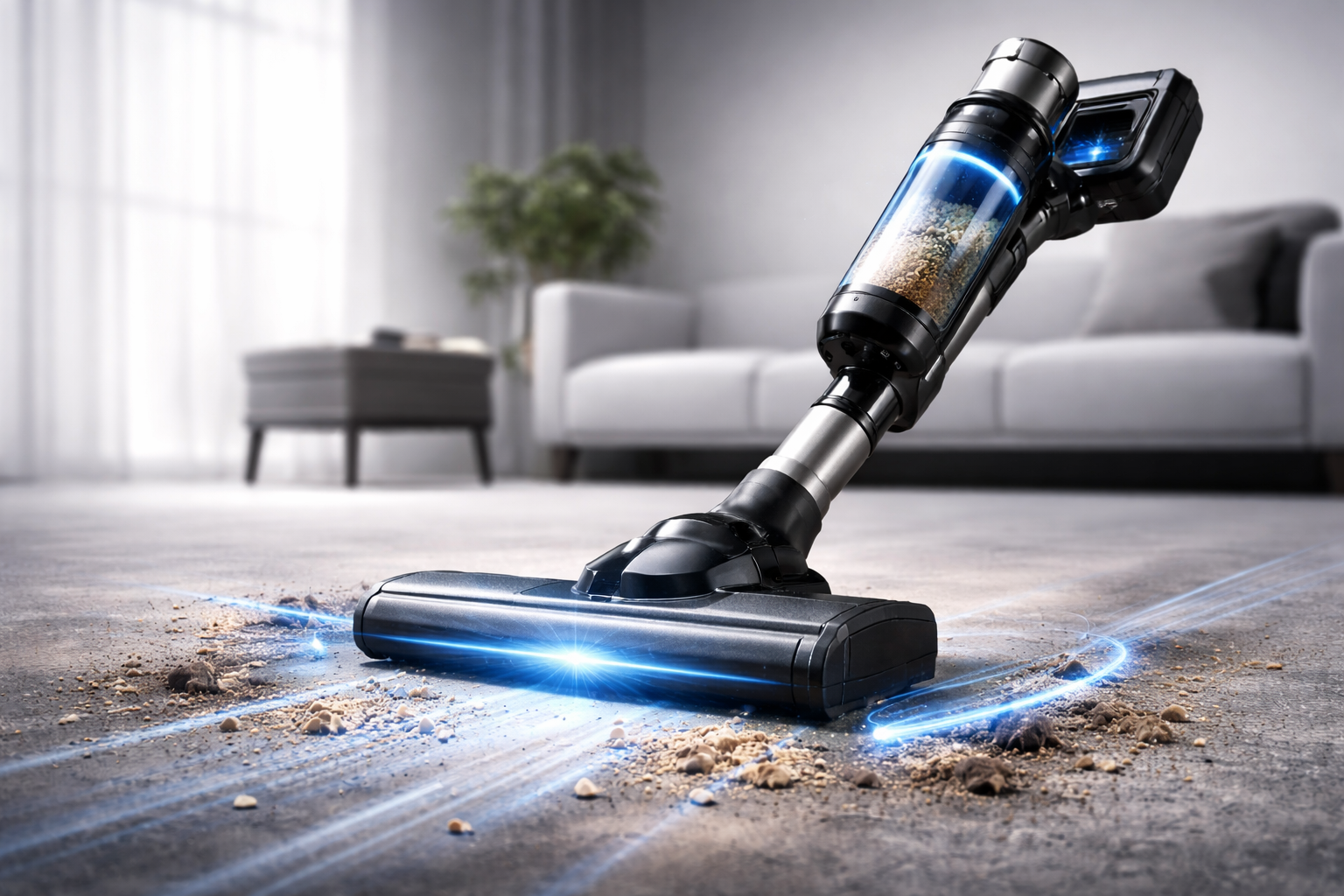
If you want to make a vacuum cleaner feel “next level,” you can redesign the floorhead, optimize filtration, or improve user experience. But one lever touches almost everything at once: the motor. A motor upgrade can increase cleaning power, extend runtime, reduce noise, and improve durability—if it’s integrated with airflow design, sealing, and control logic.
That last part matters. Many products advertise a “new digital motor” and still perform poorly because the head leaks air, filters load quickly, or heat protection kicks in too often. So the real question isn’t “Is the motor better?” It’s: How does a motor upgrade improve the entire cleaning system in real homes? ✅
Below is a practical breakdown of how modern motor technology upgrades improve vacuum performance across suction, noise, energy use, reliability, and feature differentiation—especially for Cordless Vacuum Cleaner platforms, Li-ion Cordless Handheld Vacuum Cleaner designs, and wet/dry categories.
1) More usable suction, not just higher peak suction 🔥
Motor upgrades often increase available power and allow higher fan speed, which can support High Suction Vacuum Cleaner positioning. But consumers don’t clean in perfect lab conditions—bins fill, filters load, hair tangles, and airflow paths get partially restricted.
Motor upgrades improve real suction performance in three ways:
Stronger pressure capability to pull debris when the system is partly restricted
Better control across modes (eco/standard/boost) so performance stays consistent
Improved stability under load, reducing the “starts strong then fades” effect
For procurement teams, the best proof is not a single suction number. It’s stable pickup results across real surfaces and partially loaded filters.
2) Higher efficiency = better runtime and lower heat ♻️🔋
Efficiency is where motor upgrades shine, especially in cordless designs. A modern motor can convert more electrical energy into airflow for the same battery capacity, supporting an Energy-Saving Efficient Powerful Vacuum Cleaner narrative—without relying on vague claims.
Why efficiency matters to cleaning performance
Better efficiency often means less heat, which protects bearings, electronics, and battery health
Cooler operation allows longer sustained cleaning before thermal protection limits output
For cordless devices, efficiency translates directly to more minutes of effective cleaning, not just longer “idle runtime”
This is especially important for cordless handheld vacuums, where compact housings can heat up fast and degrade performance or battery life.
3) Brushless motor upgrades reduce noise and improve comfort 🤫✨
Motor technology affects noise in two main ways:
the motor’s mechanical and electrical behavior (vibration, harmonics)
the airflow it drives (turbulence and resonance)
Upgrading to more refined motor designs can support a quiet vacuum cleaner position—especially when combined with airflow-path optimization and vibration isolation.
Where it becomes a real differentiator
Portable Quiet Vacuum Cleaner use cases: compact products where noise can feel sharp and intrusive
Quiet Vacuum for Night Use: users want acceptable cleaning without waking others 🌙
Apartment Vacuum Cleaner segments: noise is often a purchasing filter
A motor upgrade alone won’t guarantee quietness, but it enables quieter operation at the same cleaning outcomes because you can meet pickup targets at lower or better-controlled RPM.
4) Better motor control enables “smart performance” instead of brute force 🧠⚡
Modern motor systems are not just hardware. They include electronics and control algorithms that can manage:
soft start and smoother ramping
load sensing (detecting resistance or airflow change)
protection logic that is less disruptive
consistent mode mapping that matches real cleaning tasks
This is how you get performance that feels “smart,” even without an app:
stable suction on rugs vs hard floors
more predictable boost use
fewer surprise shutdowns due to heat or jams
For brands selling a Fast Lightweight Vacuum Cleaner, this matters because a lightweight body can feel unstable if the motor surges or vibrates. Smooth control makes lightweight designs feel premium.
5) Motor upgrades improve pickup indirectly by supporting better floorhead design 🧹➡️✅
Many vacuums fail not because the motor is weak, but because the floorhead wastes airflow. Motor upgrades can provide more headroom to:
maintain airflow through more complex multi-surface heads
power brush rolls effectively for carpets
improve edge and corner pickup channels
This supports better results for:
Vacuum for Multi-Surface performance
Vacuum Cleaner for Hardwood Floors (fine dust pickup without scatter)
Vacuum Cleaner for Pet Hair (embedded hair + brush roll resistance) 🐾
However, there’s a caution: if you add power without improving sealing and airflow path design, you may only create more noise and faster filter loading.
6) Motor power makes filtration choices more flexible—but pressure drop still matters 😷
A more capable motor can better tolerate filtration pressure drop, which can support a stronger HEPA Filter Vacuum Cleaner proposition. But filtration is still a system challenge:
Higher airflow through restrictive filters can increase noise and reduce efficiency
Loaded filters reduce airflow and can cause the motor to work harder (heat + tone changes)
The best results come when motor upgrades are paired with:
larger filter area (lower pressure drop)
pre-separation strategies (keeping fine dust off the final filter longer)
sealed interfaces that reduce bypass leakage
This strengthens credibility for a Vacuum Cleaner for Allergies positioning because performance remains stable and dust containment is more consistent over time.
7) Wet/dry performance benefits from motor + control upgrades (and hygiene design) 💦🧼
Wet/dry products add complexity: liquid handling, separation, and post-clean hygiene. Motor upgrades can improve:
stable pickup of mixed wet and dry debris
consistent performance across modes
better support for automated routines
In wet/dry categories, differentiation often depends on the workflow:
reliable mode switching
consistent suction during wet pickup
practical self-clean routines that users will actually do
That’s why motor and control upgrades often pair well with a Self-Cleaning Vacuum Cleaner strategy. And in premium tiers, a 4 in 1 Cordless Smart Wet & Dry Vacuum Cleaner depends heavily on robust motor control to avoid inconsistent performance across modes.
For large homes, a Large-Capacity Wet Dry Vacuum Cleaner can benefit from motor headroom to keep performance stable as tanks fill—provided handling remains user-friendly.
8) Reliability and durability: motors can reduce failure rates when designed for heat and load 🛠️🧊
In the field, many failures are linked to:
overheating
dust ingress where it shouldn’t be
bearing wear
inconsistent electronics protection
Motor upgrades that reduce heat and improve tolerance to load variations can support Multi-Functional Durable Vacuum Cleaner positioning. But again, it’s not just the motor—cooling, sealing, and structural stiffness all matter.
From a vacuums procurement perspective, durability proof should include:
endurance cycles at standard mode (realistic duty)
brush motor endurance (if applicable)
thermal behavior under partial clogging
failure-mode behavior (how the vacuum protects itself)
9) What motor upgrades mean for different product types 🧩
A) Cordless stick vacuums
A motor upgrade can improve:
stable cleaning in standard mode
quieter operation for daily use
better runtime efficiency
This strengthens the core Cordless Vacuum Cleaner SKU that typically drives volume.
B) Handheld products
For a Li-ion Cordless Handheld Vacuum Cleaner, motor efficiency and thermal control are critical. Better motors improve:
consistent suction in compact airflow paths
comfortable operation (less heat in the hand)
better performance as filters load
This also supports use cases like Car Vacuum Cleaner kits and a Portable Vacuum for Travel configuration.
C) Wet/dry systems
Motor upgrades help, but the biggest wins come when paired with hygiene-first design. If the product smells after use, performance improvements won’t save reviews.
10) Procurement checklist: how to verify motor-driven performance improvements ✅📋
If a supplier claims a “motor upgrade,” procurement teams should verify system-level outcomes:
Pickup tests on hard floors and rugs (including edge pickup)
Noise testing: dB(A) and tone profile at standard mode (not only max mode)
Runtime and heat stability for cordless units
Performance with partially loaded filters and bins
Maintenance burden: does higher power cause faster clogging or messier emptying?
For wet/dry: hygiene workflow time, odor risk, self-clean effectiveness
This is the difference between buying a “better motor” and buying a better product.
Conclusion ✅🌟
Motor technology upgrades improve vacuum cleaner performance by increasing usable suction, improving efficiency and runtime, reducing noise, enabling smarter control, and supporting more capable floorhead and filtration systems. The biggest gains happen when motor upgrades are integrated with sealing, airflow-path design, and real-world maintenance workflows—especially for cordless and wet/dry categories.
www.lxvacuum.com
Ideal Readers (Listed again at the end)
Product R&D engineers and product managers
Global vacuum buyers / vacuums procurement teams
Distributors & brand owners / vacuum cleaner distribution professionals
Related Keyword Groups (50, comma-separated)
Lanxstar vacuum motor upgrade, Lanxstar performance engineering, vacuums procurement, vacuum cleaner distribution, vacuum motor technology improvement, High Suction Vacuum Cleaner stable suction, Energy-Saving Efficient Powerful Vacuum Cleaner efficiency, quiet vacuum cleaner motor tuning, Portable Quiet Vacuum Cleaner low noise motor, Quiet Vacuum for Night Use mode mapping, Apartment Vacuum Cleaner comfort design, Cordless Vacuum Cleaner motor efficiency, Li-ion Cordless Handheld Vacuum Cleaner thermal control, cordless handheld vacuums suction stability, Fast Lightweight Vacuum Cleaner smooth ramping, Multi-Functional Durable Vacuum Cleaner motor durability, airflow efficiency per watt vacuum, suction stability under filter loading, HEPA Filter Vacuum Cleaner pressure drop management, Vacuum Cleaner for Allergies sealed filtration, Vacuum Cleaner for Pet Hair brush resistance handling, Vacuum for Multi-Surface pickup optimization, Vacuum Cleaner for Hardwood Floors fine dust control, brush roll motor endurance testing, motor vibration isolation design, noise tone reduction vacuum, nozzle pressure loss reduction, sealed system gasket durability, intelligent power mode control, runtime prediction by mode, motor heat management cordless vacuum, Car Vacuum Cleaner compact motor design, Portable Vacuum for Travel quick cleanup, wet dry vacuum motor control, Wet Dry Vacuum Cleaners performance stability, Wet and Dry Vacuum Cleaner separation efficiency, Self-Cleaning Vacuum Cleaner cycle support, 4 in 1 Cordless Smart Wet & Dry Vacuum Cleaner mode stability, Large-Capacity Wet Dry Vacuum Cleaner load stability, dustbin full performance stability, clog detection motor protection logic, after-sales parts readiness motors, distributor proof pack for motor claims, procurement RFQ motor validation tests, battery health friendly motor mapping, low maintenance suction path design, suction airflow test method documentation, best vacuum on a budget motor efficiency, best affordable vacuum performance stability, good budget vacuum cleaner durable motor