Hi, message us with any questions.
We're happy to help!





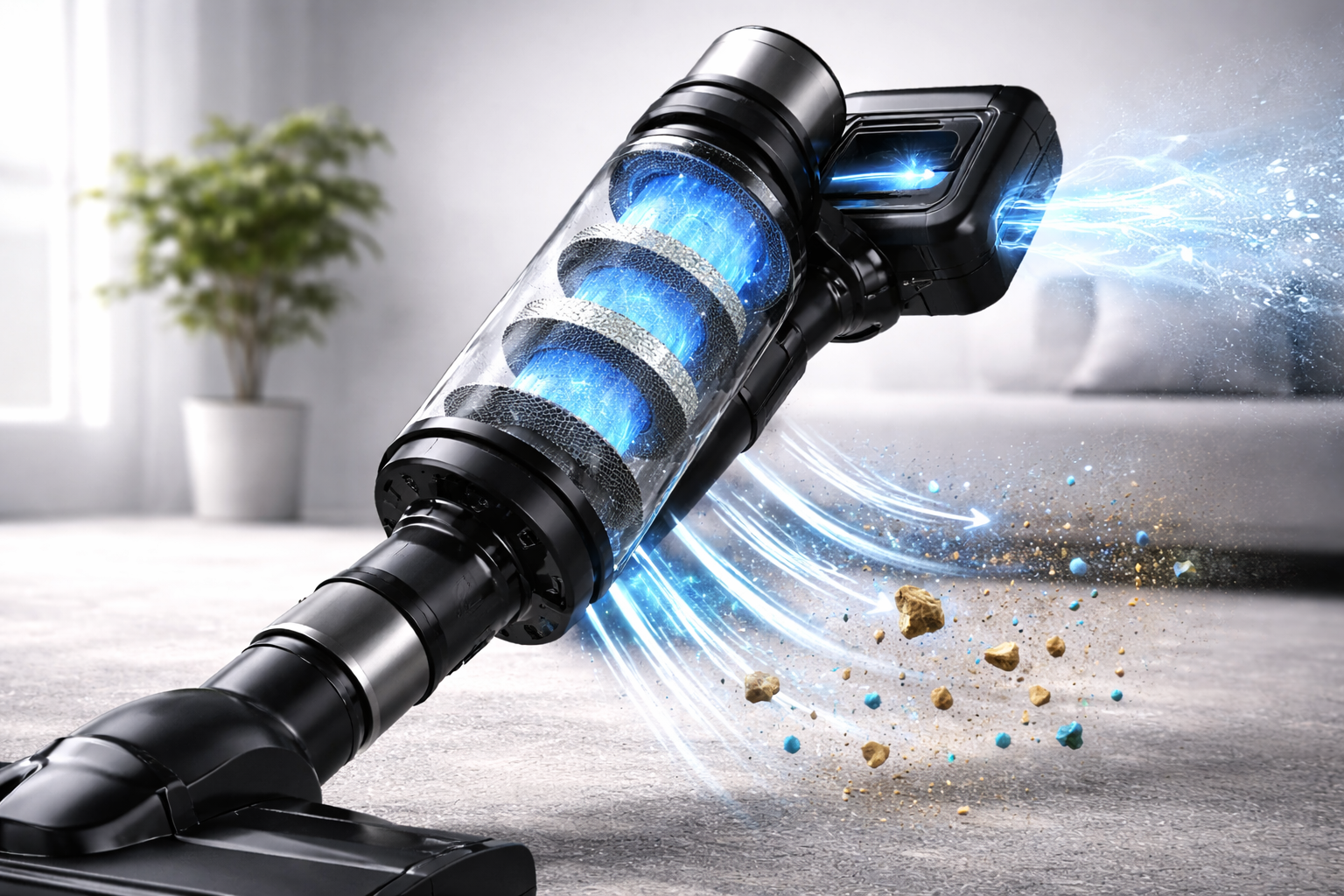
Air purification efficiency in a vacuum cleaner is not only about having a “HEPA filter.” Real dust containment depends on how well the entire system prevents particles from escaping—during cleaning, during bin emptying, and as filters load over time. That is why modern vacuums increasingly use multi-layer filtration systems: several filtration and separation stages working together to manage different particle sizes and protect airflow.
When designed correctly, multi-layer filtration can deliver three outcomes that matter to consumers and buyers:
Less dust re-release into the room air
More consistent cleaning performance over time
Higher confidence for allergy-sensitive households
This article explains how multi-layer filtration enhances air purification efficiency, what each layer does, and how to evaluate these systems in procurement and product development.
1) What “air purification efficiency” means in a vacuum context
In vacuums, “air purification efficiency” generally relates to how well the vacuum:
captures particles carried by airflow
prevents leakage around filters and joints
maintains performance as dust accumulates
For a HEPA Filter Vacuum Cleaner, users expect fine dust containment. For a Vacuum Cleaner for Allergies, they also expect the vacuum to reduce airborne dust exposure rather than spreading it.
A multi-layer design improves efficiency because each stage targets a different range of debris and reduces the burden on the final fine filter.
2) Why single-stage filtration often fails in real homes
A single filter trying to capture everything—from hair and lint to fine dust—tends to:
clog quickly
increase pressure drop (reducing airflow and pickup)
force the motor to work harder (more heat, more noise)
create bigger performance drops over time
This is why some vacuums feel strong initially but lose efficiency after a short period of use. Multi-layer filtration solves this by staging the work across multiple components.
3) The typical layers in a multi-layer filtration system (and what each layer does) 🧩
Layer 1: Inlet screening / hair and debris management
The first “layer” may be a simple screen, grill, or geometry designed to prevent large debris from reaching sensitive areas. It reduces large blockages and helps protect downstream components.
Relevance:
improves reliability for Vacuum Cleaner for Pet Hair homes 🐾
reduces clog risk and maintenance friction
Layer 2: Pre-filter (coarse filtration)
A washable pre-filter captures larger dust, lint, and clumps before they reach high-efficiency media. This is critical because it:
delays clogging of the final filter
reduces pressure drop growth over time
stabilizes airflow and suction behavior
Layer 3: Separation stage (often cyclonic or centrifugal)
Many designs include a separation stage that removes a large portion of dust from the airflow before it reaches filters. The benefit is performance stability:
less fine dust reaches the HEPA stage
filters stay cleaner longer
suction and airflow stay more consistent
This directly supports “stable performance” positioning for a High Suction Vacuum Cleaner, because the system is less likely to choke as the bin fills.
Layer 4: Fine filter / HEPA final stage
The final stage is where fine dust containment is strongest. This supports:
HEPA Filter Vacuum Cleaner credibility
Vacuum Cleaner for Allergies positioning when paired with sealing and maintenance design
A key point: HEPA performance depends heavily on the earlier stages doing their job. If the upstream layers are weak, the HEPA stage loads quickly and airflow collapses, reducing cleaning efficiency.
Layer 5: Exhaust filtering and sealing interfaces
Even with good filters, air purification efficiency can fail if air leaks around seals. Multi-layer systems must include:
proper gasket design
consistent compression control
rigid housings that maintain tolerances over time
This is where “sealed system” design becomes a practical differentiator.
4) How multi-layer filtration improves efficiency without sacrificing cleaning power 🌬️✅
One concern is that more layers mean more resistance. That can be true if poorly designed. But well-designed multi-layer filtration often improves overall performance because it:
reduces rapid clogging
keeps pressure drop lower for longer
maintains airflow at the floorhead
allows the motor to run at lower RPM for the same cleaning results (potentially quieter)
This can support both:
Energy-Saving Efficient Powerful Vacuum Cleaner positioning ♻️
quiet vacuum cleaner positioning when airflow is smoother and the motor doesn’t need to compensate aggressively
5) Maintenance design is part of filtration efficiency 🔁
Even the best filtration architecture fails if users cannot maintain it correctly.
Human-friendly maintenance design includes:
tool-free access to filters
clear “wash vs replace” instructions
replacement availability and consistent SKU planning (critical for distribution)
dustbin emptying that minimizes dust clouds
A filtration system that stays clean in real life enhances air purification efficiency more than an advanced filter that users neglect.
6) Filtration efficiency and cordless products: why pressure drop matters more 🔋
Cordless vacuums have limited energy. If filtration creates high resistance, the motor must work harder, which:
reduces runtime
increases heat
may increase noise
That’s why multi-layer systems are valuable in a Cordless Vacuum Cleaner platform: pre-separation protects fine filters, keeping efficiency higher per watt over time. The same logic applies to Li-ion Cordless Handheld Vacuum Cleaner designs, where compact size makes heat management and airflow stability more challenging.
7) Filtration considerations for wet/dry products 💦
Wet/dry products introduce hygiene risks and moisture. Filtration systems must avoid contamination traps and support easy cleaning.
If you work with Wet Dry Vacuum Cleaners or a wet dry vacuum design, evaluate:
whether wet debris reaches filters (it should be controlled and separated)
whether components rinse clean quickly
whether residual moisture can cause odor
whether the system supports a practical cleaning routine
A Self-Cleaning Vacuum Cleaner workflow can help keep internal paths and rollers cleaner, but filtration still needs to be protected from moisture where possible.
8) How procurement teams can verify air purification efficiency 🧪📊
For vacuums procurement and vacuum cleaner distribution, “multi-layer filtration” should be supported by measurable proof.
Recommended evaluation points:
dust containment testing (leakage and bypass evaluation)
pressure drop growth across filter loading stages
airflow and pickup tests before and after filter loading
emptying dust plume observation (practical user scenario)
sealing durability (gasket fatigue and housing stability)
Procurement teams should request clear documentation of filtration architecture and maintenance instructions, not just “HEPA” labels.
Conclusion
Multi-layer filtration systems enhance air purification efficiency by capturing debris in stages, protecting fine filters from rapid loading, stabilizing airflow over time, and reducing dust re-release—especially when combined with sealed interfaces and maintenance-friendly design. For consumers, this means cleaner-feeling homes and more consistent performance. For procurement and distribution, it means fewer complaints, fewer returns, and stronger long-term trust.
www.lxvacuum.com
Ideal Readers (Listed again at the end)
Product R&D engineers and product managers
Global vacuum buyers / vacuums procurement teams
Distributors & brand owners / vacuum cleaner distribution professionals
Related Keyword Groups (50, comma-separated)
Lanxstar multi-layer filtration system, Lanxstar air purification efficiency, vacuums procurement, vacuum cleaner distribution, HEPA Filter Vacuum Cleaner sealed architecture, Vacuum Cleaner for Allergies filtration confidence, multi-stage filtration vacuum design, pre-filter washable coarse filtration, cyclone separation dust management, fine dust containment HEPA stage, sealed system gasket design, bypass leakage prevention filtration, pressure drop management multi-layer filters, airflow stability under filter loading, suction stability with staged filtration, High Suction Vacuum Cleaner filtration stability, Energy-Saving Efficient Powerful Vacuum Cleaner efficiency gains, quiet vacuum cleaner smoother airflow, Portable Quiet Vacuum Cleaner sealed filtration, Apartment Vacuum Cleaner dust containment, dustbin emptying low dust plume, tool-free filter access design, replacement HEPA filter availability plan, consumables SKU standardization for filters, Vacuum Cleaner for Pet Hair dander control, pet hair pre-separation stage, Vacuum for Multi-Surface fine dust management, Vacuum Cleaner for Hardwood Floors fine dust pickup, cordless filtration efficiency per watt, Cordless Vacuum Cleaner filter loading runtime, Li-ion Cordless Handheld Vacuum Cleaner compact filtration, cordless handheld vacuums HEPA maintenance, wet dry vacuum filtration protection, Wet Dry Vacuum Cleaners hygiene-safe filtration, Wet and Dry Vacuum Cleaner contamination control, Self-Cleaning Vacuum Cleaner keeps airflow path clean, filter housing tolerance stability, gasket compression durability testing, dust containment verification protocol, airflow test before after filter load, distributor-ready filtration documentation, procurement RFQ filtration architecture, odor risk reduction through hygiene design, best vacuum on a budget HEPA credibility, low maintenance filtration workflow, suction noise tradeoff filtration design



