Hi, message us with any questions.
We're happy to help!





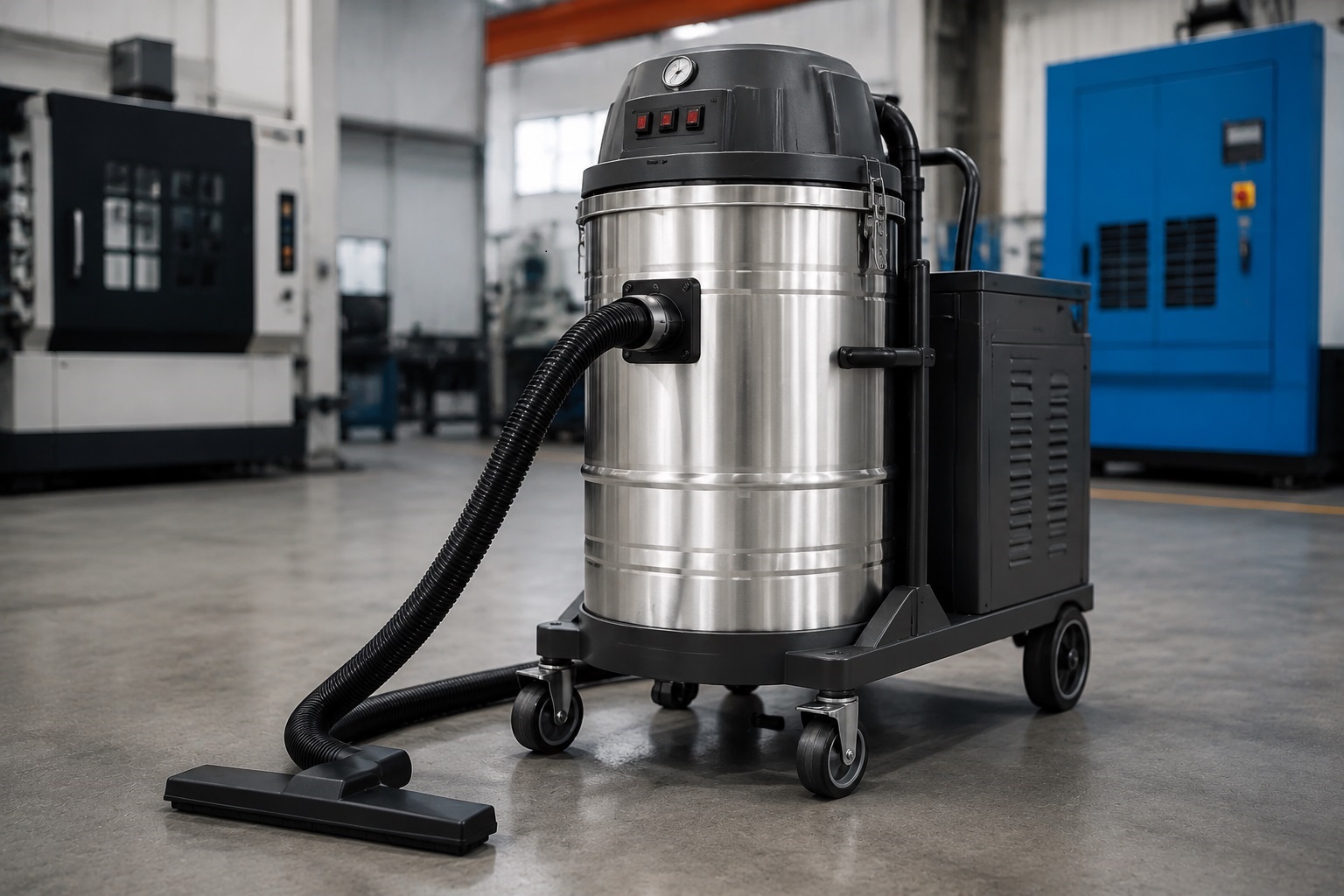
How Modern Manufacturers Reduce Downtime, Improve Safety & Increase Cleaning Efficiency
Industrial factories are under increasing pressure to improve:
Workplace safety
Production efficiency
Dust control compliance
Equipment protection
Operational cleanliness
Across Europe and North America, factory operators are discovering that poor industrial cleaning systems quietly reduce production performance every day.
This is why modern manufacturers are investing heavily in advanced industrial cleaning vacuum solutions.
Today, industrial vacuum systems are no longer viewed as simple cleaning tools.
They have become part of:
Operational strategy.
And in many industries, cleaning efficiency now directly affects production reliability.
🔥 The Hidden Cost of Poor Factory Cleaning Systems
Many factories still rely on outdated cleaning methods such as:
Manual sweeping
Consumer-grade vacuums
Compressed air cleaning
Basic dust collection systems
The problem is that these methods often increase airborne particle spread instead of controlling it.
According to European workplace safety observations, airborne industrial dust can significantly increase maintenance frequency in high-particle production environments.
This becomes especially problematic in industries handling:
Fine powders
Metal particles
Plastic debris
Chemical residue
Wood dust
A manufacturing facility in Germany reported repeated overheating issues around automated production equipment due to poor dust management near ventilation zones.
The issue initially appeared to be mechanical.
But after inspection, excessive fine-particle accumulation was identified as the root cause.
After upgrading to industrial-grade vacuum systems with stronger filtration capability, maintenance interruptions reportedly decreased noticeably during high-production periods.
This highlights an important industrial reality:
Poor cleaning systems create hidden operational risks.
⚙️ Why Traditional Cleaning Methods Fail in Modern Factories
Modern production environments operate at much higher efficiency levels than older factories.
As production speed increases, so does debris accumulation.
Traditional cleaning methods struggle to handle:
Continuous production residue
Fine airborne particles
Heavy industrial debris
Large-area cleaning demands
Hazardous material containment
A CNC machining workshop in Northern Italy reported that manual sweeping frequently redistributed metal dust into surrounding equipment zones.
This increased:
Equipment contamination
Maintenance frequency
Cleaning labor time
After transitioning to centralized industrial cleaning vacuum systems with metal particle separation capability, the facility improved workshop cleaning speed while reducing secondary dust spread.
This is why many modern manufacturers now view industrial vacuum systems as:
Productivity infrastructure — not maintenance accessories.
🌀 Why Airflow Engineering Matters More Than Motor Power
One of the biggest misunderstandings in the industrial vacuum industry is the belief that:
Higher wattage automatically means better performance.
Experienced buyers know this is incorrect.
Industrial vacuum performance depends heavily on:
Airflow engineering
Suction stability
Filtration efficiency
Debris separation design
Continuous runtime capability
Weak airflow systems often perform well initially but lose suction rapidly under heavy industrial usage.
This creates:
Longer cleaning cycles
Increased dust accumulation
Operational delays
One electronics assembly facility in the Netherlands reported improved airborne particle control after replacing unstable low-airflow units with industrial vacuum systems designed for continuous suction consistency.
Operators noticed:
Faster cleaning cycles
Lower airborne dust levels
Reduced cleaning interruptions
This is why experienced buyers increasingly prioritize:
Stable airflow under continuous industrial conditions.
Not just startup suction power.
💨 Industry-Specific Vacuum Requirements Most Buyers Ignore
One of the biggest mistakes new industrial buyers make is treating all factories as identical environments.
Different industries create completely different cleaning challenges.
Professional buyers increasingly select systems based on:
Industry-specific operational risks.
🏭 Metal Fabrication Workshops
Metal processing facilities often require:
Heavy-duty steel construction
Metal chip separation systems
High airflow resistance capability
Continuous runtime performance
A fabrication plant in France experienced repeated hose blockage issues when using standard vacuum systems not designed for sharp metal debris.
After upgrading to reinforced industrial vacuum equipment, airflow stability improved significantly.
🧪 Pharmaceutical Manufacturing
Pharmaceutical environments prioritize:
HEPA filtration
Fine particle containment
Contamination control
Stainless steel vacuum systems
Several pharmaceutical operators in the UK reported increasing demand for advanced filtration systems due to stricter airborne particle compliance requirements.
In these facilities:
Filtration quality directly affects compliance risk.
🍞 Food Processing Facilities
Food manufacturing environments often require:
Hygienic cleaning systems
Stainless steel components
Moisture-resistant vacuum systems
Easy sanitation capability
Food-grade facilities increasingly prioritize industrial vacuum systems that reduce contamination risks during sanitation cleaning procedures.
🔋 Battery & Electronics Manufacturing
Battery and electronics factories frequently generate:
Fine conductive dust
Sensitive component debris
Static-sensitive particles
Several electronics facilities in Germany reported that poor dust control contributed to equipment contamination near sensitive assembly areas.
As a result, advanced filtration and sealed airflow systems are becoming increasingly important in electronics manufacturing.
📉 The Real ROI Problem Cheap Vacuum Systems Create
Many factory operators initially focus on lowering purchasing costs.
But experienced manufacturers calculate something far more important:
Downtime cost.
A low-cost vacuum system may appear economical during purchasing.
However, hidden long-term costs often include:
| Problem | Operational Impact |
|---|---|
| Weak airflow | Longer cleaning cycles |
| Poor filtration | Equipment contamination |
| Hose failure | Cleaning interruptions |
| Motor overheating | Production downtime |
| Frequent maintenance | Labor inefficiency |
| Limited spare parts | Delayed repairs |
A production facility in Belgium reported that repeated maintenance interruptions from low-quality imported vacuum systems eventually increased operational costs far beyond the original purchasing savings.
This is why industrial buyers increasingly focus on:
Total operating efficiency.
Not just machine price.
🛠️ What Professional Industrial Buyers Actually Evaluate
Professional B2B buyers rarely purchase equipment based only on catalogs.
They evaluate how systems perform under real factory conditions.
🔍 1. Continuous Runtime Stability
Industrial facilities often require vacuum systems capable of operating:
Multiple shifts daily
High-frequency cleaning cycles
Continuous industrial workloads
Consumer-grade equipment typically fails quickly under these conditions.
♻️ 2. Filtration Performance
Poor filtration creates:
Airborne contamination
Equipment wear
Increased maintenance
Worker safety concerns
Modern factory cleaning equipment increasingly integrates:
HEPA filtration
Cyclonic separation
Multi-stage dust containment
because industrial environments demand cleaner air management.
🔇 3. Noise Reduction
Several manufacturing operators in Germany reported increasing demand for quieter industrial systems due to stricter workplace noise standards.
Modern systems now use:
Insulated motor chambers
Optimized airflow channels
Noise reduction engineering
to improve operator comfort.
🔧 4. Maintenance Accessibility
Industrial downtime is expensive.
Professional buyers increasingly evaluate:
Filter replacement speed
Hose durability
Motor service accessibility
Spare parts logistics
because maintenance delays directly impact production schedules.
🚀 Why Industrial Buyers Are Becoming More Selective About Suppliers
The industrial vacuum market has changed significantly in recent years.
Professional buyers no longer evaluate suppliers based only on pricing.
They increasingly assess whether an industrial vacuum supplier can provide:
OEM customization
Technical consultation
Spare parts stability
Compliance support
Long-term engineering cooperation
One distributor in the UK noted that delayed spare parts delivery became one of the largest operational frustrations after global logistics disruptions.
As a result, many industrial buyers now prioritize:
Supply chain reliability over low pricing.
🧠 Smart Manufacturers Calculate Risk — Not Just Cost
Modern factory operators increasingly understand that industrial cleaning systems affect:
Production stability
Equipment lifespan
Worker safety
Air quality compliance
Maintenance efficiency
This is why advanced manufacturers increasingly treat industrial vacuum systems as:
Risk management tools.
Not simple cleaning equipment.
📊 Factory Selection Guide: Which Vacuum System Fits Your Industry?
| Factory Type | Recommended Vacuum Solution |
|---|---|
| Pharmaceutical Plant | HEPA Filtration Vacuum |
| Metal Fabrication Workshop | Heavy Duty Metal Chip Vacuum |
| Food Processing Factory | Stainless Steel Hygienic Vacuum |
| Electronics Manufacturing | Fine Particle Containment Vacuum |
| Chemical Plant | Sealed Industrial Vacuum System |
| Wood Processing Facility | High-Airflow Dust Extraction Vacuum |
This type of industry-specific matching is becoming increasingly important in industrial procurement decisions.
🌍 Future Trends in Industrial Cleaning Vacuum Solutions
The next generation of industrial vacuum systems is moving toward:
Smart diagnostics
IoT monitoring
Predictive maintenance alerts
Energy-efficient airflow systems
Modular industrial cleaning platforms
Advanced contamination control
Forward-thinking manufacturers increasingly recognize that:
Factory cleanliness is becoming a competitive advantage.
Not just a maintenance responsibility.
💡 5 Common Mistakes Industrial Buyers Should Avoid
❌ Choosing Based Only on Purchase Price
Cheap systems often create expensive downtime later.
❌ Ignoring Industry-Specific Requirements
Different factories require different vacuum architectures.
❌ Underestimating Filtration Importance
Poor filtration increases contamination risks significantly.
❌ Overlooking Spare Parts Availability
Repair delays can interrupt production schedules.
❌ Choosing Suppliers Without Technical Support
Industrial environments require long-term engineering cooperation.
✅ Conclusion
Choosing the right industrial cleaning vacuum solutions requires much more than comparing specifications.
Professional manufacturers increasingly prioritize:
Continuous airflow stability
Industry-specific cleaning capability
Advanced filtration systems
Heavy-duty runtime performance
Reliable supplier support
Long-term operational efficiency
Modern industrial facilities understand an increasingly important reality:
Efficient cleaning systems improve production performance.
Reliable industrial vacuum systems help factories:
Reduce downtime
Improve workplace safety
Protect equipment
Improve air quality
Increase operational efficiency
And in today’s industrial market, operational cleanliness is becoming a critical part of manufacturing competitiveness.
👥 Recommended Audience
Industrial factory owners
Manufacturing plant managers
Industrial vacuum distributors
OEM equipment buyers
Factory maintenance engineers
Industrial cleaning associations
Vacuum system R&D teams
Hashtags
industrialcleaningvacuum, industrialcleaningvacuumsolutions, industrialvacuumsupplier, OEMvacuummanufacturer, factorycleaningequipment, heavydutyvacuum, industrialvacuumsystem, industrialdustextraction, industrialfiltrationsystem, manufacturingcleaningsolutions, industrialmaintenanceequipment, factorydustcontrol, industrialairflowengineering, industrialpowdervacuum, industrialdebrisremoval, industrialworkplacesafety, HEPAindustrialvacuum, industrialmotorvacuum, industrialcleaningtechnology, industrialsuctionsystem, industrialdustmanagement, industrialvacuumengineering, smartindustrialvacuum, factorymaintenanceequipment, continuousruntimevacuum, industrialequipmentcleaning, industrialcleaningsupplier, industrialairqualitycontrol, industrialfacilitymaintenance, industrialplantcleaning, industrialfiltrationtechnology, industrialcleaningROI, manufacturingefficiency, automatedindustrialcleaning, industrialdustcontainment, industrialOEMsolutions, industrialcleaningindustry, industrialvacuumdistribution, productionfacilitycleaning, factoryoperationalcleanliness, heavyindustrialvacuum, industrialcleaningautomation, industrialairfiltration, industrialcleaningengineering, industrialdustsolutions, manufacturingplantcleaning, industrialmaintenanceengineering, industrialriskmanagement, factoryproductivitysolutions, Lanxstar



