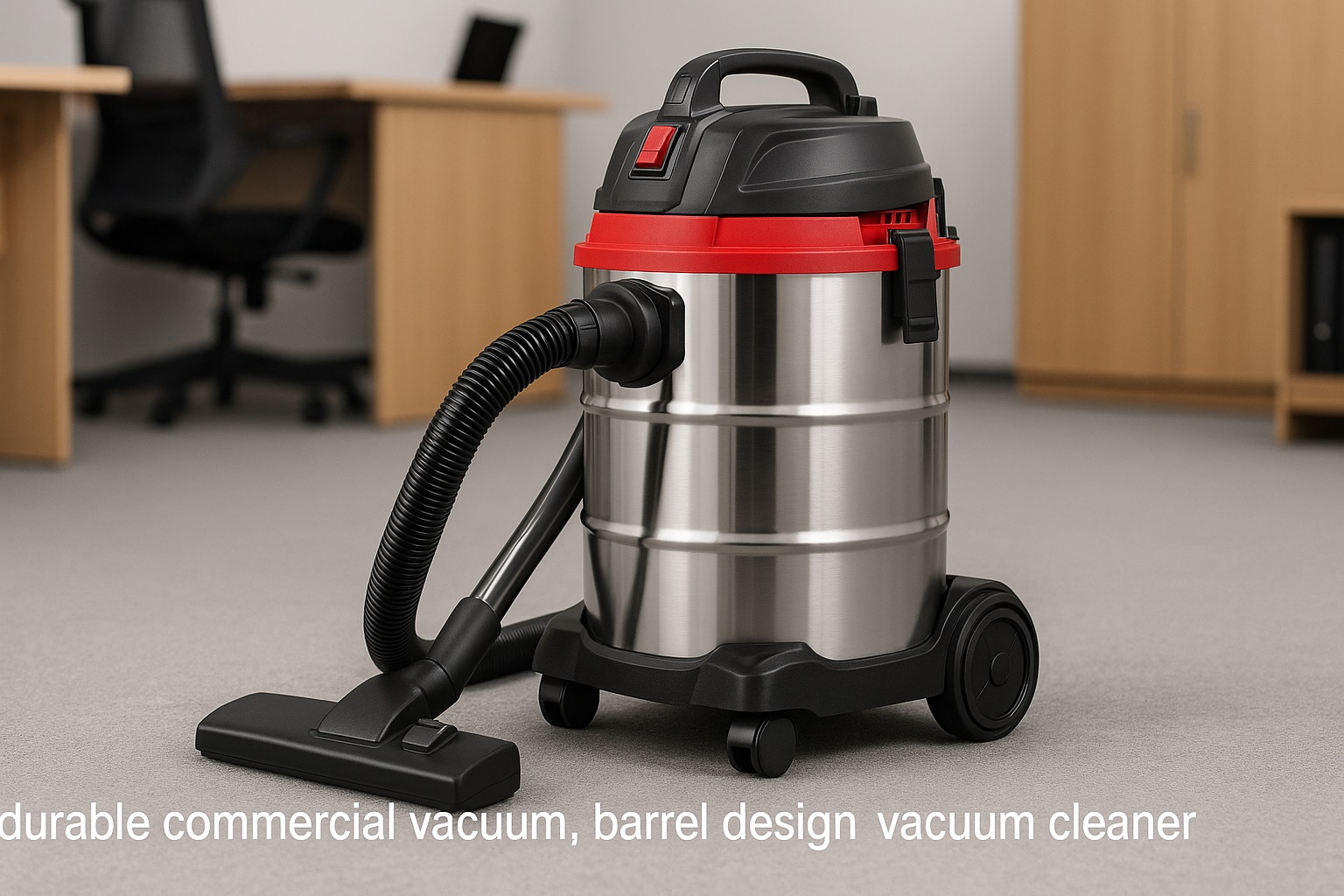
Marketing commercial cleaning equipment is fundamentally different from selling consumer products. Commercial buyers focus on performance, reliability, cost efficiency, and long-term value rather than impulse or brand emotion.
To market barrel vacuum cleaners effectively, distributors and manufacturers must align messaging with real operational needs and procurement priorities of commercial clients.
1. Understand Commercial Buyer Decision Drivers 🧠
Commercial clients typically evaluate products based on:
Successful marketing begins by addressing these priorities clearly and consistently in all communication.
2. Position Barrel Vacuum Cleaners as Long-Term Solutions 🏢
Rather than emphasizing price, effective marketing positions barrel vacuum cleaners as professional, long-term investments.
Key positioning messages include:
Designed for continuous commercial use
Lower replacement and maintenance costs
Suitable for large areas and high-frequency cleaning
This approach helps shift conversations away from price competition.
3. Segment Customers by Industry and Use Case 🏭
Commercial clients are not a single group. Tailored messaging improves relevance and conversion.
Examples of segmentation include:
Offices and corporate buildings
Hotels and hospitality facilities
Warehouses and factories
Cleaning contractors and facility managers
Marketing materials should clearly demonstrate how barrel vacuum cleaners solve problems in each environment.
4. Use Application-Based Demonstrations and Case Examples 🔍
Commercial buyers trust real-world results.
Effective marketing tools include:
Application photos and videos
Case studies and customer references
Demonstrations showing capacity and durability
Showing how the product performs in actual working conditions builds credibility and confidence.
5. Educate Buyers Instead of Selling Features 📘
Many commercial buyers are not vacuum specialists.
Strong marketing focuses on:
Explaining why features matter
Connecting technical specifications to business outcomes
Simplifying complex technical details
Education-based marketing shortens sales cycles and builds trust.
6. Highlight After-Sales Support and Reliability 🔄
For commercial clients, support matters as much as the product.
Marketing should clearly communicate:
Availability of spare parts and consumables
Maintenance support and service processes
Manufacturer reliability and supply stability
This reassures buyers and reduces perceived purchasing risk.
7. Support Distributor and Channel Sales Teams 🤝
Manufacturers and brand owners should empower distributors with:
Strong channel support ensures consistent messaging and improves overall market performance.
8. Build Long-Term Relationships, Not One-Time Sales 🚀
Commercial vacuum sales often lead to repeat orders, accessories, and multi-site contracts.
Effective marketing emphasizes:
Relationship-focused marketing delivers sustainable business growth.
Conclusion: Value-Driven Marketing Wins Commercial Clients 🏆
Marketing barrel vacuum cleaners to commercial clients requires a shift from product promotion to value communication. By focusing on durability, efficiency, cost control, and real-world applications, distributors and manufacturers can build trust and win long-term customers.
In competitive B2B markets, education, credibility, and consistency are the keys to successful commercial vacuum marketing.
For companies looking to develop effective marketing strategies and source reliable barrel vacuum cleaners for commercial markets, more information is available at www.lxvacuum.com.
Target Readers 🎯
Vacuum cleaner distributors and wholesalers
B2B sales and marketing teams
Commercial cleaning equipment suppliers
Importers and regional agents
OEM and private-label brand owners
50 Related Keyword Groups
barrel vacuum cleaner marketing, commercial vacuum sales, B2B cleaning equipment marketing, vacuum cleaner distributor marketing, commercial vacuum positioning, industrial vacuum sales strategy, professional vacuum marketing, commercial cleaning equipment marketing, barrel vacuum B2B sales, vacuum cleaner channel marketing, commercial vacuum branding, cleaning equipment sales strategy, B2B vacuum market, vacuum cleaner distributor strategy, commercial vacuum promotion, industrial vacuum marketing, professional cleaning equipment sales, vacuum cleaner marketing guide, commercial vacuum sales process, barrel vacuum product positioning, cleaning equipment marketing content, vacuum cleaner sales training, B2B equipment marketing strategy, commercial vacuum lead generation, vacuum cleaner buyer education, commercial vacuum value proposition, cleaning equipment distributor support, industrial cleaning equipment marketing, professional vacuum branding, commercial vacuum customer segmentation, vacuum cleaner marketing materials, barrel vacuum market strategy, B2B cleaning solutions marketing, commercial vacuum business development, vacuum cleaner channel sales, industrial vacuum sales enablement, professional cleaning marketing strategy, commercial vacuum growth strategy, barrel vacuum cleaner supplier marketing, B2B vacuum equipment market, commercial vacuum sales optimization, vacuum cleaner distributor support, cleaning equipment marketing plan, commercial vacuum sales tools, professional vacuum sales strategy











