Hi, message us with any questions.
We're happy to help!





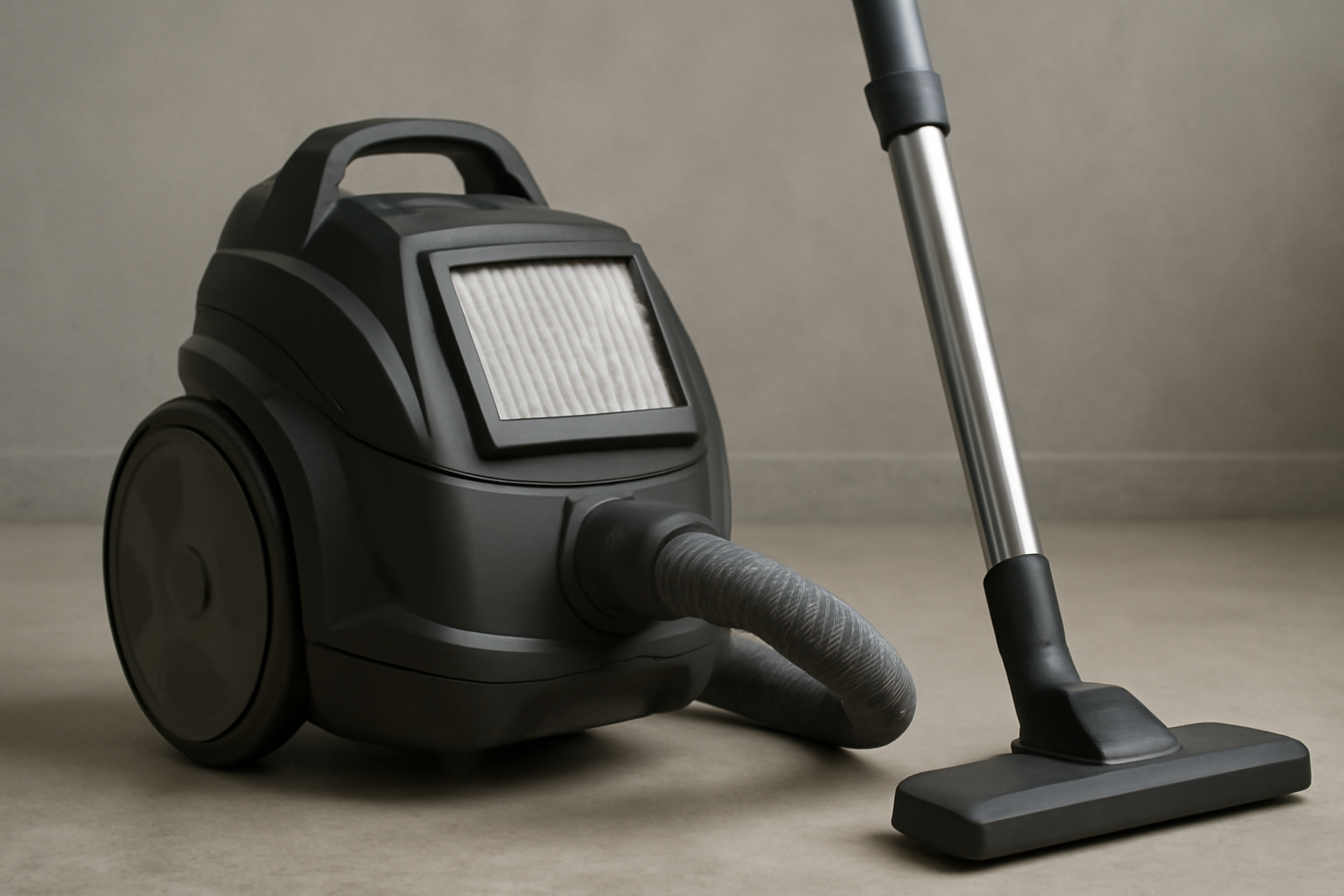
How Micro-Engineering, Smart Sensors, and Circular Thinking Are Transforming Clean Air
🌫️ 1. The Unseen Crisis Inside Our Walls
People spend over 90 % of their time indoors, yet the air inside modern buildings is often two to five times more polluted than the air outside.
Dust, pollen, pet dander, and micro-plastics drift through rooms unseen. Vacuum cleaners, once merely dust collectors, now stand at the frontline of a global health challenge.
As climate-controlled environments seal tighter for energy efficiency, filtration becomes the new ventilation.
High-Efficiency Particulate Air (HEPA) filters—originally developed in the 1940s for nuclear research—have evolved into everyday tools that quietly protect respiratory health.
🧬 2. What “HEPA” Really Means
A genuine HEPA filter captures at least 99.97 % of particles 0.3 microns in diameter—roughly one-hundredth the width of a human hair.
It works through three intertwined mechanisms:
Interception – particles following airflow paths stick to fibers.
Impaction – larger particles crash directly into fibers.
Diffusion – tiny particles zig-zag via Brownian motion until captured.
Recent advances replace random fiber mats with electro-spun nanofibers only a few hundred nanometers thick.
These form precise pore structures that trap more particles with lower airflow resistance, allowing powerful suction without higher energy demand.
⚙️ 3. Engineering the Modern HEPA Filter
Modern filters are no longer static mats tucked inside plastic frames.
They are multi-layer composites blending melt-blown polypropylene, electrostatic coatings, and sometimes activated-carbon layers for odor control.
Key innovations include:
Gradient density structures – coarse outer layers catch large dust; finer inner layers stop microscopic particles.
Reinforced pleat geometry – increases surface area without adding size.
Nanofiber overlays – boost filtration efficiency while maintaining breathability.
In next-generation vacuum cleaners, filter cartridges often integrate sensors that track air resistance and temperature, signaling when cleaning or replacement is due.
This shift from passive component to smart subsystem marks a major leap in appliance design.
🌪️ 4. Airflow, Suction, and the Efficiency Paradox
Filtration always creates resistance; more protection usually means more energy.
Engineers now use computational fluid dynamics to design housings that optimize airflow around the filter, reducing turbulence and maintaining suction pressure.
Variable-speed digital motors adjust output automatically, ensuring consistent performance as filters load with dust.
The result is an appliance that maintains strong cleaning capability while consuming less electricity—efficiency through intelligence rather than brute force.
🌬️ 5. Beyond Particles: The Rise of Multi-Function Filters
Traditional HEPA materials capture solids; newer hybrids address gases and microbes.
Activated-carbon layers adsorb volatile organic compounds (VOCs) emitted from paints or furniture.
Photocatalytic coatings using titanium dioxide break down organic molecules under UV light.
Some experimental filters integrate antimicrobial silver or copper ions, inhibiting bacterial growth on the surface.
This convergence—particulate, chemical, and biological filtration—turns vacuum systems into miniature air purifiers.
For households with allergies or asthma, it’s a health upgrade hidden inside a cleaning tool.
🔬 6. The Science of Clean Air Quality
Clean air is measurable.
Sensors detect particulate matter (PM2.5 and PM10), humidity, and temperature, feeding data to apps that visualize indoor conditions.
By coupling real-time monitoring with filtration, engineers create closed-loop systems: the machine “knows” when to intensify suction or prompt maintenance.
Data from connected vacuums also help researchers understand how indoor pollution fluctuates by region or season.
In large facilities, aggregated data guide cleaning schedules and HVAC settings, preventing over-cleaning and saving energy.
♻️ 7. Sustainability: The Filter’s Second Life
Disposable filters pose a waste problem.
Each one contains polymers and trapped dust that complicate recycling.
To counter this, manufacturers are experimenting with washable pre-filters, biodegradable fibers, and modular cartridges where the frame is reused and only the media replaced.
Closed-loop logistics—collecting used filters for industrial recycling—are emerging in commercial sectors.
Such systems mirror printer-cartridge returns: economical for suppliers, responsible for the planet.
Future designs may adopt bio-based polymers like polylactic acid (PLA), offering comparable strength and heat resistance with reduced fossil input.
🧠 8. The Procurement View: Health, Compliance, and ROI
For distributors and institutional buyers, filtration quality is no longer a soft benefit—it is a compliance issue.
Hospitals, hotels, and schools now include indoor-air standards in tender documents.
Procurement managers evaluate vacuum systems not just by cost or suction but by verified HEPA certification, energy rating, and filter-replacement logistics.
A filter that maintains efficiency for 500 hours instead of 300 hours directly lowers maintenance budgets.
When multiplied across fleets of machines, this durability becomes measurable ROI.
Moreover, organizations use clean-air metrics in sustainability reports, linking staff well-being to corporate ESG goals.
🏗️ 9. Manufacturing Precision and Quality Assurance
Producing nanofiber HEPA media demands micro-level control.
Electrospinning machines stretch polymer jets in electric fields, forming webs measured in nanometers.
Uniform fiber diameter ensures predictable airflow resistance; any inconsistency can halve efficiency.
Quality-control labs test filters for penetration using aerosolized sodium chloride or paraffin oil—standard methods defined in EN 1822 and ISO 29463.
Each batch receives a classification from E10 to H14, with H14 reserved for medical-grade filters.
Automation and inline optical scanners now verify every pleat and weld, ensuring consistent performance across millions of units.
🌐 10. Regional Trends: Europe, the Middle East, and Beyond
In Europe, strict Eco-Design and Energy-Label regulations push for filters that maintain efficiency without raising energy use.
Middle Eastern markets, challenged by dust and humidity, prioritize durability and reusability.
Smart connected vacuums are gaining traction in urban centers where air pollution awareness is growing.
Meanwhile, Asia leads in manufacturing capacity, exporting high-grade HEPA materials globally.
The result is a diversified supply chain where quality assurance and traceability determine long-term contracts.
🔋 11. Digital Twins and Predictive Maintenance
Digital-twin modeling allows engineers to simulate a vacuum’s airflow, particle distribution, and acoustic performance before building prototypes.
These virtual models predict how filters clog over time, enabling predictive maintenance algorithms.
Users receive alerts before suction drops noticeably, preventing overuse and premature motor strain.
Facilities can schedule filter replacement collectively, reducing logistics costs and minimizing downtime.
Predictive maintenance also generates anonymized datasets useful for improving future designs—a feedback loop of perpetual optimization.
🌾 12. The Human Story Behind the Filter
Technology aside, the HEPA revolution ultimately protects people.
Children, the elderly, and allergy sufferers benefit most from cleaner indoor air.
For many users, switching to a sealed filtration system means fewer sneezes, less dusting, and a tangible sense of freshness.
Designers now frame filtration as part of mental wellness: bright, open spaces feel healthier when air is invisible and scent-free.
Marketing may mention suction power, but loyalty builds around trust—the assurance that unseen particles stay trapped where they belong.
🔭 13. Looking Forward: Beyond HEPA
HEPA represents a milestone, not the finish line.
Emerging research explores electret filters that hold electrostatic charge for extended periods, and graphene-oxide membranes capable of molecular-level separation.
Hybrid devices may soon combine vacuuming, humidification, and air sterilization in one modular system.
Artificial intelligence could further personalize operation: analyzing household habits and automatically adjusting cleaning frequency based on occupancy and pollution levels.
In short, the future of filtration is adaptive—learning, communicating, and evolving with its environment.
🧭 14. Conclusion: The Invisible Innovation
Filtration is a quiet revolution.
While sleek designs and digital features grab attention, the filter inside determines whether a vacuum cleaner truly improves life quality.
Today’s HEPA innovations—nanofiber materials, smart sensors, and circular manufacturing—transform an ordinary component into an environmental guardian.
For engineers, this field bridges materials science, data analytics, and sustainability.
For procurement leaders, it’s a benchmark for product quality and long-term value.
And for everyone breathing indoors, it’s an invisible shield making daily life cleaner, safer, and calmer.
🔖 Hashtags
#HEPAFilter #VacuumTechnology #AirQuality #IndoorAirPollution #CleanAirInnovation #FiltrationEngineering #NanofiberTechnology #SmartAppliance #EnergyEfficiency #CircularEconomy #SustainableDesign #GreenManufacturing #AirPurification #HealthTech #EnvironmentalEngineering #SmartSensors #PredictiveMaintenance #DigitalTwin #SustainableLiving #EcoDesign #NextGenVacuum #SmartHomeDevices #LowCarbonAppliance #RecyclableMaterials #EcoEngineering #GreenInnovation #HomeAppliances #ModernHomeCare #SmartCleaningTech #ProductTesting #HumanCenteredDesign #SustainabilityTrends #LifecycleThinking #EnergySavingAppliance #FutureOfCleaning #SustainableProducts #CleanAirSolutions #HVACIntegration #MaterialScience #AirFiltrationSystems #DataDrivenDesign #EnergySmartHome #NanoTechnology #EcoFriendlyCleaning #AirMonitoring #IndustrialDesign #InnovationStrategy #ApplianceMarketInsights #SustainableEngineering #IndoorHealth #ScienceOfCleanAir #EfficientPerformance