Hi, message us with any questions.
We're happy to help!





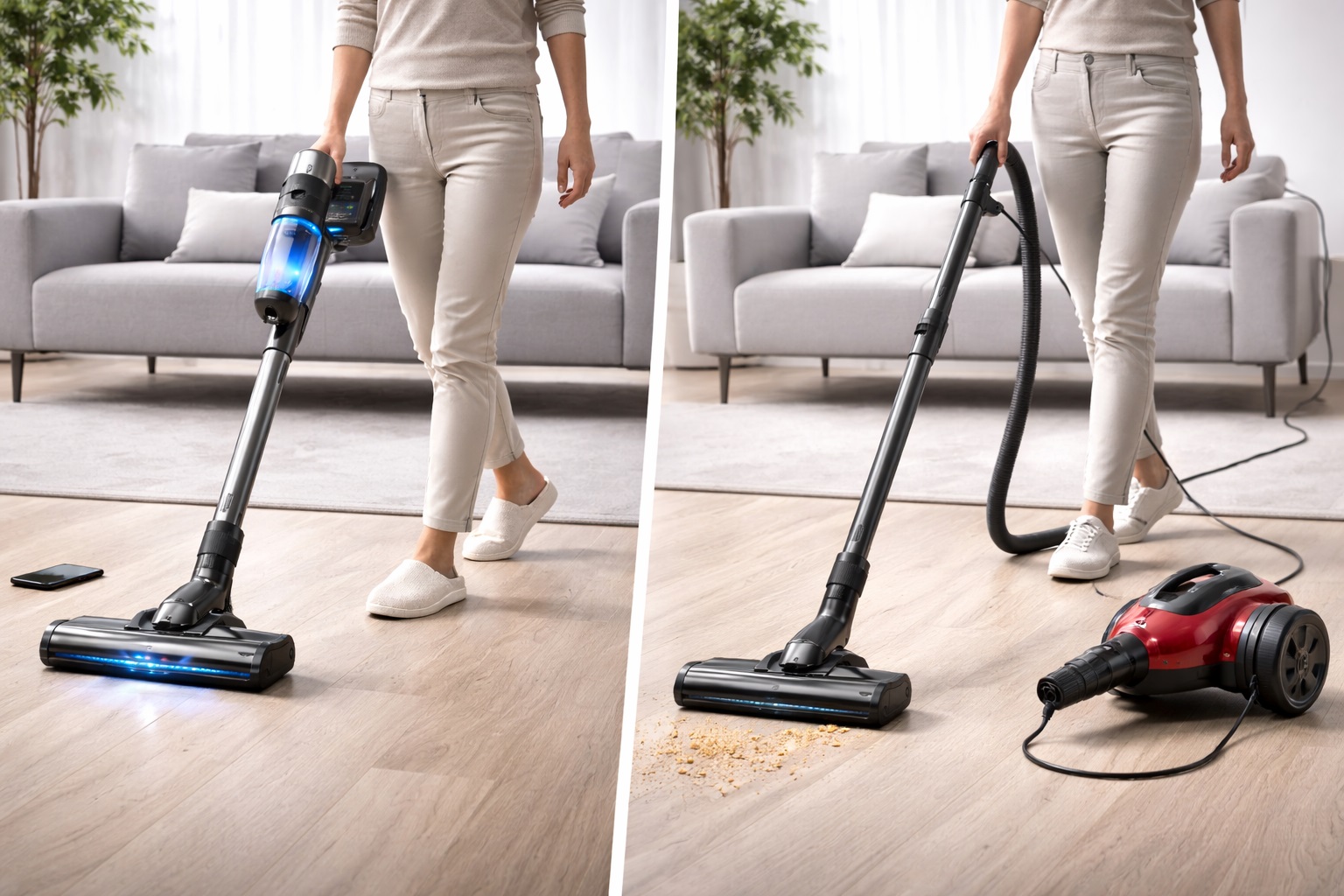
The cordless revolution has reshaped the vacuum cleaner market—but corded models are far from dead. The truth is simple: cordless wins on convenience, while corded wins on sustained power and predictable cost. What matters for brands, buyers, and distributors is not taking sides—it’s understanding how feature differences drive market acceptance, review performance, and return risk.
This guide compares cordless and corded vacuums from a practical standpoint: performance stability, user experience, noise, filtration, wet/dry suitability, and total cost of ownership. It also explains how to build a SKU matrix that matches real demand instead of following hype.
I. The core tradeoff: convenience vs. sustained performance 🎯
Most consumers choose a vacuum based on daily habits:
quick touch-ups, stairs, and frequent cleaning → cordless feels natural
long sessions, heavy debris, or light commercial duty → corded often performs more consistently
So the first differentiation step is defining your target scenario:
Apartment Vacuum Cleaner positioning often favors cordless + quiet comfort
family homes with multiple rooms may favor cordless daily drivers plus a heavier-duty option
wet mess or mixed cleaning might justify specialized Wet Dry Vacuum Cleaners
Instead of “cordless vs corded,” think “short sessions vs long duty cycles.”
II. Cordless: the feature advantages consumers immediately feel 🔋✨
A modern Cordless Vacuum Cleaner stands out because it reduces friction:
no plug switching
fast grab-and-go cleaning
easier stair and corner access
better portability for cars and travel
1) The handheld ecosystem advantage
Cordless platforms often support:
cordless handheld vacuums for spot cleaning
a companion Li-ion Cordless Handheld Vacuum Cleaner for quick crumbs, upholstery, and tight spaces
a practical Car Vacuum Cleaner kit for seat rails and interiors 🚗
a Portable Vacuum for Travel use-case for hotels or small spaces 🧳
This modular ecosystem is a strong differentiation tool for distribution programs because bundles increase average order value.
2) Quiet positioning is easier in cordless (sometimes) 🤫
Many consumers associate cordless with modern, refined UX. When engineered well, cordless can support quiet vacuum cleaner positioning—especially in “standard” or “quiet mode” settings for Quiet Vacuum for Night Use.
However, cordless can also become noisy at high speed because small motors may create high-frequency tone. So quiet differentiation still requires airflow tuning and vibration control.
III. Corded: where it still wins (and why it remains relevant) 🔌✅
Corded vacuums keep strong acceptance in many markets because they deliver:
stable suction without battery fade
longer duty cycles without overheating concerns
predictable long-term cost (no battery replacement anxiety)
For procurement teams, corded products can be attractive for:
consistent cleaning performance across extended use
fewer battery-related warranty issues
simpler compliance and spare-parts planning
Corded products also fit certain distribution channels where consumers still prioritize “plug-in power” as a quality cue—especially for heavier cleaning sessions.
IV. Performance differences that matter: suction stability vs peak marketing ⚡
Consumers and reviewers increasingly judge vacuums by “does it keep cleaning well?” not “what’s the peak number?”
Cordless performance reality
Cordless vacuums can show performance variation based on:
battery charge level
mode selection (eco/standard/boost)
thermal limits after prolonged high power
filter loading and bin fill level
A cordless model can still earn High Suction Vacuum Cleaner positioning if it delivers stable pickup in normal modes and doesn’t collapse after a short burst.
Corded performance reality
Corded models typically provide more stable power delivery, which can make performance feel consistent—especially under heavy debris loads.
Differentiation tip: in content and spec sheets, shift language from peak suction to stable cleaning outcomes on real surfaces.
V. Noise and comfort: who has the advantage? 🤫
Noise isn’t just volume; it’s also tone and vibration.
Cordless noise profile
Can be quieter in standard modes when airflow is optimized
Can have high-frequency whine at high RPM in boost mode
Compact housings can amplify vibration if not isolated
Corded noise profile
Larger motors may produce lower-frequency noise (often less “sharp”)
Some designs are louder overall due to higher airflow
Heavier bodies can damp vibration (sometimes improving “hand feel”)
If your market emphasizes apartments and night use, differentiate with a Portable Quiet Vacuum Cleaner strategy and validate with repeatable dB(A) and tone testing.
VI. Filtration and allergy acceptance: cordless vs corded isn’t the main issue 😷
For a HEPA Filter Vacuum Cleaner and Vacuum Cleaner for Allergies, the most important factor is not the power source—it’s whether the system is sealed and maintainable.
What buyers should focus on:
sealed filtration design to minimize bypass leakage
easy filter access so users maintain performance
dust containment during emptying (a major complaint point)
Cordless or corded can both succeed here. The differentiator is the filtration system design and the maintenance UX.
VII. Wet/dry suitability: battery constraints change the equation 💦
Wet/dry cleaning introduces:
higher mechanical complexity
more maintenance steps
potential odor issues if drying is poor
Cordless wet/dry: convenience + engineering pressure
Cordless wet/dry products are popular because they’re flexible and modern. A premium approach is the 4 in 1 Cordless Smart Wet & Dry Vacuum Cleaner, which combines multiple modes and guided workflows. But it also demands:
strong battery management (wet mode can be power-hungry)
reliable self-cleaning routines
careful sealing and hygiene design to prevent odor
A Self-Cleaning Vacuum Cleaner feature becomes especially important for cordless wet/dry success.
Corded wet/dry: sustained operation
Corded wet/dry products can run longer without battery concerns, which can be helpful for larger cleaning tasks. However, the user experience tradeoff (cord management) may reduce adoption in some consumer segments.
For families needing fewer refills, a Large-Capacity Wet Dry Vacuum Cleaner can differentiate—but only if handling remains comfortable.
VIII. Total cost of ownership (TCO): the procurement lens 💼
For vacuums procurement teams, TCO can decide the lineup:
Cordless: battery replacement risk, charging accessories, and thermal-related failures
Corded: fewer battery issues, but potentially higher shipping weight and different usage expectations
For vacuum cleaner distribution, TCO influences:
warranty claim rates
spare parts planning (filters, brush rolls, batteries)
customer support burden
A balanced portfolio can reduce overall business risk while serving multiple segments.
IX. Market acceptance: what drives adoption across channels 🌍
E-commerce
Cordless often performs well because:
convenience is easy to communicate
short videos show benefits instantly
bundles (tools + spare filters) increase conversion
Value-driven shoppers still search for budget phrases like best vacuum on a budget and best affordable vacuum. Cordless can win here if “value engineering” protects durability and maintenance experience.
Retail and regional preferences
Some regions and retail segments still prefer corded for perceived “real power.” Acceptance often depends on:
home size
flooring mix
electricity price sensitivity
cultural expectations around appliance longevity
Household type segmentation
apartments and small homes → cordless + quiet focus
pet homes → brush design + maintenance workflow
mixed surfaces → head design and Vacuum for Multi-Surface proof
allergy-sensitive households → sealed HEPA credibility
X. How to build the right lineup (instead of choosing a side) 🧩
A practical SKU matrix for many brands looks like:
a main Cordless Vacuum Cleaner for daily whole-home use
a Li-ion Cordless Handheld Vacuum Cleaner companion SKU
a specialized wet/dry model (cordless smart or corded heavy-duty) depending on target market
clear differentiation for pets, allergies, apartments, and travel/car segments
This reduces internal competition and helps distributors create clean shelves and clear listings.
Conclusion: Cordless and corded can both win—if you position by scenario and prove outcomes 🌟
Cordless vacuums dominate convenience and ecosystem bundling, while corded models still win on sustained performance and predictable cost. The best market strategy is not picking a winner—it’s building a scenario-led lineup and proving stable cleaning outcomes through tests. When you align power source choice with real user habits and distribution realities, market acceptance becomes predictable instead of risky. ✅
www.lxvacuum.com
Ideal Readers
Global vacuum buyers / vacuums procurement teams
Distributors & brand owners / vacuum cleaner distribution professionals
Product R&D engineers and product managers
Related Keyword Groups
Lanxstar cordless vs corded vacuum, Lanxstar vacuum market analysis, vacuums procurement, vacuum cleaner distribution, Cordless Vacuum Cleaner acceptance trends, corded vacuum sustained suction, Li-ion Cordless Handheld Vacuum Cleaner platform, cordless handheld vacuums bundle strategy, Car Vacuum Cleaner cordless kit, Portable Vacuum for Travel compact cordless, quiet vacuum cleaner cordless mode, Quiet Vacuum for Night Use cordless apartment, Apartment Vacuum Cleaner cordless docking, High Suction Vacuum Cleaner stability comparison, suction consistency cordless vs corded, airflow efficiency per watt cordless, battery runtime by mode analysis, battery thermal management vacuum, HEPA Filter Vacuum Cleaner sealed system, Vacuum Cleaner for Allergies positioning, dust containment during emptying, Vacuum Cleaner for Pet Hair brush design comparison, Vacuum Cleaner for Hardwood Floors head design, Vacuum for Multi-Surface pickup testing, Fast Lightweight Vacuum Cleaner cordless ergonomics, Multi-Functional Durable Vacuum Cleaner durability factors, Energy-Saving Efficient Powerful Vacuum Cleaner efficiency story, wet dry vacuum cordless suitability, Wet Dry Vacuum Cleaners platform choice, Wet and Dry Vacuum Cleaner mode stability, Self-Cleaning Vacuum Cleaner wet hygiene, 4 in 1 Cordless Smart Wet & Dry Vacuum Cleaner market fit, Large-Capacity Wet Dry Vacuum Cleaner handling tradeoff, corded wet dry vacuum long duty cycle, accessory ecosystem for vacuums, spare parts planning filters batteries, warranty claim rate reduction strategy, e-commerce vacuum positioning, best vacuum on a budget cordless value, best affordable vacuum platform choice, best budget vacuum cleaner segmentation, best value hoover positioning, best value for money hoover messaging, best vacuum cleaners on a budget SEO, best vacuums on a budget intent, good budget vacuum cleaner conversion, regional vacuum preference analysis, channel assortment planning, distributor-ready vacuum SKU matrix



