Hi, message us with any questions.
We're happy to help!





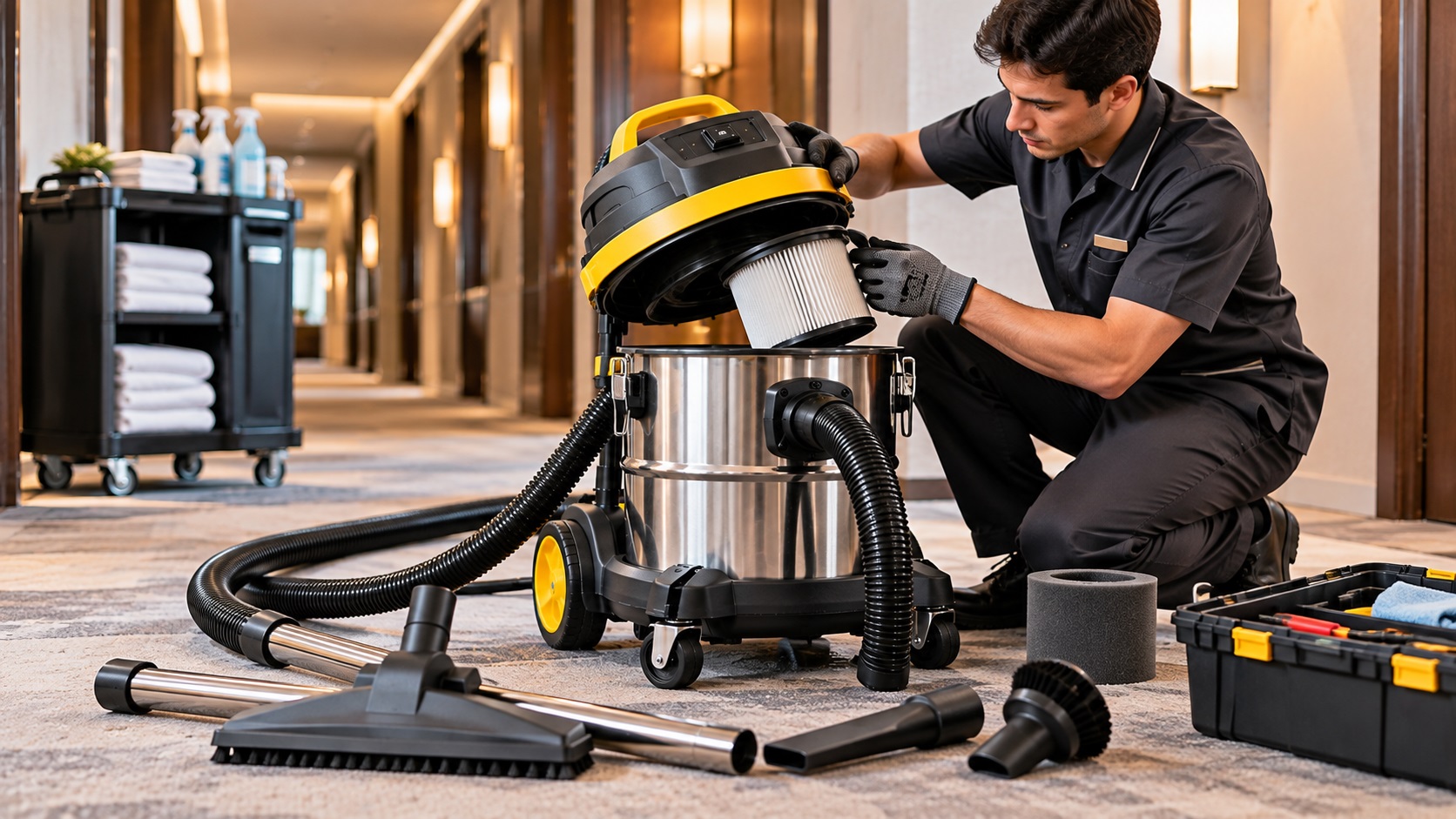
Why Vacuum Maintenance Matters in Hotel Cleaning 🏨
Commercial vacuum cleaners can work hard in a hotel.
One machine may clean guest rooms in the morning, corridors in the afternoon and public areas later in the day. Depending on the property, cleaning equipment can operate for hours and may be used by several employees during different shifts.
This workload means maintenance should not begin only after a machine stops working.
Preventive care can help a commercial vacuum cleaner maintain consistent suction, reduce avoidable downtime and make daily housekeeping operations more predictable.
For a wet and dry vacuum cleaner, maintenance is especially important because the machine may encounter both dry dust and liquids.
Filters, hoses, tanks, seals and accessories all affect performance.
A blocked hose can make a powerful motor feel weak. A heavily loaded filter can restrict airflow. A damaged seal may reduce suction. Incorrect wet pickup procedures can create unnecessary risks for the machine.
For hotel cleaning teams, effective maintenance therefore begins with a simple principle:
Keep the airflow path clean, inspect wear components regularly and address small problems before they become large ones. 🔧
1. Create a Simple Daily Inspection Routine
A commercial vacuum should receive a brief inspection before or after each working shift.
This does not need to become a complicated engineering procedure.
Hotel employees can check:
power cable condition;
plug condition;
hose connections;
visible hose damage;
filter condition;
tank fill level;
wheels and casters;
floor nozzle;
unusual sounds;
unusual odors.
For a High Suction Vacuum Cleaner, even a small blockage can significantly affect practical pickup performance.
If an employee notices that cleaning suddenly requires several passes instead of one, the machine should be inspected rather than simply operated for longer.
A daily visual check can also identify damaged components before they interrupt housekeeping operations.
Hotels with large cleaning teams can incorporate this inspection into equipment return procedures at the end of each shift.
2. Empty the Tank Before It Becomes Overfilled 🪣
One of the simplest maintenance habits is also one of the most important.
Do not continuously operate a vacuum with an excessively full tank or dust container.
As debris accumulates, airflow and filtration conditions can change. In wet applications, excessive liquid collection can also interfere with normal operation if the machine reaches its designed capacity.
A Large-Capacity Wet Dry Vacuum Cleaner reduces the frequency of emptying, but large capacity does not mean unlimited capacity.
Hotel cleaning teams should establish clear emptying points.
For example:
Guest-room vacuum: inspect after each housekeeping shift.
Public-area vacuum: check between major cleaning zones.
Wet/dry machine: inspect immediately after significant liquid collection.
Large hotels may also benefit from recording which teams are responsible for emptying shared equipment.
This avoids situations where one shift assumes the next team will handle maintenance.
3. Keep Filters Clean to Protect Suction 💨
Filters play a central role in vacuum performance.
As dust accumulates, airflow can become restricted. The result may be reduced pickup performance and additional stress on the vacuum system.
A HEPA filter vacuum cleaner also requires correct filter maintenance to preserve its intended filtration performance.
Hotel teams should follow the manufacturer's instructions regarding:
filter inspection;
cleaning;
washing, where permitted;
drying;
replacement intervals.
Never assume that every filter can be washed.
Some filters are designed for replacement rather than washing, while others may require specific cleaning procedures.
If a washable filter is cleaned with water, it should generally be completely dry before reuse unless the manufacturer's instructions specifically state otherwise.
Installing a wet filter where a dry filter is required can affect airflow and potentially damage the equipment.
📌 A useful hotel practice is to keep replacement filters available rather than waiting until every installed filter has reached the end of its service life.
4. Learn the Signs of a Blocked Hose
A vacuum can have a functioning motor and still produce poor cleaning results because airflow is restricted elsewhere.
Hose blockages are common.
Hotels vacuum many types of debris, including:
paper pieces;
hair;
threads;
food particles;
packaging fragments;
dust;
small objects accidentally left on floors.
A blockage may occur inside the hose, extension tube or floor nozzle.
Typical signs include:
reduced suction at the nozzle, unusual motor sound, weak debris pickup or sudden performance decline.
If suction drops unexpectedly, employees should switch off and unplug the machine before inspecting accessible airflow components according to the manufacturer's instructions.
Do not attempt to solve a blockage by repeatedly running the machine at maximum power.
For a high suction power vacuum cleaner, clear airflow is essential for effective operation.
5. Inspect Hoses for Cracks and Air Leaks
A hose does not need to be completely blocked to reduce performance.
Small cracks, loose connections or damaged seals can allow outside air into the system.
This reduces suction where it is actually needed—at the cleaning nozzle.
Hotel teams should periodically inspect the entire hose, paying particular attention to:
connection points;
flexible sections near fittings;
areas frequently bent during storage;
visible cracks;
loose cuffs.
Hoses in commercial environments experience repeated pulling, twisting and movement around furniture.
A commercial grade vacuum cleaner should use durable components, but no hose lasts forever.
Keeping spare hoses available can prevent a relatively inexpensive component from taking an entire machine out of service.
6. Clean Floor Tools and Accessories Regularly 🧹
Hotel vacuum accessories come into direct contact with dust, hair, fibers and debris.
Over time, these materials can collect around brushes, nozzle openings and wheels.
Housekeeping teams should inspect floor tools and accessories regularly.
Hair and fibers can be particularly problematic around moving components.
Crevice tools should also be checked for obstructions.
For a Multi-Functional Durable Vacuum Cleaner, maintaining accessories is essential because the machine's versatility depends on those tools functioning correctly.
Hotel cleaning managers can assign accessory cleaning as part of a weekly equipment maintenance routine.
This also provides an opportunity to identify missing tools before the next shift needs them.
7. Maintain Wet/Dry Vacuums Differently After Liquid Pickup 💧
A wet dry vacuum cleaner requires additional attention after collecting liquids.
Leaving dirty liquid inside the tank can create odors and residue.
After wet pickup, employees should follow the manufacturer's procedures for emptying and cleaning the tank.
Depending on the machine and application, maintenance may include:
Emptying collected liquid.
Rinsing or cleaning the tank where appropriate.
Checking the float or liquid shut-off system.
Inspecting the hose.
Cleaning wet pickup accessories.
Allowing relevant components to dry.
The wet and dry suction system should also be checked for correct filter configuration before switching between wet and dry applications.
Hotel teams should never assume that the same filter arrangement applies to both modes.
Always follow the instructions for the specific model.
This is particularly important when several employees share one machine.
8. Prevent Odors in Wet/Dry Vacuum Tanks
Hotels place a high value on cleanliness and guest experience.
A vacuum cleaner that develops an unpleasant smell can undermine both.
Odors may develop when wet debris, dirty water or organic material remains inside the tank.
After liquid pickup, do not simply store the machine until the next shift.
Clean and dry the relevant components according to the manufacturer's instructions.
Restaurant and banquet cleaning equipment deserves particular attention because collected debris may contain food residues.
A clean tank also makes future maintenance easier and allows employees to identify damage or contamination more quickly.
✨ Clean equipment should itself be part of a professional housekeeping standard.
9. Check Wheels and Casters
Wheels may seem unrelated to suction, but they are essential to commercial vacuum usability.
A hotel machine moves through guest rooms, corridors, elevators and public spaces every day.
Hair, threads and carpet fibers can become wrapped around casters.
Employees should inspect wheels for:
trapped debris;
excessive wear;
loose fasteners;
poor rotation;
physical damage.
A Fast Lightweight Vacuum Cleaner loses much of its mobility advantage if one wheel stops rotating smoothly.
Hotels should also replace damaged wheels promptly.
Dragging equipment with a failed caster can damage flooring and place additional strain on the machine body.
10. Inspect Power Cables and Plugs Carefully ⚡
Electrical components require particular attention.
Commercial vacuum cleaners are repeatedly plugged in, unplugged, moved and stored.
Cables can become trapped under equipment or pulled around furniture.
Employees should visually inspect cables and plugs for damage.
If electrical damage is found, the machine should be removed from service and handled according to the hotel's safety procedures and the manufacturer's service recommendations.
Employees should not improvise electrical repairs.
For hotel groups purchasing equipment, cable durability and replacement procedures should be evaluated during procurement.
Maintenance begins with good product design.
11. Listen for Changes in Motor Sound
Experienced housekeeping employees often recognize how their equipment normally sounds.
A sudden change in motor tone can indicate a developing issue.
Possible causes may include airflow restriction, incorrect assembly, filter problems or other mechanical conditions.
Employees do not need to diagnose the motor themselves.
Instead, they should report unusual sounds early.
Continuing to operate equipment that sounds abnormal can turn a manageable maintenance problem into a more expensive repair.
For a dual motor vacuum cleaner, maintenance teams should also understand the operating controls and recommended usage of the specific machine.
Professional service personnel should handle internal motor repairs where required.
12. Case Study: Hotel Solves Recurring Suction Problems 📋
Consider a 220-room hotel where housekeeping staff repeatedly report that several vacuum cleaners have “weak motors.”
The maintenance team initially assumes the equipment is reaching the end of its service life.
Before replacing the machines, the hotel performs a systematic inspection.
The team discovers three recurring issues:
filters are heavily loaded, several hoses contain partial blockages, and one hose has a significant air leak near its connector.
After filters are serviced or replaced and the airflow paths are restored, much of the original cleaning performance returns.
The hotel then introduces a weekly inspection routine.
Housekeeping supervisors receive a simple checklist covering filters, hoses, tanks, wheels and accessories.
The key lesson is important:
Loss of suction does not automatically mean motor failure.
Basic airflow maintenance should be checked before a commercial vacuum cleaner is classified as defective.
13. Case Study: Banquet Team Improves Wet Vacuum Maintenance
🍽️ A large hotel uses Large-Capacity Wet Dry Vacuum Cleaner units for banquet and event areas.
The machines frequently collect spilled drinks and dirty water after events.
The hotel begins experiencing odor complaints from the equipment storage area.
An inspection reveals that machines are sometimes stored immediately after liquid pickup without thorough tank cleaning.
Management introduces a post-event procedure:
empty → rinse as appropriate → inspect → dry → store.
The hotel also assigns responsibility to the final cleaning shift instead of leaving maintenance undefined.
This simple procedural change helps keep the equipment cleaner and ready for the next event.
The example demonstrates that equipment reliability depends not only on machine design but also on staff procedures.
14. Protect Low-Noise Performance
A low noise vacuum cleaner is valuable in hotels because cleaning often occurs around guests.
Maintenance can influence perceived noise.
Loose components, damaged wheels or airflow restrictions may cause a machine to sound different from normal.
A Portable Quiet Vacuum Cleaner should therefore be periodically checked for unusual vibration or rattling.
Noise changes should not automatically be treated as normal aging.
They can provide an early warning that something requires inspection.
For premium hospitality environments, keeping equipment operating smoothly helps preserve the low-disturbance cleaning experience the hotel originally purchased the machine to provide.
15. Build a Preventive Maintenance Schedule 📅
Rather than waiting for breakdowns, hotels can organize vacuum maintenance by frequency.
Daily tasks may include: visual inspection, tank emptying, cable checks and removal of obvious nozzle debris.
Weekly tasks may include: filter inspection, hose inspection, wheel cleaning and accessory checks.
Periodic tasks may include: replacement of worn filters, inspection of seals, examination of electrical components by qualified personnel and replacement of damaged hoses or wheels.
The exact schedule should follow manufacturer recommendations and actual usage intensity.
A machine used for several hours every day may need more frequent attention than one reserved for occasional spill recovery.
Hotel groups can also record maintenance history for each unit.
This helps identify models or components that generate unusually high service costs.
16. Keep Common Spare Parts Available 🔩
Downtime can be expensive even when the failed component is inexpensive.
If a hotel must wait several weeks for a replacement hose or filter, a usable machine may remain out of service unnecessarily.
Common spare inventory may include:
filters;
hoses;
floor tools;
crevice tools;
wheels;
compatible consumables.
The exact spare parts list depends on the model.
When buying from a vacuum cleaner supplier, hotels should ask which components commonly require replacement and whether those parts can be ordered separately.
For hotel groups, centralized spare-parts purchasing can simplify inventory management.
This is also an important consideration when evaluating a new vacuum cleaner manufacturer.
17. Maintenance Should Influence Procurement Decisions
Hotels often think about maintenance after equipment has already been purchased.
It is better to consider it during procurement.
When evaluating a commercial vacuum cleaner for hotel use, ask:
How quickly can the filter be accessed?
How easy is the tank to empty?
Can hoses and wheels be replaced?
Are spare parts available?
Does the supplier provide operating documentation?
Can replacement filters be purchased in bulk?
An inexpensive machine with difficult maintenance can become costly across a large fleet.
This is why the best affordable vacuum for commercial hospitality use should be judged by total ownership cost, not simply the initial invoice.
18. Energy Efficiency Depends on Maintenance Too ⚡
An energy efficient vacuum cleaner should convert electrical input into useful cleaning performance effectively.
But even a well-designed machine cannot perform optimally when its filter is clogged or hose is restricted.
Poor airflow may cause employees to make additional cleaning passes.
That means more operating time and potentially greater energy use for the same task.
Maintaining an Energy-Saving Efficient Powerful Vacuum Cleaner therefore involves preserving its intended airflow and suction performance.
For hotel groups with large equipment fleets, maintenance and energy efficiency should be considered together.
Good preventive maintenance supports both productivity and operating-cost control.
19. What Distributors and Procurement Teams Should Ask Suppliers 🌍
For wholesalers and large hotel groups, long-term service support should be part of supplier evaluation.
When sourcing from an industrial vacuum cleaner supplier, cleaning equipment supplier or vacuum cleaner manufacturer in China, buyers should ask about:
spare parts availability;
filter supply;
hose availability;
motor replacement options;
exploded parts diagrams where available;
maintenance instructions;
warranty procedures;
recommended service intervals.
A low vacuum cleaner price wholesale can become less attractive if replacement parts are difficult to obtain.
Before a bulk vacuum cleaner purchase, distributors should consider ordering a reasonable quantity of appropriate consumables and commonly required spare parts.
This can improve after-sales support for their own customers.
20. OEM and Private Label Maintenance Support
Companies developing an OEM vacuum cleaner, ODM vacuum cleaner or private label vacuum cleaner should consider maintenance from the beginning of the project.
Branding the machine is only one part of building a commercial product.
Distributors should also plan:
replacement filter SKUs;
spare hose supply;
accessory availability;
user instructions;
maintenance guidance;
warranty handling.
When selecting an OEM industrial vacuum cleaner manufacturer, buyers should discuss spare-parts continuity alongside customization and production capacity.
For a bulk order vacuum cleaner, it may be efficient to ship selected spare components with the main order.
This is particularly useful for importers who need to maintain local after-sales inventory.
21. Maintenance Checklist for Hotel Cleaning Teams ✅
A practical commercial vacuum checklist can be simple.
Before Use
Check the cable and plug.
Inspect the hose connection.
Confirm the filter and tank are correctly installed.
Check wheels and accessories.
After Dry Cleaning
Empty the tank when required.
Check the filter.
Remove debris from nozzles.
Store accessories correctly.
After Wet Cleaning
Empty liquids promptly.
Clean the tank according to instructions.
Inspect the liquid protection system.
Clean relevant accessories.
Allow components to dry where required.
Weekly
Inspect hoses for cracks and blockages.
Clean wheels and casters.
Review filter condition.
Check missing or damaged accessories.
Periodically
Replace worn filters and components.
Review maintenance records.
Inspect machines showing unusual noise, odor or performance changes.
Arrange professional servicing where necessary.
22. When Should a Commercial Vacuum Be Replaced?
Maintenance can extend equipment life, but no commercial machine operates indefinitely.
Hotels should compare repair cost with replacement cost when equipment becomes older or increasingly unreliable.
Possible replacement indicators include:
repeated major failures;
unavailable spare parts;
excessive downtime;
damaged structural components;
declining performance despite correct maintenance;
repair costs approaching replacement economics.
A heavy duty vacuum cleaner may offer a longer practical service life in demanding applications, but only when properly maintained and correctly matched to the workload.
Hotels should use maintenance records to make replacement decisions based on actual operating history rather than guesswork.
Better Maintenance Creates More Reliable Hotel Cleaning
🏨 Commercial vacuum maintenance does not need to be complicated.
Consistent basic care can make a significant difference.
Keep filters clean. Empty tanks before they become overloaded. Inspect hoses for blockages and leaks. Maintain accessories and wheels. Clean wet/dry tanks after liquid collection. Report unusual motor sounds early. Keep common spare parts available.
Most importantly, establish clear responsibility.
When everyone assumes somebody else will maintain shared equipment, maintenance is easily missed.
For hotel groups, preventive maintenance also creates useful procurement data. Repair frequency, spare-parts consumption and equipment downtime can help buyers evaluate future models more accurately.
For wholesalers and distributors, supplying a reliable commercial vacuum means supporting the product beyond the original sale through filters, hoses, accessories and appropriate spare parts.
Lanxstar provides commercial and wet/dry vacuum cleaner solutions for professional cleaning applications and can discuss equipment configurations, spare-parts requirements, OEM/ODM projects and bulk purchasing with hospitality buyers, wholesalers, distributors and international importers.
For additional product and sourcing information, visit www.lxvacuum.com
If you are interested, please feel free to contact us.
50 Related SEO Keywords:
commercial vacuum maintenance, hotel vacuum cleaner maintenance, hotel cleaning equipment maintenance, wet dry vacuum cleaner maintenance, wet and dry vacuum cleaner, wet dry vacuum cleaner, commercial vacuum cleaner, industrial vacuum cleaner, hotel vacuum cleaner, commercial vacuum cleaner for hotel use, High Suction Vacuum Cleaner, Portable Quiet Vacuum Cleaner, Multi-Functional Durable Vacuum Cleaner, Fast Lightweight Vacuum Cleaner, Energy-Saving Efficient Powerful Vacuum Cleaner, Large-Capacity Wet Dry Vacuum Cleaner, HEPA filter vacuum cleaner, high suction power vacuum cleaner, low noise vacuum cleaner, energy efficient vacuum cleaner, commercial grade vacuum cleaner, heavy duty vacuum cleaner, dual motor vacuum cleaner, stainless steel vacuum tank, wet and dry suction system, hotel housekeeping equipment, hotel cleaning equipment, hospitality cleaning equipment, hotel carpet vacuum cleaner, hotel facility cleaning equipment, vacuum cleaner filter maintenance, vacuum cleaner hose maintenance, vacuum cleaner suction troubleshooting, wet vacuum tank cleaning, commercial vacuum spare parts, facility management cleaning equipment, commercial cleaning equipment, vacuum cleaner supplier, vacuum cleaner manufacturer, vacuum cleaner manufacturer in China, industrial vacuum cleaner supplier, cleaning equipment supplier, wholesale vacuum cleaner, bulk vacuum cleaner purchase, OEM vacuum cleaner, ODM vacuum cleaner, private label vacuum cleaner, Lanxstar, vacuum manufacturer, vacuum cleaner maker