Hi, message us with any questions.
We're happy to help!





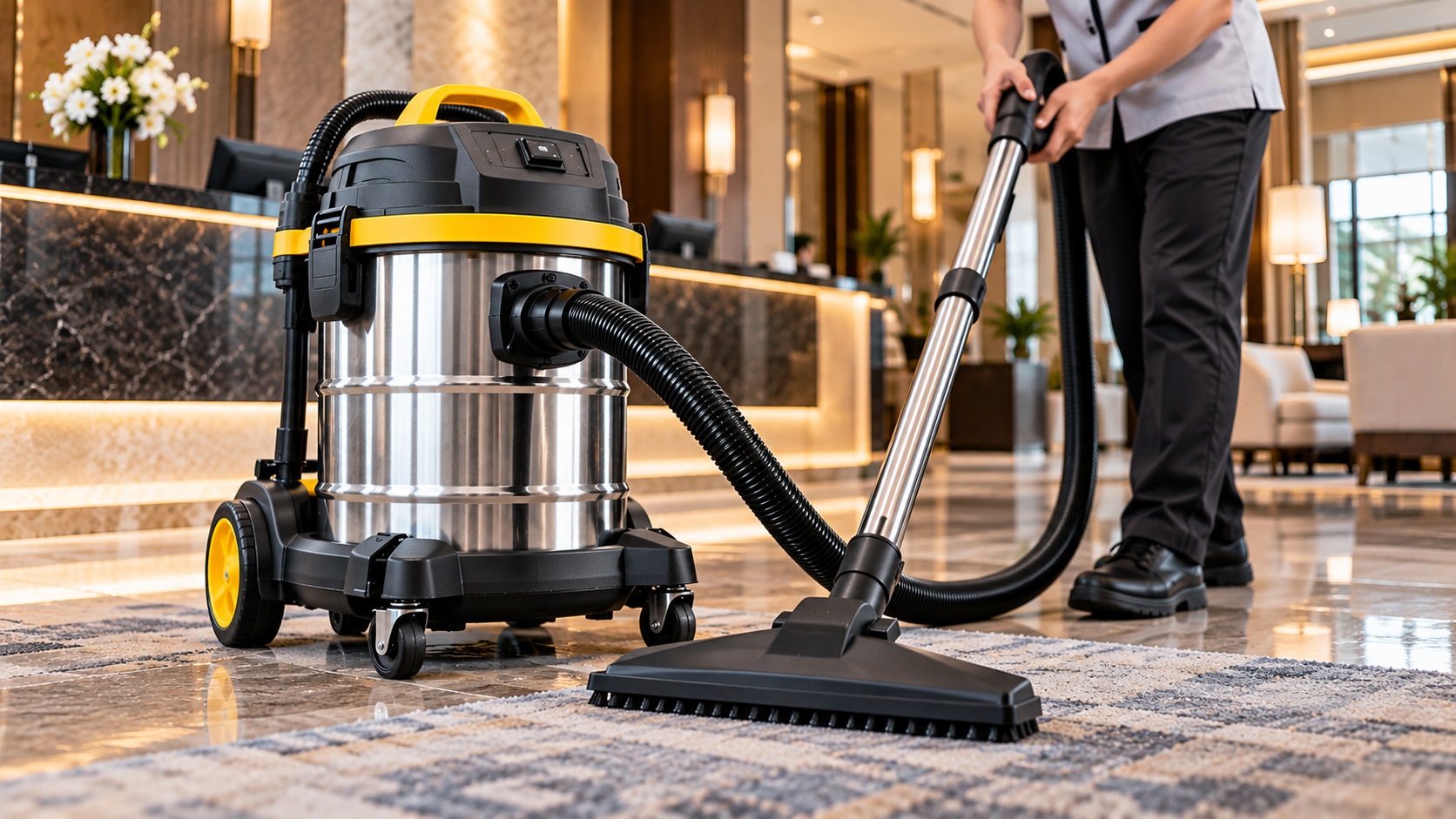
What Makes a Vacuum Cleaner Suitable for Hospitality Cleaning? 🏨
Hotels, resorts, serviced apartments and other hospitality facilities require exceptionally consistent cleaning.
Guests expect carpets to look clean, room corners to be free of dust, public spaces to remain presentable and accidental spills to be handled quickly. At the same time, cleaning teams often work while guests remain inside the building.
That combination creates a unique equipment challenge.
The ideal commercial vacuum cleaner for hospitality cleaning should not simply offer maximum suction. It needs to combine practical cleaning performance with low noise, maneuverability, useful filtration, convenient maintenance and durable construction.
In some hotel areas, wet and dry vacuum cleaner capability adds another level of flexibility.
For professional buyers, the question therefore becomes:
Which vacuum cleaner features actually improve hospitality cleaning operations?
The following features provide a useful framework for comparing commercial vacuum cleaners.
1. Strong and Consistent Suction Power 💨
Effective pickup remains the foundation of vacuum cleaning.
Hotel carpets can collect hair, crumbs, dust, sand and debris carried indoors by guests. Entrance areas can be particularly challenging because dirt is repeatedly tracked inside.
A High Suction Vacuum Cleaner can help employees remove debris with fewer passes.
However, suction should be evaluated as a complete system.
Motor wattage alone does not determine cleaning performance. Buyers should also consider airflow, vacuum pressure, floor-tool design, hose dimensions, filtration resistance and internal sealing.
A high suction power vacuum cleaner should deliver consistent performance during actual use rather than simply displaying an impressive electrical rating.
Hotels should test candidate machines on their own flooring whenever possible.
For example, compare how efficiently each vacuum removes representative debris from:
corridor carpet;
guest-room carpet;
entrance mats;
hard flooring;
furniture edges.
Practical testing can reveal performance differences that are difficult to identify from specifications alone.
2. Low Noise for Guest-Friendly Cleaning 🔇
Noise control is one of the most valuable vacuum cleaner features in hospitality.
Unlike many industrial facilities, hotels cannot simply isolate cleaning operations from building occupants.
A guest may be sleeping in one room while housekeeping cleans the next. Business travelers may participate in video conferences. Other guests may be working or relaxing in lobby areas.
A low noise vacuum cleaner helps cleaning teams operate with less disruption.
A Portable Quiet Vacuum Cleaner can be especially useful for:
guest rooms;
executive floors;
corridors;
serviced apartments;
premium hotel areas.
Procurement teams should request sound-level information where available and compare products under similar conditions.
However, noise should not be reduced at the expense of practical cleaning performance.
The target should be an effective balance:
quiet operation + adequate suction + reasonable cleaning speed.
For hospitality equipment, this balance can be more valuable than maximum motor output.
3. Lightweight and Easy-to-Move Design
Housekeeping is physically demanding work.
Employees may move cleaning equipment through dozens of rooms, around beds and furniture, into elevators and along long corridors.
A Fast Lightweight Vacuum Cleaner can help reduce unnecessary handling effort.
When comparing models, procurement teams should look beyond the published machine weight.
Consider:
handle position;
wheel diameter;
caster movement;
turning radius;
machine stability;
hose flexibility;
cable storage;
accessory storage.
A slightly heavier machine with excellent wheels may be easier to operate than a lighter machine with poor mobility.
👩🔧 This is why housekeeping employees should participate in sample testing whenever possible.
They can quickly identify practical issues that procurement staff may overlook.
4. Wet and Dry Cleaning Capability 💧
Hospitality cleaning is not limited to dry dust.
Hotels regularly encounter spilled drinks, wet entrance areas, restaurant accidents and other liquid cleanup requirements.
A wet dry vacuum cleaner can give housekeeping and facility teams additional flexibility.
A properly designed wet and dry suction system can collect dry debris and appropriate liquids using the same machine according to operating instructions.
This can be useful in:
restaurants;
banquet halls;
conference facilities;
entrances;
kitchens and service areas;
maintenance departments.
However, not every room attendant necessarily needs wet/dry equipment.
A hotel may use lightweight dry vacuums for standard room cleaning while strategically placing larger wet/dry machines in public or service areas.
This creates a more efficient equipment fleet.
5. Appropriate Tank Capacity 🪣
Tank size affects both productivity and maneuverability.
A Large-Capacity Wet Dry Vacuum Cleaner can reduce the frequency of emptying, making it useful for banquet halls, conference centers and large public areas.
However, a large tank can increase machine dimensions and weight.
For guest rooms, compact equipment may be easier to maneuver around beds, chairs and luggage racks.
Hospitality buyers should therefore match tank capacity to cleaning zones.
Guest rooms: compact and highly maneuverable.
Corridors: moderate capacity with good mobility.
Public spaces: moderate to larger capacity.
Banquet and maintenance areas: larger wet/dry capacity where required.
The goal is not maximum capacity. It is the right capacity for the workflow.
6. Effective Filtration
Hotels need to manage dust efficiently while maintaining a comfortable indoor environment.
A HEPA filter vacuum cleaner may be appropriate where higher-efficiency filtration is required.
However, procurement teams should verify actual filtration specifications rather than relying only on product names or marketing descriptions.
Important questions include:
What type of filter is installed?
What filtration performance is specified?
How easily can employees access it?
Can the filter be cleaned?
How frequently does it need replacement?
What is the replacement cost?
Can the supplier provide replacement filters consistently?
Filtration also influences suction performance.
As filters become loaded with dust, airflow can decline if they are not properly maintained.
Easy maintenance can therefore help preserve cleaning performance over time.
7. Useful Hospitality Cleaning Accessories 🧹
A vacuum cleaner is only as practical as the tools available for real cleaning tasks.
Hotels contain many surfaces and difficult-to-reach areas.
A good hospitality accessory package might include:
floor nozzle;
carpet tool;
crevice nozzle;
round brush;
upholstery tool;
wet pickup nozzle;
extension tubes.
A crevice nozzle helps employees clean around room edges and furniture.
An upholstery attachment can be useful for appropriate chairs, sofas and other fabric surfaces.
For a Multi-Functional Durable Vacuum Cleaner, accessory design should support the actual cleaning workflow rather than simply increase the number of items listed in a catalog.
Accessory storage also matters.
Tools that can be stored directly on the machine are less likely to be lost between housekeeping shifts.
8. Durable Wheels and Casters
🛞 Wheels are rarely the first feature mentioned in vacuum cleaner marketing, but they can become one of the most important components in a hotel.
Commercial vacuum cleaners move constantly.
They cross carpet, hard flooring, elevator thresholds and service areas.
Poor wheels can make even a lightweight machine frustrating to use.
Hotel buyers should examine:
wheel materials;
wheel diameter;
caster rotation;
stability when pulling the hose;
movement across different flooring.
For a commercial grade vacuum cleaner, wheel durability should be considered part of overall machine durability.
For hotel groups purchasing hundreds of machines, buyers should also ask whether replacement wheels and casters can be ordered separately.
9. Practical Hose and Cable Length
Working reach influences cleaning efficiency.
If a cable is too short, housekeeping staff must repeatedly unplug and reconnect the machine.
If the hose is too short, employees may need to move the entire vacuum around furniture constantly.
However, excessively long hoses and cables can create storage and handling problems.
The correct length depends on the cleaning environment.
Hotels should test candidate machines in actual guest rooms and corridors.
A useful trial can measure how many times an employee needs to change electrical outlets when cleaning a typical area.
Small workflow improvements can become significant when multiplied across hundreds of rooms every day.
10. Easy Maintenance and Filter Access 🔧
Hospitality equipment should be simple to maintain.
Complex daily maintenance increases labor time and can lead to improper servicing.
Important maintenance features include:
easy tank opening;
accessible filters;
simple hose removal;
replaceable accessories;
convenient liquid drainage;
easy cable inspection.
For a wet/dry machine, drainage can be particularly important.
A large tank may be convenient during cleaning but difficult to empty if employees must lift the entire machine when it contains liquid.
Larger models may therefore benefit from a practical drain system.
The easier equipment is to maintain correctly, the more likely housekeeping teams are to keep it performing effectively.
11. Durable Tank Construction
Hotels should select tank materials according to application.
A stainless steel vacuum tank can provide durability and a professional appearance. It is commonly associated with commercial wet/dry equipment.
Quality polymer tanks can offer advantages such as lower weight and corrosion resistance.
There is no universal material that is automatically best for every hospitality environment.
Instead, evaluate:
durability + weight + cleaning requirements + cost + appearance.
For guest-facing areas, equipment appearance may also matter more than it does in purely industrial environments.
12. Energy Efficiency for Large Hotel Fleets ⚡
Energy consumption becomes more relevant as fleet size increases.
A single vacuum may not create a major difference in a hotel's electricity budget, but a hotel group operating hundreds or thousands of units should consider efficiency.
An energy efficient vacuum cleaner should deliver sufficient cleaning performance without unnecessary electrical consumption.
An Energy-Saving Efficient Powerful Vacuum Cleaner should therefore be judged according to output rather than wattage alone.
Hotel procurement teams can consider:
energy consumption per operating hour + cleaning productivity.
A machine that consumes slightly less electricity but requires significantly more cleaning time may not provide the expected savings.
Efficiency should be evaluated as part of the complete cleaning process.
13. Case Study: Large Resort Selects Equipment by Cleaning Zone 📋
Consider a resort with 400 guest rooms, several restaurants, conference facilities and extensive public spaces.
The original procurement plan is to purchase one vacuum model across the entire property.
During testing, however, the housekeeping department discovers that one specification cannot efficiently serve every area.
For guest rooms, employees prefer a Portable Quiet Vacuum Cleaner because it is easier to move and creates less disturbance.
For public areas, the resort chooses commercial machines with greater capacity and stronger sustained performance.
For banquet and maintenance areas, several wet dry vacuum cleaner units are added for handling dry debris and appropriate liquid spills.
The resort therefore standardizes within categories rather than forcing every cleaning task onto one machine.
This approach maintains purchasing control while providing employees with equipment appropriate to their work.
14. Case Study: Hotel Chain Focuses on Maintenance Costs
Consider a hotel chain operating 30 properties.
The group previously purchased vacuum cleaners primarily according to initial price.
After several years, management discovers that replacement hoses, filters and wheels vary widely among properties.
Some models no longer have readily available parts.
The group changes its procurement policy.
New commercial vacuum cleaner evaluations now include:
spare parts availability;
filter cost;
hose replacement cost;
wheel availability;
expected service life;
warranty procedures.
The chain also reduces the number of unrelated vacuum platforms in use.
This demonstrates why the best affordable vacuum in a professional environment is not necessarily the machine with the lowest invoice price.
Long-term support can be equally important. 💰
15. Heavy-Duty Construction Where It Is Actually Needed
A heavy duty vacuum cleaner can be useful for demanding hotel applications, but it is not necessary everywhere.
Maintenance departments, renovation projects and large event areas may require more robust equipment.
A dual motor vacuum cleaner can provide additional performance for selected high-demand applications.
However, using oversized industrial equipment for routine guest-room cleaning can increase weight, noise and energy consumption unnecessarily.
The correct strategy is to match equipment class to workload.
This is why hotel procurement teams should distinguish between:
housekeeping vacuum cleaners, commercial public-area machines and heavier maintenance equipment.
16. Features Wholesalers Should Evaluate Before Bulk Orders 🌍
Hotel equipment distributors and wholesalers need to consider both user requirements and supply-chain factors.
Before a bulk vacuum cleaner purchase, evaluate:
product specifications;
sample consistency;
motor configuration;
tank material;
filtration;
accessory quality;
packaging;
spare parts;
production capacity;
quality-control processes.
When working with a vacuum cleaner manufacturer in China, buyers should also confirm electrical configurations and applicable documentation for the destination market.
A professional vacuum cleaner supplier should be able to explain which models are intended for hotels, commercial cleaning companies or heavier industrial applications.
For distributors, a well-structured product range is usually more useful than many nearly identical models.
17. OEM, ODM and Private Label Hospitality Vacuum Cleaners
Hospitality equipment distributors may want customized products for their own markets.
An OEM vacuum cleaner project may involve:
logos;
labels;
packaging;
colors;
accessories;
selected configurations.
An ODM vacuum cleaner program may involve additional product development depending on supplier capability.
A private label vacuum cleaner can help distributors build a recognizable commercial cleaning equipment line.
Before selecting an OEM industrial vacuum cleaner manufacturer, buyers should confirm MOQ, sample approval, customization scope, quality standards, production lead time and certification responsibilities.
For a bulk order vacuum cleaner, these requirements should be documented before mass production.
18. Value for Money Means More Than Low Price
Search terms such as best vacuum on a budget, best budget hoover, good budget vacuum cleaner, best affordable vacuum, best value for money hoover and best vacuums on a budget often focus attention on purchase price.
Professional hospitality procurement should use a broader definition of value.
Consider:
purchase price + energy + filters + accessories + maintenance + spare parts + downtime + replacement cycle.
When comparing vacuum cleaner price wholesale offers, a lower factory price can be attractive but should not hide higher long-term operating expenses.
A commercial machine that lasts longer and has readily available spare parts may provide better lifecycle economics.
For large hotel groups, even small differences per machine become significant across the entire fleet.
19. How to Test Vacuum Cleaner Features Before Purchasing 🧪
Before placing a major order, buyers should conduct practical testing.
A useful hospitality trial can include:
Suction Test: Clean representative carpet and floor debris.
Noise Test: Operate the machine near occupied-area conditions.
Mobility Test: Move it around furniture, corridors and elevators.
Accessory Test: Clean edges, upholstery and narrow spaces.
Filter Test: Remove, inspect and reinstall the filtration system.
Tank Test: Empty dry debris and, where applicable, liquids.
Cable Test: Evaluate working reach in a typical hotel room.
Maintenance Test: Ask housekeeping employees to perform routine cleaning of the machine.
For international distributors, samples should also be inspected for packaging, labeling and configuration before confirming production.
20. Supplier Features Matter Too
The machine itself is only part of a long-term commercial purchase.
A reliable cleaning equipment supplier or industrial vacuum cleaner supplier should support buyers with clear specifications, consistent production and replacement parts.
Companies planning to import vacuum cleaner from China should evaluate:
manufacturing experience;
quality-control procedures;
production capacity;
customization capabilities;
export packaging;
documentation;
communication;
after-sales support.
A factory direct vacuum cleaner program can provide customization opportunities when purchasing quantities justify them.
For wholesalers, working directly with a capable vacuum cleaner manufacturer can also simplify repeat orders and product development.
The Features That Matter Most in Hospitality Cleaning
🏨 The most useful hospitality vacuum cleaner is rarely the one with the largest motor or the longest specification sheet.
Successful hotel cleaning depends on how well individual features work together.
Strong suction helps remove embedded debris. Low noise protects the guest environment. Lightweight construction improves mobility. Wet/dry capability adds flexibility. Effective filtration supports consistent cleaning, while appropriate tank capacity reduces unnecessary interruptions.
Durable wheels, practical accessories, convenient cable management and easy maintenance can be just as important in daily operations.
For hotel groups, distributors and wholesalers, product features should also be evaluated alongside spare parts, lifecycle costs, manufacturing consistency and supplier capabilities.
The objective is not to maximize every specification.
It is to create the right combination of performance, comfort, durability, efficiency and cost for the intended hospitality application.
Lanxstar provides commercial and wet/dry vacuum cleaner solutions for professional cleaning applications and can discuss product configurations, OEM/ODM projects and bulk purchasing requirements with hotel equipment buyers, wholesalers, distributors and international importers.
For additional product and sourcing information, visit www.lxvacuum.com
If you are interested, please feel free to contact us.
50 Related SEO Keywords:
hospitality vacuum cleaner, hotel vacuum cleaner, commercial vacuum cleaner for hotels, hotel cleaning equipment, hotel housekeeping vacuum cleaner, wet and dry vacuum cleaner, wet dry vacuum cleaner, commercial vacuum cleaner, industrial vacuum cleaner, High Suction Vacuum Cleaner, Portable Quiet Vacuum Cleaner, Multi-Functional Durable Vacuum Cleaner, Fast Lightweight Vacuum Cleaner, Energy-Saving Efficient Powerful Vacuum Cleaner, Large-Capacity Wet Dry Vacuum Cleaner, low noise vacuum cleaner, HEPA filter vacuum cleaner, high suction power vacuum cleaner, energy efficient vacuum cleaner, commercial grade vacuum cleaner, heavy duty vacuum cleaner, dual motor vacuum cleaner, stainless steel vacuum tank, wet and dry suction system, hotel carpet vacuum cleaner, hotel room cleaning equipment, hotel lobby vacuum cleaner, hotel corridor vacuum cleaner, hospitality cleaning equipment, professional hotel vacuum cleaner, housekeeping cleaning equipment, hotel facility cleaning equipment, commercial cleaning equipment, facility management cleaning equipment, vacuum cleaner supplier, vacuum cleaner manufacturer, vacuum cleaner manufacturer in China, industrial vacuum cleaner supplier, cleaning equipment supplier, wholesale vacuum cleaner, bulk vacuum cleaner purchase, OEM vacuum cleaner, ODM vacuum cleaner, private label vacuum cleaner, factory direct vacuum cleaner, bulk order vacuum cleaner, Lanxstar, vacuum manufacturer, vacuum cleaner maker, OEM industrial vacuum cleaner manufacturer