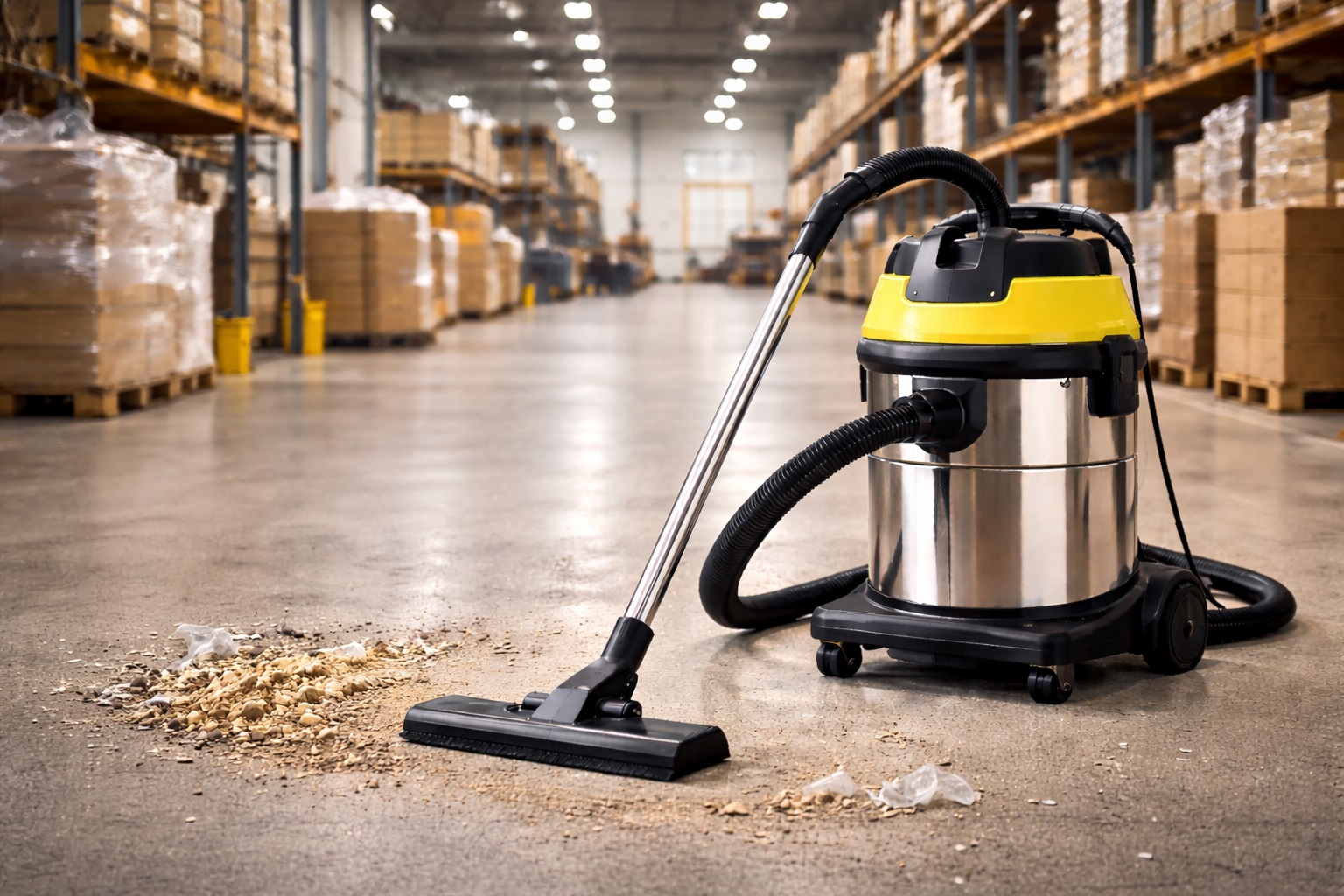
Warehouses and logistics centers are not designed for aesthetics.
They are designed for speed, volume, and continuity.
Pallet movement, forklifts, conveyors, and constant material handling generate:
In this environment, cleaning equipment is not a background tool—it directly affects safety, productivity, and operational uptime.
In logistics, every interruption has a ripple effect.
This article explains what type of vacuum cleaner works best in warehouses and logistics centers—and why general commercial solutions often fail when operations scale.
🧠 1. Large Facilities Multiply Small Inefficiencies
In small buildings, inefficiencies remain isolated.
In warehouses and logistics centers, they scale exponentially.
Consider:
A vacuum that loses only a few minutes per cycle can create hours of lost productivity across shifts and teams.
This is why large facilities require a Multi-Functional Durable Vacuum Cleaner that can:
Replace multiple specialized machines
Maintain performance over long shifts
Reduce tool switching across zones
💧 2. Wet & Dry Capability Is Operational Insurance
Spills are unavoidable in logistics environments:
Stopping operations to change equipment increases:
Slip and collision risk
Workflow disruption
Downtime
A reliable wet and dry vacuum cleaner (or Wet and Dry Vacuum Cleaner) allows teams to:
At logistics scale, wet & dry capability is not optional—it is insurance.
🧹 3. Capacity Determines How Far a Team Can Go
Distance matters.
Small tanks lead to:
A Large-Capacity Wet Dry Vacuum Cleaner enables:
Operational reality:
In a distribution center, walking to empty a tank can take longer than cleaning an entire aisle.
⚡ 4. Energy Efficiency Protects Continuous Operations
Logistics facilities often run:
Vacuum cleaners that overheat or draw excessive power introduce instability.
An Energy-Saving Efficient Powerful Vacuum Cleaner supports operations by:
Running cooler during long duty cycles
Maintaining stable airflow
Reducing unplanned shutdowns
Here, energy efficiency is less about electricity cost—and more about reliability under continuous load.
🌬️ 5. HEPA Filtration Supports Dust Control and Workforce Safety
Warehouse dust is not only visible—it is airborne.
Fine particles from:
Cardboard
Packaging materials
Industrial residue
can impact:
Worker health
Conveyor sensors
Automated systems
A HEPA Filter Vacuum Cleaner helps:
Capture fine dust at the source
Reduce airborne contamination during cleaning
Support safer working conditions
For this to work at scale, HEPA filtration must be paired with:
Sealed airflow systems
Strong, stable suction
Without system support, filters clog quickly and reduce efficiency.
🏭 6. Different Warehouses Have Different Priorities
Not all logistics environments are the same:
E-commerce fulfillment centers prioritize speed, coverage, and lightweight maneuverability
Cold storage facilities require reliable wet & dry response and sealed components
Manufacturing logistics warehouses demand durability and stable suction for heavier debris
The right vacuum solution must match warehouse type, not just general specifications.
📌 Case Insight: A Distribution Center Reduced Downtime
A regional distribution center struggled with:
After upgrading to:
Large-Capacity Wet Dry Vacuum Cleaner systems
Durable, multi-functional platforms
Energy-efficient designs with HEPA support
the center achieved:
The layout didn’t change.
The cleaning system did.
🚀 How Logistics Buyers Should Think
Experienced logistics buyers don’t ask:
“Which vacuum is most powerful?”
They ask:
How much area can one machine cover per shift?
Can it handle wet and dry hazards instantly?
Will performance remain stable across long shifts?
Does filtration control dust instead of redistributing it?
They understand one core principle:
In logistics environments, equipment must scale with throughput—or it becomes friction.
✅ Warehouse & Logistics Decision Checklist
Before approving vacuum solutions, confirm:
True wet and dry vacuum cleaner capability
Large-Capacity Wet Dry Vacuum Cleaner design
Multi-Functional Durable Vacuum Cleaner construction
Energy-Saving Efficient Powerful Vacuum Cleaner performance
HEPA Filter Vacuum Cleaner with sealed airflow
Built for continuous, high-dust environments
If any item is missing, inefficiency will multiply across operations.
✅ Conclusion: In Logistics, Stability Protects Uptime
Warehouses and logistics centers demand more than powerful machines.
They demand coverage, durability, and system stability.
By choosing:
Multi-Functional Durable Vacuum Cleaner platforms
Large-Capacity Wet Dry Vacuum Cleaner solutions
Reliable wet and dry vacuum cleaner capability
Energy-efficient, stable performance
Proper HEPA Filter Vacuum Cleaner systems
logistics operators protect safety, productivity, and throughput.
Stable cleaning systems protect uptime—not just cleanliness.