Hi, message us with any questions.
We're happy to help!





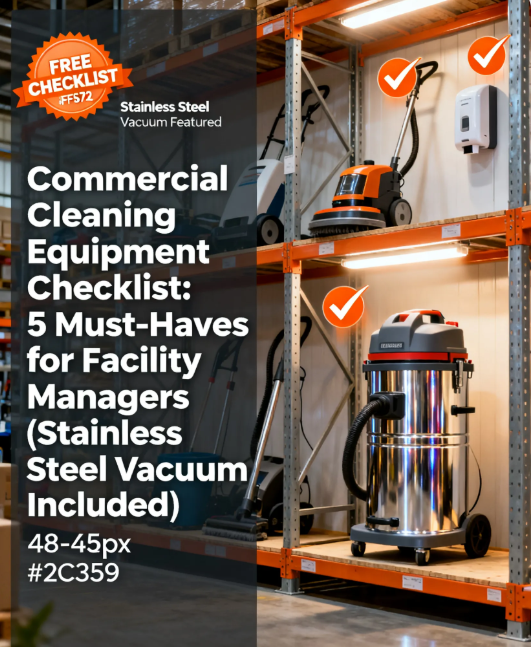
Every facility manager buys cleaning equipment eventually — and most do it from a position of weakness: an old machine has failed mid-contract, the budget must be spent by year-end, or a tenant complaint forces an emergency purchase. The result is reactive buying: wrong specs, weak supplier terms and equipment that costs more to own than to buy. This checklist exists to prevent that. It is the full procurement sequence used by professional facility management cleaning equipment teams, organized into eight stages and forty checkpoints. Print it, work it, and buy from strength.
Stage 1: Needs Audit — Before Any Specification 📝
The most expensive purchases are the ones that answer no actual need. Start with the site, not the catalog:
✅ 1. Duty profile per zone: Document floor types, square meters, traffic levels and cleaning frequency for every zone — lobby, offices, washrooms, pantries, plant rooms, docks
✅ 2. Wet/dry mix: Count the real liquid events per month (rain exposure, pantry density, washroom programs) — this decides whether a wet dry vacuum cleaner is required or optional
✅ 3. Noise windows: Record when cleaning can occur. Occupied-hours cleaning in offices or hospitals demands a low noise vacuum cleaner; night-window buildings have freedom
✅ 4. Filtration requirements: Any healthcare, laboratory or high-allergen tenancy? Then a HEPA filter vacuum cleaner is a compliance item, not an upgrade
✅ 5. Ergonomics and access: Stair-only zones, narrow service risers, elevator dependency — physical constraints that override paper specifications
Stage 2: Specification Writing 📋
Convert the audit into tender language suppliers must answer point-by-point:
✅ 6. Performance minimums: State working suction and airflow at load, not input watts — the spec a high suction power vacuum cleaner claim must actually prove
✅ 7. Noise maximums: A decibel ceiling at 1 meter, measured, not marketed
✅ 8. Capacity sizing: Match tank capacity to cleaning routes and emptying logistics (see our capacity guide) — a large-capacity wet dry vacuum cleaner belongs at dock level, not on floor trolleys
✅ 9. Build material: Stainless steel vacuum tank specification for wet duty and hygiene-sensitive zones; state the gauge
✅ 10. Energy requirements: Documented kWh consumption where the portfolio reports ESG data — favor an energy efficient vacuum cleaner platform
✅ 11. Cord, hose and reach: Match to outlet spacing per route to avoid hidden productivity tax
✅ 12. Certification list: CE, GS, RoHS, ETL/UL as required by market — with certificate numbers, not claims
Stage 3: Budget and TCO Modeling 💰
✅ 13. Full cost lines: Acquisition + energy + consumables + maintenance + downtime labor — labor being 70–80% of cleaning cost, machine-induced minutes matter most
✅ 14. Lifecycle assumption: Set expected service life per machine class (3–8 years by duty tier) and amortize honestly
✅ 15. Spares pricing: Request filter, hose and gasket prices now — the cheap machine with expensive consumables is a subscription trap
✅ 16. Productivity modeling: A fast lightweight vacuum cleaner that saves four minutes per shift pays a premium quickly across a portfolio
✅ 17. Budget alignment: Map the purchase to the correct budget line (capital vs operating) and confirm approval path before tendering
Stage 4: Supplier Identification and Vetting 🔍
✅ 18. Factory vs trading company: Ask directly. A genuine vacuum cleaner manufacturer in China with its own industrial vacuum cleaner factory controls quality and pricing; intermediaries add 8–15% without adding control
✅ 19. Vertical integration: What is made in-house (tanks, motors, molding) versus bought in — the predictor of price stability and consistency
✅ 20. Quality systems: ISO 9001 baseline, batch test documentation, sample testing protocol
✅ 21. Export track record: Years of shipments to your market; reference customers at comparable fleet size — a serious vacuum cleaner supplier provides both unprompted
✅ 22. Certification hygiene: Verify certificates are current and scope-matched to your destination market
✅ 23. OEM/ODM capability: If branding matters, confirm the partner runs OEM vacuum cleaner and ODM vacuum cleaner programs with documented spec control
Stage 5: Sample and Trial Phase 🧪
Never skip this stage for any fleet purchase:
✅ 24. Multi-unit samples: Test three units, not one — variance between units reveals production consistency
✅ 25. Bench testing: Calibrated suction, noise at 1 m, power draw at load
✅ 26. Durability run: 8-hour continuous duty for daily-use machines; a genuine heavy duty vacuum cleaner passes, consumer-grade units fail within two hours
✅ 27. Field trial: One real shift in a real zone — a hotel shift, a dock washdown, a washroom route
✅ 28. Sample-to-production match clause: Contract language guaranteeing the delivered machines match the tested samples exactly
Stage 6: Commercial Negotiation 💼
✅ 29. Volume tiering: Consolidate annual needs into framework quantities — 300–800 unit tiers typically unlock 8–15% versus spot buying; a bulk vacuum cleaner purchase gains more by tier than by haggling
✅ 30. Spares-in-lieu: Negotiate a 1–2% genuine-parts package instead of a marginal unit discount — higher real value, locks quality
✅ 31. Payment structure: 30/70 terms, currency choice and framework contract schedule — all legitimate price levers that never touch the machine
✅ 32. Delivery terms: EXW/FOB/CIF clarity plus container loading plans for imported fleets
✅ 33. Price validity: Lock quotation validity long enough for your approval cycle — 60–90 days is reasonable
Stage 7: Contract Terms 📜
The clauses that protect you after the invoice:
✅ 34. Warranty scope: Duration, covered components, exclusions — in writing, with the claims process
✅ 35. Spare-parts SLA: Where parts ship from and maximum lead time (48-hour dispatch is a fair ask from a professional industrial equipment supplier)
✅ 36. Training and documentation: Crew training materials, service manuals, spare-parts lists at handover
✅ 37. Sustainability documentation: Energy data, repairability statements and materials info — increasingly scored in tenders
✅ 38. Exit and dispute path: Escalation contacts on both sides, and the governing law you agreed
Stage 8: Delivery and Acceptance 🚚
✅ 39. Inspection protocol: Unboxing check against spec (tank gauge, motor brand, accessory count, labels) on a sampled basis across the shipment
✅ 40. Acceptance sign-off: Formal acceptance only after a set number run in service for 30 days without defect claims — hold the final payment tranche until then
Real Cases: The Checklist in Action 📁
Case 1 — University Estate, Leeds 🇬🇧
A university estate team ran the full sequence for a 60-machine renewal. The Stage 1 audit revealed that half their old fleet had been specified for night-window cleaning that no longer existed — daytime teaching required a portable quiet vacuum cleaner profile campus-wide. Catching this at Stage 1 (rather than after delivery) avoided a £40,000 mis-buy, and the consolidated tender at Stage 6 priced 14% below the previous fragmented spend.
Case 2 — Hospital Group, Riyadh 🇸🇦
A hospital group's procurement team applied Stage 2 and 5 with discipline: HEPA-sealed specification, three-unit samples, and an 8-hour continuous run. Two of three shortlisted suppliers failed the durability test outright. The winning supplier — an experienced vacuum cleaner manufacturer in China — passed all stages and accepted the sample-to-production match clause without hesitation, a response that itself signaled quality confidence. Three years on, warranty claims sit under 1%.
Case 3 — Logistics Park, Rotterdam 🇳🇱
A logistics park operator used Stage 3's TCO modeling to overturn an apparent saving. The cheapest quotation looked 18% better on unit price, but consumables pricing (Stage 3, point 15) and a 6-week parts SLA (absent — point 35) reversed the ranking entirely at three-year cost. They contracted with the second supplier at a 4% premium and documented a 12% lower total cost. Their procurement lead's note: the cheapest machine is a price, not a cost.
Case 4 — FM Contractor, Toronto 🇨🇦
A cleaning contractor winning its first tower contract used the checklist's supplier vetting stages (18–23) to build a defensible audit file for the client tender. Choosing a factory-direct partner with documented industrial vacuum cleaner factory credentials, current certifications and reference accounts — and showing that file to the client — became a scored differentiator against competitors quoting traded goods. The checklist did not just protect the purchase; it won the contract.
How Suppliers Should Read This 🤝
If you sell commercial cleaning equipment, this checklist is your mirror: every checkpoint is a question your buyer will ask. Suppliers who preempt it — publishing test data, TCO worksheets, spares pricing, SLA commitments and reference programs before they are requested — convert procurement friction into trust. That is precisely the approach behind factory-direct brands like Lanxstar, and the reason checklist-armed facility managers keep renewing with manufacturing partners instead of re-tendering every cycle.
The Bottom Line 🎯
Forty checkpoints, eight stages, one principle: buy from evidence, not from brochures. Reactive equipment buying is one of the last unmanaged cost centers in many facilities — and the fix is simply process. Run the needs audit before the spec, the trial before the contract, the TCO before the price comparison, and the acceptance protocol before the final payment. A facility manager who works this checklist once will never again buy cleaning equipment from a position of weakness.
If you are interested, please feel free to contact us anytime — request our pre-filled TCO worksheet and supplier audit file to accelerate your own checklist. Begin at www.lxvacuum.com 🚀
50 Related Keywords
cleaning equipment procurement checklist, facility management cleaning equipment, commercial cleaning equipment, commercial cleaning service equipment, industrial cleaning equipment, cleaning equipment supplier, industrial equipment supplier, commercial vacuum cleaner, commercial grade vacuum cleaner, industrial vacuum cleaner, wet dry vacuum cleaner, wet and dry vacuum cleaner, large-capacity wet dry vacuum cleaner, low noise vacuum cleaner, portable quiet vacuum cleaner, fast lightweight vacuum cleaner, energy efficient vacuum cleaner, energy-saving efficient powerful vacuum cleaner, HEPA filter vacuum cleaner, high suction power vacuum cleaner, high suction vacuum cleaner, multi-functional durable vacuum cleaner, heavy duty vacuum cleaner, dual motor vacuum cleaner, stainless steel vacuum tank, vacuum cleaner supplier, vacuum cleaner supplier China, vacuum cleaner manufacturer, vacuum cleaner manufacturer in China, vacuum cleaner maker, vacuum manufacturer, industrial vacuum cleaner supplier, industrial vacuum cleaner factory, factory direct vacuum cleaner, wholesale vacuum cleaner, bulk vacuum cleaner purchase, bulk order vacuum cleaner, vacuum cleaner price wholesale, industrial vacuum cleaner cost, buy industrial vacuum cleaner, best industrial vacuum cleaner, OEM vacuum cleaner, ODM vacuum cleaner, private label vacuum cleaner, import vacuum cleaner from China, vacuum cleaner distributor Europe, hotel cleaning equipment, hospital cleaning equipment, warehouse cleaning solution, Lanxstar