Hi, message us with any questions.
We're happy to help!





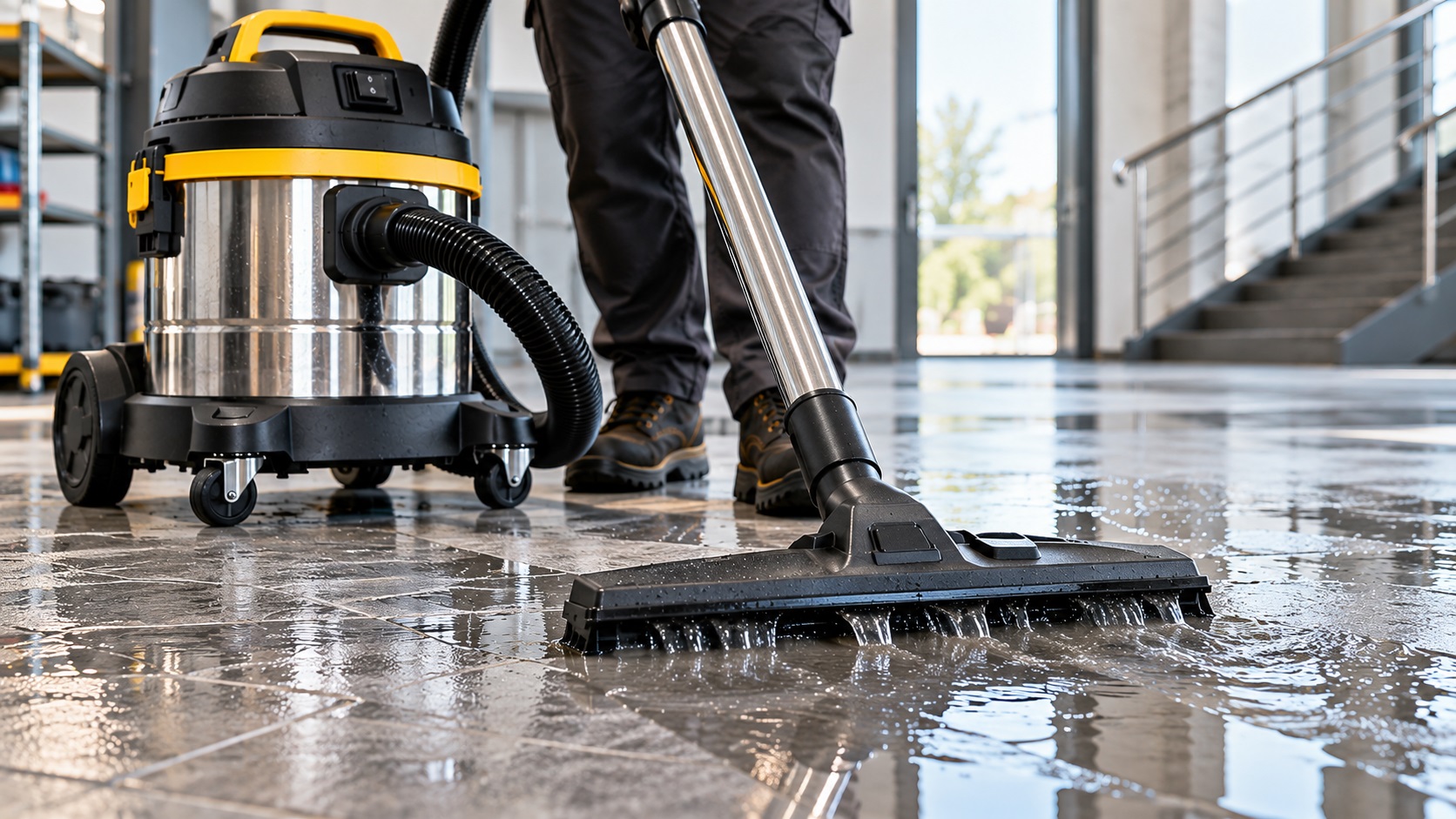
Best Vacuum Cleaner Features for Water Extraction
When buyers compare vacuum cleaners for water extraction, one specification often receives most of the attention: motor power.
A 1,000 W machine is compared with a 1,200 W machine. A dual-motor model is compared with a single-motor model. Buyers may naturally assume that the highest number represents the best water extraction performance.
Real-world performance is more complicated. 💧
An effective wet dry vacuum cleaner needs the entire system to work together. Motor performance matters, but so do airflow, suction pressure, hose diameter, wet floor nozzle design, usable tank capacity, float protection, drainage, wheel construction, seals, and maintenance accessibility.
A powerful motor attached to an inefficient airflow system may provide disappointing results.
A huge tank that is difficult to empty can slow employees down.
A strong vacuum with a poorly designed wet nozzle may leave water behind.
For professional buyers, the goal should therefore be to identify a balanced water extraction system rather than simply choosing the largest specification on a product sheet.
Here are the features that deserve the most attention.
1. Strong and Stable Suction Performance
Suction is naturally one of the first considerations for water extraction.
The vacuum must create sufficient pressure difference to lift liquid from the cleaning surface and transport it through the hose.
A high suction power vacuum cleaner can be useful for demanding commercial tasks, especially when water must travel through longer hoses or when debris is mixed with compatible liquid.
However, buyers should distinguish between:
motor input power and actual suction performance.
A higher wattage rating does not automatically guarantee proportionally better pickup.
Internal airflow design, seals, hose dimensions, motor characteristics, and nozzle design all influence the final performance at the floor.
For professional procurement, technical data should therefore be considered as a system rather than as isolated numbers.
2. Airflow Is Equally Important
Suction pressure helps lift material.
Airflow helps move that material through the system.
For water extraction, the balance between these two characteristics can significantly affect productivity.
Imagine drinking through two straws:
One is extremely narrow.
The other has a larger diameter.
Even with similar effort, the flow characteristics are different.
Vacuum cleaner hoses behave in a similar way. Hose diameter, length, bends, restrictions, and accessory design affect how efficiently air and water move toward the tank.
🌬️ A well-engineered wet and dry suction system should minimize unnecessary airflow restrictions.
For R&D engineers, optimizing the complete air path can sometimes provide more practical benefit than simply increasing motor wattage.
3. A Proper Wet Pickup Floor Nozzle
The wet nozzle is one of the most important features for water extraction, yet it is frequently overlooked.
A standard dry floor tool may use brushes designed to loosen dust.
A wet pickup nozzle generally needs to gather water toward the suction opening.
Rubber strips or similar components can help maintain useful contact with smooth floors while directing liquid into the airflow.
This matters particularly when only a thin layer of water remains.
💡 Deep standing water may be relatively easy for a suitable vacuum to collect.
A thin film across a large floor can actually require more careful nozzle design and operator technique.
Commercial buyers should therefore inspect the wet floor tool instead of treating accessories as an afterthought.
4. Appropriate Hose Diameter
Hose dimensions influence airflow and the type of material a vacuum can transport.
A larger hose can be useful when a machine needs to collect water together with larger compatible debris.
A smaller hose may provide easier handling for detailed cleaning.
The ideal diameter depends on the application.
For a car detailing vacuum cleaner, flexibility and access to tight areas can be particularly important.
For construction site cleaning equipment, a robust hose with a larger internal passage may be more practical.
For warehouse floor water pickup, a durable hose combined with a wide wet floor nozzle can increase productivity.
There is no universal ideal hose size. The correct choice should match the intended debris, airflow requirements, and cleaning environment.
5. Large Enough Tank Capacity
Tank capacity determines how much material the vacuum can contain before it must be emptied.
For frequent water collection, a Large-Capacity Wet Dry Vacuum Cleaner can reduce interruptions.
But bigger is not always better.
Remember:
1 liter of water weighs approximately 1 kilogram.
Collecting 30 liters of water adds approximately 30 kg of weight to the machine.
A 50-liter load adds approximately 50 kg.
That is before considering the weight of the vacuum itself. ⚖️
For this reason, tank capacity should be balanced with:
Wheel design
Handle design
Drainage
Machine dimensions
Operator requirements
Storage
Transportation
A hotel may benefit from a smaller, more portable machine.
A large warehouse may value a higher-capacity tank.
6. Usable Liquid Capacity, Not Just Nominal Capacity
Professional buyers should ask an additional question:
How much liquid can the machine actually collect before the shutoff system activates?
Nominal tank capacity and usable liquid capacity may differ.
Internal components occupy space, and a float mechanism may stop or restrict suction before liquid reaches the absolute top of the tank.
Therefore, a product described as a “30 L vacuum” should not automatically be marketed as collecting exactly 30 liters of water per cycle.
For a vacuum cleaner supplier or importer creating accurate specifications, understanding this distinction helps prevent misleading claims.
7. Reliable Float Shutoff Protection
A wet vacuum needs a way to prevent excessive liquid levels from reaching sensitive parts of the machine.
Many products use a float mechanism.
As the water rises, the float rises with it.
At a designed level, the system restricts the suction path or otherwise indicates that collection should stop.
This feature is extremely important during wet operation. 🚨
When evaluating samples from an industrial vacuum cleaner factory, buyers should examine:
Float movement
Cage construction
Material quality
Installation
Reliability
Ease of cleaning
The float system should also be clearly explained in the product manual.
8. Convenient Water Drainage
For large-capacity water extraction, drainage can become one of the most valuable features on the entire machine.
Consider a vacuum containing 40 liters of water.
The operator probably does not want to lift the complete machine and pour the water out manually.
A drain port or drain hose can make emptying much easier.
This is particularly useful for:
Warehouses
Workshops
Factories
Construction sites
Commercial cleaning contractors
Large public facilities
A heavy duty vacuum cleaner intended for high-volume wet cleaning should therefore be evaluated for emptying convenience as carefully as suction performance.
🛠️ Faster drainage means less downtime between cleaning cycles.
9. Single Motor or Dual Motor?
A dual motor vacuum cleaner may be attractive for demanding industrial applications.
Depending on the design, multiple motors can provide additional airflow or suction performance and may offer flexible operating modes.
However:
two motors do not automatically mean twice the useful water extraction performance.
The final result still depends on:
Air path design
Hose
Nozzle
Tank
Seals
Motor characteristics
Application
A properly engineered single-motor machine can be highly effective for many commercial environments.
A dual-motor system may be more appropriate where higher performance or demanding workloads justify the additional size, energy consumption, and cost.
The decision should be application-based.
10. Durable Tank Construction
Water extraction exposes the tank to moisture, debris, impacts, and frequent cleaning.
Tank construction therefore matters.
Stainless Steel Vacuum Tank
A stainless steel vacuum tank is popular in commercial and industrial machines because it offers a durable appearance and can be relatively easy to clean.
It can also support a professional industrial product image.
Plastic Tank
A well-designed plastic tank can offer:
Lower weight
Corrosion resistance
Impact flexibility
Potentially lower manufacturing cost
The better option depends on the intended environment.
Wholesalers should avoid assuming that stainless steel automatically means “professional” while plastic automatically means “domestic.”
Engineering quality matters more than appearance alone.
11. Strong Wheels and Stable Mobility
A vacuum cleaner behaves very differently when its tank is empty versus full of water.
A machine that rolls easily when empty may become difficult to control after collecting 30 or 40 liters.
Commercial models should therefore have an appropriate wheel system.
Important features include:
🛞 Stable casters
🛞 Durable rear wheels
🛞 Suitable wheel diameter
🛞 Strong wheel mounts
🛞 Balanced center of gravity
For uneven construction surfaces, larger wheels may provide an advantage.
For hotels and smooth commercial floors, quiet and maneuverable casters may be more important.
Mobility should always be tested with realistic tank loads.
12. An Ergonomic Push Handle
A push handle may look like a minor feature, but it can significantly improve usability.
When a commercial vacuum cleaner is carrying a large volume of water, employees should not have to pull it awkwardly by the hose or motor head.
A well-positioned handle helps operators:
Push the machine
Control direction
Move around obstacles
Transport a full tank
Reduce unnecessary strain
For a Fast Lightweight Vacuum Cleaner, the body itself may be easy enough to carry.
For larger industrial models, handle engineering becomes increasingly important.
13. Easy Wet-to-Dry Conversion
Many professional users purchase wet/dry vacuums because they want one machine for multiple tasks.
During one job, the vacuum may collect dry dust and debris.
Later, it may need to remove water.
The transition should be simple and clearly documented.
Depending on the design, operators may need to:
Remove a dust bag
Change a filter
Install a wet-use filter
Check the float
Empty the tank
Change the floor tool
A Multi-Functional Durable Vacuum Cleaner becomes much more useful when employees can change operating modes correctly without complicated procedures.
For cleaning contractors, simple conversion can reduce training requirements and operator mistakes.
14. Suitable Filtration for Dry Operation
Water extraction may be the focus, but most wet/dry vacuums also perform dry cleaning.
Therefore, filtration remains an important purchasing consideration.
A HEPA filter vacuum cleaner configuration may be valuable for certain environments where fine-particle control is required.
However, buyers must confirm how that filtration system interacts with wet operation.
Some filters must be removed before collecting liquids.
Some systems use different filters.
Others follow manufacturer-specific configurations.
Never assume that a HEPA filter designed for dry collection should remain installed during every wet pickup task.
Clear instructions from the vacuum cleaner manufacturer are essential.
15. Low Noise for Hotels and Public Facilities
Industrial power is not always the highest priority.
Hotels, offices, hospitals, schools, and retail facilities may operate cleaning equipment while other people are nearby.
In these environments, a low noise vacuum cleaner can provide significant operational advantages.
A Portable Quiet Vacuum Cleaner may allow employees to handle small water incidents without creating excessive disruption.
Noise becomes especially relevant when:
Cleaning guest corridors
Working during business hours
Operating near offices
Cleaning public areas
Using equipment frequently
For hotel cleaning equipment, water pickup capability and low noise can be a valuable combination.
16. Long and Practical Power Cable
Commercial operators need sufficient working range.
A short cable may require employees to repeatedly unplug and relocate the machine.
However, an extremely long cable also needs safe storage and management.
For water extraction equipment, cable quality and safe routing are particularly important because the cleaning environment may already contain water.
⚠️ Operators must always follow electrical safety procedures and never use equipment in unsafe electrical conditions.
For OEM projects, buyers may also need different plug and cable specifications for different countries.
17. Useful Accessory Storage
Professional cleaning equipment often includes:
Wet floor nozzle
Dry floor brush
Crevice tool
Round brush
Extension tubes
Hose
Adapters
If accessories are constantly lost, the versatility of the machine quickly decreases.
Integrated storage can therefore improve everyday usability.
For a commercial cleaning service equipment fleet, accessory organization can also reduce time spent searching for tools between jobs.
This seemingly small design feature can improve the total user experience.
18. Case Study: Warehouse Water Extraction
Consider a logistics warehouse that occasionally experiences water entering near loading doors during heavy rain. 📦
The purchasing team compares two machines.
Machine A
Very high motor wattage
Medium tank
Small wheels
No drain hose
Basic wet nozzle
Machine B
Strong but lower nominal wattage
Large usable tank
Wide wet floor nozzle
Large rear wheels
Push handle
Drain hose
Reliable float system
On paper, Machine A appears more powerful.
During actual cleaning, however, Machine B better matches the workflow.
Employees can collect water across a wider path, move the machine more easily when full, and drain the tank without lifting it.
The lesson is important:
The best water extraction vacuum is the one whose complete feature set improves the cleaning process.
This is particularly relevant when sourcing an industrial wet and dry vacuum cleaner for warehouse cleaning supplier.
19. Case Study: Hotel Maintenance Application
A hotel procurement team has different priorities. 🏨
Most incidents involve relatively small bathroom leaks, entrance water, and accidental spills.
The team initially considers a large industrial model.
Testing reveals several disadvantages:
Difficult elevator transportation
Excessive storage requirements
More noise than necessary
Large tank rarely utilized
Harder movement through guest corridors
The hotel selects a smaller commercial wet/dry vacuum with good suction, a practical wet nozzle, low noise, and easy mobility.
For this environment, portability delivers more value than maximum capacity.
This demonstrates why commercial vacuum cleaner for hotel use specifications should be based on the actual cleaning scenario.
20. Construction Site Water Extraction
Construction sites require a different feature combination. 🏗️
A wet dry vacuum cleaner for construction site work may need:
Durable tank
Strong chassis
Large wheels
Robust hose
High suction
Suitable hose diameter
Tough accessories
Convenient drainage
Water may also be mixed with compatible construction debris.
The vacuum must therefore be designed for demanding physical conditions.
However, construction sites can also contain hazardous dust.
A standard wet/dry vacuum should not automatically be used where regulations require specialized dust-control equipment.
An appropriate industrial dust extractor may be required for certain materials and applications.
21. Car Detailing Water Extraction
Automotive cleaning creates another set of requirements. 🚗
A car detailing vacuum cleaner benefits from:
Compact body
Flexible hose
Strong suction
Crevice tools
Upholstery accessories
Easy movement
Convenient tank cleaning
Maximum tank capacity may be much less important than maneuverability.
A machine needs to reach:
Seat edges
Footwells
Trunks
Door areas
Narrow interior spaces
For this application, a huge industrial vacuum could actually reduce productivity.
22. Energy Efficiency and Water Extraction
Commercial machines may operate for long periods, so energy consumption deserves consideration.
An energy efficient vacuum cleaner should deliver useful cleaning performance without unnecessary electrical consumption.
This again demonstrates why wattage alone should not be used as a performance ranking.
An Energy-Saving Efficient Powerful Vacuum Cleaner combines effective motor performance with efficient airflow, good seals, appropriate hoses, and suitable accessories.
⚡ Better engineering can help the machine accomplish more useful cleaning work from the energy it consumes.
For distributors, energy efficiency can also become an important product-positioning feature in markets where commercial customers pay close attention to operating costs.
23. Safety Features Buyers Should Not Ignore
Water and electrical equipment require careful design and operation.
Professional buyers should examine applicable product certifications and safety requirements for their target markets.
Useful design considerations may include:
Reliable liquid-level protection
Appropriate electrical insulation
Stable cable connections
Secure motor-head mounting
Clear warning labels
Durable switches
Proper operating instructions
The machine should also clearly state which liquids it must not collect.
Ordinary wet/dry vacuums should not automatically be considered suitable for flammable liquids, volatile solvents, hazardous chemicals, sewage, or other dangerous materials.
Specialized equipment may be required.
24. Features for Wholesale Buyers and Distributors
A distributor has different concerns from an individual user.
The product must not only perform well—it should also be practical to sell and support.
When comparing a wholesale vacuum cleaner, consider:
Product differentiation
Spare parts availability
Filter availability
Accessory replacement
Packaging strength
Manual quality
Product certifications
Warranty support
Model continuity
OEM customization
A slightly cheaper machine can become expensive if replacement parts are difficult to obtain.
For this reason, the relationship with the industrial vacuum cleaner supplier can be as important as the machine itself.
25. OEM and Private Label Water Extraction Vacuums
For companies developing their own brands, an OEM vacuum cleaner or private label vacuum cleaner program may allow several specifications to be adapted to the target market.
Possible customization can include:
Tank size
Motor configuration
Product color
Logo
Hose
Cable length
Plug type
Filters
Accessories
Packaging
Manuals
Labels
An ODM vacuum cleaner project may involve deeper changes depending on the manufacturer's capabilities.
For example, a distributor targeting warehouse customers might prioritize large wheels, drainage, and capacity.
A hotel equipment brand might prioritize low noise and portability.
A car-care brand might focus on compact dimensions and specialized accessories.
This is why the intended customer should be defined before product configuration begins.
26. Questions to Ask a Vacuum Cleaner Manufacturer
Before placing a bulk order vacuum cleaner, professional buyers should ask detailed questions.
A useful checklist includes:
What are the suction and airflow specifications?
What is the nominal tank capacity?
What is the practical liquid collection level?
How does the float protection system work?
Does the machine include a drain hose or drain port?
What wet floor nozzle is supplied?
What hose diameter and length are available?
What tank materials are offered?
How does the machine convert between wet and dry operation?
Which replacement filters are available?
What motor options can be supplied?
Which accessories are included?
What certifications are available for the target market?
What OEM customization options are available?
What spare parts can be ordered with the shipment?
These questions are useful when evaluating a vacuum cleaner manufacturer in China or any international manufacturing partner.
27. What About Price?
Buyers naturally compare industrial vacuum cleaner cost and vacuum cleaner price wholesale.
But the lowest factory price does not always produce the lowest ownership cost.
Consider:
Purchase price + maintenance + replacement parts + labor efficiency + service life + downtime
A machine that costs slightly more but drains quickly, moves easily, and has readily available replacement components may provide better long-term economics.
For retail buyers searching for the best affordable vacuum or best vacuum on a budget, the same principle applies.
Value should represent useful performance relative to cost—not simply the cheapest purchase price.
28. Water Extraction Feature Checklist
Before selecting a vacuum, use this practical checklist:
✅ Strong, stable suction
✅ Efficient airflow path
✅ Suitable wet pickup nozzle
✅ Appropriate hose diameter
✅ Adequate usable tank capacity
✅ Reliable float protection
✅ Convenient drainage
✅ Durable tank construction
✅ Stable wheels
✅ Ergonomic handle
✅ Easy wet/dry conversion
✅ Appropriate filtration
✅ Acceptable noise level
✅ Practical cable length
✅ Replacement filters and accessories
✅ Clear operating instructions
✅ Suitable safety compliance for the target market
A machine does not necessarily need to maximize every feature.
The goal is to select the combination that matches the intended application.
29. Which Features Matter Most for Different Users?
Different customers should prioritize different features.
Warehouse Operators
Look for:
large capacity + drainage + mobility + wide wet nozzle + durability
Hotels
Prioritize:
low noise + portability + compact dimensions + easy operation
Construction Contractors
Consider:
strong suction + durable hose + robust accessories + large wheels + drainage
Commercial Cleaning Companies
Look for:
versatility + transportability + simple maintenance + accessory selection
Car Detailing Businesses
Prioritize:
compact size + flexible hose + useful detailing tools + strong suction
Industrial Facilities
Consider:
application compatibility + durability + capacity + maintenance + appropriate safety requirements
Matching features to customers also helps wholesalers build a more logical product portfolio.
30. Final Takeaway: What Makes a Good Water Extraction Vacuum?
The best features for water extraction work together as a system.
Strong suction is important—but suction alone is not enough.
Tank capacity matters—but a large tank that cannot be emptied efficiently creates another problem.
Motor power matters—but higher wattage does not automatically mean better real-world cleaning.
For professional applications, a well-balanced water extraction vacuum should combine:
effective suction + efficient airflow + proper wet nozzle + practical tank capacity + reliable float protection + easy drainage + stable mobility + simple maintenance.
For wholesalers, importers, and OEM buyers, the same principle applies at the product-development level.
Instead of asking for the biggest tank or highest wattage, define the intended user first.
A warehouse operator, hotel housekeeper, construction contractor, cleaning company, and car detailing professional all need different combinations of features.
Choosing specifications around those real applications can help create a more useful, competitive, and commercially successful product.
Lanxstar supports commercial and industrial vacuum cleaner applications for buyers exploring wholesale, OEM, ODM, and private-label opportunities.
For more information about wet and dry vacuum cleaner solutions and commercial water extraction equipment, visit www.lxvacuum.com.
If you are interested, please feel free to contact us.
50 Related SEO Keywords
High Suction Vacuum Cleaner, Portable Quiet Vacuum Cleaner, Multi-Functional Durable Vacuum Cleaner, Fast Lightweight Vacuum Cleaner, Energy-Saving Efficient Powerful Vacuum Cleaner, Large-Capacity Wet Dry Vacuum Cleaner, wet and dry vacuum cleaner, wet dry vacuum cleaner, industrial vacuum cleaner, commercial vacuum cleaner, industrial vacuum cleaner supplier, vacuum cleaner manufacturer, industrial cleaning equipment, commercial cleaning equipment, vacuum cleaner supplier, vacuum cleaner manufacturer in China, industrial vacuum cleaner factory, wholesale vacuum cleaner, bulk vacuum cleaner purchase, OEM vacuum cleaner, ODM vacuum cleaner, private label vacuum cleaner, cleaning equipment supplier, industrial equipment supplier, construction site cleaning equipment, warehouse cleaning solution, hotel cleaning equipment, factory floor cleaning, logistics warehouse cleaning, car detailing vacuum cleaner, commercial cleaning service equipment, facility management cleaning equipment, HEPA filter vacuum cleaner, high suction power vacuum cleaner, heavy duty vacuum cleaner, dual motor vacuum cleaner, stainless steel vacuum tank, low noise vacuum cleaner, energy efficient vacuum cleaner, wet and dry suction system, industrial dust extractor, commercial grade vacuum cleaner, water extraction vacuum, wet vacuum cleaner for water, wet dry vacuum cleaner for construction site, industrial wet and dry vacuum cleaner for warehouse cleaning supplier, Lanxstar, vacuum manufacturer, vacuum cleaner maker, water extraction vacuum cleaner