Hi, message us with any questions.
We're happy to help!





Most commercial vacuum buyers still make the same mistake:
They compare machines based on purchase price instead of operational performance.
But in real commercial environments, the true cost of a vacuum cleaner is determined by:
labor efficiency
maintenance downtime
spare part replacement
operator fatigue
cleaning speed
long-term reliability
This is why the discussion around barrel vacuum cleaner vs upright vacuum business use has become increasingly important among:
European vacuum distributors
North American facility management companies
commercial cleaning contractors
industrial procurement teams
Today’s professional buyers are no longer asking:
“Which vacuum is cheaper?”
They are asking:
“Which vacuum system creates the best long-term operational ROI?”
This article explores the real-world differences between barrel and upright vacuum systems using:
commercial case scenarios
procurement failures
engineering insights
industrial cleaning logic
instead of generic marketing claims.
🧠 Why Many Commercial Vacuum Buyers Regret Cheap Purchases
In the global cleaning equipment market, many first-time importers choose vacuum systems based mainly on:
low MOQ
attractive catalog pricing
high advertised wattage
However, experienced facility managers understand a painful reality:
Cheap commercial vacuums often become expensive operational problems.
🏨 Real Business Scenario: Hotel Cleaning Operations
A mid-sized hotel management group in Central Europe replaced several upright vacuum systems with commercial barrel vacuum cleaner units across multiple properties.
The reason was not suction power.
The real issue was:
operator fatigue
difficult under-bed cleaning
excessive maintenance requests
noisy nighttime operation
After switching to barrel systems, the cleaning teams reported:
faster room turnover
easier furniture access
lower hose replacement frequency
reduced staff complaints
The procurement department also noticed maintenance downtime decreased because barrel vacuum systems had fewer moving mechanical components.
This example reflects a growing trend in hospitality cleaning:
operational efficiency matters more than retail-style appearance.
🔍 Understanding the Structural Difference
Before comparing performance, buyers must understand how these systems are fundamentally engineered.
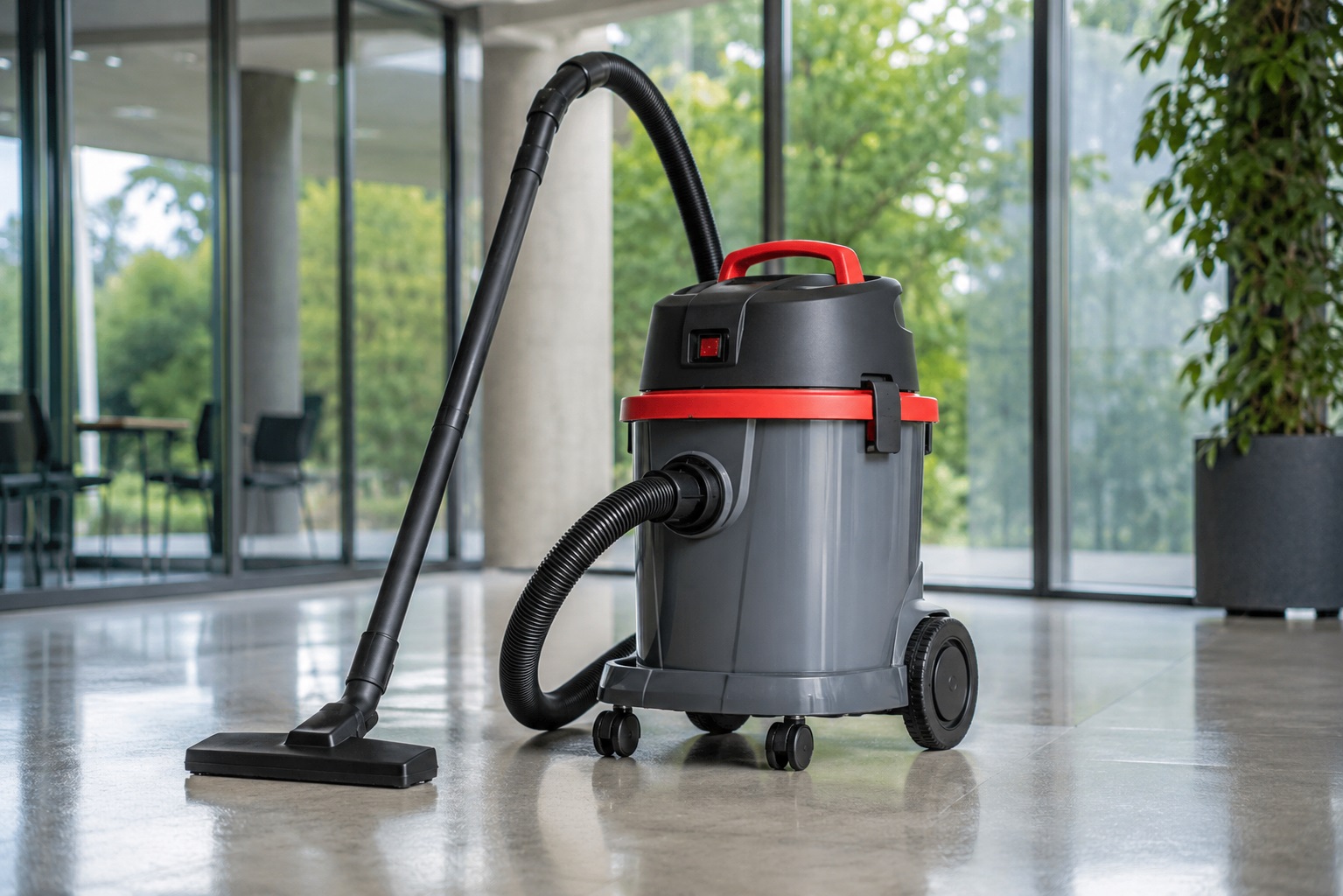
🛢️ What Is a Barrel Vacuum Cleaner?
A barrel vacuum cleaner uses:
a cylindrical tank body
flexible hose system
interchangeable cleaning accessories
separate motor and cleaning wand structure
This design improves:
movement flexibility
airflow stability
large-area cleaning efficiency
Most professional commercial cleaning vacuum systems used in:
hotels
airports
office towers
warehouses
industrial facilities
are barrel-based for this reason.
🧍 What Is an Upright Vacuum?
An upright vacuum combines:
motor
suction head
brush roller
dust collection system
into a single vertical unit.
These machines work well in:
carpet-focused environments
residential cleaning
small office spaces
However, upright systems often become less efficient in large commercial operations because operators must constantly move the full machine body.
This increases:
cleaning fatigue
maneuvering difficulty
maintenance complexity
especially in mixed-surface facilities.
📉 The Hidden Operational Cost Nobody Talks About
Most vacuum cleaner suppliers focus their marketing on:
wattage
suction claims
appearance
retail pricing
But professional buyers focus on:
labor cost per cleaning cycle.
In commercial cleaning businesses, labor often represents the largest operational expense.
Even small efficiency improvements can generate major financial savings.
📊 Real Operational Cost Example
A commercial cleaning contractor managing office buildings in North America analyzed cleaning efficiency across a 30-person cleaning team.
After replacing older upright machines with industrial barrel vacuum systems, the company estimated:
cleaning time reduced by approximately 10–15 minutes per operator daily
fewer interruptions caused by hose blockages
lower maintenance incidents
Over a yearly operational cycle, labor savings exceeded the original equipment price difference multiple times.
This is why experienced procurement managers increasingly prioritize:
ergonomics
maneuverability
runtime stability
instead of only focusing on unit cost.
⚠️ Why Many Cheap Commercial Vacuums Fail Within 12 Months
One of the biggest hidden problems in low-cost commercial vacuum equipment is internal engineering quality.
Many low-price machines use:
thin motor copper windings
weak thermal protection
low-grade plastic hose systems
poor airflow architecture
The result:
overheating
unstable suction
cracked hose joints
shortened motor lifespan
🏭 Real Import Failure Scenario
A cleaning equipment distributor importing low-cost upright vacuum systems experienced unusually high warranty claims during the first year.
The main problems included:
motor overheating
broken brush assemblies
unstable wheel structures
weak hose connectors
The distributor later transitioned toward commercial barrel vacuum cleaner systems designed with:
modular spare parts
reinforced hose materials
simplified motor layouts
As a result:
after-sales complaints decreased
spare part inventory became easier to manage
long-term customer satisfaction improved
This highlights an important reality:
the cheapest vacuum is rarely the lowest-cost solution.
🧪 Industrial Vacuum Comparison: Airflow Matters More Than Wattage
One of the most misunderstood concepts in the commercial cleaning industry is wattage.
Many inexperienced buyers assume:
higher wattage means stronger cleaning power.
In reality, professional vacuum cleaner manufacturers know performance depends more on:
airflow efficiency
sealed suction pathways
motor cooling structure
filtration resistance
hose airflow optimization
A properly engineered 1200W commercial cleaning vacuum can outperform a poorly designed 2000W system.
🔧 Engineering Insight: Why Hose Design Matters
Many industrial cleaning environments expose vacuum systems to:
cold temperatures
sharp debris
heavy pulling force
continuous movement
Low-quality hose materials often become brittle over time, especially in warehouses and logistics centers.
Professional vacuum cleaner manufacturers increasingly use:
reinforced industrial hose structures
anti-crack polymers
flexible airflow channels
to improve durability in commercial environments.
This type of engineering detail significantly impacts:
maintenance frequency
operator experience
long-term reliability
yet many inexperienced buyers overlook it completely.
🧰 Why Barrel Vacuum Systems Dominate Multi-Surface Cleaning
Modern facilities rarely contain only carpet.
Commercial cleaners now handle:
tile flooring
hardwood surfaces
warehouse dust
upholstery
wet spills
corners and ceiling edges
This is where barrel vacuum cleaner systems outperform upright designs.
Most commercial barrel systems support:
wet & dry functionality
HEPA filtration
blower modes
interchangeable floor heads
anti-static accessories
This reduces the need for multiple cleaning machines.
For procurement teams, that means:
simplified inventory
lower maintenance complexity
easier employee training
📊 Commercial Buyer Comparison Table
| Buyer Concern | Barrel Vacuum Cleaner | Upright Vacuum |
|---|---|---|
| Multi-Surface Cleaning | Excellent | Moderate |
| Carpet Cleaning | Good | Excellent |
| Under-Furniture Access | Excellent | Poor |
| Operator Fatigue | Lower | Higher |
| Industrial Dust Handling | Strong | Weak |
| Wet & Dry Cleaning | Common | Rare |
| Runtime Stability | Excellent | Moderate |
| Hose Flexibility | Excellent | Limited |
| Maintenance Complexity | Lower | Higher |
| Large Facility Cleaning | Excellent | Moderate |
🚫 Common Procurement Mistakes Buyers Should Avoid
❌ Mistake 1: Choosing Based Only on Wattage
High wattage does not guarantee:
stronger airflow
better filtration
longer lifespan
Engineering quality matters more.
❌ Mistake 2: Ignoring Spare Parts Ecosystems
Without stable access to:
filters
motors
hoses
accessories
commercial maintenance becomes difficult and expensive.
❌ Mistake 3: Believing Fake HEPA Claims
Not all HEPA labels represent real certified filtration systems.
Professional buyers should verify:
H13/H14 standards
airflow resistance data
sealed filtration testing
❌ Mistake 4: Ignoring Noise Levels
Noise matters heavily in:
hotels
offices
hospitals
schools
Quiet operation is increasingly becoming a procurement requirement.
🌍 How Professional Buyers Evaluate a Vacuum Cleaner Manufacturer
Modern B2B buyers increasingly prioritize long-term supplier capability over short-term pricing advantages.
A reliable vacuum cleaner supplier should provide:
🔹 Engineering Transparency
airflow testing
motor lifespan reports
duty-cycle performance data
🔹 OEM & ODM Capability
private label production
packaging customization
tooling support
🔹 Certification Support
CE
RoHS
UL
EMC compliance
🔹 Spare Parts Stability
long-term replacement support
standardized accessories
maintenance documentation
🔹 Production Scalability
stable lead times
consistent QC systems
high-volume manufacturing capability
The strongest vacuum cleaner manufacturers function as long-term strategic partners instead of simple exporters.
📈 The Future of Commercial Cleaning Vacuum Equipment
The global cleaning industry is evolving rapidly due to:
rising labor costs
stricter hygiene regulations
sustainability demands
operator safety requirements
The next generation of commercial cleaning vacuum systems is increasingly focused on:
quieter motors
ergonomic handling
advanced HEPA filtration
energy-efficient airflow systems
modular accessories
smart maintenance monitoring
As operational efficiency becomes more important, barrel vacuum cleaner systems are becoming the preferred platform for scalable commercial cleaning operations.
✅ Final Verdict
When comparing barrel vacuum cleaner vs upright vacuum business use, the most important factor is not the advertised specification sheet.
The real question is:
Which system delivers better long-term operational performance?
For most commercial and industrial applications, barrel vacuum cleaner systems provide stronger advantages in:
labor efficiency
maintenance simplicity
multi-surface adaptability
industrial durability
long-term ROI
For serious B2B buyers, selecting the right vacuum cleaner manufacturer is just as important as choosing the machine itself.
Because in commercial cleaning:
efficiency is profitability.
👥 Suitable Readers
European commercial vacuum distributors
North American vacuum equipment importers
Commercial cleaning contractors
Industrial procurement managers
Facility management companies
Cleaning equipment wholesalers
Vacuum cleaner OEM sourcing managers
Vacuum product engineers
Hashtags
barrelvacuumcleaner, commercialcleaningvacuum, industrialvacuumcomparison, vacuumcleanersupplier, vacuumcleanermanufacturer, commercialvacuumcleaner, industrialvacuumcleaner, wetanddryvacuum, professionalcleaningequipment, B2Bvacuumcleaner, OEMvacuumcleaner, ODMvacuummanufacturer, canistervacuumcleaner, uprightvacuumcleaner, facilitycleaningsolutions, hotelcleaningequipment, warehousecleaningmachine, industrialdustvacuum, HEPAvacuumcleaner, commercialjanitorialequipment, cleaningequipmentdistributor, vacuumcleanerfactory, industrialcleaningsolutions, commercialfloorcleaning, highpowervacuumcleaner, vacuumcleanerimporter, commercialmaintenanceequipment, professionalvacuumsystems, commercialcleaningindustry, vacuumcleanerOEM, vacuumcleanerODM, industrialvacuumsystems, Europeanvacuumbuyers, Americanvacuumdistributors, cleaningequipmentwholesale, commercialcleaningtools, industrialfacilitycleaning, heavydutyvacuumcleaner, commercialcleaningcontractor, vacuummotortechnology, commercialcleaningsupplier, industrialmaintenanceequipment, commercialcleaningmachines, professionalvacuumsolutions, vacuumcleanerprocurement, energyefficientvacuum, smartcleaningequipment, industrialcleaningmachinery, Lanxstar, commercialvacuumtechnology



