Hi, message us with any questions.
We're happy to help!





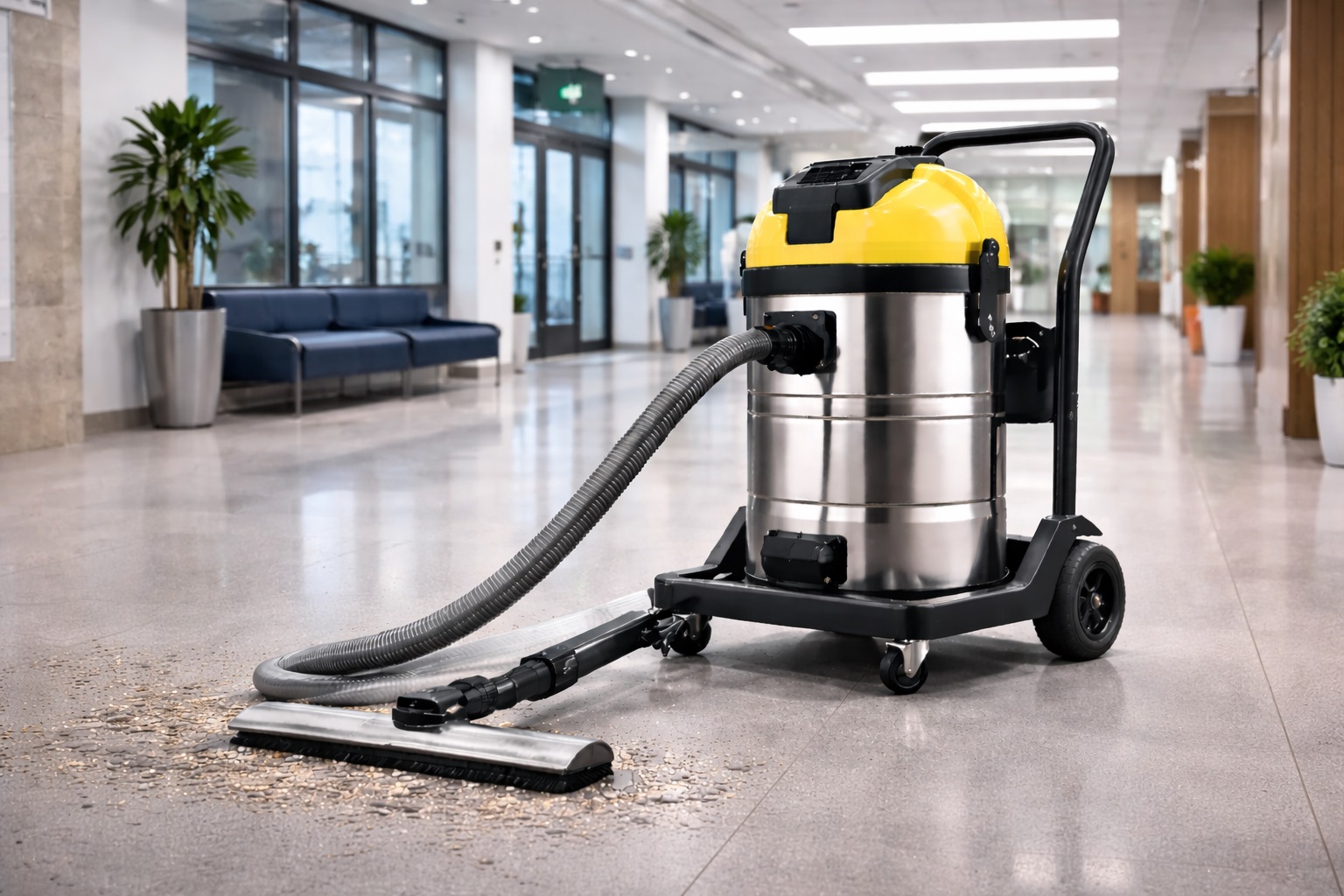
🏛️ The 3 public-facility problems that make cleaning “never finished”
Foot traffic resets the mess every hour: if cleaning routes aren’t designed, you’re always reacting.
Spills are constant: drinks, rainwater, restroom overflows—wet incidents create downtime and slip risk.
Too many surfaces: tile, stone, rubber flooring, carpet, stairs, seating, and outdoor thresholds all demand different tools.
Public facilities (airports, malls, stations, schools, hospitals’ public corridors, stadiums) don’t need “more cleaning.” They need faster recovery, fewer interruptions, and consistent results across huge areas. That’s why barrel vacuum cleaners (drum-style high-capacity vacuums) are often the backbone for large-route cleaning: fewer emptying stops, stable suction over long runs, and better support for wet/dry incident response.
This guide is written for EU & Middle East B2B vacuum cleaner procurement buyers serving public facilities. Below are practical case studies and a fleet strategy that improves cleaning efficiency without turning operations into a training nightmare.
I. 🧭 Fleet segmentation: where barrel vacuums fit (and where they don’t)
Public facilities need different tools for different zones:
Barrel vacuum cleaners: long routes, high-debris volume, event cleanup, wet incident recovery
Cordless Vacuum Cleaner: rapid spot response (lobbies, escalator landings, queue lines)
Large-Capacity Wet Dry Vacuum Cleaner: dedicated spill and restroom overflow response
Upright Vacuum Cleaners: carpeted corridors, meeting rooms, hotels inside facilities
Household Vacuum Cleaners: only for very light-duty back offices or staff rooms (if policy allows), not operational areas
A Vacuum Cleaner for Multi-Surface configuration matters because public sites are a patchwork of materials. “Multi-surface” must translate into tools + airflow strategy, not a label.
II. ✈️ Case Study 1: Airport terminal cleaning (routes + spill readiness)
Situation
Airports have huge square meterage, constant traffic, and frequent spills near food courts and gate areas.
Deployment
Barrel vacuum cleaners staged at “route nodes” (near service closets)
Cordless Vacuum Cleaner units assigned to rapid-response staff
A dedicated Large-Capacity Wet Dry Vacuum Cleaner staged for wet incidents (food court + restroom corridor)
What changed
Route teams stopped losing time to emptying small tanks
Rapid responders handled small messes without calling the route crew
Wet incidents stopped becoming 30–60 minute disruptions
Effectiveness
Faster route completion
Lower complaint rate (“dirty floors” perception drops quickly)
Reduced slip hazards due to faster wet recovery using a Wet and Dry Vacuum Cleaner workflow
III. 🏟️ Case Study 2: Stadium / arena turnaround after events
Situation
After a 15,000–60,000 person event, the facility needs a fast reset: cups, wrappers, popcorn, and sticky spills.
Deployment
Barrel vacuum cleaners for bulk debris routes (concourses, entry lanes)
Large-Capacity Wet Dry Vacuum Cleaner for sticky spills and drink zones
Cordless units for seating rows, stairs edges, and quick touch-ups
What changed
Fewer “trash bag + broom” loops
Less time spent walking back to dump points
Faster reopening for next-day events
Effectiveness
Turnaround time decreases because cleaning becomes parallelized: bulk teams + wet incident teams + detail teams.
Multi-surface tools handle tile, rubber, and stair treads—proving the value of a true Vacuum Cleaner for Multi-Surface setup.
IV. 🏫 Case Study 3: School district standardization across multiple campuses
Situation
Different schools buy different models, spares don’t match, and staff rotate—creating constant training and maintenance friction.
Deployment
Barrel vacuum cleaners for gyms, cafeterias, hallways (high-traffic bulk routes)
Upright Vacuum Cleaners for carpeted libraries and admin
Cordless Vacuum Cleaner per building for fast spot cleanup
One centralized Wet and Dry Vacuum Cleaner kit per campus for spills
What changed
Fewer spare parts SKUs
Faster onboarding for custodial staff
More consistent results across sites
Effectiveness
Procurement reduced downtime because consumables and accessories were standardized. Service contracts became easier to manage, and staff used the right tool in the right zone.
V. 🏥 Case Study 4: Hospital public corridors (non-clinical zones)
Situation
Public corridors are high traffic and must look clean continuously, but cleaning can’t disrupt visitors.
Deployment
Barrel vacuum cleaners for scheduled off-peak routes
Cordless vacuums for quick response near entrances and waiting areas
Wet/dry units staged for restroom incidents and rainy-day water tracking
What changed
Less “mop and wait” downtime
Faster response to tracked water
Lower disruption and fewer complaints
Effectiveness
A disciplined Wet and Dry Vacuum Cleaner response plan reduced slip incidents and allowed cleaning to happen while operations continued.
VI. 🚉 Case Study 5: Transit stations and platforms (multi-surface reality)
Situation
Stations include tile, textured anti-slip zones, metal edges, and outdoor thresholds that bring grit inside.
Deployment
Barrel vacuum cleaners for main concourse routes
Multi-surface tool kits (stiff brush for texture, crevice for platform edges)
Cordless units for ticketing areas and quick-touch zones
Wet/dry units for rainwater and restroom overflow incidents
Effectiveness
Cleaning became more predictable because tools matched surfaces. A Vacuum Cleaner for Multi-Surface toolkit reduced repeated passes and improved visual cleanliness.
VII. 🧠 What “multi-surface” should mean in public facilities
A real Vacuum Cleaner for Multi-Surface strategy should include:
Wide floor tool for open tile/stone
Stiff brush for textured anti-slip areas
Crevice tools for escalator edges, corners, seating rails
Upholstery tool for public seating (where applicable)
Squeegee head for wet incidents (when using wet/dry units)
This tooling approach is what lets barrel vacuum cleaners cover big areas efficiently while cordless units handle detail work.
VIII. 💧 Wet incident control: why large capacity is the difference
Public facilities don’t get occasional spills—they get continuous spills. That’s why a Large-Capacity Wet Dry Vacuum Cleaner should be staged like a “response asset,” not stored in a warehouse.
Practical wet response SOP
Block the area
Recover liquid fast (squeegee head)
Do a short dry pass if needed (or follow-up with a dry-only unit)
Log incident location/time if your facility tracks slip risk
A properly staged Wet and Dry Vacuum Cleaner reduces downtime and makes safety teams happier.
IX. 📊 Procurement scorecard (screenshot-friendly) for public facilities
Rate each supplier 1–5. Total /50.
✅ 10-point scorecard
Route efficiency for large areas (fewer stops, stable pickup)
Multi-surface tooling depth (tile, rubber, texture, seating)
Wet incident readiness (true wet recovery tools + workflow)
Large-capacity wet/dry performance (fewer tank interruptions)
Cordless deployment strategy (fast spot response)
Carpet zone capability (upright compatibility where needed)
Ease of maintenance (filters, tanks, tool access)
Noise/disruption management (clean while open)
EU/MENA parts & service support
Standardization potential across multiple sites
Interpretation:
40–50: strong public-facility fit
30–39: workable with SOP discipline
<30: expect route delays and inconsistent results
Conclusion: public facilities win when cleaning becomes route-based and response-ready
Barrel vacuum cleaners improve cleaning efficiency in public facilities when they’re deployed as a route backbone with fewer emptying stops and stable performance. Add a Cordless Vacuum Cleaner layer for rapid touch-ups, and stage a Large-Capacity Wet Dry Vacuum Cleaner as a dedicated wet-incident asset. Support everything with a true Vacuum Cleaner for Multi-Surface tooling strategy, and restrict Upright Vacuum Cleaners to carpet zones while keeping Household Vacuum Cleaners out of operational areas.
The result is what public facility managers care about most: fewer complaints, fewer disruptions, safer floors, and cleaner spaces that stay clean longer.
Hashtags
PublicFacilityCleaning, BarrelVacuumCleaners, DrumVacuumSystem, RouteBasedCleaning, CleaningRouteNodes, HighTrafficCleaning, AirportTerminalCleaning, StadiumTurnaroundCleaning, ArenaEventCleanup, SchoolDistrictStandardization, CampusCustodialProgram, HospitalPublicCorridors, TransitStationCleaning, PlatformEdgeCleaning, LobbySpotCleanup, CordlessVacuumCleaner, LargeCapacityWetDryVacuumCleaner, WetDryVacuumCleaners, WetAndDryVacuumCleaner, SpillResponseSOP, RestroomOverflowResponse, RainyDayWaterTracking, SlipHazardReduction, VacuumCleanerForMultiSurface, MultiSurfaceToolKit, TileFloorCleaning, RubberFloorCleaning, AntiSlipTextureCleaning, EscalatorEdgeCleaning, StairTreadCleaning, SeatingUpholsteryTool, WideFloorTool, StiffBrushHead, CreviceToolKit, UpholsteryCleaning, UprightVacuumCleaners, HouseholdVacuumCleaners, CarpetZoneCleaning, OfficeBackroomCleaning, ServiceSupportEU, ServiceSupportMENA, DistributorReadyConfig, ProcurementScorecard, TCOModel, ComplaintRateReduction, CleanWhileOpen, NightShiftRoutes, FacilityStandardization, ConsumablesPlanning, MaintenanceChecklist, EventVenueCleaning, Lanxstar



