Hi, message us with any questions.
We're happy to help!





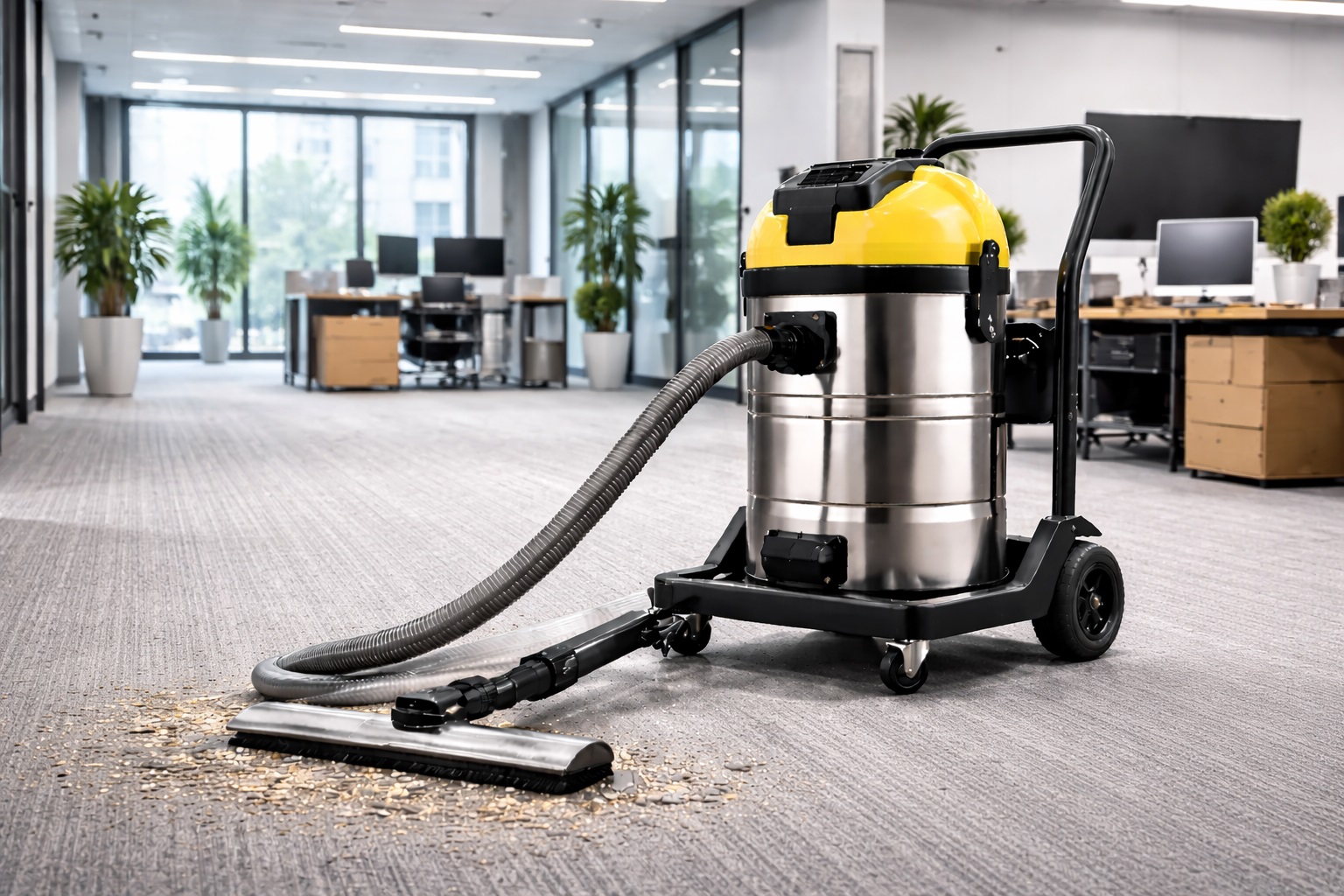
🏢 The 3 commercial-cleaning challenges that affect tenant satisfaction
Noise and disruption: cleaning must happen while people work—or quietly after hours.
Mixed surfaces: carpet tiles, hardwood, luxury vinyl, stone lobbies, and stairwells require different tools.
Spill reality: cafés, pantry areas, and rainy-day water tracking turn “cleaning” into rapid response.
Office and commercial environments are different from factories: cleanliness is visible, complaints are immediate, and schedules are tight. Yet large buildings still have the same operational truth as any facility: time is lost through walking, emptying, and repeated passes.
That’s where barrel vacuum cleaners can add value—especially in large commercial spaces—when they’re used as the backbone for long routes, bulk debris recovery, and spill response. But they don’t replace everything. The smartest commercial programs use a fleet mix that includes Upright Vacuum Cleaners, portable units, and a wet/dry response asset.
This guide is written for EU & Middle East B2B vacuum cleaner procurement buyers serving office buildings, property managers, and commercial cleaning contractors.
I. 🧭 Where barrel vacuum cleaners fit (and where they don’t) in commercial buildings
Best-fit scenarios
Large floorplate routes (open offices, long corridors)
Back-of-house and service corridors (high debris, frequent cleaning)
Lobby perimeter routes during off-peak windows
Dedicated spill response (especially if you stage a wet/dry unit)
Not the best default
Tight desk clusters and small meeting rooms (too bulky)
Carpet detail work in occupied spaces (uprights are faster)
Quick spot response (portable wins)
Procurement takeaway: In offices, barrel vacuum cleaners are a route tool and a response tool, not a universal vacuum.
II. 🧹 The commercial fleet model: route + spot + specialty
If you want consistent results with low training friction, build a three-layer approach:
1) Route cleaning (bulk + distance)
Use barrel vacuum cleaners for:
long corridors and large open areas
high-volume debris zones (service areas, entrances)
2) Spot response (seconds matter)
A Portable Self-Cleaning Vacuum Cleaner shines here:
quick deployment for crumbs, toner dust, and small debris
stable suction without constant filter fiddling
reduces walking time to cleaning closets
3) Specialty zones (surface care + wet incidents)
Upright Vacuum Cleaners for carpet tiles, rugs, and fast pass-through cleaning
Vacuum Cleaner for Hardwood Floors setup for wood and luxury vinyl (soft wheels + no-mark head)
Large-Capacity Wet Dry Vacuum Cleaner staged for spills, restrooms, and rainy-day tracking
Quiet Vacuum Cleaner capability for after-hours and tenant-sensitive schedules
Where Household Vacuum Cleaners fit: only in back offices or very light-duty areas if policy allows. They typically don’t scale for multi-floor commercial routes.
III. 🪵 Hardwood and luxury vinyl: why “hard floor safe” is not optional
Hardwood and LVT floors are expensive—and scratch complaints are common.
What a Vacuum Cleaner for Hardwood Floors should actually include
Soft, no-mark wheels/casters
A soft roller or no-scratch floor head
Smooth airflow path that won’t spit grit back onto the floor
A routine that vacuums grit at entrances before it gets tracked deeper
Operational tip: Many “floor scratches” come from vacuuming after grit has been tracked. A portable unit staged at entrances plus a barrel-route loop prevents that.
IV. 🤫 Quiet cleaning that protects productivity (and tenant retention)
Noise is a KPI in commercial cleaning because it drives complaints.
Where a Quiet Vacuum Cleaner matters most
early morning and late afternoon cleaning windows
executive floors and meeting zones
shared workspaces and co-working buildings
healthcare-adjacent office buildings
Procurement tip: Evaluate “quiet” by whether cleaning can occur while occupied without complaints—not just decibel numbers. Pair a Quiet Vacuum Cleaner for occupied routes with barrel systems for after-hours bulk routes.
V. 💧 Spill response: the “hidden” reason to spec wet/dry capacity
Spills happen daily in commercial buildings: coffee, soda, cleaning liquids, restroom incidents, and rainy-day water tracking.
Why capacity matters
Small tanks create repeated trips and long “wet floor” time. A Large-Capacity Wet Dry Vacuum Cleaner reduces:
recovery time
time cones are up
slip risk and complaints
A simple wet response SOP
Block the area (cones/signage)
Recover liquid fast (squeegee head)
Quick dry pass if needed
Log incident location/time for safety reporting
This is where a wet/dry unit becomes a service-level tool, not a “nice to have.”
VI. 🧠 Practical application cases (commercial reality)
📍 Case 1: Multi-floor office tower route cleaning
Setup: barrel vacuum cleaners staged per two floors, uprights assigned to carpet-heavy zones, portable self-cleaning units for quick desk-cluster response.
Result: fewer interruptions, faster route completion, fewer complaints.
☕ Case 2: Lobby + café zone
Setup: portable units for constant crumbs, a wet/dry unit staged for drink spills, barrel system for after-hours deep route cleaning.
Result: cleaner appearance during peak hours, faster spill recovery.
🪵 Case 3: Executive hardwood corridors
Setup: dedicated hardwood-safe head and wheels, quiet vacuum route during occupied hours, barrel unit kept off the hardwood unless fitted with safe tooling.
Result: fewer scratch complaints, better tenant satisfaction.
🧰 Case 4: Contractor cleaning teams across multiple buildings
Setup: standardized fleet package (barrel + upright + portable + wet/dry), shared accessories, shared consumables.
Result: faster training, easier maintenance, fewer “wrong tool” incidents.
VII. 📊 The “minutes saved per route” metric (the best way to justify procurement)
Commercial cleaning is route economics.
Track:
minutes per floor (before vs after)
emptying trips per route
complaint rate (noise + floor appearance)
wet-floor time after spills
Barrel vacuum cleaners improve efficiency when they reduce emptying trips; portable self-cleaning units improve efficiency when they reduce walking time; uprights improve efficiency when carpet coverage speed matters.
VIII. 🧾 Screenshot-friendly procurement scorecard (office & commercial)
Rate each supplier 1–5. Total /50.
✅ 10-point scorecard
Route efficiency for large areas (bulk coverage, fewer stops)
Carpet zone performance (upright compatibility and speed)
Hard-floor safety (true hardwood/LVT-safe tooling)
Noise management (quiet operation for occupied cleaning)
Spot-response readiness (portable self-cleaning practicality)
Wet incident response (true wet/dry tools and workflow)
Large-capacity wet recovery (reduced “wet floor” time)
Ease of maintenance (filters, tanks, tool access)
Consumables/service support in EU/MENA
Standardization potential across buildings
Interpretation:
40–50: strong commercial fit
30–39: workable with SOP discipline
<30: expect complaints, slow routes, and maintenance friction
Conclusion: commercial cleaning efficiency is a fleet strategy, not a single machine
Barrel vacuum cleaners can significantly improve cleaning efficiency in office and commercial environments when they’re used for what they do best: long routes, bulk debris, and predictable after-hours cleaning. Pair them with Upright Vacuum Cleaners for carpet productivity, a Portable Self-Cleaning Vacuum Cleaner for fast spot response, and a staged Large-Capacity Wet Dry Vacuum Cleaner for spill control.
Add true Vacuum Cleaner for Hardwood Floors tooling to protect premium surfaces, and prioritize a Quiet Vacuum Cleaner option where tenant disruption affects satisfaction and retention. Keep Household Vacuum Cleaners limited to light-duty back-office spaces only.
That’s how commercial programs reduce route minutes, cut complaints, and keep buildings looking “continuously clean.”
Hashtags
OfficeCleaning, CommercialCleaning, PropertyManagementCleaning, FacilitiesManagement, BarrelVacuumCleaners, DrumVacuumSystem, CleaningRouteEfficiency, MultiFloorRouteCleaning, UprightVacuumCleaners, HouseholdVacuumCleaners, PortableSelfCleaningVacuumCleaner, SpotCleanupStrategy, VacuumCleanerForHardwoodFloors, HardwoodSafeFloorHead, LuxuryVinylFloorCleaning, NoMarkWheels, QuietVacuumCleaner, OccupiedHourCleaning, NightShiftCleaningRoutes, TenantComplaintReduction, LobbyCleaning, CafeSpillResponse, LargeCapacityWetDryVacuumCleaner, WetDryVacuumCleaners, WetAndDryVacuumCleaner, SpillResponseSOP, RestroomOverflowResponse, RainyDayWaterTracking, SlipHazardReduction, CarpetTileCleaning, MeetingRoomCleaning, ExecutiveFloorCare, EntranceGritControl, ServiceCorridorCleaning, BackOfHouseCleaning, StandardizedCleaningFleet, ConsumablesPlanning, MaintenanceChecklist, ServiceSupportEU, ServiceSupportMENA, DistributorReadyConfig, ProcurementScorecard, TCOModel, MinutesPerRouteMetric, CleaningWhileOpen, CoWorkingSpaceCleaning, BuildingOperations, ContractorCleaningTeams, HardFloorScratchPrevention, ToolingKitStandardization, EUCommercialProcurement, MENACommercialSupply, Lanxstar



