Hi, message us with any questions.
We're happy to help!





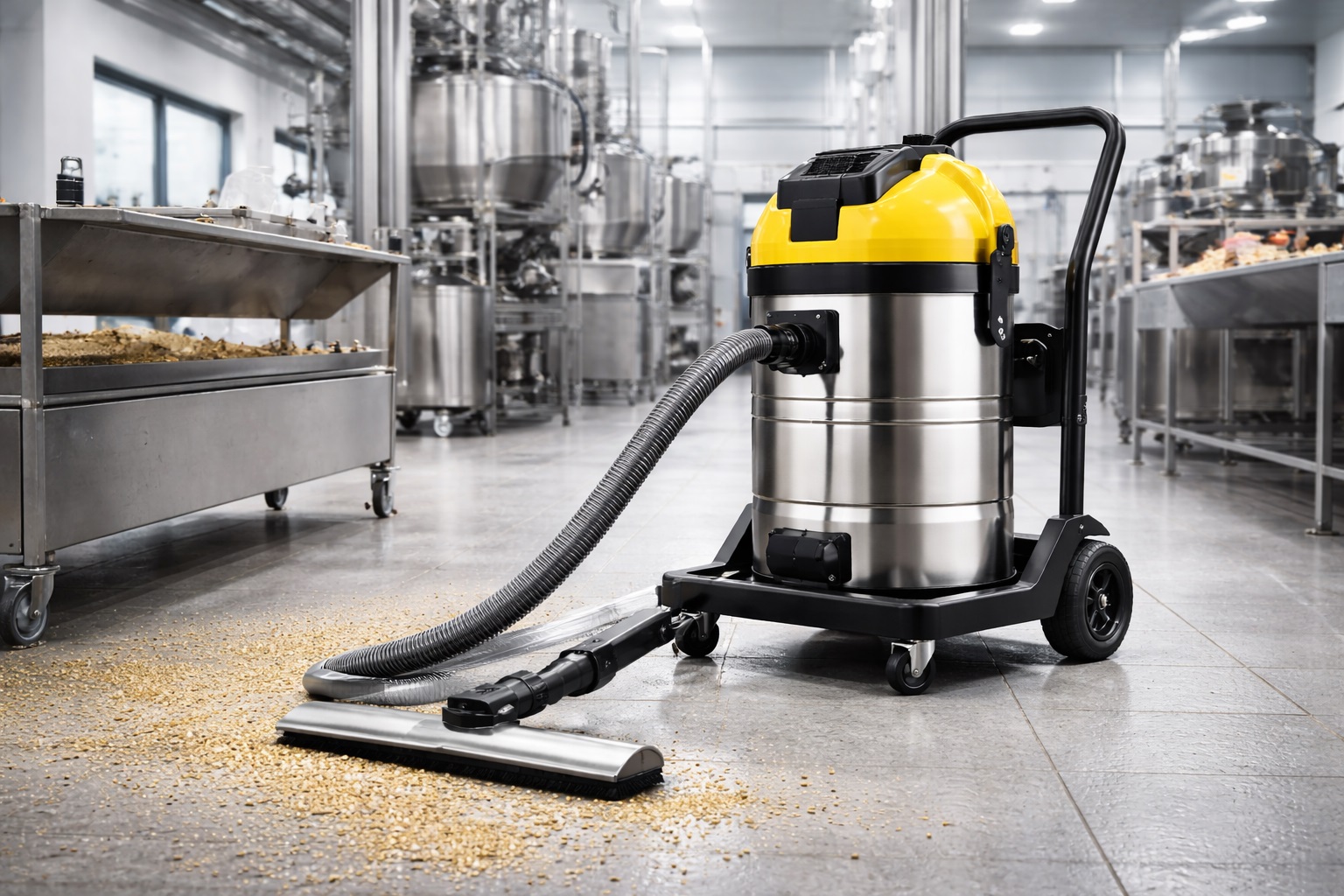
🚨 The 3 hidden “efficiency killers” most food plants don’t count
Micro-stoppages from messy cleanup: operators pause lines repeatedly to sweep, scrape, and re-clean.
Long changeovers: flour, sugar, seasoning dust, and moisture turn into sticky buildup that slows sanitation.
Allergen and cross-contact risk: a single contaminated tool can trigger rework, holds, or disposal.
Food processing efficiency isn’t only about faster machines—it’s about fewer interruptions, shorter sanitation windows, and cleaner restarts. That’s exactly where barrel vacuum cleaners (drum-style high-capacity vacuums) outperform improvised cleaning methods and small tanks.
This guide is written for EU & Middle East vacuum cleaner procurement buyers and distributors serving food processors. The goal: show how the right vacuum configuration can reduce downtime, simplify audits, and improve throughput—without turning your plant into a maintenance headache.
I. 🥫 Why barrel vacuum cleaners improve production efficiency (not just cleanliness)
In food plants, “cleaning time” is often production time in disguise. Barrel vacuum cleaners can increase effective output because they:
Shorten cleanup during micro-stops (fewer stoppages for sweeping, rework, and wipe-downs)
Speed up changeovers with fast recovery of powders and debris
Reduce re-clean events by containing dust instead of re-aerosolizing it
Support hygienic waste handling (liners, controlled disposal, less recontamination)
Where they don’t replace other categories:
Upright Vacuum Cleaners are still excellent for office areas, carpets, and front-of-house zones.
Household Vacuum Cleaners may be acceptable for non-production areas (depending on plant policy), but they’re rarely built for frequent, heavy-duty sanitation cycles or large debris loads.
Procurement takeaway: Use barrel vacuum cleaners in production and sanitation zones, while Upright Vacuum Cleaners / Household Vacuum Cleaners remain “non-process” tools.
II. 🧼 The vacuum-first sanitation strategy (the fastest route to shorter changeovers)
Most plants follow a “scrape → wet wash → dry” rhythm. That’s fine—until powders and debris turn into paste after water hits them.
A better approach is often vacuum-first sanitation, which looks like this:
Step 1: Dry removal before water
Vacuum flour, sugar, spice dust, crumbs, and packaging debris
Clear corners, conveyor frames, and under-belt zones
Reduce what becomes “wet sludge” later
Step 2: Targeted wet cleaning
Smaller wet footprint
Less chemical usage
Less rinse time
Step 3: Drydown support
Faster dryback, fewer slip hazards, quicker restart
Why this improves OEE (Overall Equipment Effectiveness):
Shorter planned downtime (sanitation windows shrink)
Fewer unplanned stoppages (less buildup-related jams and sensor fouling)
Faster startup after cleaning (less residue-driven defects)
This workflow is where a Large-Capacity Wet Dry Vacuum Cleaner can be a big win, because it handles both dry pre-clean and liquid recovery when configured properly.
III. 🍞 Powders are your “efficiency tax”: how to vacuum flour and sugar without clogging
Flour and sugar behave like “production glue” once they mix with moisture. They also destroy suction if filtration is wrong.
What buyers should demand (practical filtration staging)
A production-friendly barrel vacuum setup typically needs:
Pre-separation (drop-out chamber or cyclone) to reduce filter loading
Primary filter sized for continuous powder pickup
Optional high-efficiency final stage where allergen/dust containment matters
Field indicator: If operators need to stop and “shake the filter” repeatedly, the plant is paying an efficiency tax in minutes—and those minutes compound daily.
To keep energy and labor under control, buyers should look for an Energy-Saving Efficient Powerful Vacuum Cleaner configuration: not “lowest wattage,” but stable suction with fewer filter interventions and lower overall runtime per cleanup event.
IV. 🧴 Wet + dry in one shift: how to use wet/dry capability without creating chaos
Food plants often have both:
Dry debris (powders, crumbs)
Wet residues (brines, sauces, wash water)
Two common mistakes:
Using wet mode right after powders → paste forms in hoses and filters
Treating “wet/dry” as a casual feature instead of a controlled workflow
Two-mode discipline for Wet and Dry Vacuum Cleaner systems
Mode A — Dry pickup (before washdown):
Dedicated dry accessories and dry filtration setup
Vacuum-first to keep powder out of drains and off walls
Mode B — Wet recovery (after rinse/foaming):
Liquid-appropriate separation, sensors, and seals
Controlled disposal to avoid recontamination
A properly specified Wet and Dry Vacuum Cleaner can support both modes, but procurement should insist on either:
Two dedicated units (dry-only + wet-only), or
A conversion approach that is fast, safe, and SOP-controlled
That’s how a Large-Capacity Wet Dry Vacuum Cleaner improves efficiency instead of becoming a “clog-and-clean” machine.
V. 🧠 Multi-surface reality: the plant is not one floor type
Food facilities are a patchwork of surfaces:
Epoxy floors, tile, stainless frames
Anti-slip zones
Tight corners and under-equipment voids
Packaging areas with mixed debris types
This is where a Vacuum Cleaner for Multi-Surface setup matters—not as marketing, but as an accessory and airflow strategy:
A practical multi-surface accessory kit
Wide floor tool for open epoxy/tile
Crevice tools for drains edges, frames, and under guards
Soft brush/no-mark heads for stainless and painted surfaces
Squeegee tool for wet recovery zones
Long-reach wands for overhead dust on supports and cable trays
Procurement takeaway: “Multi-surface” should mean the supplier can provide the right tools and hoses—not just a label on the box.
VI. 🧬 Allergen control that actually reduces downtime (not just risk)
Allergen controls are often framed as compliance, but they’re also a throughput lever: fewer holds, fewer re-cleans, fewer “restart surprises.”
A 4-layer allergen vacuum control plan
Zone-based vacuuming
Assign vacuums to allergen vs non-allergen zones
Color-coded accessories
Hoses and tools mapped to zones
High-efficiency filtration option
Where cross-contact risk is real, filter integrity matters
Validation-friendly routines
Simple visual checks + scheduled filter changes + documented SOP
This is where a “consumer-style” Vacuum Cleaner for Multi-Surface is not enough, and where Household Vacuum Cleaners should never be used in allergen-sensitive production zones.
VII. ⚡ Energy efficiency: what “energy-saving” should mean for procurement
Many bids talk about watts like that’s the full story. In real plants, energy waste comes from:
Operators running machines longer due to weak pickup
Frequent clogs and re-clean cycles
Repeated stops to clear filters and hoses
An Energy-Saving Efficient Powerful Vacuum Cleaner is one that:
Maintains stable suction over time
Reduces total cleaning minutes per shift
Cuts filter interventions
Supports fast, predictable changeovers
A simple buyer metric
Instead of “power consumption,” ask suppliers for:
Minutes to clean a standard area (e.g., 200 m² + under-line voids)
Filter intervention count per shift (target: near-zero)
Average runtime per cleanup event
This frames energy efficiency as total work done per kWh, not just nameplate numbers.
VIII. 🧾 The audit advantage: turning your vacuum into a documentation asset
Food plants win audits by demonstrating:
Repeatable sanitation
Tool control
Waste handling discipline
Maintenance records
Procurement requirements that help audits
Filter replacement schedule template
Spare parts list and lead times
Cleaning SOP suggestions (dry-first, wet recovery, allergen separation)
Tool control (color kit) capability
Traceable waste handling options (liners, labeling)
A barrel vacuum system that supports documentation reduces “audit prep time,” which quietly improves efficiency too.
IX. 🛒 Distributor-ready procurement scorecard (shareable, screenshot-friendly)
Rate each supplier 1–5. Total /50.
✅ 10-point scorecard for food processing barrel vacuum deployments
Changeover speed impact (vacuum-first viability)
Powder pickup stability (no clogging, no suction collapse)
Wet recovery readiness (separation, sensors, seals)
Multi-surface tool kit completeness
Hygienic design & cleanability (surfaces, seals, access)
Allergen control support (zone strategy + filtration option)
Waste handling workflow (liners, disposal practicality)
Energy efficiency in real use (minutes saved per shift)
Service & consumables availability in EU/MENA
Operator ergonomics (mobility, PPE-friendly handling)
Interpretation:
40–50: strong production-efficiency choice
30–39: workable with tight SOP discipline
<30: likely time-waste and re-clean cycles
Conclusion: production efficiency improves when sanitation becomes predictable
Food processing plants don’t gain efficiency by “cleaning harder.” They gain efficiency by cleaning smarter and faster, with fewer interruptions and fewer failures.
When barrel vacuum cleaners are specified correctly—especially as a Large-Capacity Wet Dry Vacuum Cleaner with disciplined wet/dry workflows and a true Vacuum Cleaner for Multi-Surface tool strategy—they reduce micro-stops, shorten changeovers, and improve restart quality. Combined with realistic definitions of an Energy-Saving Efficient Powerful Vacuum Cleaner, they also cut total cleaning minutes and energy waste across shifts.
Keep Upright Vacuum Cleaners and Household Vacuum Cleaners in the right places (non-process zones), and use barrel systems where production efficiency is actually won: the line, the corners, the voids, and the changeovers.
Hashtags
FoodProcessingCleaning, BarrelVacuumCleaners, DrumVacuumCleaner, IndustrialVacuumSystem, LargeCapacityWetDryVacuumCleaner, WetDryVacuumCleaners, WetAndDryVacuumCleaner, EnergySavingEfficientPowerfulVacuumCleaner, VacuumCleanerForMultiSurface, UprightVacuumCleaners, HouseholdVacuumCleaners, SanitationEfficiency, ChangeoverOptimization, OEEImprovement, MicroStopReduction, VacuumFirstSanitation, FlourDustCleanup, SugarDustControl, SpicePowderRecovery, DryCleanupBeforeWashdown, WetRecoveryAfterRinse, HygienicWasteHandling, DrumLinerSystem, BagInBagOut, FilterStagingDesign, PreSeparatorCyclone, DropOutChamber, CartridgeFilter, HighEfficiencyFiltration, AllergenControlPlan, ZoneBasedCleaning, ColorCodedAccessories, CrossContactPrevention, MultiSurfaceToolKit, CreviceToolCleaning, UnderEquipmentCleanup, ConveyorFrameCleaning, CornerAndVoidCleaning, WashdownSupport, SqueegeeRecoveryTool, SlipHazardReduction, AuditReadyCleaning, HACCPAlignment, SOPStandardization, MaintenanceChecklist, ConsumablesPlanning, ServiceSupportEU, ServiceSupportMENA, DistributorReadyConfig, B2BCleaningBuyer, Lanxstar



