Hi, message us with any questions.
We're happy to help!





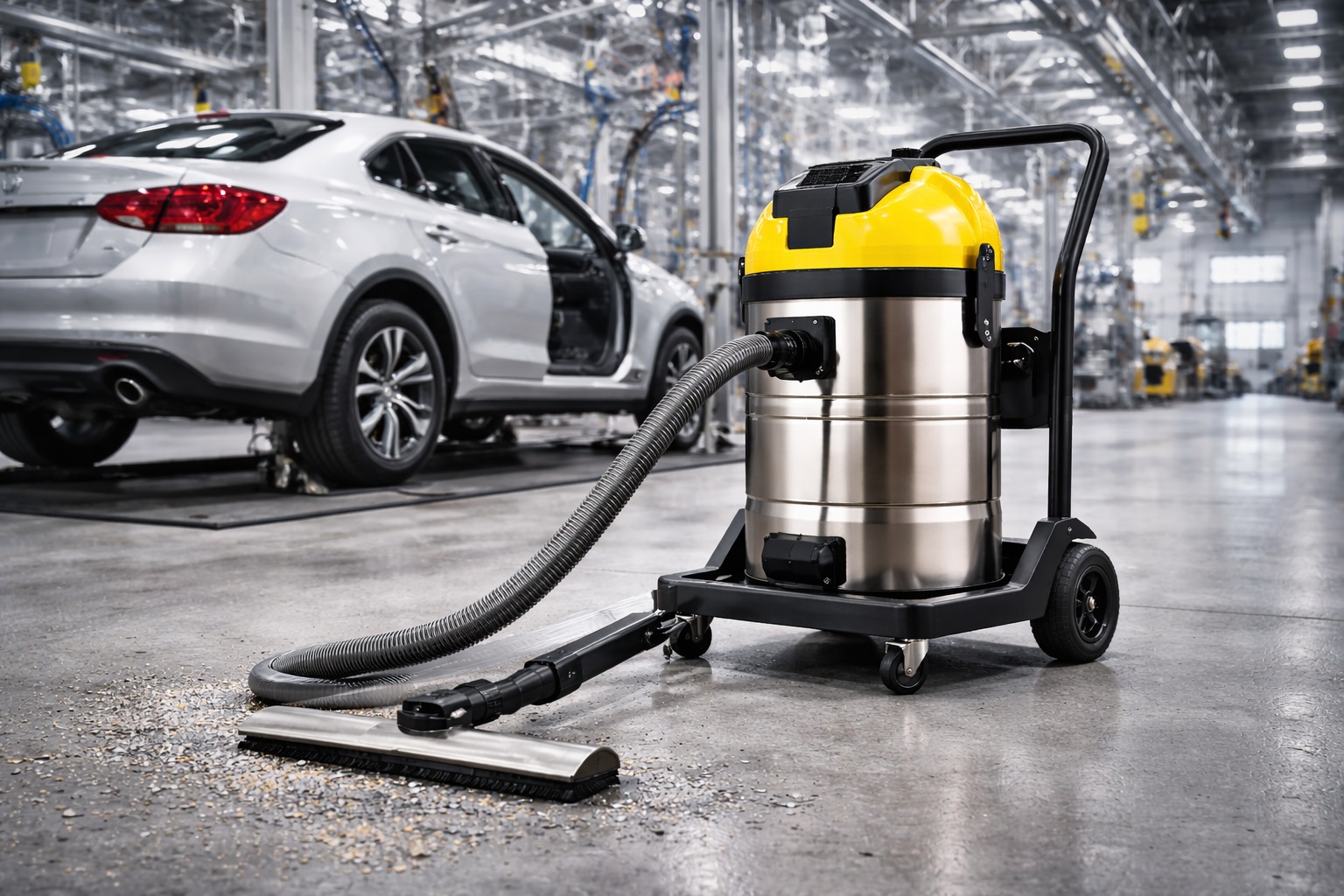
🚗 The 3 “throughput leaks” automotive plants often ignore
Micro-stoppages from debris: metal shavings, plastic trim dust, packaging scraps, and sealant crumbs trigger frequent “stop-and-fix” moments.
Quality defects caused by dust: dust in pre-paint, paint, or adhesive zones becomes rework, not just housekeeping.
Tool mismatch: using the wrong vacuum type (or the right vacuum in the wrong zone) creates clogging, slow pickup, and repeated cleaning.
In automotive manufacturing, cleaning is never “just cleaning.” It’s a control system for flow, quality, safety, and uptime. That’s why barrel vacuum cleaners (drum-style, high-capacity units) are widely adopted in body shops, machining areas, and general production zones: they handle high volume, support waste containment, and reduce operator time wasted on emptying and improvising.
This guide is written for EU & Middle East B2B vacuum cleaner procurement buyers and distributors serving automotive manufacturers—with practical configurations and workflows you can implement across stamping, body, paint, assembly, machining, and end-of-line.
I. 🏭 Where barrel vacuum cleaners fit in the automotive plant map
Think of barrel systems as the “heavy-lift backbone” of your cleaning fleet. Typical high-impact placements:
Machining & CNC cells: metal chips + coolant mist + sludge
Body shop / welding areas: grinding dust, weld spatter debris, general floor contamination
Pre-paint prep zones: dust capture that directly affects paint defects
General production aisles: large debris volumes and frequent pickups
Maintenance teams: shutdown cleaning, pit cleanup, under-line voids
Where barrel units should not be your default:
Offices, carpets, reception: Upright Vacuum Cleaners are faster and simpler for non-process zones.
Light-duty corners and quick touch-ups: a Cordless Handheld Vacuum Cleaner is the “micro-stop killer.”
Vehicle interior stations / service bays: a dedicated Car Vacuum Cleaner setup is more ergonomic and faster for seats, mats, and tight interior geometry.
Procurement takeaway: Automotive efficiency comes from a fleet mix, not a single machine. Barrel vacuum cleaners handle volume; handheld and vehicle-focused tools handle speed and ergonomics.
II. 🔧 The “right tool for the right micro-task” fleet model (what most plants miss)
Many plants overspend by buying one “industrial” model and forcing it everywhere. The better model is task-based:
1) Barrel vacuum cleaners = high-volume, high-frequency recovery
Best for:
long shifts, large debris, frequent pickups
under-equipment voids, pits, and line edges
shutdown cleaning where speed matters
2) Cordless Handheld Vacuum Cleaner = instant response
Best for:
operator-led quick cleanup during cycle gaps
control panels, fixtures, tight crevices
preventing small debris from becoming downtime
3) Wet Dry Vacuum Cleaners = machining reality
Best for:
coolant spills, slurry, wet chips
post-maintenance cleanup
preventing slip hazards and coolant tracking
4) Car Vacuum Cleaner = EOL detailing / service
Best for:
upholstery, carpet, vents, trims
consistent QC results (fewer “redo” interiors)
5) Upright Vacuum Cleaners / Household Vacuum Cleaners = non-process areas
They still matter for:
front-of-house cleanliness
meeting rooms, corridors, showrooms
But they should not be used in production zones where metal dust and oils are present.
If you need one “workhorse spec” for maintenance teams, define it as a Multi-Functional Durable Vacuum Cleaner—meaning robust hoses, impact-resistant tools, reliable filtration, and fast serviceability—not just a marketing label.
III. 🧲 Debris types that decide your vacuum spec (and your downtime)
Automotive plants don’t deal with “dirt.” They deal with specific contaminants:
A) Metal chips and swarf (machining)
Risks:
clogged hoses, damaged filters, heavy loads
coolant + chips become sludge
Solution:true Wet Dry Vacuum Cleaners capability with separation discipline, durable hoses, and appropriate filtration.
B) Grinding & sanding dust (body, prep)
Risks:
airborne dust, surface contamination, filter loading
Solution:staged filtration + consistent suction; consider dedicated zones and tool control.
C) Plastic trim dust & foam particles (assembly/EOL)
Risks:
scattered debris, recurring touch-ups
Solution:rapid response using Cordless Handheld Vacuum Cleaner units at point-of-use.
D) Paint-area dust (quality-critical)
Risks:
paint defects, rework loops
Solution:vacuum-first cleaning discipline and accessories designed for edges, corners, and under-guards.
Buyer reality: The wrong spec doesn’t just slow cleaning—it increases rework and micro-stoppages.
IV. 🧪 Wet + dry without chaos: the operating discipline that keeps suction stable
In automotive, “wet + dry” usually means coolant + chips + general debris. The fastest way to create downtime is mixing workflows without discipline.
Two-mode discipline for Wet Dry Vacuum Cleaners
Mode A — Dry recovery
dry debris only (dust, trim scraps, packaging)
keep dry filters dry
focus on speed and coverage
Mode B — Wet recovery
coolant, slurry, wet chips
liquid separation and sensors in place
controlled disposal and rinse routine
Procurement best practice: Either
two dedicated units (dry-only + wet-only), or
a Wet Dry Vacuum Cleaners system with safe conversion plus an SOP that operators actually follow.
This is how a wet/dry platform becomes an uptime tool instead of a constant “clean-the-cleaner” problem.
V. 🎯 Productivity playbook: 6 ways barrel vacuum cleaners improve OEE
If you want “48-hour shareability,” you need a plan that looks like solutions, not product talk.
1) Reduce micro-stops with point-of-use kits
Deploy:
handheld units at high-touch stations
barrel vacuum cleaners in central “rapid response” locations (end of line edges, aisles)
Result: small spills don’t snowball into downtime.
2) Cut changeover and restart time
During shift transitions or tool changes:
vacuum-first the area (dry debris)
then targeted wipe or wash only where needed
Result: faster restart + fewer defects.
3) Prevent “debris migration”
Debris travels via:
shoes, carts, air movement, and coolant tracking
A high-capacity barrel vacuum strategy reduces re-circulation of dust and chips.
4) Improve paint and adhesive outcomes
Dust control is quality control:
vacuum corners, under guards, and line edges before prep
avoid sweeping that re-aerosolizes dust
Result: fewer surface contamination defects.
5) Standardize maintenance shutdown cleaning
Create a shutdown SOP:
barrel vacuum cleaners for pits and voids
wet/dry for coolant zones
tool checklist for completeness
Result: predictable downtime windows.
6) Make cleaning measurable
Track:
minutes per cleanup event
number of micro-stops linked to debris
rework incidents linked to dust/contamination
Result: procurement can justify the fleet on TCO, not opinions.
VI. 🧰 Accessories are the real “multi-functional” factor
A vacuum can’t be “Multi-Functional” without the right tooling. For automotive plants, specify an accessory pack that matches reality:
Wide floor tool for aisles and open epoxy
Crevice tools for fixtures, rails, corners
Brush/no-mark heads for painted surfaces and sensitive panels
Squeegee tool for wet recovery zones
Long-reach wands for under-line voids and pit edges
Durable hose spec that tolerates chips (not consumer-grade corrugated hoses)
If the supplier can’t standardize accessories across your fleet, you’ll lose time to mismatched parts and broken tools—especially across multiple sites.
VII. 📦 Procurement scorecard (screenshot-friendly) for automotive applications
Score each supplier 1–5. Total /50.
✅ 10-point scorecard
Coverage of debris types (chips, dust, wet slurry, trim debris)
Wet/dry workflow readiness (separation, sensors, easy cleanup)
Sustained pickup performance (no frequent clogging)
Durability (hoses, casters, impact resistance)
Serviceability (filter change time, access, spare parts)
Tooling kit completeness (crevice, brush, squeegee, long reach)
Ergonomics (mobility, PPE-friendly handling)
Fleet compatibility (shared accessories, standardized consumables)
Documentation support (SOP templates, maintenance schedules)
Local support in EU/MENA (parts availability, training)
Interpretation:
40–50: strong fit for automotive manufacturing
30–39: workable but expect SOP enforcement and higher oversight
<30: likely downtime, tool breakage, and suction instability
Conclusion: automotive plants win when cleaning becomes a production system
The best automotive facilities treat cleaning as part of flow and quality, not an afterthought. Barrel vacuum cleaners deliver outsized value because they handle high-volume recovery with less operator interruption. Pair them with Cordless Handheld Vacuum Cleaner units for instant response, Wet Dry Vacuum Cleaners for coolant realities, and a dedicated Car Vacuum Cleaner approach for end-of-line interiors.
Keep Upright Vacuum Cleaners and Household Vacuum Cleaners where they belong—non-process zones—and specify a Multi-Functional Durable Vacuum Cleaner kit based on tools, maintainability, and fleet standardization. The result is simple: fewer micro-stops, shorter downtime windows, and more consistent quality.
Hashtags
AutomotiveManufacturingCleaning, BarrelVacuumCleaners, DrumVacuumCleaner, IndustrialVacuumFleet, ProductionEfficiency, OEEImprovement, MicroStopReduction, MachiningCellCleanup, MetalChipsRecovery, SwarfCollection, CoolantSpillRecovery, WetDryVacuumCleaners, WetAndDryCleanup, SlurryVacuuming, BodyShopCleaning, GrindingDustControl, PrePaintDustControl, PaintDefectReduction, AssemblyLineHousekeeping, UnderLineVoidCleaning, PitCleanupSOP, MaintenanceShutdownCleaning, MultiFunctionalDurableVacuumCleaner, HeavyDutyHose, DurableAccessories, ToolingKitStandardization, CordlessHandheldVacuumCleaner, PointOfUseCleaning, RapidResponseCleaning, CarVacuumCleaner, EndOfLineDetailing, InteriorVacuumWorkflow, UpholsteryVacuuming, MultiSurfacePlantCleaning, EpoxyFloorCleaning, CreviceToolCleaning, SqueegeeRecoveryTool, NoMarkBrushTool, UprightVacuumCleaners, HouseholdVacuumCleaners, NonProcessZoneCleaning, FacilityFrontOfHouse, DistributorReady, B2BProcurement, ServiceSupportEU, ServiceSupportMENA, SparePartsAvailability, CleaningSOP, TCOModel, Lanxstar