Hi, message us with any questions.
We're happy to help!





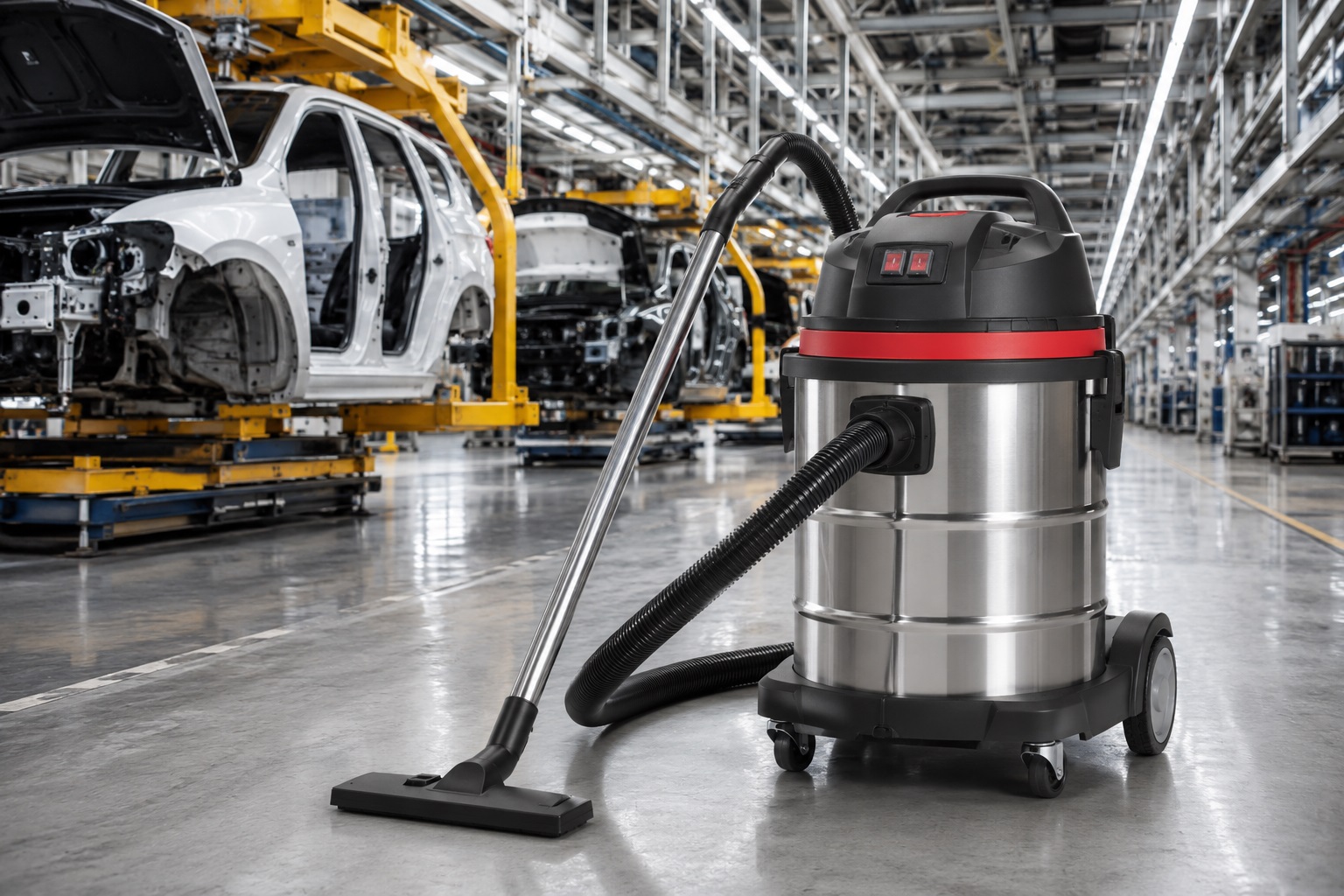
Introduction
When automotive manufacturers talk about improving production capacity, the discussion usually focuses on robotics, automation, AI inspection, predictive maintenance, and digital factory systems. These investments matter, but one operational factor quietly influences all of them: automotive factory cleaning.
Dust, welding slag, metal chips, plastic particles, oil mist, battery powder, and packaging debris are not only visual cleaning issues. They affect sensor accuracy, shorten bearing life, block cooling systems, contaminate components, increase manual labor, and create unexpected downtime.
In modern automotive manufacturing, where production lines often operate across multiple shifts, a small contamination issue can become a major production problem. A dirty sensor may trigger false alarms. Fine metal particles may damage moving parts. Dust inside electrical cabinets may reduce heat dissipation. These small problems rarely appear in financial reports, but they directly reduce manufacturing efficiency.
Here is the key idea many factories still overlook:
Most automotive plants do not have a cleaning problem. They have a contamination management problem.
Cleaning is an activity. Contamination management is a system. The difference determines whether a factory simply removes visible dust or prevents contamination from damaging production performance.
🔍 The Hidden Cost of Contamination in Automotive Production Lines
Many procurement teams compare cleaning equipment by purchase price. Experienced plant managers compare it by cost avoidance.
Dust and debris create several hidden costs:
More frequent machine stoppages
Higher maintenance labor hours
Shorter component lifespan
More quality inspection failures
Increased spare parts consumption
Reduced operator productivity
Higher safety and housekeeping risks
For example, metal dust from welding or grinding may slowly enter bearings, rails, motors, or robotic joints. At first, there is no obvious failure. Over time, equipment vibration increases, accuracy decreases, and emergency maintenance becomes more frequent.
This is why factory dust removal should not be treated as a low-level housekeeping task. It should be part of a structured production line maintenance program.
The real value of an industrial vacuum system is not only that it removes dust. Its value is that it protects uptime, equipment reliability, product consistency, and factory safety.
🏭 From Cleaning Schedule to Contamination Control Strategy
Traditional factory cleaning often follows this model:
Production → Dust Accumulation → Manual Cleaning → Production Restart
This approach is reactive. The factory waits until contamination becomes visible, then removes it.
A smarter model looks like this:
Production → Continuous Dust Capture → Preventive Cleaning → Equipment Protection → Stable Output
This approach is proactive. Instead of allowing dust to spread across the production environment, the factory controls contamination near the source.
For automotive plants, this shift is important because production lines are becoming more sensitive. Robotic welding cells, automated guided vehicles, precision sensors, vision inspection systems, and EV battery production areas all require cleaner operating conditions.
A modern automotive factory cleaning strategy should answer five questions:
Where is dust generated?
What type of dust or debris is produced?
How does contamination move through the production area?
Which machines or processes are most vulnerable?
What cleaning method prevents the highest operational risk?
Factories that answer these questions usually make better equipment decisions and avoid buying vacuum systems that look powerful but do not solve the real problem.
⚙️ Why One Vacuum System Cannot Fit Every Automotive Workshop
A common mistake in industrial vacuum purchasing is using one type of vacuum for the entire factory.
Automotive factories generate different contaminants in different areas. Each area needs a different cleaning strategy.
| Production Area | Main Contamination | Recommended Cleaning Solution |
|---|---|---|
| Welding line | Welding slag, metal dust, sparks | Heavy-duty industrial vacuum with spark-resistant filtration |
| CNC machining area | Metal chips, coolant, oil residues | Industrial vacuum system with chip and liquid separation |
| Paint shop | Fine paint dust, overspray particles | High-filtration vacuum with safety-focused design |
| EV battery line | Conductive powder, fine particulate dust | Specialized vacuum system with advanced filtration |
| Final assembly | Plastic fragments, packaging debris, textile dust | Quiet, ergonomic vacuum for frequent daily cleaning |
| Electrical cabinet area | Fine dust and airflow blockage | Controlled dust removal with precision cleaning tools |
This table shows why the buying decision should begin with contamination type, not motor power.
A vacuum that works well for packaging debris may not be suitable for metal dust. A system designed for dry dust may fail quickly in areas with oil and coolant. A standard unit may not be safe for fine powder or sensitive battery production environments.
The right industrial vacuum system depends on the process, material, dust risk, operation time, and maintenance requirements.
🛒 B2B Buyer’s Checklist: How to Choose an Industrial Vacuum System
For European and North American B2B buyers, the best purchasing question is not:
“Which vacuum has the strongest suction?”
The better question is:
“Which vacuum reduces the greatest operational risk in our production line?”
Use this checklist before requesting quotations.
1. Airflow and Vacuum Pressure
Airflow helps move lightweight dust over larger areas. Vacuum pressure helps collect heavier materials such as metal chips or compact debris.
A welding line, CNC workshop, and final assembly area may require different airflow-pressure combinations.
2. Filtration Efficiency
Fine dust is often more dangerous than visible debris. High-efficiency filtration helps protect sensitive equipment and improve workplace air quality.
For automotive factory cleaning, filtration should match the particle size and material risk.
3. Continuous-Duty Operation
Automotive factories often run long shifts. A light-duty vacuum may overheat or fail under continuous use.
Buyers should confirm whether the system is designed for extended industrial operation.
4. Filter Cleaning System
Filters clog quickly in dusty production areas. Automatic or semi-automatic filter cleaning reduces downtime and keeps suction performance stable.
5. Maintenance Accessibility
A vacuum system that is difficult to maintain creates long-term costs. Buyers should check filter replacement, dust container removal, motor access, hose durability, and spare parts availability.
6. Noise Level
Noise matters, especially in final assembly and operator-heavy areas. Lower noise improves worker comfort and supports safer daily operations.
7. Expandability
Can the vacuum system support future production line expansion? Can it connect to a central vacuum network? Can multiple operators use it at the same time?
Scalability is important for growing automotive manufacturing facilities.
8. Safety Requirements
Some dust types require special safety designs. Fine metal dust, conductive powder, and paint-related particles may need specialized equipment.
Procurement teams should always match the vacuum system to the actual production risk.
📊 ROI Thinking: The Real Value Is Not the Vacuum, But the Downtime It Prevents
Many buyers calculate return on investment by comparing equipment price. This is too narrow.
A better ROI model includes:
Downtime reduction
Lower emergency maintenance costs
Less manual cleaning labor
Fewer spare parts replacements
Longer equipment lifespan
Better production consistency
Improved workplace safety
Higher overall manufacturing efficiency
For example, if a factory reduces unplanned stoppages by even a small percentage, the savings may be greater than the cost difference between a low-end vacuum and a professional industrial system.
This is why industrial cleaning equipment should be evaluated as part of production line maintenance, not as a cleaning supply purchase.
A low-cost vacuum may look attractive during procurement, but if it clogs frequently, requires excessive labor, or fails under continuous operation, it becomes expensive over time.
The best factories do not buy the cheapest cleaning equipment. They buy the equipment that protects the most valuable production assets.
🧠 The Overlooked Link Between Factory Dust Removal and OEE
Overall Equipment Effectiveness, or OEE, is influenced by availability, performance, and quality.
Contamination affects all three.
Availability: Dust and debris increase machine stoppages and emergency maintenance.
Performance: Dirty sensors, clogged cooling systems, and worn components reduce operating stability.
Quality: Particles on components, surfaces, or assembly zones may increase defects and rework.
This is why factory dust removal can directly support OEE improvement.
Many automotive plants invest heavily in software to measure production efficiency, but they underestimate the physical environment that influences those measurements. A smart factory still depends on clean machines, stable airflow, accurate sensors, and reliable production surfaces.
In this sense, automotive factory cleaning is not separate from digital manufacturing. It supports the conditions that allow digital systems to work properly.
🚗 Cleaning Strategy for Different Automotive Production Stages
Body Shop
The body shop often produces welding dust, metal particles, and grinding residue. These contaminants can affect robotic welding cells, rails, fixtures, and moving parts.
Recommended focus:
Capture dust close to the source
Remove metal particles before they spread
Protect robotic systems and sensors
Use durable hoses and tools for heavy debris
Paint Shop
Paint shops require more controlled cleaning because fine particles can affect surface quality.
Recommended focus:
High-efficiency dust removal
Controlled airflow management
Careful surface cleaning
Equipment suitable for fine particulate matter
Machining Area
Machining zones produce chips, coolant, oil, and mixed wet-dry waste.
Recommended focus:
Separate liquids and solids
Prevent slippery floor conditions
Reduce manual shoveling and sweeping
Protect machine tools from particle accumulation
EV Battery Production
Battery-related production can involve fine powders and sensitive contamination risks.
Recommended focus:
Advanced filtration
Safe collection of fine particles
Strict cleaning procedures
Equipment selection based on material risk
Final Assembly
Final assembly areas usually produce lighter debris, packaging waste, textile dust, and plastic fragments.
Recommended focus:
Operator-friendly vacuum systems
Low-noise cleaning equipment
Frequent quick cleaning
Clean and organized workstations
By designing cleaning procedures around each production stage, manufacturers create a more reliable and efficient factory environment.
💡 A Practical Framework: Source, Path, Impact, Control
Many factories clean what they see. High-performing factories manage what they measure.
A simple framework can improve industrial cleaning decisions:
Source
Where is the dust or debris generated?
Examples: welding cells, cutting machines, sanding stations, packaging zones.
Path
How does contamination move?
Examples: airflow, forklift traffic, operator movement, conveyor vibration.
Impact
What does the contamination affect?
Examples: sensors, motors, bearings, surfaces, product quality, worker safety.
Control
What is the best intervention?
Examples: mobile vacuum, central vacuum system, dust extraction unit, scheduled cleaning, operator training.
This framework helps buyers avoid random equipment purchases. It turns industrial cleaning into a measurable operational system.
For B2B buyers, this is especially valuable because it connects equipment selection with production outcomes.
🏗️ Central Vacuum System vs. Mobile Industrial Vacuum
Both solutions have advantages. The right choice depends on factory layout, contamination type, and cleaning frequency.
| Solution | Best For | Advantages | Limitations |
|---|---|---|---|
| Mobile industrial vacuum | Flexible cleaning across different zones | Easy deployment, lower initial setup, movable | Requires operator movement and manual handling |
| Central vacuum system | Large plants with repeated cleaning points | Stable suction network, multi-point use, scalable | Higher initial planning and installation cost |
| Specialized vacuum unit | Hazardous or fine dust applications | Designed for specific risks | May not be suitable for general cleaning |
| Wet and dry industrial vacuum | Mixed liquid and solid waste | Useful in machining and maintenance areas | Needs proper waste handling procedures |
For smaller or changing production environments, mobile units may offer better flexibility. For large automotive factories with fixed dust generation points, a central system may improve long-term manufacturing efficiency.
A strong purchasing strategy may combine both: central systems for continuous dust control and mobile units for maintenance, emergency cleaning, and flexible production areas.
🔧 Common Purchasing Mistakes to Avoid
Mistake 1: Buying Only by Motor Power
High motor power does not guarantee better cleaning performance. Airflow, vacuum pressure, filtration, hose design, and dust container capacity all matter.
Mistake 2: Ignoring Filter Maintenance
A vacuum with poor filter cleaning loses performance quickly. Stable suction is more important than impressive initial suction.
Mistake 3: Using Commercial Vacuums in Industrial Areas
Commercial cleaning equipment is not designed for heavy dust, metal chips, continuous shifts, or harsh production environments.
Mistake 4: Overlooking Total Cost of Ownership
Spare parts, filter replacement, downtime, labor, and service access can cost more than the original equipment price.
Mistake 5: Choosing One Model for Every Area
Different production zones require different vacuum configurations. One-size-fits-all purchasing often creates poor results.
Avoiding these mistakes helps procurement teams select systems that perform reliably in real automotive manufacturing conditions.
🌍 Future Trend: Industrial Cleaning Will Become Part of Smart Factory Data
The next stage of automotive factory cleaning will not be limited to stronger motors or bigger dust containers.
Future systems will focus on:
Sensor-based dust monitoring
IoT-connected vacuum systems
Predictive filter maintenance
Energy-efficient industrial cleaning
Centralized cleaning data
Automated cleaning routes
Integration with facility management platforms
As factories become smarter, cleaning will become more measurable. Maintenance teams will not simply ask whether an area looks clean. They will ask whether contamination levels are controlled, whether filters are performing correctly, and whether cleaning activities are reducing production risk.
This trend creates opportunities for industrial vacuum distributors, equipment manufacturers, and product development engineers. Buyers will increasingly demand smarter, safer, and more efficient cleaning solutions.
✅ Conclusion
Industrial cleaning is no longer a background task in automotive production lines. It is a productivity investment.
A well-designed automotive factory cleaning strategy protects machines, improves safety, reduces downtime, supports quality control, and increases long-term manufacturing efficiency. The most effective factories do not simply clean after dust appears. They manage contamination before it becomes a production risk.
For B2B buyers in Europe and North America, the right industrial vacuum system should be selected according to contamination type, production area, filtration needs, continuous-duty requirements, safety standards, and future expansion plans.
In modern automotive manufacturing, cleanliness is not about appearance. It is about reliability, uptime, and competitive advantage.
👥 Who Should Read This Article
European and North American B2B industrial vacuum buyers, automotive factory procurement managers, industrial vacuum distributors, maintenance engineers, production line managers, industrial cleaning solution providers, vacuum product development engineers, automotive manufacturing consultants, and factory equipment importers.
Hashtags
automotive factory cleaning, production line maintenance, automotive manufacturing, industrial vacuum system, factory dust removal, manufacturing efficiency, industrial cleaning equipment, dust extraction system, industrial vacuum cleaner, heavy duty vacuum cleaner, production line cleaning, factory vacuum solution, industrial dust collector, automotive plant cleaning, welding dust removal, metal dust collection, CNC chip vacuum, oil and chip vacuum, EV battery production cleaning, battery dust removal, assembly line cleaning, central vacuum system, mobile industrial vacuum, HEPA industrial vacuum, continuous duty vacuum, factory maintenance, preventive maintenance, contamination control, clean manufacturing, smart factory cleaning, Industry 4.0 cleaning, manufacturing productivity, equipment reliability, downtime reduction, OEE improvement, lean manufacturing cleaning, workplace safety, air quality management, industrial housekeeping, plant engineering, B2B vacuum buyers, industrial vacuum distributors, vacuum cleaner procurement, industrial equipment buyers, OEM manufacturing, production efficiency, factory automation, maintenance engineering, vacuum technology, Lanxstar



