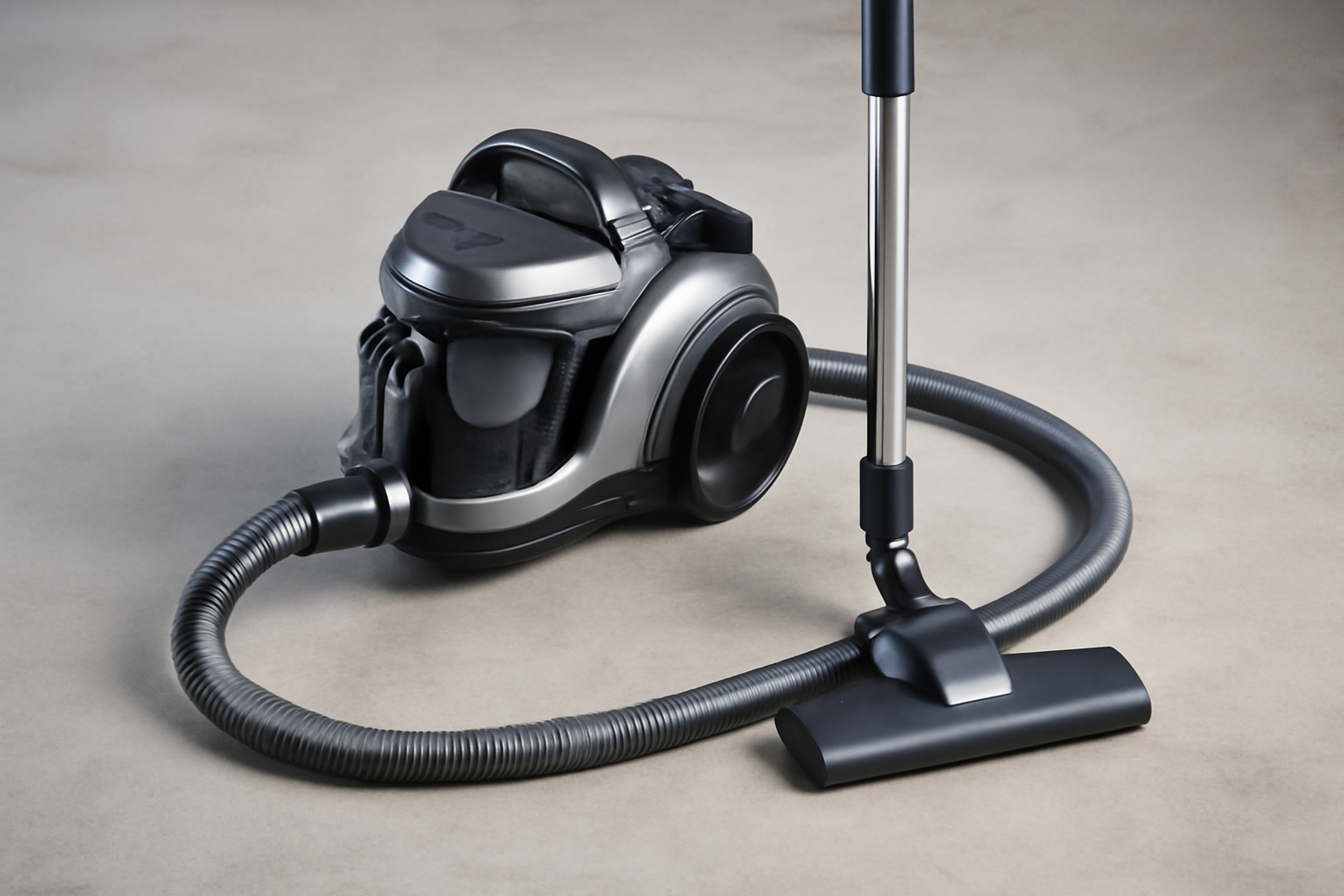
In the world of vacuums procurement and vacuum cleaner distribution, unit price has long been the most visible metric — yet it’s also the most misleading. The true competitiveness of a vacuum cleaner brand isn’t just about sticker price or wattage; it’s about the Total Cost of Ownership (TCO) — the complete economic picture over the product’s lifetime.
This article unpacks how distributors, engineers, and decision-makers can build a practical TCO model that captures the real financial impact of vacuum fleets — from R&D to field operation and after-sales support.
⚙️ 1. Redefining Cost: Beyond the Purchase Invoice
For B2B buyers, especially those managing hundreds or thousands of units, the biggest expenses often occur after the initial purchase.
A realistic TCO model must include:
Maintenance cycles (filters, belts, brushrolls, HEPA systems)
Motor endurance and suction decay over time
Downtime and replacement logistics
Power consumption per duty hour
Warranty and service logistics costs
A High Suction Vacuum Cleaner that lasts 2× longer between maintenance cycles often outperforms a cheaper alternative by a wide margin, especially in commercial cleaning contracts.
🧩 2. Quantifying Energy and Performance Efficiency
When comparing models, traditional metrics like watts or amperage no longer suffice.
Instead, look at suction efficiency (air watts per kWh) — the ratio of performance to power draw.
Energy costs, especially in the EU and Middle East, can account for 15–25% of total lifecycle cost.
A Quiet Vacuum Cleaner with optimized motor geometry and acoustic insulation not only reduces user fatigue but also enables longer duty cycles in hospitality and healthcare settings — translating directly into operational savings.
🔬 3. Reliability Modeling: Engineering Meets Finance
R&D and engineering teams should work together with financial analysts to quantify failure probabilities.
Using Weibull distribution modeling for parts like motors and PCBs provides a mathematical basis for predicting field returns.
To build a realistic reliability model:
Use accelerated life testing (ALT) for core components.
Record mean time between failures (MTBF) and correlate with field data.
Include environmental multipliers (humidity, fine dust load, voltage variation).
This data is the backbone for service contracts, spare-part forecasting, and warranty cost modeling.
🧾 4. Consumables and Labor: The Hidden OPEX
Consumables and operator time often surpass the vacuum’s purchase price across its lifecycle.
Consumables:
HEPA filters, dust bags, brush rolls, and seals.
Their price-to-lifetime ratio affects recurring operational costs.
Labor:
A manufacturer that integrates tool-less maintenance mechanisms gains measurable ROI for distributors and end-users alike.
🌍 5. Logistics and Sustainability: TCO’s Emerging Dimensions
In 2025 and beyond, sustainability costs are no longer optional.
TCO must now include:
Recycling & EPR (Extended Producer Responsibility) fees
Transport efficiency — optimizing pallet density and packaging volume
Carbon footprint per operating hour
Distributors in the EU and MENA region already report clients asking for carbon transparency per unit.
Choosing lighter materials or modular components not only reduces emissions but also cuts inbound freight costs — a hidden TCO win.
💡 6. Turning TCO Insights into Procurement Leverage
Armed with a full TCO model, buyers can:
Justify higher CAPEX with lower OPEX over time.
Benchmark suppliers on service, uptime, and durability — not just price.
Build supplier scorecards that reward real performance metrics.
For engineering-driven brands like Lanxstar, sharing transparent lifecycle data has become a new trust currency in B2B procurement — especially in premium segments like hospitality and facility management.
📈 Conclusion: From Unit Price to Value Intelligence
The TCO mindset separates mature distributors from transactional traders.
It reframes purchasing as strategic asset management.
By mapping out maintenance, energy, reliability, and sustainability factors, buyers can confidently identify vacuum platforms that deliver decades of profitable operation — not just months of sales volume.
And for manufacturers, the TCO framework doubles as a storytelling engine: it proves why design, materials, and reliability aren’t costs — they’re competitive moats.
🧭 Hashtags
#VacuumsProcurement #VacuumCleanerDistribution #HighSuctionVacuumCleaner #QuietVacuumCleaner #VacuumCleanerForPetHair #HEPAFilterVacuumCleaner #WetAndDryVacuumCleaner #ApartmentVacuumCleaner #Lanxstar #LanxstarVacuumCleaner #LanxstarSmartVacuum #LanxstarCordlessVacuum #LanxstarWetDryVacuum #CommercialVacuum #CordlessVacuum #StickVacuum #RobotVacuum #CyclonicTechnology #SmartVacuum #FloorCare #DustSensor #BrushlessMotor #HEPAAirSystem #LowNoiseDesign #EnergyEfficientVacuum #BaglessTechnology #VacuumFilterReplacement #IndustrialVacuum #CleaningInnovation #VacuumEngineering #SuctionTesting #VacuumMotorDesign #RDCollaboration #ODMVacuum #CleaningEquipment #ProfessionalCleaning #B2BProcurement #CleaningTechnology #HomeApplianceDesign #VacuumManufacturing #SupplyChainOptimization #VacuumOEM #AirWatts #DustCollectionSystem #VacuumFleetManagement #ServiceEfficiency #SustainableDesign #EcoVacuum #SmartCleaning #AfterSalesSupport #VacuumMaintenance #CleaningBusiness #TCOModel #FleetCostOptimization











