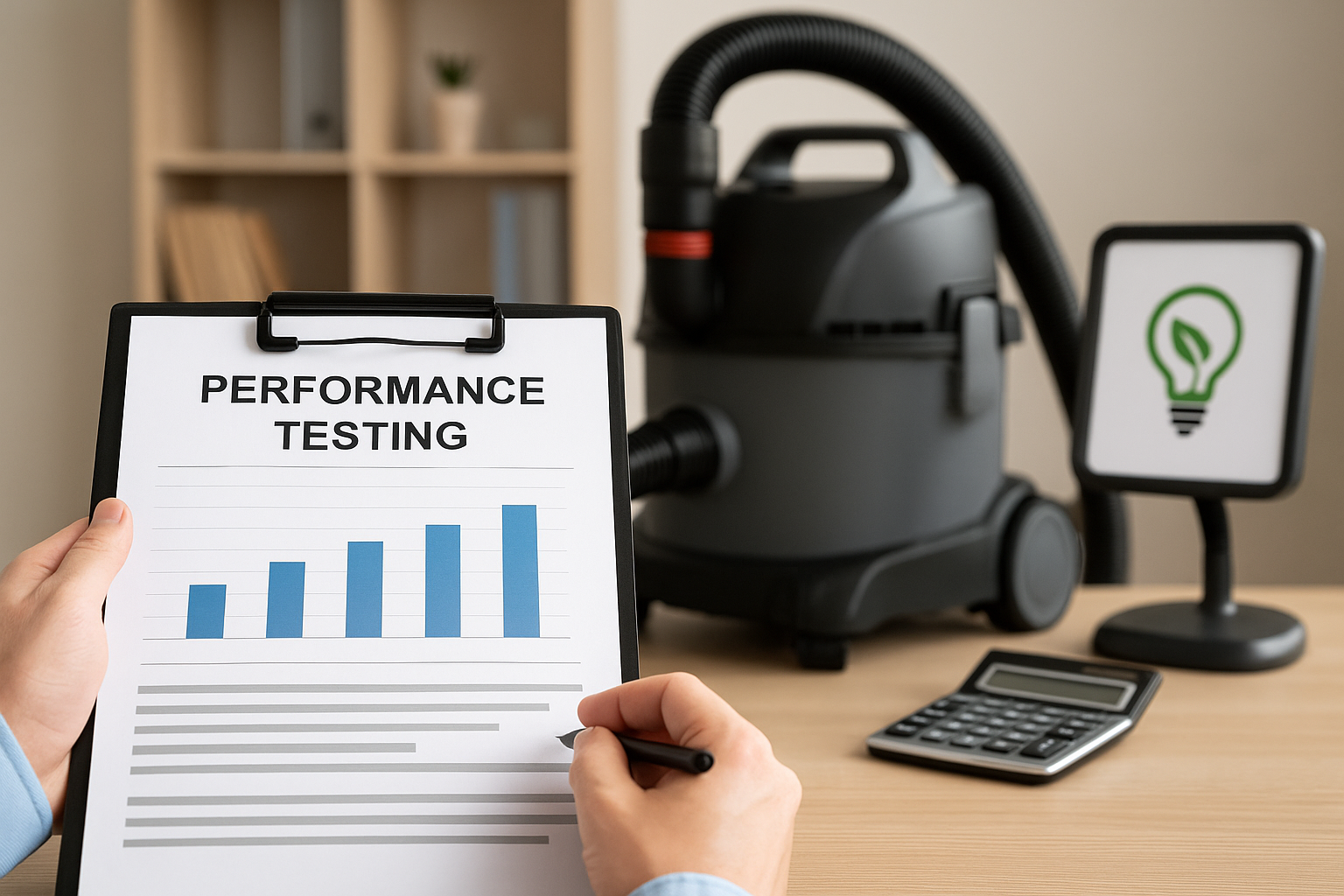
When procuring industrial vacuum cleaners, relying solely on technical spec sheets can lead to misinformed decisions. While specifications provide a useful baseline, true performance is determined by how the vacuum operates under real-world conditions. For procurement officers and operations managers, evaluating beyond the specs is essential to ensure value, durability, and operational efficiency.
Test Under Real Operating Environments
Spec sheets often highlight best-case scenarios, but cleaning conditions vary dramatically across industries. To assess actual performance, tests should be conducted in the environments where the vacuums will be deployed—factories, warehouses, or construction sites. Third-party lab comparisons by organizations like Consumer Reports demonstrate how on-site testing can yield drastically different results than lab-controlled benchmarks.
Evaluate Airflow Efficiency and Suction Retention
Suction power is just one metric. Airflow efficiency, measured over time and across different debris types, better reflects real performance. Machines that lose suction when filters clog or hoses bend are unsuitable for demanding industrial tasks. Whitepapers by The American Cleaning Institute emphasize that airflow and suction consistency should be evaluated over extended use, not just at peak operation.
Operator Experience and Ergonomics
Even the most powerful vacuum won’t succeed if operators find it difficult to use. Factors like weight distribution, handle design, noise level, and ease of maintenance play a critical role in real-world performance. Studies from Ergonomics International show that equipment usability is directly linked to productivity and injury reduction in industrial environments.
In many cases, the right solution involves more than raw specs. A truly effective machine must combine high-suction capability with quiet operation, portable structure, intelligent self-cleaning, and multi-functional adaptability—built with durable materials for fast and lightweight usage, while being energy-saving, efficient, and large-capacity enough to handle wet and dry applications—all delivered in one powerful vacuum cleaner.
Conclusion
To procure vacuums that truly perform, decision-makers must look beyond the brochure. Real performance comes from practical trials, long-term reliability, and usability in the field. Only then can industrial buyers make informed, cost-effective investments.
✅ Explore real-world vacuum performance standards at www.lxvacuum.com