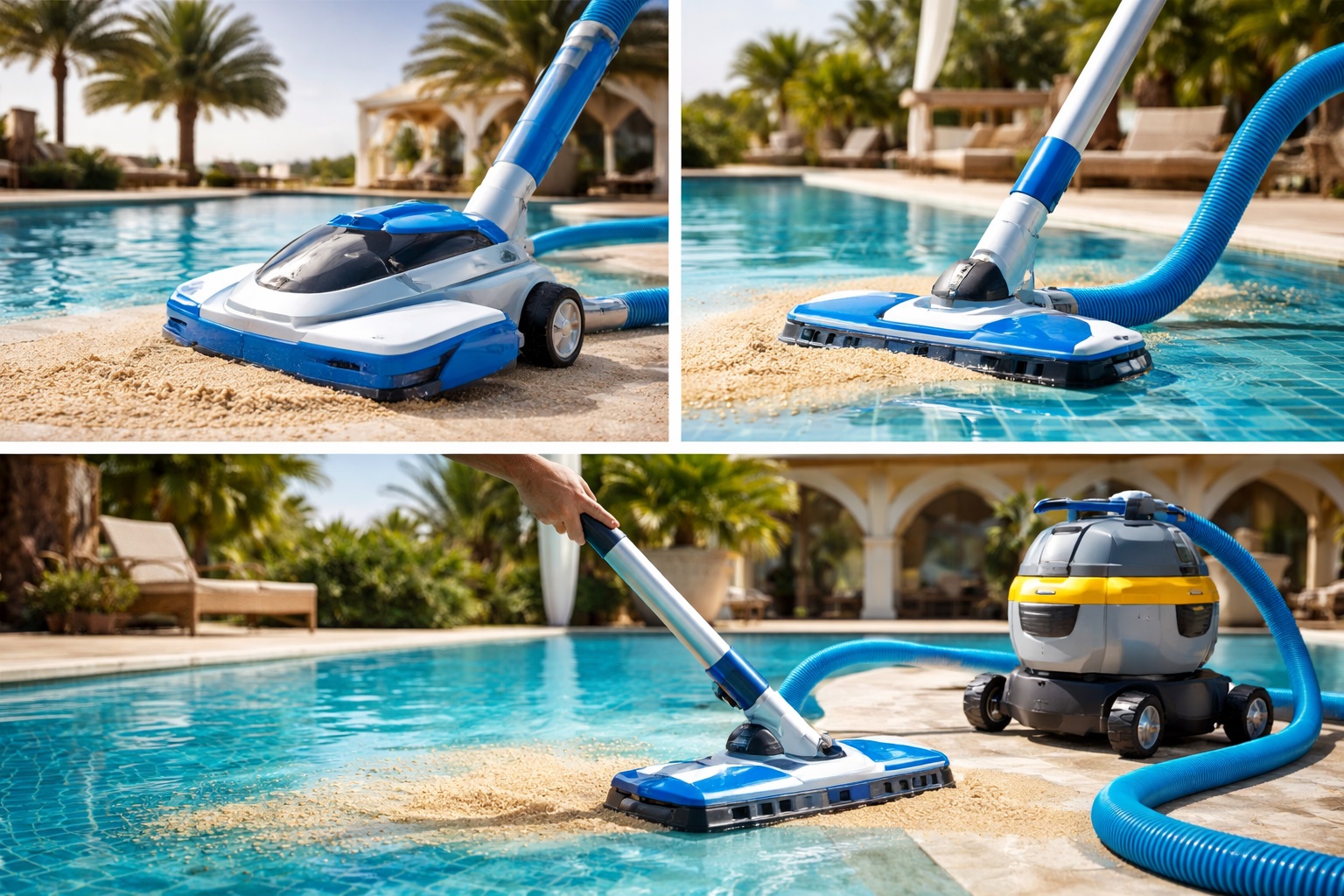
A System-Level Cleaning Problem, Not a Maintenance Failure
For many pool operators and facility managers in the Middle East, sand returning to the pool feels like an endless cycle. Pools are vacuumed, filters are cleaned, yet fine sand keeps reappearing days—or even hours—later.
The common assumption is simple: the environment is too harsh.
But in reality, pool sand keeps coming back not because cleaning fails, but because the cleaning system is not designed for desert conditions.
This article explains the real reasons behind recurring pool sand in Middle East pools and outlines practical, system-level solutions for B2B buyers, distributors, engineers, and commercial pool operators.
🌪️ Desert Reality: Why Middle East Pool Sand Behaves Differently
Most pool cleaning systems used globally are designed for dust, leaves, or organic debris—not desert sand.
Fine Particle Characteristics
Middle Eastern sand is ultra-fine, lightweight, and often electrostatically charged. Instead of sinking permanently, it remains suspended in water longer and is easily disturbed by circulation pumps.
Once lifted incorrectly, sand does not exit the system—it recirculates.
Constant Environmental Reintroduction
Wind pressure, daily temperature shifts, and sandstorms continuously push particles into outdoor pool environments. Even covered pools experience ingress through overflow channels, deck surfaces, and airflow gaps.
Key Insight:
If a cleaning system focuses only on removal and ignores containment, sand will inevitably return.
🧠 Why Traditional Pool Cleaning Approaches Fail
Recurring sand is rarely caused by a lack of effort. It is caused by incorrect equipment logic.
Suction Without Stability
Many operators rely on basic pool vacuums or household-grade machines. While suction may appear strong, airflow is unstable. Fine sand is lifted, then released back into the water column.
This is why a high suction vacuum cleaner alone does not solve the problem.
Secondary Dust Release
Without proper sealing and filtration, fine particles escape through exhaust airflow and resettle around the pool. This creates the illusion that “sand was never removed.”
🧹 Wet and Dry Vacuum Cleaner: A Foundation, Not a Feature
A properly engineered wet and dry vacuum cleaner is essential for pool sand removal in desert regions.
What Actually Matters for B2B Buyers
Stable suction under wet load
Controlled airflow to prevent turbulence
Moisture-resistant internal filtration
Compatibility with multi-stage filtration systems
Unlike basic pool vacuums, wet and dry systems are designed to extract and retain fine particulate matter rather than redistribute it.
🔇 Quiet Vacuum Cleaner: Enabling Frequency, Not Just Comfort
In hotels, resorts, and residential compounds, noise limits how often cleaning can occur.
A quiet vacuum cleaner allows maintenance teams to clean pools during operating hours without disrupting guests. Higher cleaning frequency reduces sand buildup before it becomes visible or problematic.
Operational Advantage:
Lower downtime, better water clarity, improved guest experience.
🧪 HEPA Filter Vacuum Cleaner: Containment Is the Real Solution
Fine sand does not disappear—it moves.
A HEPA filter vacuum cleaner prevents ultra-fine sand and dust from escaping through exhaust airflow. In desert environments, this significantly reduces secondary contamination around pool decks and equipment rooms.
For commercial operations, HEPA filtration is not a luxury—it is a risk control mechanism.
🧳 Portable Vacuum for Travel: Useful, but Limited
A portable vacuum for travel works well for:
However, portability often means reduced sustained suction and simplified filtration. These units should support—not replace—primary cleaning systems in commercial pools.
⚙️ What Actually Stops Sand from Coming Back
Effective sand control in Middle East pools requires a system-level strategy:
High suction vacuum cleaner with stable airflow
Wet and dry vacuum cleaner capability
HEPA-grade exhaust containment
Quiet operation for frequent cleaning
Maintenance schedules aligned with wind patterns
This approach reduces recurrence instead of reacting to it.
📌 A Strategic Note for B2B Buyers and Distributors
Recurring pool sand is not a cleaning problem—it is a design mismatch.
For distributors, OEM partners, facility solution providers, and product engineers operating in Europe and the Middle East, vacuum systems engineered specifically for desert environments represent a long-term competitive advantage.
Those who solve sand at the system level will lead the next phase of commercial pool maintenance in arid regions.
Hashtags
Pool Maintenance, Middle East Pools, Sand in Pools, High Suction Vacuum Cleaner, Wet and Dry Vacuum Cleaner, Quiet Vacuum Cleaner, HEPA Filter Vacuum Cleaner, Portable Vacuum for Travel, Commercial Pool Cleaning, Desert Climate Cleaning, Pool Sand Removal, Pool Filtration Systems, Industrial Vacuum Cleaner, B2B Cleaning Equipment, Pool Maintenance Solutions, Swimming Pool Industry, Hotel Pool Maintenance, Resort Pool Cleaning, Outdoor Pool Challenges, Fine Dust Control, Airflow Engineering, Vacuum Filtration Technology, Pool Equipment Suppliers, Middle East B2B Buyers, EU Cleaning Equipment Distributors, Facility Management Solutions, Industrial Cleaning Systems, Low Noise Cleaning Equipment, Professional Pool Services, Pool Water Quality Management, Engineering Cleaning Solutions, Pool Cleaning Innovation, Commercial Facility Cleaning, Vacuum Cleaner Manufacturing, Product R&D Engineering, Cleaning Industry Standards, Pool Maintenance Contractors, Arid Region Equipment Design, Dust Containment Systems, Pool Service Optimization, Environmental Cleaning Solutions, Lanxstar











