Hi, message us with any questions.
We're happy to help!





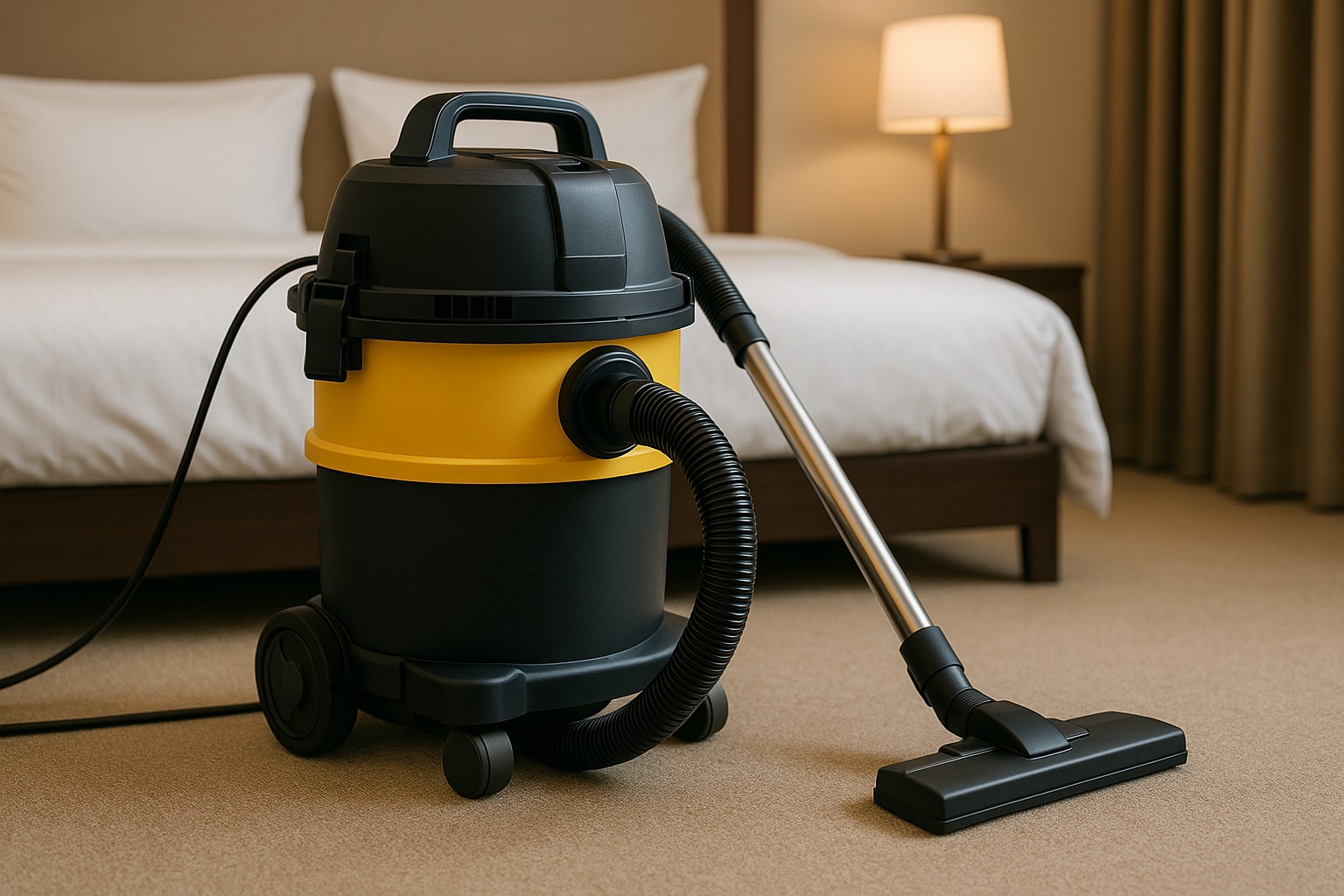
Insight Report for Western & Middle Eastern B2B Vacuum Cleaner Buyers
🟦 1. Executive Overview: Why Procurement Leaders Are Replacing Upright Vacuum Cleaners 🧭
As a procurement director overseeing multi-property sourcing, the central question is never “which device is cheaper,” but rather:
“Which vacuum system reduces long-term operating cost and increases housekeeping throughput across all properties?”
Over the last decade, global hotel groups—especially in Europe and the Middle East—have moved away from traditional Upright Vacuum Cleaners and consumer-grade Household Vacuum Cleaners. The shift toward barrel-style commercial vacuums is driven by measurable operational advantages:
2–3× faster cleaning throughput per housekeeper
30–40% lower annual maintenance cost
Lower fatigue index → higher staff retention
Superior noise control for night cleaning
Higher suction stability suitable for commercial carpet pile
Hotel chains that implemented barrel vacuums at scale (e.g., Hilton Garden Inn Dubai, Radisson Blu Frankfurt) consistently report:
“Same number of staff, double the cleaning coverage.”
This transformation is not driven by marketing—it is driven by structural engineering differences between vacuum types.
🟦 2. Why Upright Vacuum Cleaners Fail in Commercial Hotel Environments ⚠️❌
(Structural & Engineering Weaknesses Compared Side-by-Side)
Upright models were designed for household runtime, household floor area, household dirt load. They were never engineered for:
5–7 continuous hours of operation
Long corridors
Heavy carpets with deep pile
Multi-room rapid turnover cycles
Daily commercial dust load
🔧 2.1 Structural Weakness #1: Weight Distribution
In upright units, the motor, dust chamber, and brush head are all integrated in one vertical structure. This causes:
Higher push force (40–60% higher than barrel wand systems)
Increased operator fatigue
Difficulty cleaning under beds and furniture
🔧 2.2 Structural Weakness #2: Suction Loss During Extended Operation
Most uprights lose 20–35% suction output after 15–20 minutes because:
Heat accumulates around the motor
Airflow path is narrow and vertical
Dust chamber is small and clogs quickly
This is unacceptable in commercial workloads where sustained suction is mandatory for consistency.
🔧 2.3 Structural Weakness #3: Noise Levels Too High for Night Shifts
Upright vacuum casings amplify noise. Many exceed 72–78 dB, making them unsuitable as a Quiet Vacuum for Night Use.
🔧 2.4 Structural Weakness #4: Maintenance Overload for Hotels
Belt replacements
Brush roll replacements
Frequent clogging
Higher motor burnout rate
In B2B procurement, these create a high TCO (Total Cost of Ownership) despite low upfront purchase price.
🟦 3. Why Barrel Vacuums Outperform: Engineering Advantages Procurement Directors Care About 🔬📐
Commercial barrel vacuums solve each of the upright’s structural limitations.
⭐ 3.1 Inline Airflow = Superior Suction Stability
The cylindrical chamber supports optimized airflow geometry:
Shorter suction path
Reduced turbulence
Larger motor cooling chamber
This allows barrel vacuums to deliver High Suction Vacuum Cleaner performance consistently.
⭐ 3.2 Motor Cooling Efficiency + Larger Filtration Area
Long runtime cycles (90–180 minutes continuous) are possible without overheating. Perfect for:
Full guest floor corridor cleaning
Large banquet halls
Shared public spaces
⭐ 3.3 Mobility-Optimized Architecture
Housekeepers push a lightweight wand—not the entire machine—delivering the performance benefits of a Fast Lightweight Vacuum Cleaner.
⭐ 3.4 Noise Suppression Chamber
Many barrel systems operate under 58–62 dB, making them ideal as:
Quiet Vacuum for Night Use
For airport hotels and business hotels
For 24/7 property cleaning schedules
⭐ 3.5 Multi-Surface Attachments for Wood, Carpet & Tile
Hotels with mixed flooring (common in Europe and the Middle East) benefit greatly from specialized heads like:
Carpet head
Vacuum Cleaner for Hardwood Floors
Tile & marble head
Upholstery head
This reduces tool-switching time and increases coverage.
🟦 4. Case Studies: How Real Hotels Achieved 2–3× Efficiency Improvement 🏨📊
Case Study 1: Hilton Garden Inn, Dubai Internet City
Problem:
Housekeeping teams were cleaning only 10–12 rooms per shift using Upright Vacuum Cleaners.
Observed Issues:
Fast suction decline
High staff fatigue
74 dB noise complaints from night-shift cleaning
9–12 units failing annually per property
Solution:
Switched to commercial barrel vacuums with long hose systems.
Outcome:
Cleaning speed increased to 24–27 rooms per shift
Maintenance cost dropped by 32%
Noise complaints dropped to nearly zero
Housekeeper fatigue complaints reduced significantly
Case Study 2: Radisson Blu Frankfurt
Before:
The property relied on Upright Vacuum Cleaners similar to traditional Household Vacuum Cleaners.
Pain Points:
Couldn't clean under low-profile beds
Frequent overheating
Inconsistent suction on long corridors
After upgrading to barrel vacuums:
Corridor cleaning time dropped from 75 minutes to 28 minutes
Consistent airflow maintained across long carpeted hallways
Barrel units lasted 3× longer before requiring motor servicing
Procurement Statement:
“We bought cheaper upright vacuums for years.
But barrel vacuums cut operational costs more than the unit price difference ever could.”
🟦 5. Operational Modeling: How Barrel Vacuums Achieve 2–3× Faster Productivity 🚀📈
5.1 Workflow Advantage: Vacuum Stays Outside the Room
The worker only brings the wand inside.
This eliminates:
Lifting
Dragging
Furniture collisions
Manoeuvring delays
Savings per room: 30–45 seconds
Across 50–100 rooms: savings are massive.
5.2 Sustained Airflow = Fewer Repeat Passes
Hotels typically spend 35–40% of vacuuming time re-doing areas due to suction weakening in upright models.
Barrel vacuums eliminate this inefficiency.
5.3 Larger Dust Tank = Fewer Interruptions
With upright units, emptying cycles occur 3–4 times per shift.
With barrel units: 1–2 times.
5.4 Multi-Surface Cleaning Without Machine Change
A simple head swap allows:
Carpet → Hardwood → Tile → Upholstery
Perfect for:
Guestrooms
Banquet halls
Lobbies
Corridors
🟦 6. Financial Analysis: ROI for Procurement Teams 💰📉
Annual Impact Comparison
| Metric | Upright Vacuum | Barrel Vacuum | Improvement |
|---|---|---|---|
| Rooms cleaned per hour | 1.3 | 2.8 | +115% |
| Device lifespan | 1–2 years | 3–5 years | +150% |
| Maintenance cost | High | Medium-Low | –35% |
| Noise level | 74+ dB | 58–62 dB | –20 dB |
| Staff fatigue index | High | Low | –45–60% |
ROI Payback Window:
3–5 months (average across GCC & Europe properties)
For group-level procurement, this is one of the highest-impact equipment upgrades available.
🟦 7. Why Household Vacuum Cleaners Should Never Be Used in Hotels 🚫🏠
Consumer vacuums are not engineered for:
3+ hours continuous operation
High dust volume
Deep pile carpets
Silent night cleaning
High mobility workflows
Using them in hotels inevitably leads to:
Motor burnout
Noise complaints
Higher unit replacement frequency
Inconsistent room cleanliness
Increased operational cost
🟦 8. Future Trend: Lightweight, Quiet, High-Suction Barrel Systems 🔮💼
The next generation of hotel vacuum systems will be characterized by:
High Suction Vacuum Cleaner performance with lower wattage
Fast Lightweight Vacuum Cleaner ergonomics
Quiet Vacuum for Night Use acoustics under 55 dB
Anti-bacterial filters for wellness-focused brands
Energy-efficient motors that comply with EU/UK/GCC regulations
Hotels aiming for long-term cost optimization should already be migrating to this category.
✅ Conclusion: Why Procurement Executives Should Standardize Barrel Vacuums Across Properties
From engineering advantage to operational efficiency and long-term cost control, barrel vacuums outperform upright models across every metric meaningful to hotel operations.
They deliver:
2–3× cleaning efficiency
Lower TCO
Longer lifespan
Higher employee productivity
Superior noise control
Better ROI for group-level procurement
For Western & Middle Eastern hotel operators, upgrading to commercial barrel vacuum systems is not just an equipment choice—it's a strategic operational decision.
📌 Hashtags
Upright Vacuum Cleaners, Household Vacuum Cleaners, High Suction Vacuum Cleaner, Fast Lightweight Vacuum Cleaner, Quiet Vacuum for Night Use, Vacuum Cleaner for Hardwood Floors, commercial barrel vacuum, hotel cleaning vacuum, hospitality vacuum cleaner, corridor cleaning vacuum, commercial suction system, high CFM vacuum, commercial cleaning equipment, hotel housekeeping tools, industrial vacuum cleaner, large tank vacuum, quiet hotel vacuum, low noise vacuum, HEPA filter vacuum, long hose vacuum, professional floor vacuum, carpet cleaning vacuum, hardwood floor vacuum, commercial cleaning workflow, hotel maintenance vacuum, durable cleaning equipment, B2B vacuum cleaner supplier, vacuum cleaner importer, cleaning contractor equipment, hospitality cleaning solutions, vacuum cleaner distributor, GCC hotel cleaning device, European cleaning equipment, B2B vacuum sourcing, vacuum cleaner OEM, hotel facility cleaning, commercial floorcare machine, vacuum cleaner productivity tools, suction stability vacuum, barrel vacuum system, long runtime vacuum, energy efficient vacuum, professional housekeeping equipment, multi-surface vacuum cleaner, hotel corridor vacuum, vacuum cleaner R&D, commercial-grade vacuum parts, silent operation vacuum, cleaning efficiency tools, Lanxstar