Hi, message us with any questions.
We're happy to help!





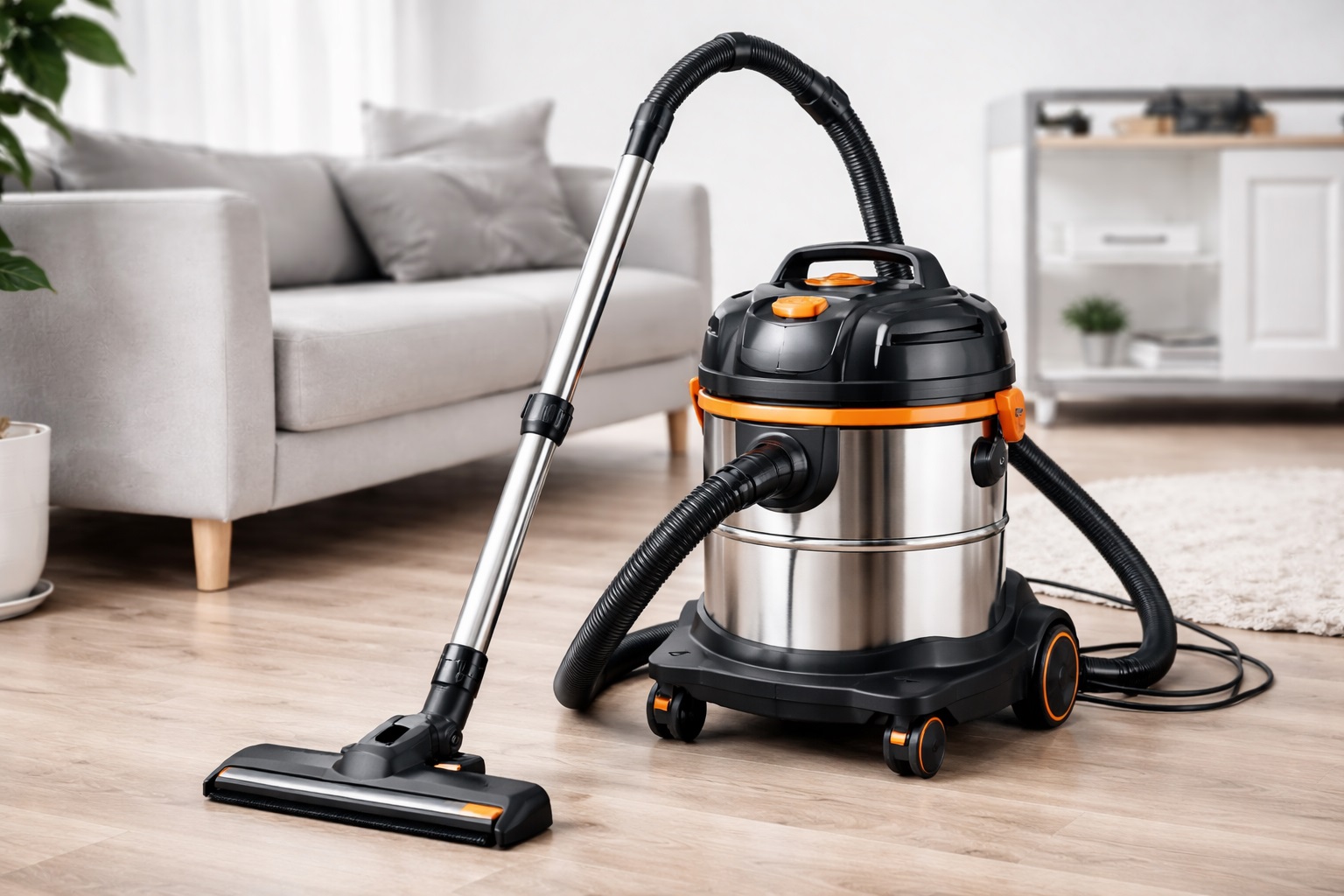
🧩 Quick Procurement Verdict (Copy/Paste for Internal Teams)
Choose barrel (canister) if your channel sells into mixed homes (hardwood + rugs), pet households, apartments with stairs, or you need one platform that can scale into multiple SKUs with accessory kits.
Business upside: typically lower scratch/complaint risk on hard floors, better accessory-driven upsell, and easier serviceability (lower warranty friction) versus many upright formats.
Minimum spec targets (recommended): strong sealed airflow design, suction control, hardwood-safe head option, anti-tangle hair tool, and a spare-parts plan that supports 24–36 months of availability.
If you’re sourcing Household Vacuum Cleaners for Europe and the Middle East, barrel vacuums often outperform alternatives not because of hype—but because the architecture is more adaptable, testable, and profitable across a product line.
🧭 I. The Design Advantage: Why Barrel Architecture Wins in Real Homes
Barrel vacuums separate the motor + filtration unit from the cleaning head. That single choice changes how the product behaves in the field:
More stable cleaning across surfaces: Mixed-floor households (tile, laminate, hardwood, area rugs) are common in both EU and Middle East markets. Barrel platforms handle “switching contexts” better because the head can be optimized without rebuilding the entire machine.
Mobility for high-frequency tasks: Sofas, curtains, corners, and car interiors aren’t niche—they’re daily use cases that drive reviews and returns. Barrel designs naturally support hose-and-wand cleaning.
A scalable platform strategy: You can build a lineup from one core unit by changing heads, filtration tier, cord length, and accessory kits—ideal for a Multi-Functional Durable Vacuum Cleaner positioning.
🧾 Barrel vs Upright: What B2B Buyers Should Expect (Shareable Table)
| Decision Factor | Barrel / Canister | Upright Vacuum Cleaners |
|---|---|---|
| Mixed-floor performance | Strong (head swap + suction control) | Often strong on carpets, varies on hard floors |
| Hardwood risk (scratches/drag) | Lower (lighter head + canister behind) | Higher if head is heavy/rigid wheels |
| Pet hair versatility | High (mini tools + turbo heads) | Can be excellent, but less modular |
| Serviceability | Usually easier access + space | Can be compact/tight layouts |
| Accessory upsell | Excellent (kits & add-ons) | Moderate (often fewer modular kits) |
| Packaging damage sensitivity | Moderate (canister shell) | Moderate (upright neck/head parts) |
| Best retail message | “All-home flexibility + premium care” | “All-in-one carpet power” |
Procurement reality: You can still stock Upright Vacuum Cleaners for carpet-heavy segments, but barrel units are a safer “default platform” when your customer base is diverse.
🧪 II. “High Suction” That Holds Up: A Buyer’s Test Protocol (With Targets)
Many suppliers sell “strong suction” as a headline. In field reality, buyers suffer from power drop after filter loading, overheating, or loud operation—then returns follow.
Here’s a practical, repeatable way to verify a true High Suction Vacuum Cleaner claim without turning your warehouse into a lab.
🧰 A Fast Procurement Test Protocol (45–60 Minutes per Sample)
1) Pickup stress test (carpet + hard floor)
Debris mix: fine dust (flour), sand, pet hair, cereal.
Pass target (recommended):
No repeated clogging in standard cleaning mode
Visible pickup improvement vs baseline in ≤ 2–3 passes
2) Partial-load suction stability
Pre-load filter/bag to simulate real use (not fully clean conditions).
Pass target (recommended): suction/airflow should feel consistent; no sudden “choking” behavior.
3) Thermal endurance run
Run 20–30 minutes under realistic load.
Pass target (recommended): no burning smell, no shutdown, stable performance, casing not uncomfortably hot.
4) Seal & leakage check
Look for air bypass around filter housing and connections.
Pass target (recommended): tight gasket seating + no visible dust leakage at joints after testing.
🔍 Spec sanity-check (use as a guideline, not a rule)
If a supplier only pushes wattage, treat it as a red flag. Performance is about airflow + sealed path + head design, not just watts.
For many household categories, buyers often target a balanced range (example):
Suction: ~18–25 kPa (varies by design)
Airflow: ~28–35 L/s (varies by design)
Noise: prefer “comfortable conversation range” in real use; test it, don’t trust brochures.
Why barrel helps: The canister body usually provides more space to engineer airflow, insulation, and cooling—so “high suction” can be delivered without turning into an overheating, noisy return generator.
🐾 III. Pet Hair Performance: What “Vacuum Cleaner for Pet Hair” Really Means
A Vacuum Cleaner for Pet Hair wins or fails on hair management, not marketing.
🧠 The 4 Engineering Levers That Actually Matter
Anti-tangle brush geometry: comb structures, blade angles, and bristle spacing.
Air path width + bend discipline: hair forms ropes; narrow turns = clogs.
Tooling that reaches fabric: mini motorized tools for sofas and car seats can make or break customer satisfaction.
Filtration that doesn’t choke early: clogged filters cut suction fast and trigger “weak suction” complaints.
🧩 Barrel advantage: modular “pet SKU” without retooling
With a canister base, you can create a pet-focused variant via:
turbo brush head
mini motorized pet tool
anti-tangle roller upgrade
upgraded pre-filter strategy
Commercial upside: This lets distributors offer a “pet bundle” at a higher ASP without changing the core platform—clean margins, low operational complexity.
🪵 IV. Hardwood Floors: How Barrel Vacuums Reduce Claims and Boost Reviews
For a Vacuum Cleaner for Hardwood Floors, what kills brands isn’t dust left behind—it’s scratches, scuffs, and grit dragging. That’s the return you can’t “argue away.”
🛡️ Hardwood-Safe Requirements (Procurement Checklist)
Soft contact surface: parquet brush, soft roller, felt strip, or equivalent
Rubberized wheels: reduce point pressure + rolling grit damage
Suction control: avoid “sticking” that makes users drag the head
Edge cleaning behavior: perimeter dust is where buyers judge quality
Barrel advantage: less weight pressing into the head + better maneuverability. Uprights can be fine on hard floors when designed for it—but barrel designs make “floor protection” easier to deliver consistently across SKUs.
🧰 V. Multi-Functionality Without Complexity (Where Profit Actually Comes From)
A Multi-Functional Durable Vacuum Cleaner strategy is a product-line strategy, not a feature list.
💼 Accessory Ecosystem = Profit Engine
For B2B channels, accessories are:
lightweight to ship
low-failure
easy to bundle
perfect for repeat purchases
🎯 A Proven 3-Kit Architecture (One Canister, Three Markets)
Essential Kit (volume seller): combo floor head + crevice + dusting brush
Pet Kit (high margin): turbo brush + mini pet tool + anti-tangle head
Hard Floor Kit (low return risk): soft roller/parquet head + scratch-safe wheels + edge tool
How this drives growth: You keep the manufacturing base stable while giving buyers “choice.” This improves conversion and reduces SKU chaos in your warehouse.
🛠️ VI. Durability & After-Sales: The Hidden Reason Barrel Vacuums Protect Your Brand
B2B success isn’t only first-sale performance; it’s what happens after 3 months when real households misuse products.
🧱 Top Failure Points to Audit Before You Place an Order
Hose & cuffs: check swivel joints and pull-force resistance (real users yank).
Wand integrity: telescopic wobble becomes “cheap feel” complaints fast.
Thermal protection: stable motor protection reduces early failure risk.
Filter accessibility: if it’s hard to clean, users won’t—then they blame suction.
Barrel advantage: more internal volume often means simpler layouts and faster repair access. That’s a major reason barrel platforms can show lower lifetime friction in distributor service networks.
📌 Add a “Service Promise” to Your Product Page
A simple, channel-friendly promise boosts trust:
“Filters available for 24–36 months”
“Common parts stocked locally”
“Standardized nozzle interface for upgrades”
This turns after-sales from a cost center into a loyalty lever.
📦 VII. Procurement Scorecard + The 10 Questions That Prevent Bad Containers
🧾 Supplier Evaluation Scorecard (Use This in Vendor Comparison)
Score 1–5 each, then weight based on your channel priorities:
Performance stability under partial filter loading
Hardwood-safe head option + suction control
Pet-hair tool performance (anti-tangle + mini tool)
Seal quality (dust leakage risk)
Noise + thermal behavior under 20–30 min run
Spare parts availability plan (24–36 months)
Packaging drop resistance
Batch traceability + QC documentation
Accessory ecosystem breadth (upsell potential)
Warranty handling process (response time, DOA policy)
❓ 10 Vendor Questions (Ask These Before You Sign)
What are your top 5 field failure modes, and how did you reduce them in the last 12 months?
Can you provide spare parts pricing and availability commitment for 24–36 months?
What’s your packaging drop-test method and acceptable damage rate?
How do you validate suction stability after filter loading (not just “fresh out of box”)?
What’s your motor thermal protection design and shutoff behavior?
How do you prevent hair wrap on the brush (show tool geometry, not words)?
Can you support multiple accessory kits with the same base unit (SKU strategy support)?
What’s your batch traceability method for motors and key plastics?
What compliance documents can you provide for our target market channels?
What’s your warranty/DOA process timeline and responsibility split?
These questions quickly reveal whether you’re dealing with a “catalog seller” or a real manufacturer partner.
🧯 Bonus: When Barrel Vacuums Are NOT the Best Choice
To keep your assortment credible, acknowledge reality:
If your main segment is deep carpet cleaning and consumers want an “all-in-one push” feel, a well-designed upright can win.
If storage space is extremely constrained and customers dislike pulling a canister, uprights can reduce “annoyance returns.”
If your price band is ultra-low and accessory ecosystem isn’t valued, the barrel platform advantage may be under-monetized.
Best practice: lead with barrel as your flexible core platform, then add a targeted upright line for carpet-heavy or storage-sensitive segments.
✅ Conclusion: Why Barrel Vacuums Win for Household Cleaning—and for B2B Growth
For Europe and Middle East channels, barrel vacuums are often the most strategic foundation for Household Vacuum Cleaners because they combine performance flexibility with business practicality:
Real “high suction” is easier to sustain through better airflow and thermal design—supporting a credible High Suction Vacuum Cleaner positioning.
Modular heads and tools let you build premium bundles for Vacuum Cleaner for Pet Hair and Vacuum Cleaner for Hardwood Floors without rebuilding the base unit.
The accessory ecosystem strengthens margins and repeat sales, powering a true Multi-Functional Durable Vacuum Cleaner lineup.
Serviceability and spare parts planning reduce warranty chaos and protect brand reputation.
You can still carry Upright Vacuum Cleaners for specific segments, but if you want a scalable, lower-risk product platform that sells across the widest range of households, barrel vacuums typically offer the best blend of performance, differentiation, and total cost control.
📌 Hashtags
householdvacuumcleaners, barrelvacuumcleaner, canistervacuum, uprightvacuumcleaners, highsuctionvacuumcleaner, multifunctionaldurablevacuumcleaner, vacuumcleanerforpethair, vacuumcleanerforhardwoodfloors, petvacuumsolutions, hardwoodfloorcare, parquetvacuum, turboBrushHead, antiTangleBrush, sealedFiltrationSystem, HEPAvacuum, allergyFriendlyVacuum, baggedvacuumcleaner, baglesscanistervacuum, cyclonicvacuum, quietvacuumcleaner, lowNoiseVacuum, longReachVacuum, stairCleaningVacuum, sofaCleaningTool, curtainCleaningAttachment, creviceTool, dustingBrush, softRollerHead, parquetBrush, rubberWheels, scratchSafeVacuum, edgeCleaningNozzle, highAirflowVacuum, strongPickupPerformance, motorThermalProtection, durableVacuumHose, metalTelescopicWand, afterSalesService, sparePartsSupply, warrantyCostControl, privateLabelVacuum, OEMvacuumcleaner, ODMvacuumcleaner, B2Bvacuumdistribution, wholesalevacuumcleaner, vacuumprocurement, productlineStrategy, accessoryEcosystem, qualityControlTesting, supplierScorecard, vendorAudit, EUmarketAppliances, MiddleEastRetail, distributionMargin, serviceNetwork, Lanxstar