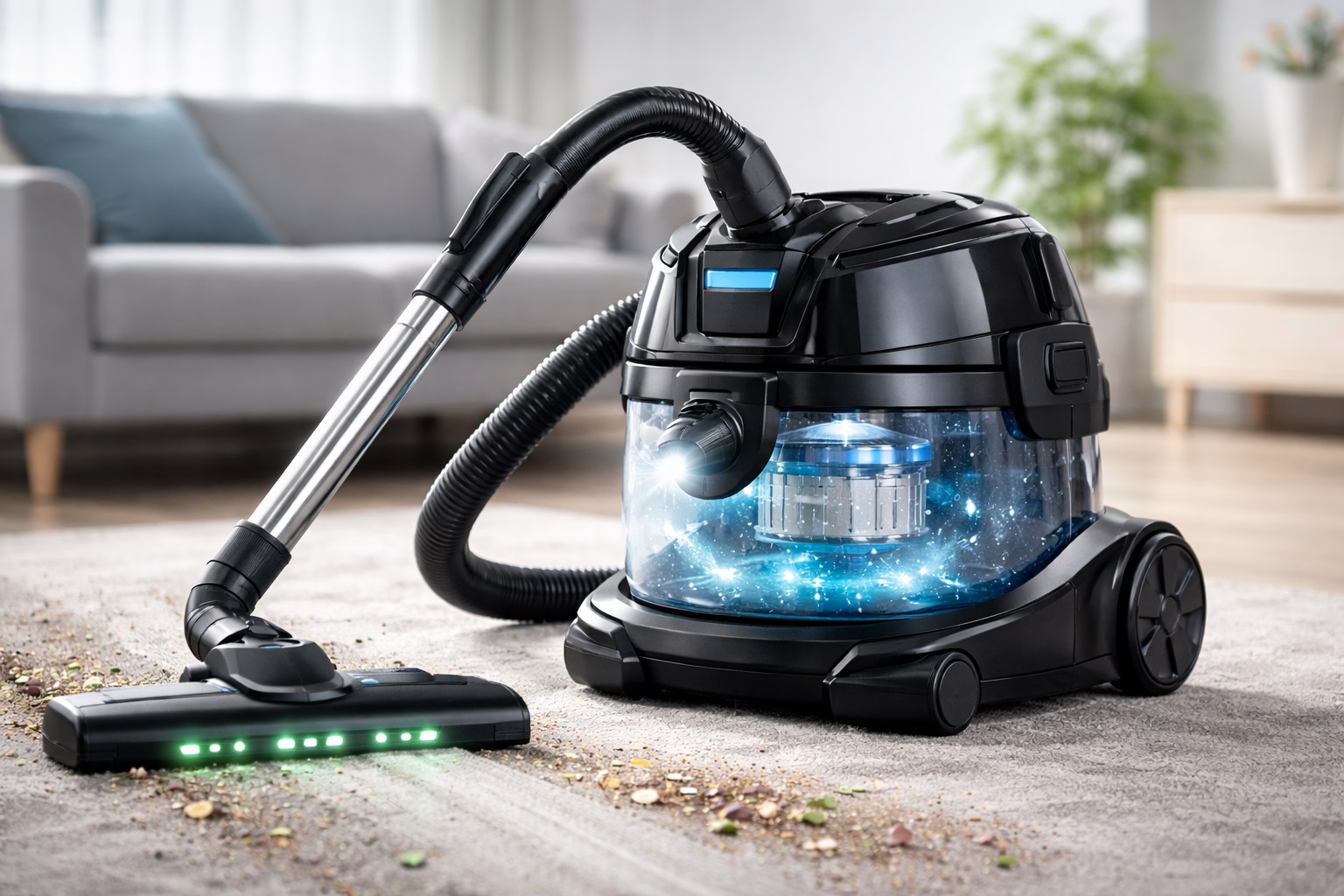
As consumer awareness of indoor air quality continues to grow, filtration technology has become a decisive factor in vacuum cleaner selection. For fine dust, allergens, and microscopic particles, buyers and engineers are often faced with a critical decision: choosing between a Water Filtration Vacuum Cleaner and a HEPA Filter Vacuum Cleaner. While both systems are effective, they rely on fundamentally different filtration mechanisms that lead to distinct performance outcomes.
1. Understanding Fine Dust and Allergens
Fine dust generally refers to particles smaller than 10 microns, including household dust, pollen, mold spores, dust mite residue, and pet dander 🐾. These particles remain airborne for long periods and can easily be re-circulated if not properly captured.
For use cases such as Vacuum Cleaner for Allergies, Apartment Vacuum Cleaner, or Quiet Vacuum for Night Use, effective containment of these microscopic pollutants is more important than peak suction alone.
2. HEPA Filter Vacuum Cleaner: Precision-Based Filtration
A HEPA Filter Vacuum Cleaner captures particles through a dense fibrous structure that forces air through microscopic pathways. Certified HEPA filters are designed to trap up to 99.97% of particles as small as 0.3 microns, making them a trusted standard in allergy-focused cleaning solutions.
Key strengths include predictable filtration performance, compact system integration, and suitability for Cordless Vacuum Cleaner and cordless handheld vacuums. These characteristics make HEPA systems popular in lightweight and portable designs.
However, HEPA filtration efficiency is closely tied to filter condition. As filters become clogged, airflow resistance increases, which can reduce suction performance and place additional strain on the motor. Regular filter replacement is essential to maintain optimal performance.
3. Water Filtration Vacuum Cleaner: Natural Particle Containment
A Water Filtration Vacuum Cleaner uses water as the primary medium to trap dust and allergens. Incoming air is forced through a water chamber, where particles are absorbed, bound, and prevented from escaping back into the environment 💧.
This approach offers clear advantages for fine dust control. There are no dry filter pores that can clog or leak, and filtration performance remains stable until the water is replaced. Water filtration is especially effective in Wet and Dry Vacuum Cleaner and Large-Capacity Wet Dry Vacuum Cleaner scenarios, where moisture and debris are collected simultaneously.
4. Indoor Air Quality and Secondary Pollution Risk
One critical difference between the two systems lies in how captured dust is stored. HEPA filters retain allergens in a dry state, which can lead to secondary pollution during filter removal or disposal.
Water filtration systems significantly reduce this risk. Dust and allergens are locked into liquid form and disposed of safely, minimizing airborne re-release. As a result, exhaust air often feels cleaner and fresher, which is why water filtration is frequently described as a self-purifying system 🌿.
5. Performance Stability Over Time
From a procurement and engineering perspective, long-term consistency is essential. HEPA-based vacuums perform exceptionally well when filters are new, but filtration efficiency and suction can gradually decline as filters load with dust.
Water filtration systems maintain consistent airflow and fine dust capture over extended use. The absence of consumable filters reduces maintenance variability and makes system performance easier to predict throughout the product lifecycle. This reliability is increasingly attractive in large-scale vacuums procurement programs.
6. Which Filter Is Better for Fine Dust and Allergens?
The optimal choice depends on application priorities:
HEPA Filter Vacuum Cleaners are ideal for compact designs, standardized allergen certification requirements, and users seeking lightweight, low-effort daily cleaning.
Water Filtration Vacuum Cleaners are better suited for environments demanding maximum allergen containment, wet and dry versatility, and long-term operating cost control.
As health awareness and sustainability requirements rise globally, water filtration technology is gaining renewed interest across vacuum cleaner distribution networks 🌍.
Conclusion
Both HEPA and water filtration technologies are capable of capturing fine dust and allergens effectively. However, water filtration delivers superior containment stability and minimizes secondary pollution, while HEPA filtration offers certified precision in lightweight and portable formats. Understanding these differences enables buyers, distributors, and engineers to select the most suitable vacuum solution for their target market and long-term strategy.
For advanced vacuum cleaner solutions and OEM support, visit www.lxvacuum.com
📌 50 Related Keyword Groups
water filtration vacuum cleaner, HEPA filter vacuum cleaner, vacuum cleaner for allergies, fine dust vacuum, high suction vacuum cleaner, wet dry vacuum, wet and dry vacuum cleaner, large-capacity wet dry vacuum cleaner, quiet vacuum cleaner, quiet vacuum for night use, cordless vacuum cleaner, cordless handheld vacuums, li-ion cordless handheld vacuum cleaner, portable quiet vacuum cleaner, multi-functional durable vacuum cleaner, energy-saving efficient powerful vacuum cleaner, vacuum cleaner for pet hair, apartment vacuum cleaner, vacuum for multi-surface, car vacuum cleaner, portable vacuum for travel, self-cleaning vacuum cleaner, fast lightweight vacuum cleaner, HEPA vacuum for allergens, water filtration vacuum system, wet dry vacuum cleaners, vacuum cleaner distribution, vacuums procurement, Lanxstar, best vacuum on a budget, best budget hoover, good budget vacuum, best affordable vacuum, best budget vacuum, best value for money hoover, best value hoover, best vacuum cleaners on a budget, best vacuums on a budget











