Hi, message us with any questions.
We're happy to help!





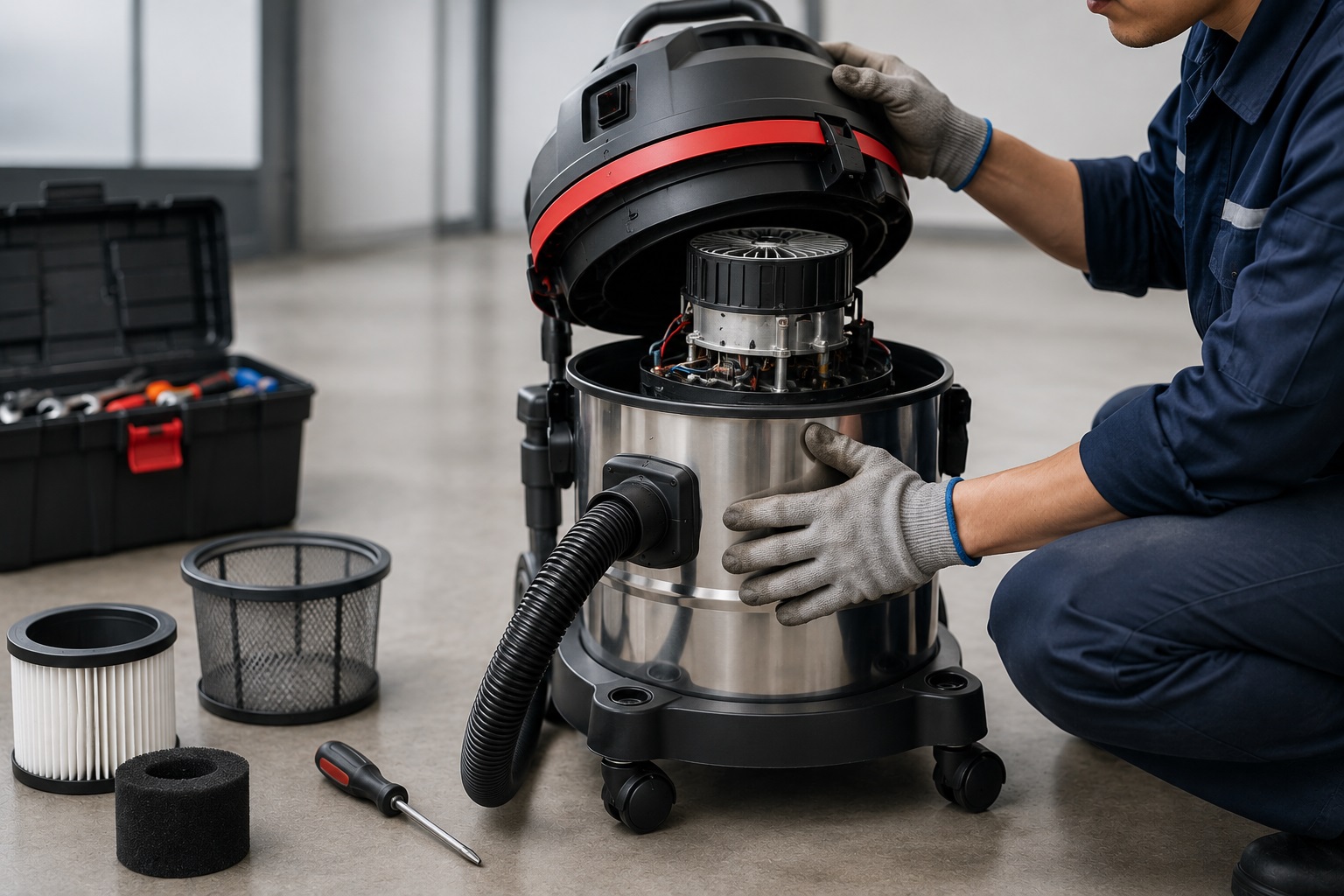
Why Many Vacuum Problems Are Misdiagnosed
In the industrial cleaning industry, vacuum failures are often blamed on:
weak motors
poor suction
low product quality
cheap manufacturing
But experienced service engineers know the reality is far more complex.
Many so-called “motor failures” are actually caused by:
airflow restriction
overheating
filtration neglect
RPM instability
airflow leakage
poor maintenance routines
For distributors, OEM buyers, and commercial cleaning contractors, understanding common vacuum cleaner technical issues is critical for reducing:
downtime
maintenance costs
warranty claims
replacement frequency
customer complaints
This guide explains the most common industrial vacuum problems, their engineering causes, troubleshooting methods, and how professional manufacturers improve long-term system reliability.
## ⚙️ The Most Common Vacuum Cleaner Technical Issues
Professional service teams repeatedly encounter the same technical failures across industrial vacuum systems.
## 🚨 ① Motor Overheating
Why It Happens
One of the most common industrial vacuum problems is:
motor overheating
Many operators assume overheating means the motor itself is defective.
In reality, overheating is often caused by:
clogged filters
airflow restriction
blocked cooling channels
excessive runtime
airflow leakage
unstable voltage
📌 Engineering Insight
In many industrial vacuum systems:
Airflow is also the motor’s cooling mechanism.
Once airflow decreases, internal motor temperature rises rapidly.
## 🔬 Common Symptoms of Motor Overheating
| Symptom | Possible Cause |
|---|---|
| Hot motor housing | Airflow restriction |
| Burning smell | Thermal overload |
| Sudden shutdown | Thermal protection activation |
| Reduced suction | Cooling instability |
| Loud motor noise | Bearing stress |
## 🏭 Case Study: Why a Warehouse Vacuum Overheated Repeatedly
A warehouse cleaning contractor in Germany experienced repeated motor overheating issues with industrial vacuums during long cleaning shifts.
Initially, operators suspected poor motor quality.
However, engineering inspection revealed:
airflow pathways were partially blocked
filters contained heavy dust buildup
hose turbulence reduced cooling airflow
motor RPM increased under airflow resistance
✅ Final Fix
The contractor implemented:
scheduled filter cleaning
airflow inspection routines
cooling channel maintenance
preventive thermal monitoring
📈 Results
| Improvement | Result |
|---|---|
| Overheating incidents | Reduced significantly |
| Motor lifespan | Increased |
| Downtime | Lower |
| Runtime stability | Improved |
## ⚡ ② Loss of Suction Power
Loss of suction is one of the most frequently reported vacuum problems.
However, low suction rarely means the motor is weak.
## 🔍 Common Causes of Suction Loss
| Cause | Technical Effect |
|---|---|
| Clogged filters | Airflow restriction |
| Hose blockage | Reduced debris transport |
| Air leakage | Pressure loss |
| Damaged seals | Suction instability |
| Full dust tank | Reduced airflow efficiency |
## 📌 Industry Truth
Many “high suction” vacuums lose performance because:
airflow pathways become unstable
filtration resistance increases
airflow leakage develops over time
—not because motor wattage decreases.
## 🛠️ Vacuum Troubleshooting Method
Professional service engineers typically diagnose suction problems in this order:
✅ Step 1 — Inspect Filters
Dirty filters are one of the largest causes of airflow collapse.
✅ Step 2 — Check Hose Blockage
Long industrial hoses often accumulate:
dust buildup
packaging debris
fine particles
✅ Step 3 — Test Airflow Leakage
Air leakage reduces:
static pressure
suction stability
debris transport efficiency
✅ Step 4 — Evaluate Motor Cooling
Poor cooling can reduce RPM stability and airflow efficiency.
## 🔥 ③ Excessive Vacuum Noise
Many operators assume loud noise simply means “strong power.”
In reality, excessive noise often indicates engineering problems.
## 🔬 Common Causes of Excessive Noise
| Technical Issue | Noise Cause |
|---|---|
| Bearing wear | High-frequency vibration |
| Fan imbalance | Turbulence noise |
| Airflow instability | Air resonance |
| Loose components | Mechanical vibration |
| Motor overheating | RPM instability |
## 🏨 Case Study: How Noise Problems Reduced Hotel Cleaning Efficiency
A commercial cleaning contractor in France received repeated complaints regarding excessive vacuum noise during daytime hotel cleaning.
The machines generated:
high airflow turbulence
unstable motor RPM
vibration noise above 85dB
🔍 Engineering Diagnosis
Technicians discovered:
worn bearings
airflow imbalance
poor acoustic insulation
unstable cooling airflow
✅ Optimization Strategy
The supplier upgraded the systems with:
balanced airflow channels
vibration-reduction structures
improved motor insulation
optimized airflow pathways
📈 Results
| Improvement | Result |
|---|---|
| Operating noise | Reduced significantly |
| Daytime usability | Improved |
| Customer complaints | Lower |
| Cleaning productivity | Higher |
## ⚠️ ④ Frequent Motor Shutdowns
Unexpected shutdowns are often related to thermal protection systems.
Modern industrial vacuums frequently include automatic protection features.
## 📌 Common Shutdown Causes
| Cause | Engineering Impact |
|---|---|
| Motor overheating | Thermal cutoff activation |
| Airflow collapse | Cooling failure |
| Voltage instability | Electrical protection trigger |
| Filter blockage | Thermal stress |
| Excessive runtime | Heat accumulation |
## 🔍 Why Cheap Vacuums Fail Faster
Many low-cost vacuum systems reduce manufacturing costs through:
simplified cooling structures
low-grade bearings
weak airflow sealing
poor thermal management
unstable RPM control
The machine may perform well during short demonstrations.
However, under continuous industrial operation:
thermal fatigue increases
airflow efficiency decays
bearing wear accelerates
motor winding degradation worsens
📌 Industry Insight
Many industrial vacuum failures are actually:
Long-term cooling failures disguised as motor problems.
## 🧪 ⑤ Airflow Blockage and Hose Turbulence
Industrial vacuums often use long hose systems.
Poor airflow engineering can create:
hose turbulence
static pressure loss
airflow instability
debris accumulation
📌 Engineering Insight
High suction alone cannot compensate for poor airflow pathway design.
## 📊 How Professional OEM Vacuum Factories Improve Reliability
Leading OEM vacuum factories improve vacuum reliability through:
| Engineering Improvement | Benefit |
|---|---|
| Balanced airflow channels | Stable cooling |
| Thermal protection systems | Longer lifespan |
| Brushless motor technology | Reduced maintenance |
| Low-turbulence hose design | Better airflow efficiency |
| HEPA airflow optimization | Improved filtration |
Professional vacuum cleaner suppliers understand that long-term reliability depends on:
Total airflow system engineering.
## 🧠 Why Preventive Maintenance Solves Most Vacuum Problems
Professional cleaning contractors increasingly use preventive maintenance to reduce equipment failure.
## 📊 Preventive Maintenance Impact
| Maintenance Practice | Estimated Failure Reduction |
|---|---|
| Filter cleaning | -25% failures |
| Airflow inspection | -18% failures |
| Thermal monitoring | -15% failures |
| Bearing inspection | -12% failures |
| Hose cleaning | -10% failures |
## 📌 How Buyers Should Troubleshoot Vacuum Problems
| Problem | First Inspection Priority |
|---|---|
| Motor overheating | Airflow cooling |
| Weak suction | Filters & hoses |
| Excessive noise | Bearings & airflow |
| Sudden shutdown | Thermal protection |
| Airflow instability | Hose turbulence |
## 🚀 Future Trends in Vacuum Troubleshooting
Modern industrial vacuum systems increasingly use:
smart thermal monitoring
airflow sensors
predictive maintenance systems
RPM stability tracking
automatic filter cleaning technology
Professional industrial vacuum manufacturers are moving toward:
Preventing failures before they happen.
## 💡 How B2B Buyers Can Avoid Expensive Vacuum Problems
❌ Mistake #1: Ignoring Airflow Restriction
Restricted airflow rapidly increases motor stress.
❌ Mistake #2: Assuming All Problems Are Motor Failures
Many issues originate from cooling and airflow instability.
❌ Mistake #3: Neglecting Preventive Maintenance
Small airflow problems often become major failures over time.
❌ Mistake #4: Choosing Suppliers Without Engineering Support
A professional vacuum cleaner supplier should provide:
troubleshooting guidance
airflow testing data
maintenance recommendations
thermal performance reports
replacement part support
## 🚀 Looking for a Reliable OEM Vacuum Factory?
Professional industrial vacuum manufacturers should help buyers optimize:
airflow cooling
thermal protection
filtration efficiency
runtime stability
motor durability
preventive maintenance systems
The most reliable industrial vacuum systems are not simply the most powerful.
They are the best engineered and easiest to maintain.
For serious B2B buyers, understanding vacuum technical issues fix strategies is essential for reducing downtime, improving equipment reliability, and lowering long-term operating costs.
📌 Suitable Audience
European industrial vacuum distributors
North American commercial cleaning equipment buyers
OEM vacuum sourcing managers
Industrial maintenance engineers
Commercial cleaning contractors
B2B cleaning equipment importers
📌 Hashtags
vacuumcleanertechnicalissues, vacuumtechnicalissuesfix, motoroverheating, vacuumtroubleshooting, vacuumcleanersupplier, oemvacuumfactory, industrialvacuumcleaner, airflowcooling, suctionloss, industrialvacuummaintenance, vacuumrepairsolutions, industrialcleaningequipment, airflowrestriction, thermalprotection, vacuumengineering, industrialvacuumtechnology, vacuumairflowdesign, industrialmaintenanceequipment, vacuumperformanceissues, industrialvacuumsystem, commercialvacuumcleaner, airflowinstability, vacuumcoolingsystem, industrialdustcollection, vacuumrepairguide, professionalvacuumsystems, industrialcleaningsolutions, vacuumfiltrationproblems, industrialvacuumrepair, vacuumruntimeefficiency, airflowefficiency, vacuummaintenanceguide, industrialequipmentmaintenance, commercialcleaningtechnology, industrialvacuumapplications, vacuumdiagnostics, industrialvacuumfactory, vacuummotorcooling, industrialvacuumdurability, airflowleakage, thermalfatigue, vacuummotorprotection, industrialcleaningmachines, vacuumsystemengineering, industrialvacuumperformance, vacuumnoiseproblems, vacuumairflowoptimization, industrialvacuumbuyers, durablevacuumsystems, Lanxstar



