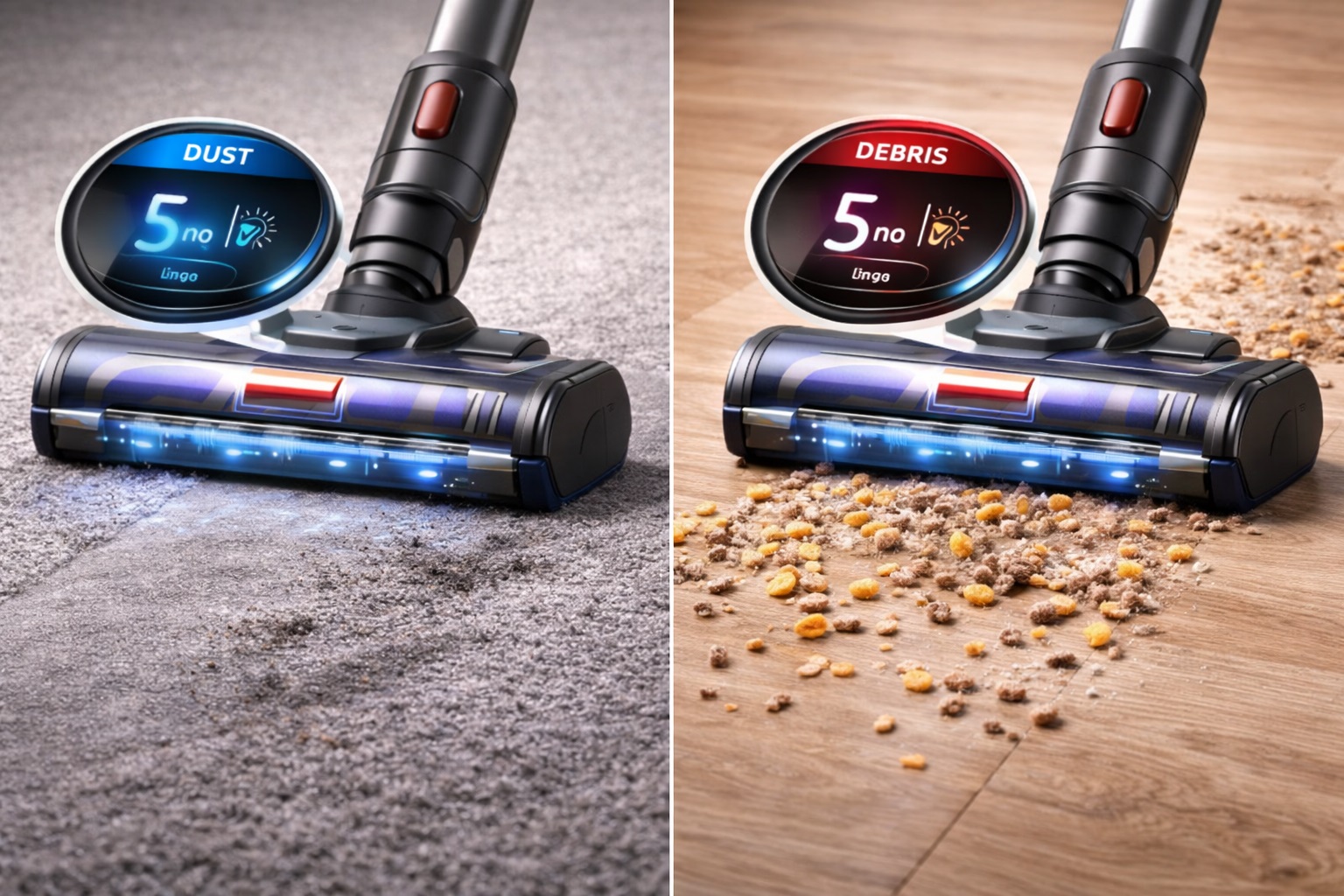
A Practical Mode-Selection Guide for Europe & Middle East B2B Buyers
🚀 Why “Wrong Mode” Is a Silent Performance Killer
Many customer complaints sound like product defects:
But in reality, a large percentage of these issues come from using the wrong vacuum mode for the wrong type of dirt.
For distributors and after-sales teams, this misunderstanding leads to:
This guide explains how to correctly match vacuum modes to dirt types, with special focus on wet and dry vacuum cleaner, multi-functional durable vacuum cleaner, fast lightweight vacuum cleaner, portable self-cleaning vacuum cleaner, vacuum cleaner for hardwood floors, and quiet vacuum for night use.
🧠 First Principle: Fine Dust and Large Debris Behave Differently
Fine Dust
Includes:
Flour, ash, cement dust
Pet dander
Fine sand
Characteristics:
Lightweight
Easily airborne
Easily escapes airflow
Large Debris
Includes:
Food crumbs
Pet food
Hair clumps
Small gravel
Characteristics:
💡 Expert Insight
Trying to clean both with the same mode almost always causes dissatisfaction.
⚙️ How Vacuum Modes Are Actually Designed (Not Marketed)
Manufacturers design modes to balance:
Suction power
Airflow speed
Noise
Energy use
A multi-functional durable vacuum cleaner typically includes:
Each mode is optimized for specific dirt behavior, not “better or worse cleaning.”
🌫️ Fine Dust: Why Lower, Stable Power Works Better
For fine dust, the biggest enemy is turbulence, not weak suction.
Recommended Mode Characteristics
Moderate suction
Stable airflow
Reduced motor RPM
This prevents dust from:
Best Product Types
💡 B2B Lesson
Many “dust not removed” complaints disappear when users stop using max mode.
🪵 Hardwood Floors: Fine Dust + Surface Sensitivity
On hardwood floors:
Using high power here often causes:
👉 For vacuum cleaner for hardwood floors, low or standard mode is almost always the correct choice.
🧱 Large Debris: When Power and Airflow Matter
Large debris needs:
Recommended Mode Characteristics
Best Use Cases
Kitchen floors
Entryways
Pet feeding areas
💡 Distributor Reality
Customers expect visible “instant pickup” with debris—this is where higher modes shine.
🧼 Wet and Dry Vacuum Cleaner: Mode Switching Is Critical
For wet and dry vacuum cleaner models, mode misuse is extremely common.
Dry Mode
Best for:
Wet Mode
Best for:
⚠️ Common Mistake
Users often clean fine dust in wet mode, causing:
Sludge buildup
Reduced performance
Odor complaints
🧩 Portable Self-Cleaning Vacuum Cleaner: Let the System Work
A portable self-cleaning vacuum cleaner is designed to:
But this only works if:
💡 After-Sales Insight
Interrupting self-cleaning cycles is a top cause of “it lost suction” complaints.
🪶 Fast Lightweight Vacuum Cleaner: Speed ≠ Max Power
With a fast lightweight vacuum cleaner, users often assume:
“It’s light, so I need max power.”
In reality:
👉 Standard mode usually delivers better control and results, especially for dust.
🔇 Quiet Vacuum for Night Use: Mode Is the Product
For quiet vacuum for night use, the mode is the value proposition.
Night-use modes prioritize:
Using boost mode at night:
💡 B2B Insight
Quiet modes are not “weaker”—they are more precise.
❌ The 7 Most Common Mode-Related Mistakes
Always using max mode
Cleaning fine dust with boost power
Using wet mode for dry dust
Ignoring surface type
Interrupting self-cleaning cycles
Expecting quiet mode to handle heavy debris
Assuming one mode fits all scenarios
Each mistake increases dissatisfaction.
🧭 A Simple Mode-Matching Framework (Share with Customers)
✔ Fine dust → Low / Eco / Quiet mode
✔ Hardwood floors → Standard or quiet mode
✔ Large debris → High / Boost mode
✔ Mixed mess → Wet and dry vacuum cleaner (correct mode)
✔ Night cleaning → Quiet vacuum for night use
✔ Self-cleaning models → Allow full cleaning cycles
This framework alone can reduce early complaints significantly.
🏁 Final Takeaway
Vacuum cleaners don’t “perform inconsistently”—they perform exactly as the selected mode allows.
For EU & Middle East B2B buyers, educating customers on:
Dirt type
Surface type
Mode selection
is one of the lowest-cost, highest-impact improvements you can make.
Right mode, right result.
📌 Suitable Readers
Vacuum cleaner distributors & wholesalers
After-sales & customer support teams
B2B sourcing managers
Cleaning equipment entrepreneurs
End users seeking better results
📌 Hashtags
wet and dry vacuum cleaner, multi-functional durable vacuum cleaner, fast lightweight vacuum cleaner, portable self-cleaning vacuum cleaner, vacuum cleaner for hardwood floors, quiet vacuum for night use, vacuum cleaner distributor, B2B vacuum cleaner, EU vacuum market, Middle East vacuum market,
vacuum cleaner modes, fine dust cleaning, large debris cleaning, home cleaning equipment, cleaning appliance B2B, low noise vacuum cleaner, durable cleaning equipment, vacuum cleaner wholesaler, smart home cleaning,
hardwood floor dust removal, debris pickup solutions, vacuum cleaner R&D, cleaning technology innovation, product sourcing strategy, after sales cost reduction,
user education content, vacuum cleaner training, household cleaning tools, modern home appliances, appliance distribution, vacuum cleaner business, global vacuum cleaner market, professional cleaning solutions, intelligent vacuum system,
vacuum cleaner market insights, appliance supply chain, cleaning industry trends, Lanxstar, B2B sourcing guide, cleaning mode education











