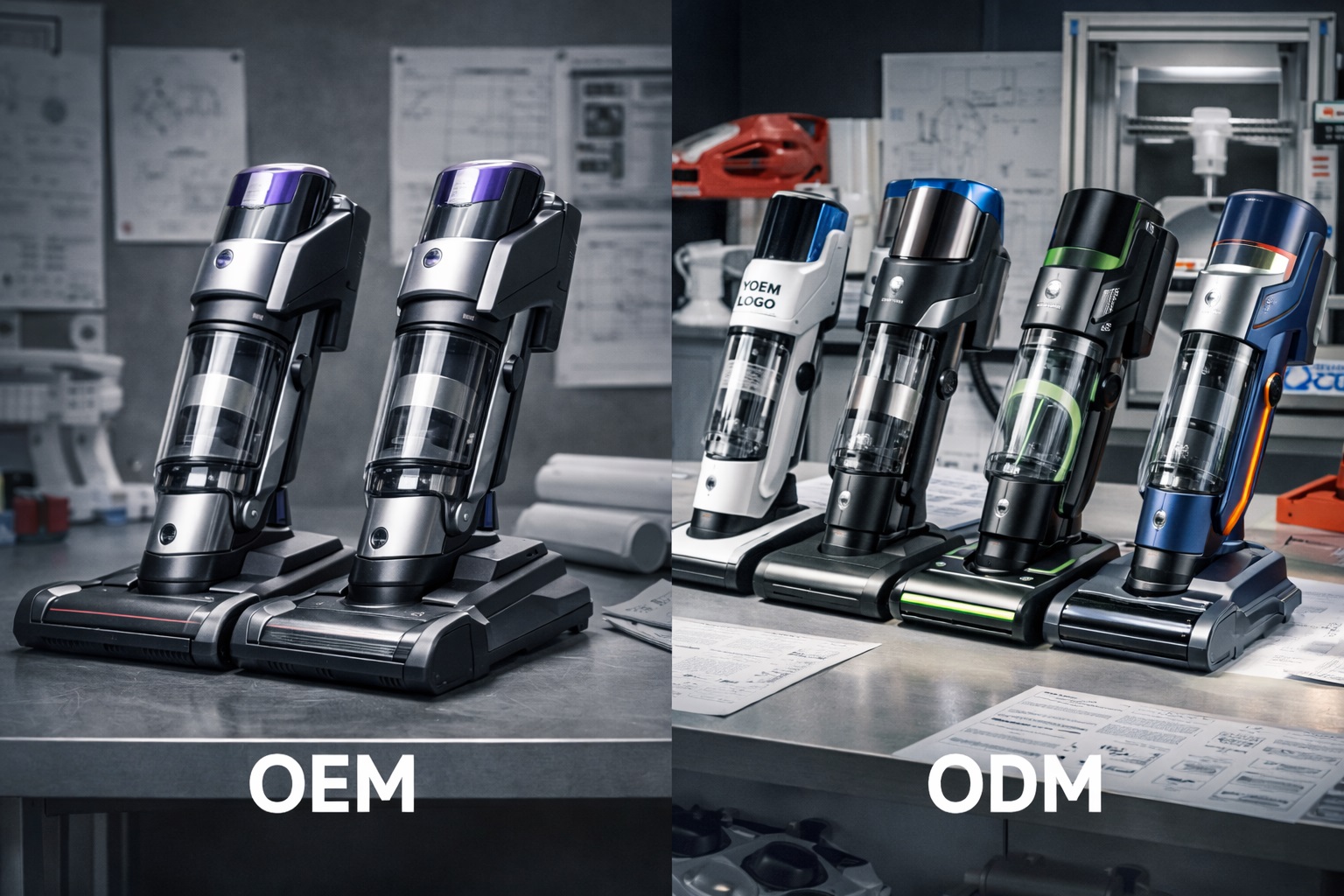
 In the vacuum cleaner industry, OEM vs. ODM is not a technical distinction—it is a business strategy decision.
Choosing the wrong model can lock buyers into:
This article breaks down how OEM and ODM models actually work in practice, using real product categories such as multi-functional durable vacuum cleaner, wet and dry vacuum cleaner, and 4 in 1 cordless smart wet & dry vacuum cleaner—and helps you decide which path fits your current stage.
🧩 Understanding OEM and ODM Beyond the Definitions
On paper:
OEM = You provide the design, the factory manufactures
ODM = The factory provides the design, you brand and sell
In reality, the difference lies in risk ownership, speed, and control.
Most buyer mistakes happen when OEM or ODM is chosen for the wrong reason, not because one model is inherently better.
🚀 When ODM Is the Smarter Choice
ODM works best when speed and risk control matter more than exclusivity.
Typical ODM advantages:
Faster time-to-market
Lower upfront development cost
Pre-tested compliance and reliability
Proven market performance
For products like a car vacuum cleaner or vacuum for multi-surface, ODM allows buyers to:
Best-fit buyers:
ODM is especially effective for standardized products such as wet and dry vacuum cleaner models where functionality is well-established.
🛠️ Where OEM Becomes a Strategic Advantage
OEM becomes valuable when differentiation and control drive your growth.
OEM allows buyers to:
Own unique product specifications
Control feature prioritization
Build long-term brand equity
Protect margins through differentiation
For advanced products like a 4 in 1 cordless smart wet & dry vacuum cleaner, OEM enables:
Custom feature combinations
Market-specific performance tuning
Deeper integration of smart or hygiene functions
Best-fit buyers:
🧠 The Hidden Cost of Choosing OEM Too Early
Many buyers rush into OEM believing it guarantees exclusivity.
In reality, early-stage OEM often leads to:
Long development cycles
Higher MOQ pressure
Multiple redesign loops
Delayed revenue
Without clear volume forecasts or market validation, OEM can slow growth rather than accelerate it.
Rule of thumb:
If speed and learning matter more than uniqueness, ODM usually wins.
🧪 Compliance, Testing, and Responsibility Gaps
One overlooked difference is who carries technical responsibility.
In ODM, factories usually hold validated compliance data
In OEM, buyers often share or fully own compliance risks
For regulated markets and products like vacuum cleaner for allergies, where filtration and hygiene claims matter, ODM significantly reduces early-stage exposure.
OEM becomes safer only when buyers have:
📊 Margin Reality: OEM vs. ODM
Contrary to common belief:
ODM often wins on:
Faster cash flow
Lower sunk cost
Reduced error correction
OEM wins when:
Margins follow execution quality, not just the sourcing model.
🌍 Multi-Market Expansion Considerations
For buyers serving Europe and the Middle East:
Many successful buyers start with ODM, then transition to OEM after market validation, especially for multi-functional durable vacuum cleaner lines.
This staged approach reduces risk while preserving long-term control.
🔄 The Hybrid Path: ODM Today, OEM Tomorrow
The most effective strategy is often not choosing one forever.
Smart buyers:
This is common for:
The result: faster learning, stronger differentiation, and controlled investment.
🚀 The Right Choice Is Contextual, Not Ideological
OEM and ODM are tools—not labels of quality.
The right choice depends on:
Professional buyers evaluate sourcing models the same way they evaluate products: based on fit, not hype.
📌 Suitable Readers
Vacuum cleaner brand founders
European vacuum cleaner importers
Middle Eastern vacuum cleaner distributors
OEM / ODM sourcing managers
Cleaning equipment entrepreneurs
Product managers and category leaders
📌 Hashtags
multi-functional durable vacuum cleaner, wet and dry vacuum cleaner, 4 in 1 cordless smart wet & dry vacuum cleaner, car vacuum cleaner, vacuum for multi-surface, vacuum cleaner for allergies, OEM vacuum cleaner, ODM vacuum cleaner, private label vacuum cleaner, vacuum cleaner manufacturer, vacuum cleaner sourcing strategy, OEM vs ODM decision, vacuum cleaner product development, vacuum cleaner compliance, CE vacuum cleaner, RoHS vacuum cleaner, vacuum cleaner for Europe, vacuum cleaner for Middle East, B2B vacuum cleaner sourcing, vacuum cleaner distributor, vacuum cleaner importer, commercial vacuum cleaner, home cleaning equipment, cordless vacuum cleaner, smart vacuum cleaner system, allergy friendly vacuum cleaner, multi surface vacuum cleaner, vacuum cleaner R&D, vacuum cleaner engineering, vacuum cleaner testing, vacuum cleaner certification, vacuum cleaner supply chain, brand building strategy, product differentiation vacuum, vacuum cleaner innovation, cleaning industry trends, vacuum cleaner OEM ODM, private label vacuum strategy, time to market optimization, sourcing risk management, scalable vacuum cleaner business, product launch strategy, modular vacuum platforms, smart cleaning solutions, Lanxstar