Hi, message us with any questions.
We're happy to help!





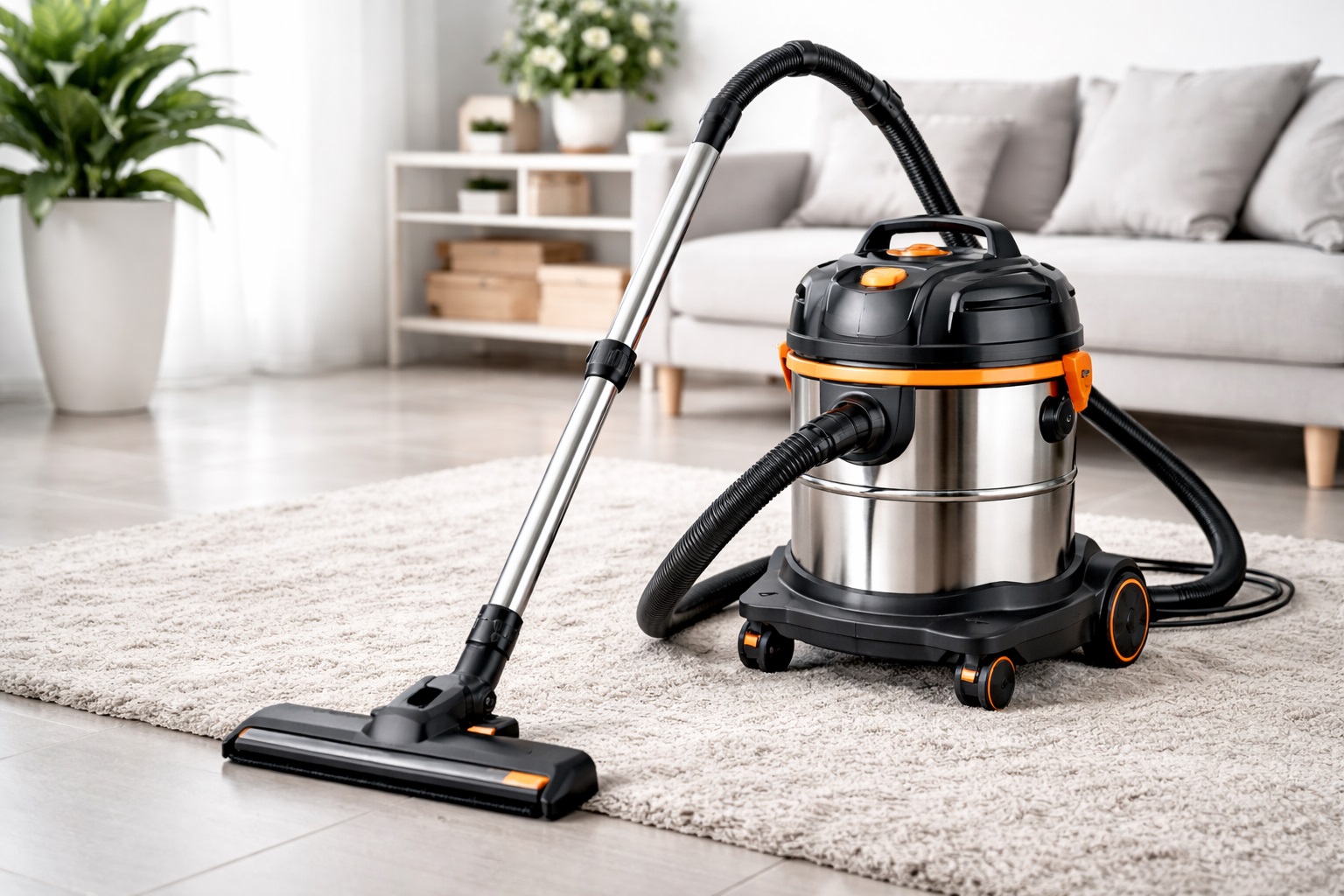
If you’re selecting Household Vacuum Cleaners for Europe and the Middle East, your buyers aren’t only comparing “cleaning power.” They’re comparing noise, floor safety, portability, energy consumption, and how often the product becomes annoying to use. That’s where barrel (canister) vacuums quietly outperform many categories—especially when households have hardwood, tile, mixed rugs, and neighbors nearby.
This article is written for EU & Middle East vacuum cleaner distributors and B2B buyers who want a straightforward, spec-driven story that sells—and holds up after thousands of real homes.
🧩 Quick Procurement Verdict (Copy/Paste for Your Team)
Barrel vacuums win when you need a versatile platform that can credibly claim: Quiet Vacuum for Night Use, hardwood-safe cleaning, and flexible reach for stairs/sofas—without over-engineering the entire unit.
If your channel also stocks Upright Vacuum Cleaners, treat barrel as the “all-home, all-surface” workhorse and upright as the “carpet-first, one-piece convenience” option.
For a strong sell-through plan, build 3 bundles: Essential, Hardwood, Quiet/Pet—using the same canister base and different heads.
🧭 I. Why Barrel Vacuum Architecture Fits Real Homes Better (and Makes Your SKU Strategy Easier)
A barrel vacuum splits the machine into two roles:
Canister: motor, filtration, dust container/bag, noise insulation
Cleaning interface: hose + wand + floor head (and tools)
This separation creates a commercial advantage: one stable core, many market-ready variants. In B2B terms, you can standardize the expensive parts (motor housing, filtration, power system) and differentiate where consumers feel it most (heads, wheels, suction control, noise experience).
📊 Shareable Table: Barrel vs Upright — What Buyers Actually Notice
| Buyer Experience Factor | Barrel / Canister | Upright Vacuum Cleaners |
|---|---|---|
| Mixed flooring (hardwood + rugs) | Excellent (head choice + suction control) | Mixed; many are carpet-biased |
| Night-time usability | Often quieter (canister insulation + distance from head) | Often louder near user |
| Portability for stairs/sofa | Strong (hose + tools) | Can be bulky to lift |
| Hardwood protection | Easier to deliver “safe glide” | Higher scratch risk if head is heavy/rigid |
| Platform scalability | High (same base, multiple kits) | Lower (more integrated design) |
Bottom line: barrel vacuum design naturally supports your “multi-SKU, multi-market” plan without turning your supply chain into chaos.
⚡ II. Benefit 1 — Energy Efficiency Without Weak Cleaning: The Real “Energy-Saving” Story
Many brands try to sell energy savings by lowering wattage. That backfires if pickup feels weaker. The smarter approach is building an Energy-Saving Efficient Powerful Vacuum Cleaner that cleans faster per pass—so users run it for less time and still feel results.
🧠 The procurement truth: “Efficient” is airflow + system design, not just low watts
Energy efficiency improves when you reduce waste in:
leaky seals
turbulent airflow turns
restrictive filters that choke too early
floor heads that don’t convert suction into pickup
✅ B2B-ready “efficiency checks” you can run on samples
Time-to-clean test: same debris load, measure how many passes needed for a visibly clean track.
Filter-load stability: pre-load the filter slightly; see whether performance collapses. Efficient designs keep “usable suction” longer.
Head effectiveness: a great head often beats a bigger motor in real homes.
Procurement message that sells: “Cleans faster with less power waste” is a stronger claim than “low wattage,” because it ties directly to user experience.
🪶 III. Benefit 2 — Faster Cleaning with Less Fatigue: Why “Lightweight” Must Be Felt at the Floor Head
Consumers say “I want a Fast Lightweight Vacuum Cleaner,” but what they really mean is:
“I don’t want a heavy head dragging on my wrist.”
“I don’t want to fight the machine around furniture.”
“I want fast transitions between rooms and surfaces.”
Barrel vacuums shine because the weight is not concentrated on the cleaning head. The head can be engineered to glide, while the canister rolls behind.
🔧 What “lightweight” should mean in your product spec (not just a marketing number)
Low push-force on hard floors (glide quality matters more than total kg)
Balanced wand ergonomics (less wrist torque)
Smooth caster wheels (canister follows without tipping)
Fast tool switching (simple locks, minimal effort)
📌 A simple distributor demo that boosts conversion
In-store or in a buyer demo:
Place a chair + table legs on hardwood.
Have the tester navigate around it in 20 seconds.
Watch: barrel head agility is immediately obvious.
That’s a “feel-based proof” that converts better than spec sheets.
🪵 IV. Benefit 3 — Hardwood-Safe by Nature: Lower Complaint Risk, Higher Review Quality
Hard floors are unforgiving. The biggest risk for a Vacuum Cleaner for Hardwood Floors isn’t dust left behind—it’s scratches, scuffs, and grit dragging. Those complaints destroy reputation fast, especially on social media.
🛡️ Hardwood-safe design checklist (use this in supplier selection)
Soft-contact edge (parquet brush / soft roller / felt strip)
Rubberized wheels (reduce micro-scuff potential)
Suction control (avoid “sticking” that forces dragging)
Wide debris intake (reduces grit pushing/rolling)
💡 Unique viewpoint (that many articles miss)
Hardwood damage complaints often come from the head design, not the customer:
A rigid plastic lip + strong suction can pull grit under the edge.
Once grit is trapped, every push becomes abrasion.
Barrel advantage: less head weight + easier head swapping lets you offer a true hardwood-focused kit without redesigning the whole vacuum.
🌙 V. Benefit 4 — Quiet at Night: How Barrel Models Support “Quiet Vacuum for Night Use” Credibly
“Quiet” is one of the easiest claims to fake—and one of the fastest to be exposed by real users.
A credible Quiet Vacuum for Night Use needs more than insulation. Noise comes from multiple sources:
motor whine
airflow turbulence
head friction
vibration transfer through housing
🔍 What to demand from suppliers (practical, testable)
Noise consistency under load: some vacuums get much louder when filters start clogging. Test 10 minutes in, not only at start.
Vibration management: poor balancing makes a vacuum “feel loud” even if decibels look okay.
Head acoustics: a loud head can ruin a quiet canister.
✅ Simple warehouse test (no special equipment required)
Run vacuum in a closed room.
Stand 2–3 meters away (typical living room distance).
Have someone read normal conversation lines.
If you constantly raise your voice, it won’t feel “night friendly.”
Why barrel helps: the canister (where the motor is) sits farther from the user’s ears than many upright designs, and it’s easier to add insulation and damping space.
🧰 VI. Benefit 5 — “One Vacuum, Many Jobs”: Multi-Use Value That Increases Basket Size
Barrel vacuums naturally support multi-task cleaning: corners, curtains, sofas, car interiors, stairs. This is why many buyers treat them as the best all-round option in Household Vacuum Cleaners assortments.
💼 The B2B growth lever: accessory ecosystem = recurring revenue
Instead of selling “one machine,” you sell a platform:
Parquet brush upgrades
Soft roller head
Mini tool kits
Replacement filters and hoses
🎯 A proven 3-bundle strategy for EU & Middle East channels
Essential Bundle: standard floor head + crevice + dusting brush
Hardwood Bundle: parquet/soft roller + rubber wheels emphasis + edge tool
Quiet Home Bundle: noise-focused messaging + gentle head + suction control emphasis
This supports higher AOV and clearer segmentation—without multiplying base-unit complexity.
🧾 VII. Buyer Toolkit: A Practical Scorecard to Reduce Returns and Warranty Pressure
When you choose between barrel models (or barrel vs Upright Vacuum Cleaners), the biggest hidden cost is variance—units that perform inconsistently across batches.
✅ Procurement scorecard (1–5, weight as needed)
Performance stability after light filter loading
Hardwood-safe head quality (soft-contact + glide)
Quietness perception in real-room test
Push-force / head maneuverability (felt lightweight)
Seal quality (dust leakage risk)
Spare parts availability (filters, hoses, heads) for 24–36 months
Packaging protection (damage rate risk)
QC traceability (motor and plastics)
Accessory ecosystem breadth (bundle strategy)
Warranty/DOA handling process clarity
❓ 7 questions that prevent “surprise problems” after the container arrives
Which parts fail most often, and what changed in the latest revision?
Can you commit to spare parts supply for 24–36 months?
How does noise change after 10–15 minutes of use?
Which hardwood head is standard, and what is optional?
What’s the suction control range, and how is it implemented?
What’s your packaging drop-test approach?
Can the same base support multiple kits (hardwood/quiet/standard) without tooling changes?
✅ Conclusion
If you need a product that households actually enjoy using—especially in mixed-floor environments—barrel vacuums deliver five advantages that translate into better sell-through and fewer complaints:
More credible efficiency for an Energy-Saving Efficient Powerful Vacuum Cleaner positioning
Easier “fast and lightweight” experience through low push-force and agile heads
Safer delivery of a true Vacuum Cleaner for Hardwood Floors promise
Stronger case for a Quiet Vacuum for Night Use story
Multi-job flexibility that increases bundle value in Household Vacuum Cleaners assortments
Keep Upright Vacuum Cleaners as a focused option for carpet-first customers, but for broad household coverage—and a scalable, bundle-driven business plan—barrel vacuums are often the smarter core platform.
📌 Hashtags
householdvacuumcleaners, barrelvacuum, canistervacuumcleaner, uprightvacuumcleaners, energysavingvacuum, efficientpowerfulvacuumcleaner, fastlightweightvacuumcleaner, vacuumcleanerforhardwoodfloors, quietvacuumfornightuse, lownoisevacuum, nightcleaningvacuum, hardwoodsafevacuum, parquetbrush, softrollerhead, rubberizedwheels, suctioncontrol, sealedairflow, airflowefficiency, pickupperformance, filterloadstability, thermalprotection, vibrationdamping, noiseinsulation, ergonomicwand, telescopicwand, smoothcasters, staircleaningtool, sofaattachment, curtaincleaningtool, crevicetool, dustingbrush, accessorybundle, modularvacuumkits, distributorstrategy, B2Bvacuum, wholesalevacuumcleaner, vacuumprocurement, privateLabelVacuum, OEMvacuumcleaner, ODMvacuumcleaner, qualitycontrol, batchtraceability, packagingdroptest, warrantycostcontrol, sparepartsavailability, serviceability, returnsreduction, mixedfloorcleaning, EUappliancechannel, MiddleEastdistribution, GCCretail, Lanxstar



