Hi, message us with any questions.
We're happy to help!





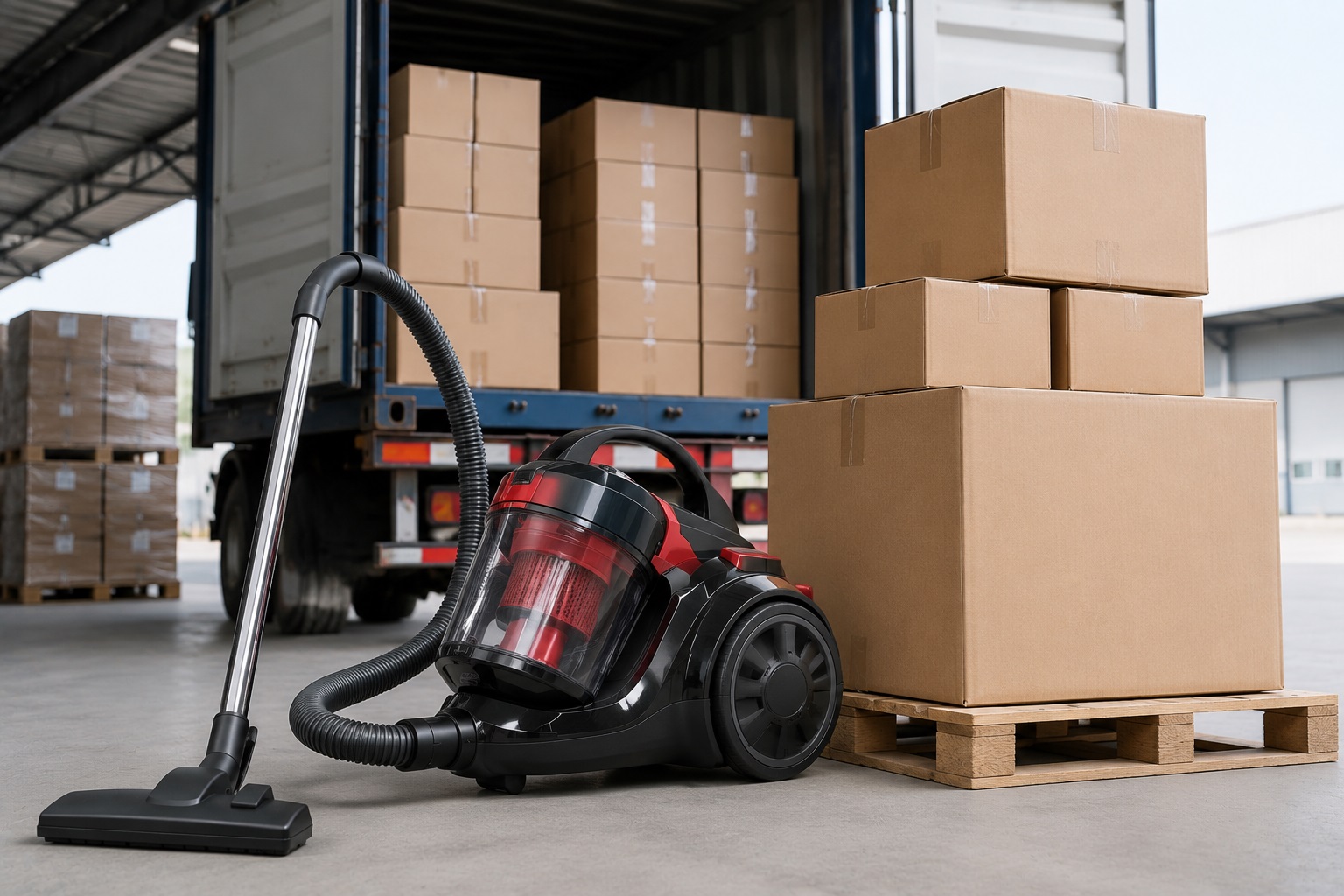
1. Why Shipping Planning Matters for Bulk Vacuum Cleaner Orders
After finding a suitable vacuum cleaner manufacturer, confirming samples, negotiating pricing, and approving production, buyers face another important challenge: getting the products from the factory to the destination market safely and economically.
For a bulk vacuum cleaner purchase, logistics can significantly influence the final landed cost.
Vacuum cleaners present a particular shipping challenge because many models are relatively bulky compared with their value and weight. A Large-Capacity Wet Dry Vacuum Cleaner, for example, may occupy considerable container space even when the actual machine is not exceptionally heavy.
This means purchasing teams should not evaluate only the factory unit price.
Packaging dimensions, units per carton, container utilization, port charges, customs clearance, insurance, inland transportation, and destination fees can all influence the real cost.
🚢 For bulk orders, logistics should be considered before the purchase order is finalized—not after production is completed.
2. Get Accurate Packaging Information Before Calculating Freight
One of the first pieces of information buyers should request from a vacuum cleaner supplier China is the complete packing specification.
This normally includes:
unit dimensions
carton dimensions
net weight
gross weight
units per carton
carton volume
number of cartons
total gross weight
total shipment volume
For vacuum cleaners, CBM (cubic meter) is particularly important because ocean freight and container planning are strongly influenced by cargo volume.
The basic calculation is:
Carton Length × Width × Height × Number of Cartons = Total Shipment Volume
Dimensions must be converted into meters when calculating CBM.
For example, if an industrial vacuum cleaner carton measures approximately:
0.50 m × 0.45 m × 0.70 m
the carton occupies:
0.1575 CBM
A shipment of 200 cartons would theoretically occupy:
31.5 CBM
However, theoretical CBM should not automatically be treated as actual container capacity because loading patterns, carton orientation, unusable spaces, pallets, and container limitations can affect utilization.
📦 Ask the manufacturer for an actual container loading quantity whenever possible.
3. FCL vs LCL: Which Is Better for Vacuum Cleaner Shipping?
International buyers commonly choose between FCL (Full Container Load) and LCL (Less than Container Load) for sea freight.
LCL Shipping
LCL allows a buyer to ship cargo without filling an entire container.
This can be useful for:
trial orders
new product testing
smaller distributors
mixed product purchases
initial OEM launches
For example, a distributor testing a new commercial vacuum cleaner for hotel use may prefer a smaller shipment rather than committing immediately to a full container.
However, LCL cargo generally passes through more consolidation and handling stages.
This can increase handling exposure and may create additional origin or destination charges.
FCL Shipping 🚢
FCL gives the buyer use of a complete container.
For larger wholesale vacuum cleaner orders, this can offer advantages in:
cargo control
loading efficiency
reduced handling
easier shipment planning
potentially lower freight cost per unit at sufficient volume
Whether LCL or FCL is more economical depends on shipment volume, route, freight market, local charges, and other commercial factors.
Do not assume that one option is always cheaper. Request comparable quotations.
4. 20GP, 40GP, or 40HQ: How Should Buyers Choose?
Vacuum cleaner importers frequently use standard dry containers such as 20GP, 40GP, and 40HQ.
Because many vacuum cleaners are relatively bulky rather than extremely dense, a 40HQ can often be attractive for high-volume orders.
However, actual loading quantity depends on carton dimensions.
A Portable Quiet Vacuum Cleaner designed for commercial applications may have compact packaging, while a heavy duty vacuum cleaner with a large tank and accessories may require substantially more space.
Similarly, a stainless steel vacuum tank can sometimes allow components or accessories to be packed strategically, depending on the product design.
💡 Packaging engineering can directly influence procurement economics.
If a manufacturer can safely reduce carton dimensions without compromising protection, more units may fit into a container, reducing freight cost per unit.
For this reason, professional buyers should discuss packaging optimization with their vacuum cleaner manufacturer in China before mass production.
5. Understand EXW, FOB, and CIF Before Ordering
Incoterms define important responsibilities between buyers and sellers. Three terms frequently encountered when sourcing vacuum cleaners from China are EXW, FOB, and CIF.
EXW
Under an EXW arrangement, the seller makes the goods available at the agreed location, while the buyer assumes substantial responsibility for arranging onward transportation and export-related processes according to the applicable Incoterms framework.
EXW can provide greater logistics control but may be less convenient for inexperienced importers.
FOB
FOB is commonly used for containerized sourcing discussions, although buyers should work with logistics professionals to ensure the selected Incoterm is appropriate for the actual transportation arrangement.
Under FOB, responsibilities and risk transfer are determined according to the agreed named port and Incoterms rules.
CIF
CIF includes cost, insurance, and freight to the named destination port under the relevant Incoterms framework.
However, CIF does not mean all destination expenses are included.
Import duties, taxes, customs clearance, port charges, local delivery, and other expenses may remain outside the supplier's quotation.
⚠️ Always write the Incoterm version and named place/port clearly in commercial documents.
6. Calculate Landed Cost, Not Just Factory Price
Suppose a buyer receives an attractive quotation for a factory direct vacuum cleaner.
The factory price may look excellent, but it is only one part of the total commercial picture.
A simplified landed-cost model can include:
Product cost + packaging + inland logistics + export charges + international freight + insurance + import duties + taxes + customs clearance + destination charges + final delivery
The exact calculation varies by country and transaction structure.
For a bulk order vacuum cleaner, divide the total landed cost by the number of saleable units to estimate landed cost per unit.
💰 This provides a much better comparison than looking only at vacuum cleaner price wholesale.
A supplier offering a slightly higher product price may actually provide better overall economics if its packaging allows significantly more units per container or reduces damage rates.
7. Case Study: Shipping Industrial Wet and Dry Vacuums to Europe 🇪🇺
Consider a hypothetical European distributor purchasing an industrial wet and dry vacuum cleaner for warehouse cleaning.
The buyer initially plans a smaller LCL shipment because the product is new to its market.
After calculating the total volume and comparing quotations, the purchasing team discovers that the order is approaching a volume at which FCL becomes commercially attractive.
The team then evaluates:
FCL freight
LCL freight
origin charges
destination charges
loading quantity
warehouse delivery
insurance
inventory requirements
At the same time, the industrial vacuum cleaner supplier reviews the carton configuration.
By improving how accessories are packed and reducing unnecessary empty packaging space without weakening protection, the supplier can improve loading efficiency.
The distributor ultimately evaluates shipping cost per vacuum cleaner, rather than comparing only headline freight quotations.
📊 Case takeaway: Container utilization can be just as important as negotiating a small reduction in the factory price.
8. Packaging Is Critical for Industrial Vacuum Cleaners
Industrial equipment may experience multiple handling stages before reaching the final customer.
A wet dry vacuum cleaner, dual motor vacuum cleaner, or high suction power vacuum cleaner may contain components that require protection against impact, vibration, compression, or moisture during transportation.
Packaging should therefore be appropriate for the actual distribution chain.
Buyers should consider:
carton strength
internal protection
accessory positioning
wheel protection
hose placement
cable protection
moisture protection where appropriate
pallet requirements
stacking limitations
shipping marks
For a High Suction Vacuum Cleaner intended for professional customers, receiving a damaged hose, cracked accessory, or deformed tank can undermine customer confidence even when the motor works perfectly.
📦 Good export packaging protects both the product and the brand.
9. OEM and Private-Label Orders Need Additional Shipping Coordination
An OEM vacuum cleaner, ODM vacuum cleaner, or private label vacuum cleaner usually requires more logistics coordination than a standard product.
Custom orders may include:
branded cartons
color boxes
custom manuals
barcode labels
product labels
promotional materials
customized accessories
different plug configurations
retailer-specific packaging
Before production, confirm packaging artwork and shipping marks.
If a retailer requires specific carton dimensions, pallet heights, barcode formats, or warehouse labels, communicate these requirements to the OEM industrial vacuum cleaner manufacturer early.
Late packaging changes can delay shipment and increase costs.
For large retail programs, packaging specifications may be nearly as important as the product specification itself.
10. Pre-Shipment Inspection Reduces Import Risk 🔍
Before paying the final balance or authorizing shipment, many professional buyers perform a pre-shipment inspection.
Depending on the order and inspection plan, checks may include:
order quantity
product appearance
model numbers
suction operation
switches
cables and plugs
filters
wet/dry functions
accessories
packaging
labels
carton markings
manuals
For a Multi-Functional Durable Vacuum Cleaner, inspectors should understand which functions were included in the approved specification.
For an Energy-Saving Efficient Powerful Vacuum Cleaner, relevant electrical and performance specifications should match the agreed product configuration.
Third-party inspection can be particularly useful when the buyer cannot visit the industrial vacuum cleaner factory personally.
The inspection standard and acceptance criteria should ideally be agreed before production.
11. Prepare the Correct Shipping and Customs Documents
The documents required for international vacuum cleaner shipments depend on destination, shipment structure, and applicable regulations.
Common commercial and logistics documents can include:
commercial invoice
packing list
bill of lading or sea waybill
certificate of origin where applicable
insurance documents where relevant
customs-related documents
product compliance documentation where required
For European markets, buyers should separately ensure that relevant product regulatory requirements have been addressed.
As discussed in compliance planning, CE marking, RoHS requirements, technical documentation, labeling, and declarations should be evaluated according to the actual product.
🚨 Shipping documents and product compliance documents serve different purposes. Do not confuse the two.
Always confirm current import requirements with your customs broker, freight forwarder, or qualified trade professional for the destination country.
12. Case Study: OEM Commercial Vacuum Cleaners for a Hotel Distributor 🏨
Imagine a distributor ordering an OEM commercial vacuum cleaner for hotel use.
The buyer chooses a low noise vacuum cleaner because its hotel customers frequently clean corridors and guest areas during operating hours.
The order includes:
custom branding
printed cartons
local-language manuals
selected accessories
destination-specific plugs
barcode labels
The distributor originally focuses mainly on manufacturing lead time.
However, its freight forwarder identifies a potential issue: the customized carton is larger than the standard factory carton, reducing the number of machines that can fit into the planned container.
The buyer then works with the manufacturer to redesign the internal packaging while maintaining adequate product protection.
The optimized carton improves container utilization.
The lesson is valuable:
OEM packaging should be designed with logistics efficiency in mind, not only shelf appearance.
13. Plan Production and Shipping Lead Times Together
Buyers sometimes treat manufacturing and shipping as separate schedules.
They should be planned together.
A simplified procurement timeline may include:
Purchase order → deposit → materials → production → inspection → balance/payment arrangements → booking → container loading → export process → ocean transit → customs clearance → local delivery
Potential delays can occur at multiple stages.
Seasonal shipping demand, holidays, port congestion, weather, customs inspections, factory capacity, and carrier schedules can all affect delivery.
If products are needed for a retail promotion, trade show, hotel opening, warehouse project, or seasonal sales period, build contingency time into the schedule.
⏱️ Do not calculate delivery dates using factory production time alone.
A professional cleaning equipment supplier should communicate expected production schedules, but international buyers should coordinate the complete logistics timeline with their freight partners.
14. How to Reduce Bulk Vacuum Cleaner Shipping Costs
Freight markets change constantly, but buyers can improve shipping economics through several structural measures.
Optimize Carton Dimensions
Reducing unnecessary packaging volume can increase container utilization.
Consolidate Orders
If appropriate, combining multiple vacuum cleaner models or cleaning equipment products may improve logistics efficiency.
Compare FCL and LCL
Do not automatically choose one shipping method based on previous orders.
Plan Earlier
Urgent shipments reduce logistics flexibility and can increase costs.
Improve Forecasting
Regular distributors can share purchasing forecasts with their vacuum cleaner supplier so production and shipping can be planned more efficiently.
Compare Total Charges
A low ocean-freight quotation can be misleading if destination fees are unusually high.
🚢 Compare the complete route cost whenever possible.
15. Shipping Different Types of Vacuum Cleaners
Different products create different logistics priorities.
Industrial Vacuum Cleaner
An industrial vacuum cleaner may be large and robust, making carton volume and product protection important.
Wet and Dry Vacuum Cleaner
A wet and dry vacuum cleaner often includes tanks, hoses, floor tools, tubes, and other accessories. Efficient internal packing can reduce wasted space.
Commercial Vacuum Cleaner
A commercial vacuum cleaner may prioritize compact packaging, particularly when distributors supply hotels, offices, retailers, and cleaning-service companies.
Car Detailing Vacuum Cleaner
A car detailing vacuum cleaner may include specialized accessories that require organized packaging to prevent missing components.
HEPA Filter Vacuum Cleaner
A HEPA filter vacuum cleaner requires appropriate protection of filtration components so filters are not damaged during transport.
Product-specific packaging should therefore form part of supplier evaluation.
16. Cargo Insurance and Risk Management
International transportation always involves risk.
Cargo can potentially be damaged, lost, exposed to moisture, or affected by transportation incidents.
Buyers should discuss appropriate cargo insurance with qualified insurance providers or freight professionals based on shipment value, Incoterms, route, and risk profile.
Also establish procedures for documenting damage.
When cargo arrives, photographs, container information, carton condition, quantity records, and timely notification may become important if a claim is necessary.
For high-value commercial cleaning equipment or large bulk vacuum cleaner purchase programs, risk management should be planned rather than treated as an afterthought.
🛡️ Insurance does not replace good packaging, inspection, or logistics planning—it complements them.
17. Why Spare Parts Should Be Included in Shipping Planning
Professional vacuum cleaners eventually require consumable or replacement components.
Depending on the model, these may include:
filters
hoses
floor tools
tubes
wheels
switches
seals
brushes
selected electrical components
For factory floor cleaning, logistics warehouse cleaning, and commercial cleaning service equipment, downtime can create operational costs.
Therefore, buyers should discuss spare-parts requirements before the main shipment leaves China.
Shipping a small replacement component separately by international express can sometimes cost disproportionately more than including appropriate spare parts with a bulk shipment.
For distributors, spare-parts planning can also improve after-sales service and customer satisfaction.
18. Shipping Budget Vacuum Cleaners Requires Careful Cost Control
Retail buyers searching for the best vacuum on a budget, best budget hoover, good budget vacuum, best affordable vacuum, or best value hoover operate in price-sensitive markets.
In these categories, logistics efficiency becomes especially important because freight can represent a meaningful portion of landed cost.
A good budget vacuum cleaner is difficult to price competitively if inefficient packaging causes excessive shipping cost per unit.
For buyers sourcing the best vacuum cleaners on a budget or best vacuums on a budget, supplier evaluation should therefore include:
carton dimensions
units per container
product weight
packaging cost
damage rate
accessory configuration
landed cost
The goal is not simply to reduce packaging.
It is to achieve the best balance between protection, presentation, and shipping efficiency.
19. Working With a Chinese Vacuum Cleaner Manufacturer on Logistics
For companies planning to import vacuum cleaner from China, coordination between the manufacturer, buyer, freight forwarder, inspection company, and customs broker can significantly improve shipment execution.
A professional vacuum cleaner manufacturer in China should be able to provide accurate packing data, production schedules, loading information, commercial documents, and reasonable cooperation with the buyer's logistics provider.
Lanxstar can be evaluated by international buyers seeking industrial, commercial, wet and dry, OEM/ODM, and wholesale vacuum cleaner solutions according to their specific product and logistics requirements.
When requesting a quotation, buyers can improve accuracy by providing:
product model or application
estimated quantity
destination
preferred Incoterm
OEM requirements
packaging requirements
expected delivery schedule
🤝 This enables the manufacturer and logistics partners to build a more realistic supply plan.
20. Final Bulk Vacuum Shipping Checklist
Before a shipment leaves the factory, confirm the following:
Product: The mass-production vacuum cleaners match approved specifications.
Quantity: Final unit and carton quantities are confirmed.
Inspection: Pre-shipment inspection has been completed when required.
Packaging: Export cartons and internal protection are suitable for transportation.
Container Loading: Loading quantities and container type have been confirmed.
Incoterm: Responsibilities and the named place or port are clearly documented.
Freight: Shipping method, carrier arrangements, and expected schedule are understood.
Documents: Commercial and logistics documentation is prepared correctly.
Compliance: Applicable destination-market product requirements have been addressed separately.
Insurance: Cargo insurance responsibilities are understood.
Spare Parts: Necessary replacement filters, accessories, or spare parts have been considered.
Destination Costs: The buyer understands customs, taxes, port charges, and inland-delivery expenses as applicable.
Delivery Plan: Warehouse receiving arrangements are ready before cargo arrives.
✅ A structured checklist helps turn an international shipment from a last-minute logistics task into a controlled part of procurement.
Conclusion
Shipping a bulk vacuum cleaner purchase successfully requires coordination across manufacturing, packaging, inspection, freight, customs, compliance, insurance, and final delivery.
For importers buying an industrial vacuum cleaner, wet dry vacuum cleaner, commercial vacuum cleaner, or OEM/private-label product, freight should be evaluated as part of the total procurement cost rather than as a separate expense after production.
FCL versus LCL, carton dimensions, container utilization, Incoterms, landed cost, documentation, pre-shipment inspection, and spare-parts planning can all influence profitability.
For wholesalers and distributors, the most effective strategy is to connect product design with logistics from the beginning. A vacuum cleaner that uses container space efficiently, arrives without damage, clears customs smoothly, and reaches customers on schedule can create significantly more value than a product selected purely because of its factory price.
For professional vacuum cleaners, OEM/ODM projects, bulk purchasing, and industrial cleaning equipment solutions, visit www.lxvacuum.com.
If you are interested, please feel free to contact us.
50 Related SEO Keywords
bulk vacuum cleaner shipping, bulk vacuum cleaner purchase, bulk order vacuum cleaner, wholesale vacuum cleaner, vacuum cleaner shipping from China, import vacuum cleaner from China, vacuum cleaner supplier China, vacuum cleaner manufacturer in China, vacuum cleaner supplier, vacuum cleaner manufacturer, vacuum manufacturer, vacuum cleaner maker, Lanxstar, factory direct vacuum cleaner, OEM vacuum cleaner, ODM vacuum cleaner, private label vacuum cleaner, OEM industrial vacuum cleaner manufacturer, industrial vacuum cleaner supplier, industrial vacuum cleaner factory, industrial vacuum cleaner, commercial vacuum cleaner, wet and dry vacuum cleaner, wet dry vacuum cleaner, Large-Capacity Wet Dry Vacuum Cleaner, High Suction Vacuum Cleaner, Portable Quiet Vacuum Cleaner, Multi-Functional Durable Vacuum Cleaner, Fast Lightweight Vacuum Cleaner, Energy-Saving Efficient Powerful Vacuum Cleaner, heavy duty vacuum cleaner, high suction power vacuum cleaner, dual motor vacuum cleaner, HEPA filter vacuum cleaner, stainless steel vacuum tank, low noise vacuum cleaner, energy efficient vacuum cleaner, wet and dry suction system, industrial dust extractor, commercial grade vacuum cleaner, vacuum cleaner price wholesale, industrial vacuum cleaner cost, industrial cleaning equipment, commercial cleaning equipment, cleaning equipment supplier, warehouse cleaning solution, commercial vacuum cleaner for hotel use, wet dry vacuum cleaner for construction site, industrial wet and dry vacuum cleaner for warehouse cleaning supplier, vacuum cleaner distributor Europe