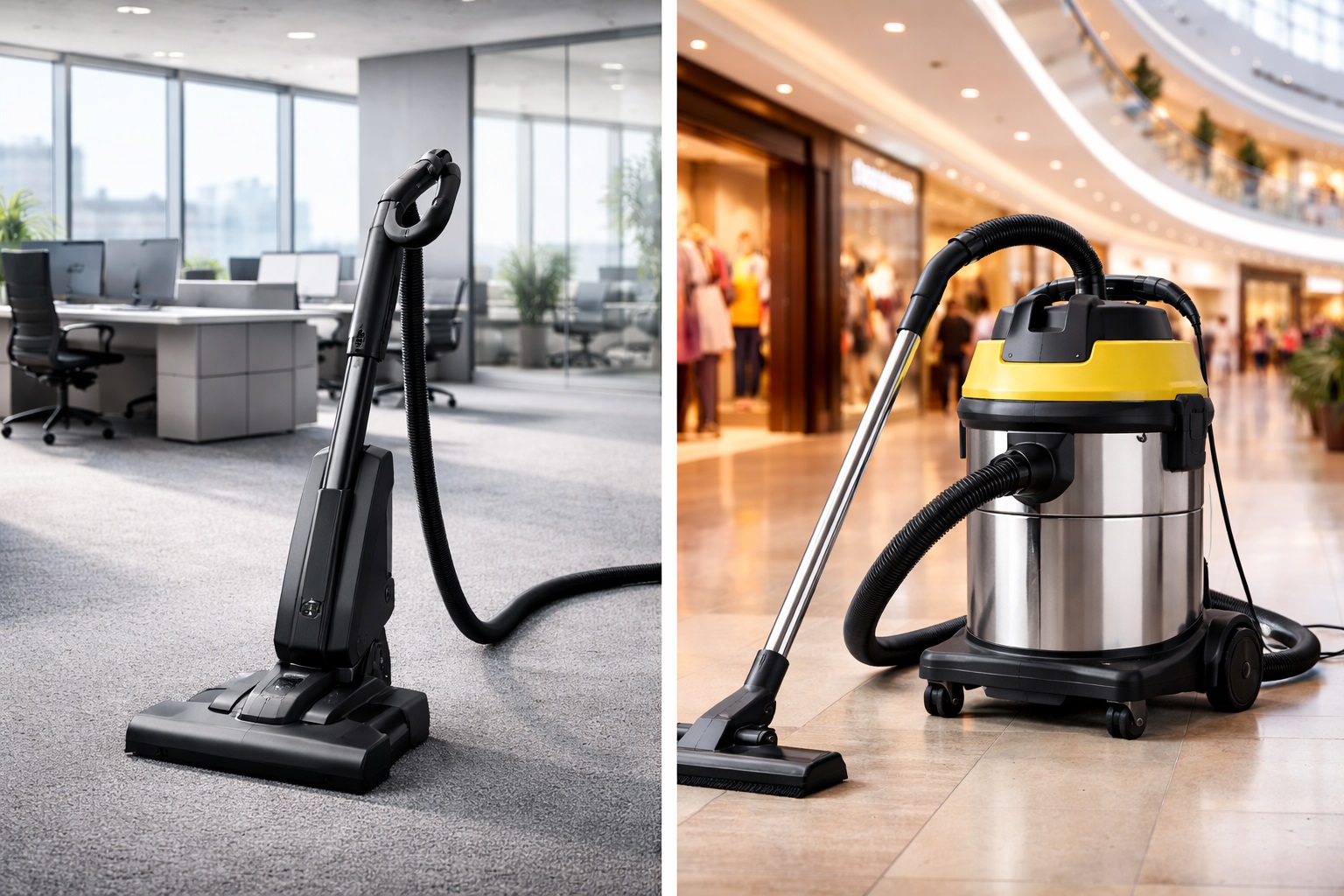
Office buildings and shopping malls are often grouped together as “commercial spaces.”
In reality, they operate under completely different cleaning conditions.
Yet many buyers make the same mistake:
they choose one type of vacuum cleaner and expect it to work equally well in both environments.
The result is predictable:
Lower cleaning efficiency
Increased staff fatigue and complaints
Faster equipment wear
Higher long-term operating costs
Commercial spaces rarely fail because of bad equipment—
they fail because of wrong assumptions about the space.
This article explains how office buildings and shopping malls differ at a structural level, and why those differences demand very different vacuum cleaner requirements.
🧠 1. Office Buildings: Predictable, Repetitive, and Time-Sensitive
Office buildings are defined by order and routine.
Typical characteristics include:
Fixed layouts
Predictable foot traffic
Scheduled cleaning windows (early morning, evening, night)
Carpets mixed with hard floors
In offices, efficiency depends on speed, consistency, and minimal disruption.
That is why a Fast Lightweight Vacuum Cleaner is especially valuable:
Operators move frequently between rooms
Long corridors require continuous motion
Heavy machines increase fatigue and slow output
Operational reality:
In office environments, lighter and more ergonomic machines often clean more area per shift than heavier, higher-spec units.
🔇 2. In Offices, Noise Is an Operational Cost
Office cleaning often takes place:
Before working hours
After hours
During partial occupancy
Excessive noise can:
This makes quiet operation critical. A Quiet Vacuum Cleaner helps maintain flexibility and avoid conflicts with occupants.
In addition, a HEPA Filter Vacuum Cleaner is increasingly important in office buildings, where:
In offices, cleanliness includes what people breathe—not just what they see.
🏬 3. Shopping Malls: Unpredictable, High-Traffic, and Continuous
Shopping malls operate under constant public pressure.
Common characteristics include:
Heavy and uneven foot traffic
Mixed debris (dust, food waste, packaging, liquids)
Large open areas
Cleaning during business hours
In this environment, flexibility matters more than routine.
A wet and dry vacuum cleaner is essential in shopping malls because:
🔄 4. Durability Is Critical in Malls, Not Optional
Office environments stress equipment through time.
Shopping malls stress equipment through intensity.
Mall cleaning teams require a Multi-Functional Durable Vacuum Cleaner that can:
Run for long hours without overheating
Handle mixed debris without clogging
Maintain stable performance in public-facing areas
In malls, equipment failure is not just an operational issue—it is a brand risk.
⚡ 5. Energy Efficiency Scales Differently in Malls
Shopping malls involve:
At this scale, inefficient equipment quietly multiplies costs.
An Energy-Saving Efficient Powerful Vacuum Cleaner helps malls by:
In offices, energy efficiency is a cost factor.
In malls, it becomes a cost multiplier.
🏢 6. The Apartment Vacuum Mistake in Office Buildings
A common procurement error is using equipment designed for residential use in office buildings.
An Apartment Vacuum Cleaner may perform well in small spaces, but often fails in offices due to:
Limited duty cycle
Smaller capacity
Faster component wear
What looks cost-effective upfront often leads to higher replacement and maintenance costs.
📌 Case Insight: One Contractor, Two Very Different Outcomes
A regional cleaning contractor serviced both office buildings and shopping malls using the same vacuum model.
Results:
Offices: acceptable results, but rising operator fatigue
Malls: frequent breakdowns and visible cleaning delays
After adopting scenario-based standards:
Offices used lightweight, quiet, HEPA-equipped systems
Malls standardized on durable wet & dry platforms
The outcome:
The change was not staffing.
It was matching equipment to space type.
🚀 How Experienced Buyers Think About Space
Professional buyers don’t ask:
“Which vacuum is best overall?”
They ask:
Is the space predictable or unpredictable?
Is cleaning done around people or away from them?
Is debris mostly dry, or mixed with liquids?
Is fatigue or durability the bigger risk?
They understand one core principle:
There is no universal commercial vacuum—
only the right vacuum for the right environment.
✅ Space-Based Decision Shortcut
Predictable spaces (Office Buildings)
→ Prioritize speed, lightweight design, quiet operation, HEPA filtration
Unpredictable spaces (Shopping Malls)
→ Prioritize durability, wet & dry capability, energy efficiency, continuous operation
Short version:
Understand the space before you compare specifications.
✅ Conclusion: Different Spaces Demand Different Decisions
Treating office buildings and shopping malls as the same cleaning environment leads to inefficiency and higher costs.
When you:
Choose lightweight, quiet, air-quality-focused equipment for offices
Choose durable, flexible, wet & dry solutions for malls
you don’t just buy better machines—you build more stable, cost-effective operations.
Smart procurement starts with understanding the space, not the spec sheet.











