Hi, message us with any questions.
We're happy to help!





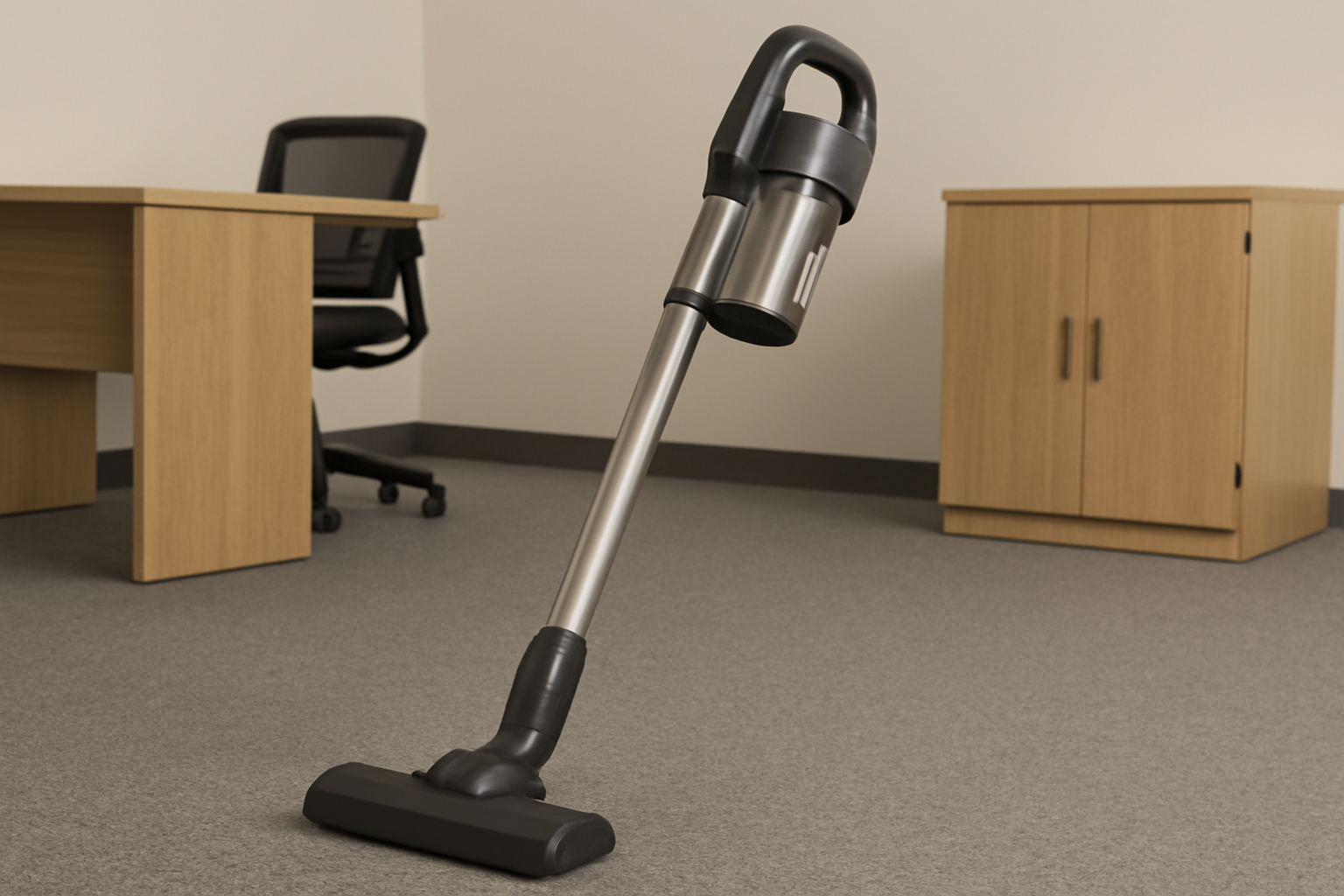
🌍 A Silent Revolution in Workplace Hygiene
Not long ago, office cleaning was invisible — a quiet background task performed after hours.
Then the pandemic hit, and everything changed.
Suddenly, cleaning became a public performance — a visible reassurance that a workspace was safe.
Now, in 2025, as offices in Europe and the Middle East return to full capacity, a new question echoes across facility management boards:
Will offices ever go back to brooms — or has the age of smart cleaning officially begun?
1️⃣ The Pandemic Changed How We Perceive Cleanliness
Before 2020, cleaning was judged by what the eye could see.
After COVID-19, it’s judged by data, air quality, and consistency.
Office tenants now demand:
Air purity reports
Cleaning frequency logs
Use of certified disinfection tools
The result? The traditional broom has been replaced by Cordless Vacuum Cleaners, Quiet Smart Systems, and HEPA-based cleaning protocols — a complete redefinition of hygiene expectations.
2️⃣ Data Is the New Mop: How Smart Cleaning Works 📲
Smart vacuums are no longer simple machines — they’re IoT-enabled hygiene devices.
They track particulate levels, map cleaning routes, and report data directly to facility dashboards.
A standard Cordless Vacuum Cleaner now includes:
HEPA H13 filtration
Noise suppression under 60 dB
Battery-swappable modules for continuous cleaning
AI sensors for floor type recognition
Facility managers use these features to quantify hygiene — transforming cleaning from a cost center into a data-driven asset.
“In 2025, the cleanest office isn’t the one that looks clean — it’s the one that can prove it.”
3️⃣ The Decline of Manual Cleaning Tools 🧽
Manual tools like brooms and mops, while symbolic of cleanliness, fall short of modern hygiene standards.
According to the European Cleaning & Hygiene Technology Alliance (ECHTA):
Brooms redistribute dust into the air
Mops can spread bacteria if not disinfected regularly
Manual cleaning limits measurable performance
Offices that still rely heavily on manual cleaning report 30–40% higher particulate levels than those using Smart Vacuum Technology or Wet Dry Vacuum Cleaners.
In other words, the broom is no longer a cleaning tool — it’s a liability.
4️⃣ Employee Health & Air Quality Awareness 🌬
Post-pandemic employees are acutely aware of indoor air health.
Research by Harvard T.H. Chan School of Public Health (2023) found that office productivity rises by 10–15% in workplaces with cleaner air and fewer airborne particles.
That’s why many companies now deploy Vacuum Cleaners for Allergies and Vacuum for Multi-Surface solutions that complement HVAC systems — continuously filtering and refreshing indoor air.
For the modern workforce, a clean environment isn’t a perk; it’s part of workplace wellness.
5️⃣ Quiet Efficiency: Cleaning Without Disruption 🔇
One challenge in office environments is maintaining hygiene without breaking focus.
Traditional vacuums were too loud, forcing night-only cleaning shifts.
The new generation of Quiet Vacuum for Night Use and Cordless Handheld Vacuum Cleaners operates under 58 dB, allowing real-time cleaning during business hours.
This creates 24-hour hygiene continuity — a massive shift from the old “clean once a day” mindset.
6️⃣ Sustainability and Corporate Responsibility 🌱
Modern businesses measure sustainability in every action — including cleaning.
Energy-Saving Efficient Powerful Vacuum Cleaner models now support:
Brushless digital motors (25–30% energy savings)
Reusable HEPA filters
Recyclable plastic bodies
For global corporations pursuing LEED, BREEAM, or GCC Green Building certification, cleaning operations are audited as part of ESG reporting.
Thus, smart vacuums are no longer just operational choices — they’re compliance tools.
7️⃣ The Hybrid Office Challenge 🏢
The rise of hybrid work models creates new complexity:
Fewer people in the office daily
Irregular traffic patterns
Unpredictable cleaning demand
To adapt, facility managers deploy AI-powered scheduling in Smart Vacuum Technology systems.
Vacuum units communicate with motion sensors and HVAC systems, automatically adjusting cleaning intensity based on occupancy.
This ensures cleaning resources are allocated intelligently — saving time, energy, and cost.
8️⃣ The ROI of Smart Cleaning 🧾
Smart cleaning equipment requires higher upfront investment, but delivers long-term payback through:
Reduced labor hours (25–30%)
Lower chemical use
Energy efficiency gains
Improved occupant satisfaction scores
For companies managing multi-location properties, integrated Smart Cleaning Management Systems provide unified dashboards for cost control and hygiene compliance across regions.
Data-backed cleanliness is now a key metric of corporate professionalism.
9️⃣ The Cultural Shift: From Janitors to Hygiene Technicians 👩🔧
Technology is reshaping not just cleaning tools, but also cleaning roles.
Workers are now trained as “Hygiene Technicians”, operating IoT-enabled systems, managing filter data, and reporting air-quality trends.
This upgrade in job status fosters pride and accountability — turning cleaning into a respected technical profession rather than a manual chore.
🔟 The Future: No Brooms, Just Smart Systems
By 2030, offices will integrate cleaning directly into building automation ecosystems.
Sensors will trigger autonomous vacuums, UV disinfection, and air purifiers in real time, adapting to occupancy and air metrics.
The broom may survive as a nostalgic symbol, but in practice, it has already been replaced — by algorithms, HEPA filters, and data dashboards.
The future of cleaning is invisible, intelligent, and interconnected.
Conclusion: The End of the Broom Era
Will offices ever go back to brooms?
The short answer: no — because cleaning has evolved beyond visibility into measurability.
Modern workplaces demand efficiency, traceability, and intelligence — all powered by smart vacuum systems and AI cleaning platforms.
As companies continue prioritizing health and ESG accountability, smart hygiene is no longer optional; it’s the new professional standard.
🧩 Hashtags
Upright Vacuum Cleaners, Household Vacuum Cleaners, Cordless Vacuum Cleaner, Fast Lightweight Vacuum Cleaner, Quiet Vacuum for Night Use, Car Vacuum Cleaner, Smart Vacuum Technology, HEPA Filtration System, Energy-Saving Efficient Powerful Vacuum Cleaner, Smart Cleaning Devices, Multi-Functional Durable Vacuum Cleaner, Smart Cleaning Management, Industrial Cleaning Equipment, Commercial HEPA Vacuum, Smart Sanitation Solutions, Clean Air Technology, Air Filtration Systems, Smart Cleaning Automation, Smart Cleaning Innovation, Office Cleaning Equipment, Corporate Facility Hygiene, Workplace Air Quality, Smart Building Hygiene, B2B Cleaning Distributor, GCC Cleaning Industry, Middle East Cleaning Market, Professional Cleaning Solutions, Post-Pandemic Cleaning Strategy, Smart Air Purification, Energy Efficient Vacuums, Sustainable Cleaning Equipment, Smart Facility Maintenance, AI Cleaning Systems, Workplace Hygiene Standards, Smart Office Ecosystem, Smart Building Automation, Facility Management Solutions, Data-Driven Cleaning, Smart Workplace Hygiene, Hygiene Technology Systems, ESG Cleaning Compliance, Smart Cleaning Workflow, Lanxstar



