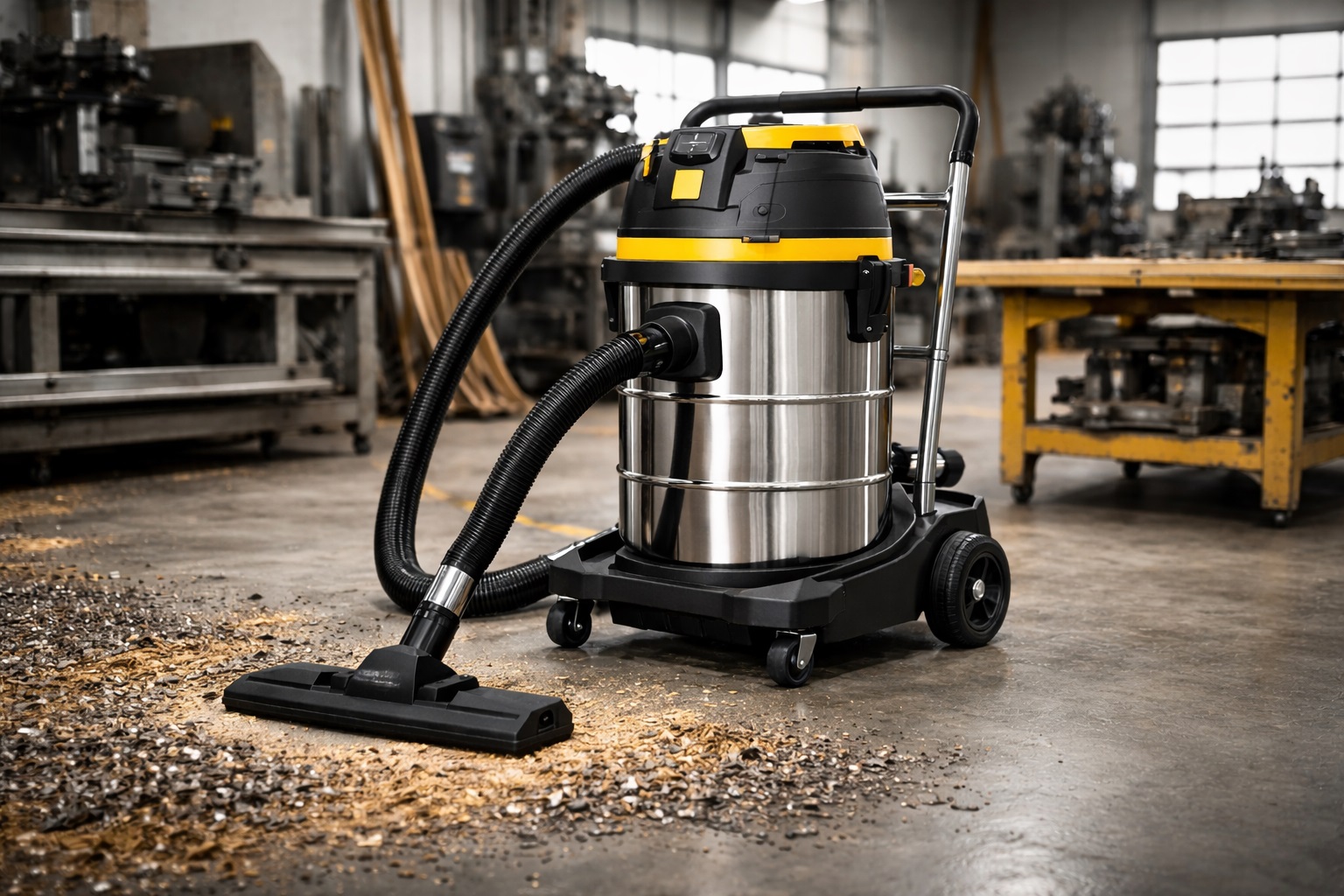
Wood dust doesn’t look dangerous—until it explodes.
Metal dust doesn’t look harmful—until your machines start failing.
Most factories don’t have a dust problem.
They have a wrong vacuum system problem.
From what we’ve seen across industrial projects:
Over 60% of dust extraction setups fail not because of power—but because they are not designed for the actual dust type.
For B2B buyers and procurement professionals, choosing the right wet dry vacuum manufacturer is about more than cleaning—it’s about risk control, compliance, and production stability.
⚙️ Why Dust Removal Is a Production-Critical System
In real factory environments, dust affects far more than cleanliness:
Machine precision (especially metal processing)
Worker safety (respiratory + explosion risks)
Compliance (OSHA / ATEX / NFPA)
Production continuity
👉 What most buyers underestimate:
Dust doesn’t stop production immediately.
It slowly reduces efficiency until problems become expensive.
🧠 Fast Selection Logic (Used by Experienced Buyers)
If you need to decide quickly, use this:
Fine, floating dust → HEPA filtration system
Heavy, sharp particles → metal dust vacuum with separation
Mixed dust + liquid → wet dry vacuum system
Explosive dust → ATEX-certified system only
Continuous production → centralized system
👉 If your supplier cannot map your dust type to a solution like this, they don’t understand your application.
🏭 Real Factory Problems (With Field-Level Details)
🪵 Case 1: Wood Processing Plant (USA)
The factory was cleaning dust manually twice per shift, yet still failing internal safety inspections.
Actual Situation:
Fine airborne dust covering machines
Workers using masks constantly
Dust accumulation near electrical systems
Problem Root Cause:
Their system was a basic collector—not a true wood dust vacuum with proper filtration.
Upgrade:
Installed a HEPA + anti-static dust extraction vacuum
What Changed:
Cleaning time reduced by 40%
Dust accumulation dropped significantly
Passed OSHA inspection within 2 months
👉 Reality Insight:
Wood dust is one of the most underestimated explosion risks in manufacturing.
🔩 Case 2: Metal Fabrication Plant (Germany)
This factory didn’t think dust was a major issue—until machines started failing.
Actual Situation:
Problem Root Cause:
They were using a general-purpose vacuum not designed for metal dust vacuum applications.
Upgrade:
High-suction industrial vacuum with metal separation + reinforced filtration
Results:
Maintenance reduced by 30%
Machine lifespan improved
Cleaning frequency reduced
👉 Critical Insight:
Metal dust doesn’t just sit on the floor—it destroys equipment over time.
🏭 Case 3: Mixed Manufacturing Facility (UK)
This plant handled both dust and liquid waste.
Actual Situation:
Problem Root Cause:
No integrated system—just fragmented tools.
Solution:
Customized system from an OEM wet dry vacuum supplier
Results:
❗ Why 80% of OEM Dust Vacuum Systems Fail (Industry Truth)
Working with a wet dry vacuum factory China can be highly cost-effective—but here’s what most buyers don’t realize:
⚠️ The #1 Failure Point: Filtration System
Many OEM systems:
⚠️ Other Common Issues:
👉 Industry Reality:
Only about 10–15% of OEM wet dry vacuum suppliers can handle fine dust or hazardous environments properly.
🧩 What Actually Matters in a Dust Extraction Vacuum
Forget marketing specs—focus on this:
🧠 Filtration Efficiency (Core Factor)
If filtration fails, everything fails.
💪 Suction Stability (Not Just Peak Power)
Consistent suction matters more than max power.
⚡ Anti-Static & Safety Design
Critical for wood and metal dust environments.
🛠️ Maintenance Accessibility
If filters are hard to replace, they won’t be replaced on time.
🔄 Continuous Operation Capability
Factories don’t stop—your vacuum shouldn’t either.
📉 The Real Cost of Choosing the Wrong System
Here’s what happens in real factories:
👉 Reality Check:
A cheaper system often leads to
3–8x higher total cost within 12 months
🚀 Where the Industry Is Going (Smart Buyers Already Know This)
🤖 Smart Dust Monitoring
♻️ Sustainable Systems
Dust recycling
Energy-efficient motors
🔗 Integrated Cleaning Systems
👉 Leading factories now treat dust extraction vacuum systems as part of production design—not maintenance tools.
🧾 Final Decision Questions (Before You Buy)
Before selecting your supplier, ask:
Are we still cleaning manually every day?
Is dust affecting machine performance?
Are we fully compliant with safety standards?
Can this system run continuously without performance drop?
👉 If your current setup still requires frequent manual cleaning:
You don’t have an industrial solution—you have a temporary workaround.
📌 Hashtags
wet dry vacuum manufacturer, OEM wet dry vacuum supplier, wet dry vacuum factory China, dust extraction vacuum, wood dust vacuum, metal dust vacuum, industrial dust extractor, dust removal system, factory dust control, industrial cleaning equipment, heavy duty vacuum system, woodworking dust vacuum, metal debris vacuum, industrial vacuum cleaner, dust collection system, anti static vacuum, explosion proof vacuum, ATEX vacuum system, OSHA compliant vacuum, factory air quality solution, industrial dust cleaning machine, vacuum for wood dust, vacuum for metal shavings, industrial suction system, B2B vacuum cleaner, OEM vacuum manufacturer, China vacuum supplier, industrial cleaning solutions, dust control equipment, factory maintenance vacuum, industrial hygiene equipment, dust filtration system, HEPA industrial vacuum, heavy duty suction machine, industrial vacuum system supplier, centralized vacuum system, smart vacuum system, industrial cleaning innovation, factory safety equipment, dust management system, professional vacuum equipment, industrial vacuum engineering, large capacity vacuum cleaner, continuous duty vacuum, manufacturing cleaning solution, industrial debris vacuum, dust removal technology, vacuum system for factories, Lanxstar