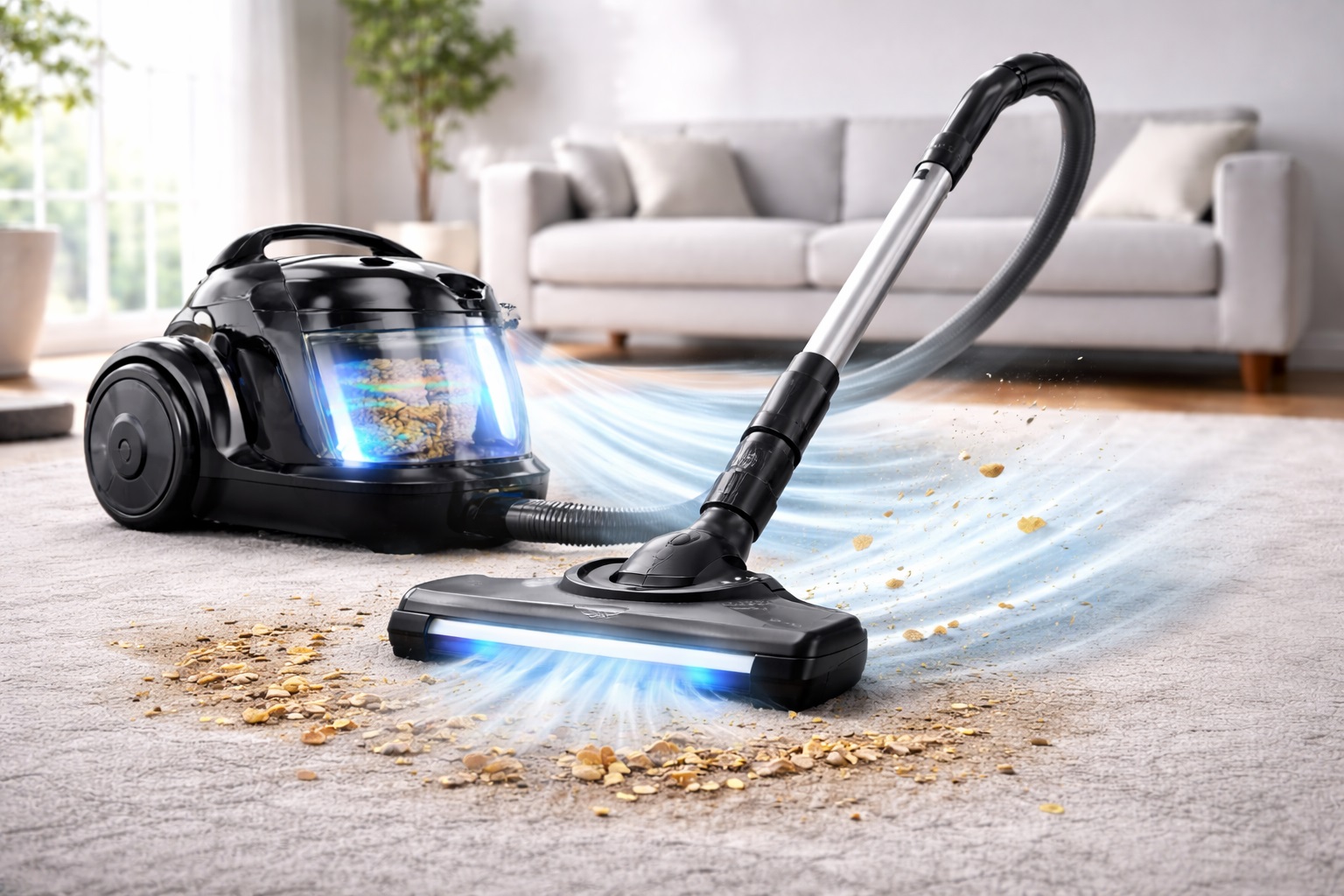
A Reality Check for Modern Home Cleaning
🎯 Target Reader
Homeowners and informed buyers in Europe & the Middle East who want to understand vacuum performance beyond marketing numbers
🔍 Introduction: Why “More Power” Sounds Convincing—but Isn’t Always Right
Walk into any appliance store and you’ll hear the same message:
“This vacuum has stronger suction—so it cleans better.”
On paper, that sounds logical. But in real homes, higher suction power does not automatically mean better cleaning.
In fact, excessive suction can:
This article explains when high suction helps—and when it actually hurts, using practical examples across Household Vacuum Cleaners, Upright Vacuum Cleaners, and Cordless Vacuum Cleaners.
⚙️ ① Suction Power vs Real Cleaning Performance
Suction power measures how strongly a vacuum pulls air—but cleaning effectiveness depends on how air moves, not just how hard it’s pulled.
What really matters:
Airflow consistency
Nozzle-to-floor contact
Brush roll agitation
Sealed system efficiency
A High Suction Vacuum Cleaner with poor airflow design may:
Stick to the floor and become hard to push
Leave debris behind due to airflow blockage
Lose performance as filters clog
Key insight:
Cleaning is about controlled suction, not maximum suction.
🏠 ② Why Upright Vacuum Cleaners Don’t Need Extreme Suction
Upright Vacuum Cleaners rely on a balance between:
Brush roll agitation
Stable airflow
Moderate suction
Excessive suction in uprights can:
In real-world testing, many upright vacuums with moderate suction outperform higher-powered models due to better mechanical design.
🔋 ③ Cordless Vacuums: Power Has a Price
With a Cordless Vacuum Cleaner, suction power directly impacts battery life.
Higher suction means:
That’s why most cordless vacuums offer multiple power modes.
Practical takeaway:
Cordless vacuums perform best when suction is adjusted to the task—low for daily dust, high for spot cleaning.
🌲 ④ Hardwood Floors Don’t Like Too Much Suction
A Vacuum Cleaner for Hardwood Floors requires finesse, not force.
Too much suction can:
Effective hardwood cleaning depends on:
Soft rollers
Smooth airflow
Lightweight handling
In many cases, lower suction combined with better brush design delivers superior results.
🔇 ⑤ More Power Often Means More Noise
Noise is one of the most common complaints with overpowered vacuums.
A Quiet Vacuum Cleaner achieves low noise by:
Reducing airflow turbulence
Controlling motor vibration
Using balanced suction levels
High suction without proper engineering leads to:
Quiet cleaning is often the result of efficient design, not weaker performance.
🧹 ⑥ Household Vacuums Need Balance, Not Extremes
For everyday Household Vacuum Cleaners, extreme suction creates diminishing returns.
Common side effects of “too much power” include:
Faster filter clogging
Increased maintenance
Reduced user comfort
Balanced vacuums are:
📌 The Right Way to Think About Suction Power
Instead of asking:
“How strong is the suction?”
Ask:
Is suction adjustable?
Is airflow stable over time?
Is the design matched to my floor types?
Does power compromise noise or usability?
Smart vacuums match power to purpose.
🧠 Final Verdict: More Suction Is Not Always Better
High suction power is useful—but only when:
For most homes, the best vacuum is not the strongest one—but the most balanced one.
Understanding this difference helps buyers choose vacuum cleaners that:
Clean better
Last longer
Feel better to use
👥 Suitable Readers
Homeowners upgrading vacuum cleaners
Hardwood floor households
Apartment residents
Users sensitive to noise
Buyers comparing cordless vs upright models
📌 Hashtags
HighSuctionVacuumCleaner, UprightVacuumCleaners, CordlessVacuumCleaner, QuietVacuumCleaner, VacuumCleanerForHardwoodFloors, HouseholdVacuumCleaners, VacuumPerformance, SuctionVsAirflow, HomeCleaningSolutions, VacuumTechnology, BalancedCleaningPower, QuietHomeAppliances, HardwoodFloorCare, CordlessCleaning, UprightVacuumDesign, SmartCleaningTools, HomeApplianceGuide, VacuumBuyerGuide, EfficientCleaning, VacuumEngineering, DailyHomeCleaning, ResidentialVacuum, VacuumInnovation, ApplianceDurability, LightweightVacuumDesign, NoiseControlTechnology, HomeHygieneSolutions, PracticalCleaningTools, ModernHomeLiving, VacuumMaintenance, EnergyEfficientAppliances, VacuumDesignInsights, HomeCareProducts, SmartHouseholdDevices, CleaningPerformanceAnalysis, VacuumUserExperience, FloorCareSolutions, HomeCleaningTrends, ApplianceEngineering, EfficientVacuumDesign, QuietLivingSolutions, ResidentialCleaningTools, HomeTechLifestyle, VacuumComparisonGuide, LongTermCleaningValue, Lanxstar