Hi, message us with any questions.
We're happy to help!





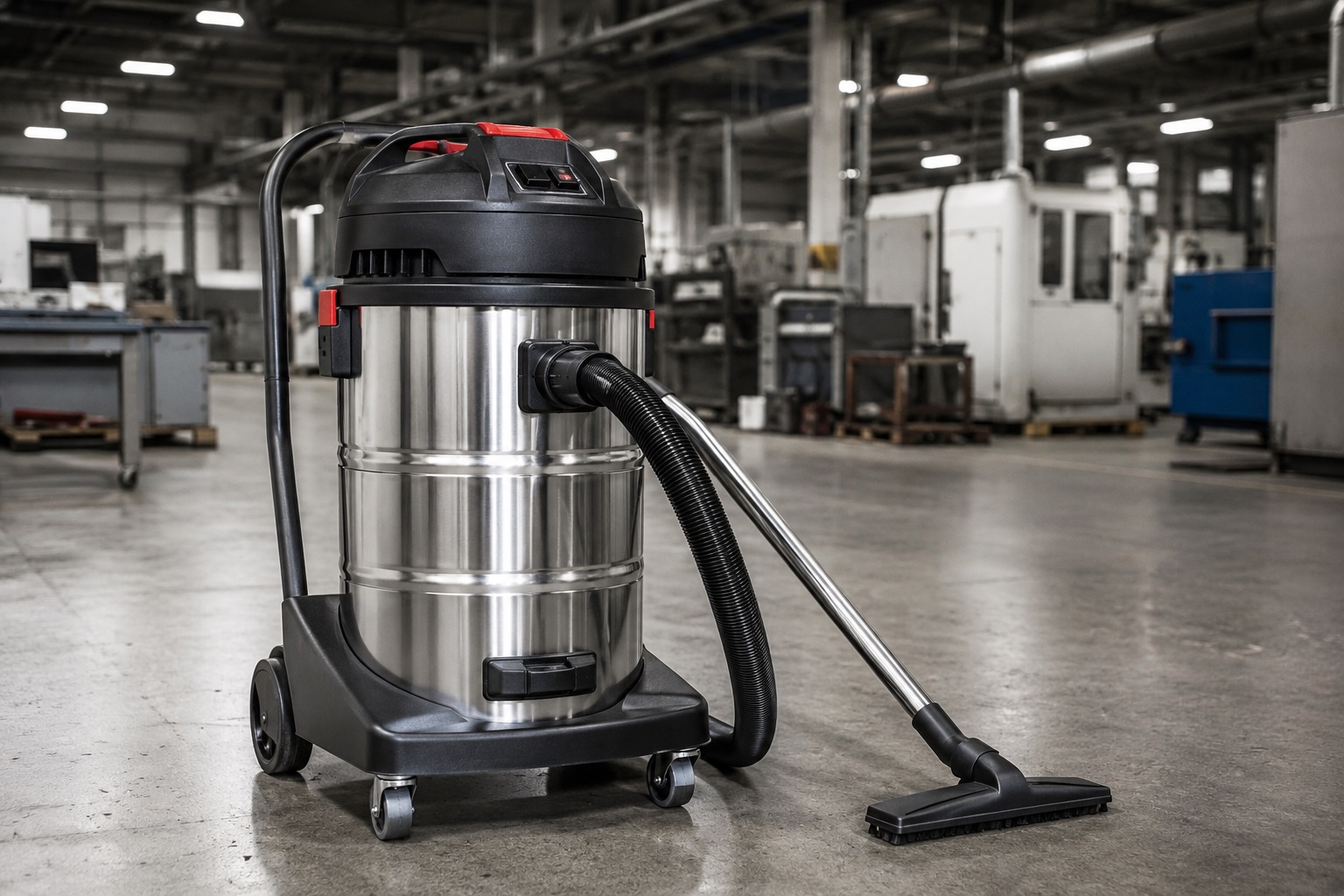
🏭 Why Most Manufacturing Plants Buy the Wrong Industrial Vacuum
When companies begin searching for an industrial vacuum for manufacturing plants, they often compare horsepower, suction ratings, and tank capacity.
While these specifications matter, they rarely determine the long-term success of the investment.
The reality is that the wrong vacuum can lead to:
Higher labor costs
Increased downtime
Faster equipment wear
Poor dust control
Regulatory compliance risks
The most expensive industrial vacuum is not the one with the highest purchase price—it is the one that slows down production.
For modern manufacturers, industrial cleaning equipment should be viewed as a productivity tool rather than a housekeeping expense.
🔍 Start With Your Manufacturing Environment
Before comparing equipment models, buyers should evaluate the materials generated within the facility.
Common contaminants include:
Fine industrial dust
Metal shavings
Plastic pellets
Packaging debris
Powder coatings
Food ingredients
Wood dust
Liquid spills
A vacuum designed for collecting cardboard scraps may perform poorly when handling fine aluminum dust or pharmaceutical powders.
The best industrial vacuum for manufacturing plants is always application-driven rather than specification-driven.
⚙️ Why Dust Characteristics Matter More Than Motor Power
One of the most common procurement mistakes is focusing on horsepower before understanding dust behavior.
Different materials create different filtration challenges.
Fine Dust Applications
Require:
HEPA filtration
Sealed collection systems
Automatic filter cleaning
Heavy Debris Applications
Require:
Higher airflow
Durable containers
Reinforced suction paths
Wet & Dry Environments
Require:
Dual-purpose collection systems
Corrosion-resistant components
Understanding the material being collected often prevents costly purchasing mistakes.
📌 Case Study: How a Food Manufacturing Plant Reduced Cleaning Costs by 32%
A food processing manufacturer in the Midwest United States operated three production lines producing powdered sugar products and baking ingredients.
The facility employed over 120 workers and operated nearly 20 hours per day.
Every week, approximately 250 kilograms of sugar dust accumulated around conveyors, filling stations, and packaging equipment.
The company initially used a conventional industrial vacuum equipped with standard cartridge filters.
At first, performance appeared acceptable.
However, several operational issues emerged:
Challenges
Suction performance declined after only a few hours of operation.
Filters required manual cleaning every two days.
Dust accumulated around sensitive equipment.
Cleaning crews spent excessive time maintaining the vacuum itself.
Internal audits revealed that employees were spending nearly 18 labor hours every week servicing clogged filters.
The procurement team originally assumed a larger motor would solve the problem.
After consulting industrial cleaning specialists, they discovered the actual issue was filtration efficiency.
The facility upgraded to an industrial vacuum featuring:
Automatic pulse-cleaning filtration
HEPA filtration
Continuous-duty operation
Results After Six Months
32% reduction in cleaning labor
41% longer filter lifespan
22% faster production line cleaning
18% reduction in maintenance workload
Improved hygiene compliance scores
Key Takeaway
Many buyers focus on horsepower.
In this case, filtration performance delivered far greater operational improvements than additional motor power.
🚀 Airflow vs. Suction: What Really Determines Cleaning Performance?
Many procurement teams compare industrial vacuums using suction ratings alone.
In reality, cleaning efficiency depends on three factors:
Airflow (CFM)
Determines how much material can be transported.
Static Pressure
Determines lifting capability.
Filtration Efficiency
Determines how long the vacuum maintains performance.
For large-scale production line cleaning, airflow often has a greater impact on productivity than maximum suction figures.
The best systems balance all three factors.
🏗️ Industrial Vacuum Selection Matrix
| Manufacturing Environment | Recommended Vacuum Type |
|---|---|
| Food Processing | HEPA Filtration Vacuum |
| Metal Fabrication | Cyclonic Industrial Vacuum |
| Pharmaceutical Production | GMP-Compliant Vacuum |
| Electronics Assembly | Anti-Static Vacuum System |
| Automotive Manufacturing | Continuous Duty Vacuum |
| Packaging Facilities | Portable Industrial Vacuum |
| Woodworking Plants | High-Capacity Dust Collection Vacuum |
This decision matrix helps procurement teams eliminate unsuitable options before engaging suppliers.
🎓 Expert Insight: What Experienced Buyers Evaluate First
New buyers typically focus on:
Motor power
Tank size
Purchase price
Experienced procurement teams evaluate:
Airflow Stability
Can performance remain consistent as filters load?
Filtration Efficiency
How effectively does the system capture fine particles?
Maintenance Requirements
How much labor is required every month?
Downtime Reduction
Can cleaning be completed without interrupting production?
Scalability
Will the vacuum support future production growth?
One of the most overlooked realities in industrial cleaning is that filtration often delivers more ROI than horsepower.
💰 ROI Example: When a More Expensive Vacuum Costs Less
An automotive components manufacturer evaluated two industrial vacuum systems.
Option A
Purchase Price: $4,800
Option B
Purchase Price: $8,900
Although Option A appeared cheaper, a five-year Total Cost of Ownership analysis revealed a different picture.
| Cost Factor | Option A | Option B |
|---|---|---|
| Filter Replacement | $1,200/year | $450/year |
| Maintenance Labor | $2,100/year | $900/year |
| Cleaning Labor | $12,000/year | $8,100/year |
| Downtime Costs | $2,500/year | $800/year |
After five years, the higher-priced system generated significantly lower operating costs.
Procurement Lesson
The cheapest industrial vacuum often becomes the most expensive machine once labor, maintenance, and downtime are included.
🛡️ Industrial Vacuums Are Maintenance Tools
Leading manufacturers no longer view vacuum systems as cleaning equipment.
They view them as preventive maintenance assets.
Regular vacuum cleaning helps reduce:
Bearing contamination
Sensor failures
Conveyor downtime
Electrical cabinet dust buildup
Motor overheating
Every kilogram of dust left behind eventually becomes a maintenance problem.
This is where manufacturing facility maintenance and industrial cleaning intersect.
🚨 Common Buyer Mistakes When Choosing Factory Cleaning Equipment
Mistake #1: Buying Based on Horsepower Alone
Motor power is only one element of performance.
Mistake #2: Ignoring Filter Replacement Costs
Annual filter expenses often exceed expected budgets.
Mistake #3: Underestimating Labor Costs
Cleaning efficiency frequently impacts ROI more than equipment price.
Mistake #4: Buying for Today's Needs Only
Production capacity often grows faster than expected.
Mistake #5: Treating Vacuums as Housekeeping Equipment
The most successful manufacturers use industrial vacuums to support equipment reliability and production efficiency.
❓ Frequently Asked Questions
What size industrial vacuum does a manufacturing plant need?
The answer depends on debris type, facility size, cleaning frequency, and production requirements.
Can industrial vacuums replace dust collectors?
No. Dust collectors capture contaminants at the source, while industrial vacuums support facility cleaning and maintenance.
Is HEPA filtration necessary?
For fine dust, food processing, pharmaceutical production, and sensitive manufacturing environments, HEPA filtration is strongly recommended.
How long does a heavy-duty industrial vacuum last?
A properly maintained system can often operate for 8–15 years.
🎯 Final Thoughts
Choosing an industrial vacuum for manufacturing plants is not simply a cleaning decision.
It is a productivity decision.
Manufacturers that evaluate airflow, filtration, labor efficiency, maintenance requirements, and long-term ownership costs consistently achieve better results than those focused solely on specifications.
As factories continue to pursue automation, sustainability, and operational efficiency, investing in the right factory cleaning equipment will remain a critical competitive advantage.
Hashtags
industrial vacuum for manufacturing plants, factory cleaning equipment, production line cleaning, industrial dust removal, heavy duty vacuum for factories, manufacturing facility maintenance, industrial cleaning systems, industrial vacuum cleaner, factory vacuum solutions, industrial dust collector, warehouse cleaning equipment, industrial filtration systems, HEPA industrial vacuum, dust extraction equipment, manufacturing cleaning solutions, industrial maintenance equipment, factory housekeeping systems, industrial debris removal, centralized vacuum systems, portable industrial vacuum, continuous duty vacuum, industrial suction systems, production floor cleaning, workplace dust control, industrial safety equipment, factory maintenance solutions, manufacturing operations efficiency, industrial cleaning technology, industrial vacuum supplier, vacuum system engineering, industrial air filtration, dust management solutions, factory hygiene systems, industrial floor cleaning equipment, production equipment maintenance, industrial facility cleaning, vacuum cleaning solutions, manufacturing dust control, industrial cleaning innovation, warehouse vacuum systems, factory automation cleaning, industrial filtration technology, dust control systems, manufacturing productivity solutions, industrial maintenance systems, smart industrial vacuum, B2B vacuum distributor, industrial cleaning contractor, factory operations management, Lanxstar